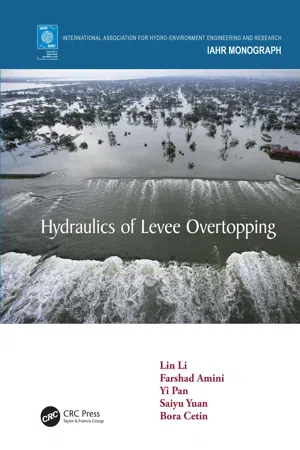
Earthen levees are extensively used to protect the population and infrastructure from periodic floods and high water due to storm surges. The causes of failure of levees include overtopping, surface erosion, internal erosion, and slope instability. Overtopping may occur during periods of flooding due to insufficient freeboard. The most problematic situation involves the levee being overtopped by both surge and waves when the surge level exceeds the levee crest elevation with accompanying wave overtopping. Overtopping of levees produces fast-flowing, turbulent water velocities on the landward-side slope that can potentially damage the protective grass covering and expose the underlying soil to erosion. If overtopping continues long enough, the erosion may eventually result in loss of levee crest elevation and possibly breaching of the protective structure. Hence, protecting levees from erosion by surge overflow and wave overtopping is necessary to assure a viable and safe levee system.
This book presents a cutting-edge approach to understanding overtopping hydraulics under negative free board of earthen levees, and to the study of levee reinforcing methods. Combining soil erosion test, full-scale laboratory overtopping hydraulics test, and numerical modeling for the turbulent overtopping hydraulics. It provides an analysis that integrates the mechanical and hydraulic processes governing levee overtopping occurrences and engineering approaches to reinforce overtopped levees. Topics covered: surge overflow, wave overtopping and their combination, full-scale hydraulic tests, erosion tests, overtopping hydraulics, overtopping discharge, and turbulent analysis.
This is an invaluable resource for graduate students and researchers working on levee design, water resource engineering, hydraulic engineering, and coastal engineering, and for professionals in the field of civil and environmental engineering, and natural hazard analysis.
Storm surge is a disastrous natural phenomenon referring to the abnormal rise in sea level caused by strong weather systems such as typhoons, extratropical cyclones, strong wind action of cold fronts, and sudden changes in barometric pressure. Storm surge causes the tide level in the affected sea area to significantly exceed the normal tide level. If the storm surge occurs simultaneously with the spring tide or upstream floods, it can lead to catastrophic disasters.
Over the past decades, the number and cost of disaster events in the United States have risen significantly (NOAA 2019), in particular, for hurricanes. Hurricanes Katrina in2005, Sandy in2012, Harvey in 2017, Maria in2017, Irma in 2017, and Michael 2018 caused the most damage in the United States. Hurricane Katrina in August 2005 was one of the most devastating and deadliest disasters in U.S. natural disaster history with an estimated loss of 1,200 human lives, with 500,000 people having left the area and 125 billion dollars of economic loss (Scawthorn and Porter 2019). Hurricane Sandy (2012) affected 24 states, with particularly severe damage in New York City due to storm surge, which flooded streets, tunnels, and subway lines and cut power in and around the city. Hurricane Harvey in 2017 brought unprecedented rainfall, basin-wide flooding, and windstorms that devastated infrastructure and flooded more than 150,000 homes. It approximately matched the damage of Katrina as the costliest hurricane on record, with $125 billion in damages (NHC 2018), primarily due to flooding in Houston and Southeast Texas. Hurricane Maria (2017) caused over 3,000 deaths and extensive damage to Puerto Rico. Hurricane Michael, which devastated northwest Florida in 2018, was the strongest storm on record for southeast U.S. and led to an estimated loss $25 billion (Baecher et al. 2019).
Cities and areas in these regions were designed with earthen levees, which are one of the most common structures built to protect against flooding and extreme event-related disasters. Earthen levees are used extensively in the United States to protect populations and infrastructure from periodic floods and high water levels caused by storm surges. There are approximately 13,679 km of levees in the United States. The causes of failure for levees include overtopping, surface erosion, internal erosion (piping), and slope instability (USACE 2000; Perry 1998; TAW 2002; ASCE 2011). Climate change is well-known to result in sea level rising at an increased rate and causing storms of increasing intensity and duration (IPCC 2012). Overtopping can occur during flooding caused by insufficient freeboard. Overtopping of levees produces fast-flowing, turbulent water velocities on the landward-side slope that can damage the protective grass covering and expose the underlying soil to erosion. If overtopping continues long enough, the erosion may eventually result in loss of levee crest elevation and ultimately breaching of the protective structure. The catastrophic consequences of levee overtopping were seen during Hurricane Katrina in the United States in August 2005. The levees were subjected to a catastrophic 8.23 m estimated storm surge during Hurricane Katrina (Grenzeback and Lukmann 2007). The surge severely strained the levee system in the New Orleans area, which began to fail as early as the morning of August 29, 2005. The levees in the New Orleans area breached at about 50 distinct locations. At least seven of the major failures were related to breaching of levees containing I-walls. The rest of the levees breached when they were overtopped by floodwater, which eroded the levee material away. Figure 1.1 shows the flow over the crest and the erosion of the landward-side slope of levees during Hurricane Katrina.
Figure 1.1 Flow over the crest (a) and the erosion of the landward-side slope of levees (b) during Hurricane Katrina. (source: http://www.recmod.com/).
Overtopping associated with earthen levees includes surge-only overflow, wave-only overtopping, and combined wave and surge overtopping. Surge-only overflow occurs when the surge level exceeds the levee crest elevation without accompanying wave action. Wave-only overtopping occurs when the surge level is below or equal to the levee crest elevation. The wave-only overtopping is unsteady compared to the steady surge-only overflow. After passing over the levee crest, each overtopping wave has a triangular discharge distribution with a maximum discharge at the leading edge that is several times greater than the time-averaged discharge. The most severe overtopping condition is when the levee is being overtopped by combined waves and surge (Hughes and Nadal 2009).
Increased rates of sea level rising and storms of increased intensity and duration (IPCC 2012; Baecher et al. 2019) increase the risks of wave overtopping under negative freeboard. Since Hurricane Katrina, wave overtopping under negative freeboard has been one of the main focus of studies. Post-Katrina investigations revealed that most earthen levee damage occurred on the levee crest and landward-side slope as a result of either wave overtopping, storm surge overflow, or a combination of both (ASCE Hurricane Katrina External Review Panel 2007). According to Hughes and Nadal (2009), during the combined wave and surge overtopping, the overtopping waves can create critical flow conditions near the leeward edge of the levee crest, resulting in supercritical wave overtopping flow on the landward-side slope. Figure 1.2 illustrates the wave overtopping under positive, zero, and negative freeboard and surge overflow.
Figure 1.2 Wave overtopping under (a) positive, (b) zero, (c) negative freeboard, and (d) surge overflow. (Adopted from Pan et al. (2015a). Reproduced with permission from Elsevier.)
Wave-only overtopping and surge-only overflow are also classical problems in the coastal engineering field. Several studies have been conducted on these topics, including physical experiments and numerical modeling for the design of levees.
Levees in soft soil or loose sediment areas often subside continuously, which results in the reduction of flood control standards. These two factors increase the risk of combined wave and surge overtopping. In recent years, several serious erosion and damage events have been observed on the landward-side slope of levees caused by combined wave and surge overtopping, which has made combined wave and surge overtopping an important factor in the design of levees. Therefore, predicting the effects of combined wave and surge overtopping on levees under extreme conditions has become one of the urgent problems to be solved in the field of coastal disaster prevention.
According to previous analyses, during overtopping, the landward-side slope of levees is subjected to significantly higher velocities and much greater erosive forces than the flood-side slope (Hughes and Nadal 2009; Li et al. 2012; Pan et al. 2013a, 2013b; Yuan et al. 2015a, 2015b; Pan et al. 2016). Field tests also indicate that erosion failure occurs first on the landward-side slope of the overtopped levee and progressively regresses (Hanson et al. 2003, 2005; van der Meer et al. 2009). Hence, protecting levees from erosion by surge overflow and wave overtopping is necessary to assure a viable and safe levee system (van der Meer et al. 2002; Sills et al. 2008; Pan et al. 2015a, 2015b; Baecher et al. 2019).
An evaluation of the various innovative overtopping protection methods indicates that a cellular confinement system using concrete-filled cells would be applicable for use when rapid, rather expensive, construction is justified and the subsequent rising of the levee is anticipated. Flow velocities in the range of 1.8–3.0 m/s can be handled using this approach. Reinforced grass would have limited application because it would take several months (or years) for the root system to develop and it would be limited (unless more flood-resistant grass and/or additional anchorage is provided) to flow durations less than 2 days. In addition, reinforced grass can handle flow velocities up to 3.8 m/s. Although reinforced grass is generally more economical than conventional engineering materials in capital cost, it can be more expensive to maintain. Soil cement is, in general, cost-competitive for nonsediment-laden flows with velocities up to 7.6 m/s (Perry 1998). For flows with high velocities, three innovative and cost-effective levee-strengthening systems, namely, anchored high-performance turf reinforcement mat (HPTRM), articulated concrete block system (hard-armor products), and roller-compacted concrete (RCC) system may be considered.
The erosion process of levees is difficult to model numerically or in small-scale physical models, and the roughness of strengthening systems must be determined by full-scale testing in laboratory flumes using defined testing protocols (Akkerman et al. 2007; Hughes 2008; Li et al. 2014; Pan et al. 2015a, 2015b). Design guidance should be developed based on full-scale study either in special facilities or in the field using an apparatus such as the Overtopping Simulator (van der Meer et al. 2009; Baecher et al. 2019). However, the present design criteria only include guidance for both grass slopes and a variety of slope protection products for steady overflow. This book is directed toward developing an innovative and cost-effective levee protection system during overtopping.
1.2 Contents of this book
The land sides of levees are subjected to significantly higher velocities and much greater erosive forces than the flood side of the levees during wave overtopping, surge overflow, or combined wave and surge overtopping in a flood. Robust levee reinforcement is critically needed to be installed on the land sides of levees to resist erosion damage. Previous research and tests have focused almost exclusively on the conditions of steady-state overflow. Therefore, little is known regarding the more problematic cases of unsteady overtopping caused by waves only or combined wave and storm surge.
The combined wave and surge overtopping has attracted more interest in the field of coastal engineering since 2005. This book describes a physical model study of a full-scale (1:1) model of levee overtopping by combined wave and surge overtopping conducted at Oregon State University (OSU). The purpose of this book is to study the hydrodynamic characteristics of the combined wave and surge overtopping process and to study the erosion characteristics of the landward-side slope of levees with different strengthening systems under combined wave and surge overtopping. The three strengthening methods include the use of anchored HPTRM, articulating concrete block system (hard-armor products), and RCC system. The tested levee cross-section was built in the 4.572 m deep wave flume. The levee model was built with a sand core and a concrete cap with a 0.76 m deep and 2.34 m wide test section, which was used to install different protection layers. Eight surge-only overflow tests under different upstream water levels and 24 combined wave and surge overtopping tests under different combinations of incident waves and average sea level were conducted. Hydrodynamic parameters and erosion characteristics in the test section of the landward-side slope of the levee model were recorded. This study is the first in the world to use a scale of 1:1 to investigate the combined wave and surge overtopping, representing true full-scale conditions.
This book presents the experimental settings, data analyses, and research conclusions in detail. Chapter 1 is the introduction; Chapter 2 introduces the existing studies of surge-only overflow and overtopping as the background of combined wave and surge overtopping research; Chapter 3 discusses the three levee-strengthening systems and their engineering properties; Chapter 4 introduces test sections constructions, instrumentation, testing procedures, and initial data analysis of large-scale wave flume test. The scale effects and the model and measurement effects are briefly discussed in Chapter 4; Chap...
Table of contents
Cover
Half Title
Series Page
Title Page
Copyright Page
About the IAHR Book Series
Table of Contents
Preface
Variables
1 Introduction
2 Surge overflow, wave overtopping, and combination
3 Three strengthening systems
4 Full-scale physical model testing of levee overtopping
5 Testing of erosion function apparatus
6 Hydraulic parameters of combined wave and surge overtopping
7 Turbulent analysis
8 Hydraulic erosion on landward-side slope of levees and conceptual model of soil loss from levee surface
9 Numerical study of combined wave overtopping and storm surge overflow of strengthened levee
10 Numerical study of turbulence overtopping and erosion
References
Index
Trusted by 375,005 students
Access to over 1.5 million titles for a fair monthly price.
Study more efficiently using our study tools.
Frequently asked questions
Yes, you can cancel anytime from the Subscription tab in your account settings on the Perlego website. Your subscription will stay active until the end of your current billing period. Learn how to cancel your subscription
No, books cannot be downloaded as external files, such as PDFs, for use outside of Perlego. However, you can download books within the Perlego app for offline reading on mobile or tablet. Learn how to download books offline
Perlego offers two plans: Essential and Complete
Essential is ideal for learners and professionals who enjoy exploring a wide range of subjects. Access the Essential Library with 800,000+ trusted titles and best-sellers across business, personal growth, and the humanities. Includes unlimited reading time and Standard Read Aloud voice.
Complete: Perfect for advanced learners and researchers needing full, unrestricted access. Unlock 1.5M+ books across hundreds of subjects, including academic and specialized titles. The Complete Plan also includes advanced features like Premium Read Aloud and Research Assistant.
Both plans are available with monthly, semester, or annual billing cycles.
We are an online textbook subscription service, where you can get access to an entire online library for less than the price of a single book per month. With over 1.5 million books across 990+ topics, we’ve got you covered! Learn about our mission
Look out for the read-aloud symbol on your next book to see if you can listen to it. The read-aloud tool reads text aloud for you, highlighting the text as it is being read. You can pause it, speed it up and slow it down. Learn more about Read Aloud
Yes! You can use the Perlego app on both iOS and Android devices to read anytime, anywhere — even offline. Perfect for commutes or when you’re on the go. Please note we cannot support devices running on iOS 13 and Android 7 or earlier. Learn more about using the app
Yes, you can access Hydraulics of Levee Overtopping by Lin Li,Farshad Amini,Yi Pan,Saiyu Yuan,Bora Cetin in PDF and/or ePUB format, as well as other popular books in Technology & Engineering & Civil Engineering. We have over 1.5 million books available in our catalogue for you to explore.