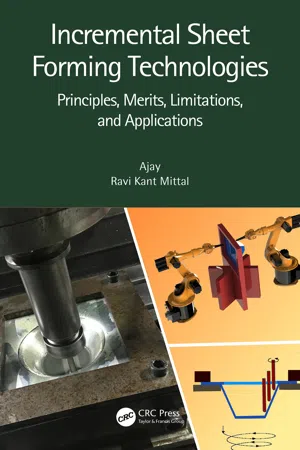
Incremental Sheet Forming (ISF) exempts use of dies and reduces cost for manufacturing complex parts. Sheet metal forming is used for producing high-quality components in automotive, aerospace, and medical industries. This book covers the benefits of this new technology, including the process parameters along with various techniques.
Each variant of this novel process is discussed along with the requirements of machinery and hardware. In addition, appropriate guidelines are also suggested regarding the relationship between process parameters and aspects of ISF process in order to ensure the applicability of the process on the industrial scale.
This book will be a useful asset for researchers, engineers in manufacturing industries, and postgraduate level courses.
1 Introduction and Need for Advanced Sheet Forming Techniques
1.1 Introduction
Since the advent of the human race many processes, tools and machines have evolved to manufacture products to make life easier and more enjoyable. In the twentieth century, many evolutions have taken place in an effort to meet the manufacturing challenges created by newer requirements, materials, tools and cost constraints, and the quest continues. The developments and advancements in the aero-space, automobile, marine, medical and many other sectors often require make-to-order manufacturing, and newer technology is required to meet this challenge. Such manufacturing systems need autonomous, flexibly integrated and adaptable processes that can respond quickly to dynamic requirements with real-time shop floor control of the process. Incremental sheet forming is an evolving modern manufacturing process for these situations, one of the buzz areas of research in sheet material manufacturing, for the economic manufacturing of custom objects. Manufacturing is a complex activity of converting raw materials into finished products with desired properties, shape and size, using a wide variety of processes, machinery, tools and other equipment with or without automation, the use of computers, robots, sensors and other special equipment; it requires people with diverse skills, knowledge and expertise in different disciplines. The effectiveness and efficiency of a manufacturing method depend on the flexibility and agility of the process as well as its feasibility for a particular application.
To carry out a manufacturing activity we require five Ms, viz. Men, Materials, Machines, Money and Methods. Methods refer to manufacturing methods used for making the desired products economically and quickly, with anticipated quality and adaptability to ever-changing needs and technological developments. In addition, knowledge of the various materials, tools, machine tools, accessories, manufacturing processes, metrology and testing instruments for checking materials or products is essential for understanding manufacturing processes.
1.2 Manufacturing Processes
The manufacturing processes or techniques for producing desired products or components are conventionally grouped into five basic production processes based on the handling of the material required to convert it into a component by giving it the desired shape, size, accuracy, finish and properties. These are:
Casting processes
Material removal processes
Forming/deformation processes
Joining processes
Special processes
The basics of these processes are briefly described here to refresh the concepts of the different methods of manufacturing, the machines and tools required for each of them and the terminologies involved.
1.2.1 Casting Processes
Casting is one of the oldest known methods for shaping materials. In casting processes, the material is melted and liquid material is poured into a cavity (called a mold) of the shape and size of the required product where it is allowed to solidify. After solidification, the product, called “castings”, is extracted from the mold. Casting processes are widely used to produce products of small sizes to very large sizes, with very intricate shapes and with strength and rigidity frequently not obtainable by other manufacturing processes.
The casting process has low production costs but is a labor-intensive process, requiring other operations to get the finished product, with limitations of dimensional accuracy and surface finish. Special casting processes, like the die-casting process, investment casting process, vacuum-sealed molding process and shell molding process, overcome these limitations.
1.2.2 Material Removal Processes
The class of manufacturing processes that use cutting or machining to remove excess material for producing the required shape, size, accuracy and finish are known as material removal processes or more commonly as machining processes. The removal of unwanted material from the raw material is done by using specific shaped cutting tools, operated manually or by machines called machine tools. With machining processes, it is possible to manufacture components with very low dimensional tolerances (accuracy and precision) that cannot be obtained by other methods of manufacturing but generate a lot of waste material from the removed portions as scrap. Typical examples of products made by machining processes include gears, automobile parts, wood furniture, nuts and bolts, etc. Examples of common machining processes include drilling, turning, milling, grinding, boring, knurling, facing, reaming, chamfering, etc. Machining is used as a secondary or subsequent process for many of the other manufacturing processes like casting, forming, etc.
1.2.3 Forming Processes
Manufacturing processes for giving the desired shape and size to raw material by permanently deforming it using force, pressure or stresses like compression, tension, shear or their combinations are known as forming processes. Unlike casting or machining, in forming, the material is neither melted nor removed. Forming processes exploit a property of materials – the ability to flow plastically (or deform) in the solid state (without melting) – when subjected to suitable stresses. The material is deformed to the desired shape and size with almost no wastage. The required force is generally high in forming processes, and the tools and equipment needed are quite expensive. Commonly, a machine for forming processes is known as a press, and forming tools used for the same are called a die and punch. Typical examples of the products manufactured by forming processes include rails, kitchen utensils, wires, drink cans, collapsible tubes and so on. No material wastage, a high cost of tooling and fast and easy large-quantity production of components are some of the characteristics of forming processes. Brittle material cannot be deformed plastically and, hence, cannot be formed. However, semi-brittle material can be formed using hot working (forming above the recrystallization temperature).
Blanking, punching, bending, stretching, rolling, forging, drawing, extrusion, spinning, etc., are some common forming processes. Forming processes are classified into two groups – bulk forming processes and sheet forming processes. The classification of forming processes is given in Figure 1.1.
FIGURE 1.1 Classification of forming processes.
Bulk forming involves severe deformation of material resulting in massive shape change. The surface-area-to-volume ratio of the workpiece is relatively small. Bulk forming is mostly done in hot working conditions. Some common bulk forming operations are forging, rolling, drawing and extrusion. Sheet forming processes are discussed in Section 1.3.
1.2.4 Joining Processes
The category of manufacturing processes where two or more workpieces are joined together to produce the required shape and/or siz...
Table of contents
Cover
Half-Title
Title
Copyright
Contents
List of Figures
List of Tables
Preface
Acknowledgments
Authors’ Biographies
List of Abbreviations
Chapter 1 Introduction and Need for Advanced Sheet Forming Techniques
Chapter 2 Incremental Sheet Forming: A Die-Less Approach
Chapter 3 Incremental Sheet Forming Process
Chapter 4 Machine Tools and Forming-Tools for Incremental Sheet Forming Process
Chapter 5 Incremental Sheet Forming Parameters
Chapter 6 Responses of Incremental Sheet Forming Process
Chapter 7 Applications and Challenges of Incremental Sheet Forming Processes
Chapter 8 Conclusions and Future Scope
Appendix A: List of US, Japanese (JP), European (EP) and International (WO) Patents Related to ISF
Index
Trusted by 375,005 students
Access to over 1.5 million titles for a fair monthly price.
Study more efficiently using our study tools.
Frequently asked questions
Yes, you can cancel anytime from the Subscription tab in your account settings on the Perlego website. Your subscription will stay active until the end of your current billing period. Learn how to cancel your subscription
No, books cannot be downloaded as external files, such as PDFs, for use outside of Perlego. However, you can download books within the Perlego app for offline reading on mobile or tablet. Learn how to download books offline
Perlego offers two plans: Essential and Complete
Essential is ideal for learners and professionals who enjoy exploring a wide range of subjects. Access the Essential Library with 800,000+ trusted titles and best-sellers across business, personal growth, and the humanities. Includes unlimited reading time and Standard Read Aloud voice.
Complete: Perfect for advanced learners and researchers needing full, unrestricted access. Unlock 1.5M+ books across hundreds of subjects, including academic and specialized titles. The Complete Plan also includes advanced features like Premium Read Aloud and Research Assistant.
Both plans are available with monthly, semester, or annual billing cycles.
We are an online textbook subscription service, where you can get access to an entire online library for less than the price of a single book per month. With over 1.5 million books across 990+ topics, we’ve got you covered! Learn about our mission
Look out for the read-aloud symbol on your next book to see if you can listen to it. The read-aloud tool reads text aloud for you, highlighting the text as it is being read. You can pause it, speed it up and slow it down. Learn more about Read Aloud
Yes! You can use the Perlego app on both iOS and Android devices to read anytime, anywhere — even offline. Perfect for commutes or when you’re on the go. Please note we cannot support devices running on iOS 13 and Android 7 or earlier. Learn more about using the app
Yes, you can access Incremental Sheet Forming Technologies by Ajay,Ravi Kant Mittal in PDF and/or ePUB format, as well as other popular books in Technology & Engineering & Mechanics. We have over 1.5 million books available in our catalogue for you to explore.