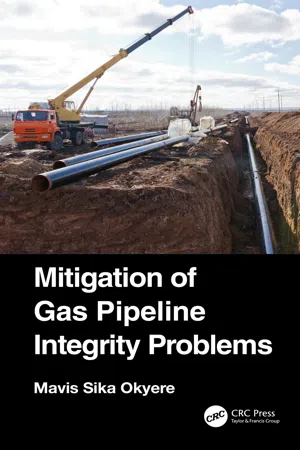
Mitigation of Gas Pipeline Integrity Problems presents the methodology to enable engineers, experienced or not, to alleviate pipeline integrity problems during operation. It explains the principal considerations and establishes a common approach in tackling technical challenges that may arise during gas production.
Covers third-party damage, corrosion, geotechnical hazards, stress corrosion cracking, off-spec sales gas, improper design or material selection, as-built flaws, improper operations, and leak and break detection
Details various hazard mitigation options
Offers tested concepts of pipeline integrity blended with recent research results, documented in a scholarly fashion to make it simple to the average reader
This practical work serves the needs of advanced students, researchers, and professionals working in pipeline engineering and petrochemical industries.
Pipeline integrity does not only concern how to keep the contents inside the pipeline, but also the means to prevent them from escaping. The causes of the loss of containment, which is more commonly described as leaks, have been classified historically into three main areas (other causes of incidents rarely affect the integrity of the pipeline). These are in order of magnitude for the United States/Europe:
Third-party damage (35–40%)
Corrosion (20%)
Material and construction defects (15–20%)
Others (20%)
It is of interest to note that these percentages change between locations; i.e. in the Union of Soviet Socialist Republics (USSR), due to the large lengths of high-pressure gas pipelines located in sparsely populated and remote regions and historical poor quality control, material and construction defects account for the highest percentage of leaks and ruptures (Posakony 1993).
Third-party damage not only has historically been the most common loss of integrity, but also provides the largest loss of integrity and the highest level of damage. The root cause of many incidents is the lack of knowledge of a pipeline’s existence or depth. The most obvious place to start with in terms of information is visual markers on the ground. However, operating companies often find themselves in a dilemma as to whether increased knowledge of the location of the pipelines makes them vulnerable to deliberate attack and whether it outweighs the decrease in third-party activity. Marker posts also require constant maintenance to keep up to date telephone numbers, etc., and to repair damage. Marker tape below ground has been shown to be of little effect unless combined with some other form of protection.
Regular contact and notification with the landowner and the occupier usually reap large dividends in preventing damage. Many pipeline operators have a right to walk and inspect the pipeline annually, which affords them time to contact each landowner. Loss of this right through inactivity and not keeping up to date a list of owners and occupiers have often been shown to be a false economy for the pipeline operator.
A further means of preventing third-party damage which has received much attention in the United States is the use of a “one call” system whereby a contractor can phone one (toll-free) number, giving the location of where he is planning to excavate, and a central record provides details on any pipeline or cable buried in the vicinity. This normally demands legislation to require all operators to provide the information and contribute toward the running costs.
The majority of pipeline companies utilize aerial observation of their pipelines, which can provide warnings of works being undertaken on or close to the pipeline. The normal frequency adopted is bi-weekly, although this can have the effect of third-party activities being kept on hold until helicopter or aeroplane has inspected the right-of-way with the knowledge that there is two weeks’ grace before another inspection.
As in most activities, the hardest information to gather is near misses or in the case of pipelines dents or gouges. There is a human tendency not to report damage to someone else’s property if it is not apparent and to forget about it. Pipelines are vulnerable to this type of damage, especially gouges that concentrate stress levels and accelerate corrosion at the locality. The only practical way to get information about these types of incidents is for the pipeline operator to accept that repair cost will not fall onto the person inflicting the damage. In the long run this will produce effective results, but is sometimes difficult to accept.
There are few pipelines that are buried without some form of corrosion protection incorporated on them in the form of coating(s) and cathodic protection. The various types of coatings and their advantages are covered in depth in Chapter 3, but two main points can be highlighted. The first is that the long-term success of a coating has been shown many times to be related to the surface preparation. Blast cleaning to ISO 8501-1 (SA 1.0–3.0) standard is a commonly used specification with pictorial and written guidelines. The second is that a cathodic protection system needs regular inspection and monitoring to ensure its continued success. Too low a voltage does not provide protection and too high a voltage can damage coatings quite severely. Internal corrosion can be prevented by the use of the correct material to resist attack, internal coating, or additives to prevent corrosion. Internal coatings have not had a good track record in the past, but advances in application technologies now mean that they should be at least as good as external coatings now are. Corrosion inhibitors have a good track record when used correctly, but require constant injection, albeit of concentrations in the order of 10 parts per million. The inclusion of water within oil and product pipelines can cause considerable problems when a pipeline loaded fully or partially with products is left dormant for long periods of time. The only satisfactory way to mothball a pipeline is to clear the contents and replace them with an inert dry liquid or gas. This is, however, often not feasible for short durations, which over a period of a few years can lead to substantial internal corrosion, commonly located about the 6 o’clock position.
The only way to reduce material and construction defects is with effective quality control.
The ensuing chapters aim to give some guidance on the means of pipeline integrity and monitoring of a pipeline commonly used. It focuses on the mitigation of the challenges to a pipeline’s integrity during design, construction, and operation (see Figure 1.1).
FIGURE 1.1 Challenges to a pipeline’s integrity.
2Third-Party Damage
2.1 Introduction
Pipeline integrity is an important requirement for the safe and reliable operation of a gas transmission system. Major threats to pipeline integrity include third-party damage, corrosion, stress corrosion cracking, material and construction defects, and soil movements. Of these, third-party damage leading to leaks and ruptures in pipelines, environmental damage, economic loss, and even death is a major threat for buried oil/gas transmission pipeline systems (John et al. 2001).
As shown in Figure 2.1, third-party damage may be caused by the following activities on or near the pipeline right-of-way (ROW):
FIGURE 2.1 Pipelines at Tema torched by suspected arsonists (Peacefm 2019).
Operating vehicles or mobile equipment over the right-of-way where a roadway does not exist
Reducing the depth of soil covering the pipeline
Plowing deeper than 30 cm (1 foot)
Ground leveling
Mining
Installing drainage systems
Augering
Fencing/landscaping
Ditch digging/clearing/excavation
Fire
Third-party damage to pipelines can:
Cause penetration of the pipe wall
Create dents, gouges, and cracks
Rupture the pipeline
Reduce the pressure strength of the pipeline below the maximum allowable operating pressure
This chapter proposes solutions to help pipeline owners and operators to end third-party damage to their pipelines.
2.2 Mitigation
If through risk assessments or by direct examination you determine the pipeline is vulnerable to third-party damage, one or more of the following mitigation measures should be introduced before or throughout construction and for the duration of pipeline operation (OECD 1997).
1. Public awareness
2. Route selection: avoid populated areas
3. Burial depth: increased depth of burial
4. Provision of additional protection
5. Pipeline surveillance
6. Improvement of signage
7. Right-of-way intrusion detection
8. Notification system
9. Safety management
10. Improvement of material quality
11. Decreased stress
12. Design factor: use of lower design factor
These mitigation measures are described in Sections 2.2.1–2.2.10.
2.2.1 Public Awareness
Before the commencement of pipeline construction, it is a good practice to consult with local authorities, statutory bodies, and non-statutory groups, and have at least 85% of landowners, pressure groups, and service industries along the pipeline route indicate their willingness to have the pipeline within their land (i.e. approval in principle). However, approval in principle has no bases in law and does not contain any rights to construct the pipeline. These groups should be contacted and given the opportunity to comment on the proposed project at an early stage.
With reference to Table 2.1 of API RP 1162, some examples of public education activities are:
Producing handouts and brochures, e.g. safety brochures
Attending exhibitions and presentations
Issuing environmental leaflets and information
Liaison with local authorities
Liaison with landowner/occupiers
Answering general inquiries from the public
Advertisements
Safety videos
If powers are available for the pipeline owner to buy land or acquire rights over the land in which to place a pipeline without the agreement of the landowner or occupier, this should be investigated and used where necessary.
Public awareness programs can be conducted monthly to create awareness among people. Standards, codes, and regulatory policies such as API RP 1162, 49 CFR 195.440, and 49 CFR 192.616 provide guidance for the d...
Table of contents
Cover
Half-Title
Title
Copyright
Dedication
Contents
Preface
Acknowledgments
Author Biography
Chapter 1 Introduction
Chapter 2 Third-Party Damage
Chapter 3 Corrosion
Chapter 4 Construction and Materials Defect
Chapter 5 Geotechnical Hazards
Chapter 6 Off-Spec Natural Gas
Chapter 7 Natural Gas Hydrate
Chapter 8 Leak and Break Detection
References
Index
Trusted by 375,005 students
Access to over 1.5 million titles for a fair monthly price.
Study more efficiently using our study tools.
Frequently asked questions
Yes, you can cancel anytime from the Subscription tab in your account settings on the Perlego website. Your subscription will stay active until the end of your current billing period. Learn how to cancel your subscription
No, books cannot be downloaded as external files, such as PDFs, for use outside of Perlego. However, you can download books within the Perlego app for offline reading on mobile or tablet. Learn how to download books offline
Perlego offers two plans: Essential and Complete
Essential is ideal for learners and professionals who enjoy exploring a wide range of subjects. Access the Essential Library with 800,000+ trusted titles and best-sellers across business, personal growth, and the humanities. Includes unlimited reading time and Standard Read Aloud voice.
Complete: Perfect for advanced learners and researchers needing full, unrestricted access. Unlock 1.5M+ books across hundreds of subjects, including academic and specialized titles. The Complete Plan also includes advanced features like Premium Read Aloud and Research Assistant.
Both plans are available with monthly, semester, or annual billing cycles.
We are an online textbook subscription service, where you can get access to an entire online library for less than the price of a single book per month. With over 1.5 million books across 990+ topics, we’ve got you covered! Learn about our mission
Look out for the read-aloud symbol on your next book to see if you can listen to it. The read-aloud tool reads text aloud for you, highlighting the text as it is being read. You can pause it, speed it up and slow it down. Learn more about Read Aloud
Yes! You can use the Perlego app on both iOS and Android devices to read anytime, anywhere — even offline. Perfect for commutes or when you’re on the go. Please note we cannot support devices running on iOS 13 and Android 7 or earlier. Learn more about using the app
Yes, you can access Mitigation of Gas Pipeline Integrity Problems by Mavis Sika Okyere in PDF and/or ePUB format, as well as other popular books in Tecnologia e ingegneria & Chimica industriale e tecnica. We have over 1.5 million books available in our catalogue for you to explore.