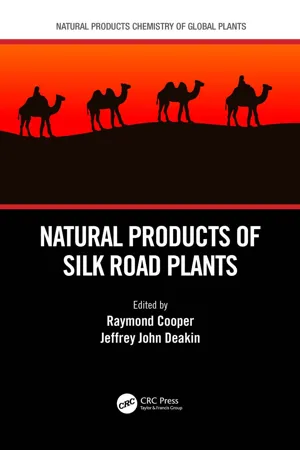
The Silk Road, a complex network of trade routes linking China with the rest of the Eurasian continent by land and sea, fostered transformation of the ethnic, cultural, and religious identities of diverse peoples. In Natural Products of Silk Road Plants there is a treasury of plants, many indigenous to countries along the trading routes of the Silk Road, that yielded medicines, cereals, spices, beverages, dyes, and euphoric and exotic compounds previously unknown to the rest of the world.
This entry in the Natural Products Chemistry of Global Plants series has been prepared for university students of chemistry and ethnobotany and for those wishing to broaden their knowledge. It opens a window on a vast region of Asia not well described for its flora and provides new and fresh insights on:
Significant plants, some endangered
Traditional and modern applications of extracts
The biochemical and pharmacological properties of extracts
Contains over 150 full colour figures
The significance of the Silk Road is being revived today through immense investment by China and other eastern countries in major schemes of transport infrastructure.
Sant Longowal Institute of Engineering and Technology Chandigarh University
Garima Bhardwaj
Sant Longowal Institute of Engineering and Technology
Pushpender Bhardwaj
Defence Institute of High-Altitude Research
Damanjit Singh Cannoo
Sant Longowal Institute of Engineering and Technology
Contents
Geographical Location of Trans-Himalaya
Ancient Silk Roads in the Region
Terrain of the Trans-Himalaya
Flora of Trans-Himalaya
Flora of Ladakh and Lahaul-Spiti in Trans-Himalaya
Five Plant Species from Ladakh in Trans-Himalaya
Arnebia benthamii
Classification
Distribution
Morphology
Traditional Uses
Phytochemistry
Bioactivity
Hippophae rhamnoides
Classification
Distribution
Morphology
Traditional Uses
Phytochemistry
Bioactivity
Podophyllum hexandrum
Classification
Distribution
Morphology
Traditional Uses
Phytochemistry
Bioactivity
Bioactivity of Podophyllotoxin Derivatives
Rheum webbianum
Classification
Distribution
Morphology
Traditional Uses
Phytochemistry
Bioactivity
Rhodiola imbricata
Classification
Distribution
Morphology
Traditional Uses
Phytochemistry
Bioactivity
Concluding Remarks
References
Geographical Location of Trans-Himalaya
The Himalayan region occupies 594,427 km2 that is about 18% of the land area of India. The mountains are approximately 2,400 km long and 240–320 km wide (Pandey et al., 2006). Geographically, there are three main divisions:
Eastern, comprising Assam, Sikkim, and northern India
Central, comprising Nepal
Western, consisting of Kumaon-Garhwal, Kashmir, and Himachal Pradesh (Figure 3.1).
Trans-Himalaya is found to the north of the main range of mountains of the Western Himalayas and extends to 329,032 km2; 67.5% of which lies in Kashmir, 17% in Himachal Pradesh, and the remaining 15.5% in the hilly districts of Uttaranchal state (Pandey et al., 2006).
FIGURE 3.1 Jammu and Kashmir, Ladakh, and Himachal Pradesh in northwest India bordering Pakistan (Shutterstock: royalty-free vector ID: 329065256).
Ancient Silk Roads in the Region
The ancient Silk Roads comprised a network of routes that linked the Indian subcontinent, eastern and central Asia, the Middle East, and countries of the Mediterranean.
India was linked with the ancient Silk Roads by four major corridors (Fonia, 2019):
A route in the Tibet which went down to the Ganges and to Sravasti
A route in western Nepal which led to the productive valleys of the river Ganges
A route in the Western Himalaya via Srinagar, Leh, and the Sangju Pass
A route down the Ganges valley in West Bengal.
Ladakh, “the land of high-rising passes”, has an area of 96,700 km2. At one time, Ladakh was an independent kingdom that occupied an important and strategic position. In ancient times, traders of the neighboring countries usually passed through Leh, the principal city of Ladakh. An important market developed there in which goods from the Silk Roads were traded through barter and currency (Dolma, 2017).
Terrain of the Trans-Himalaya
The cold desert landscape of Trans-Himalaya is administered by India and extends from north to south, from Ladakh, in Jammu and Kashmir, to Kinnaur, in Himachal Pradesh (Figure 3.2).
FIGURE 3.2 Kaza, Himachal Pradesh, India, in 2018 (Royalty-free photograph ID: 1444804982).
Trans-Himalaya is exposed to harsh climatic conditions attributable to two factors arising from its location at high elevation (3,000–5,000 m) on the leeward side of the Himalayan massif:
Minimal precipitation and
Extreme cold.
Also, the climate shows huge seasonal variation ranging from short and dry summers with harsh sunlight (maximum temperature reaching up to 36°C during the day) to long, windy, and freezing winters (minimum temperature touching −32°C at night). Water resources are minimal apart from glacier-fed streams (Singh and Gupta, 1990; Fox et al., 1994; Kala and Mathur, 2002; Chaurasia et al., 2007).
The soil is not very fertile, and the climatic conditions permit only a very short growing season. Other physical characteristics of note in the cold desert are high flux density in the ultraviolet part of the electromagnetic spectrum, low air density, low atmospheric pressures of oxygen and carbon dioxide and vigorous winds (40–60 km/h) generally in the afternoon hours (Kala and Mathur, 2002; Chaurasia et al., 2007; Bhardwaj et al., 2019). Precipitation occurs mostly as snow during winter and soil moisture remains. The flora and fauna have adapted to these extreme conditions. However, most species occur in sparse populations.
Despite such inhospitable conditions, it is thought that the region has been inhabited by human beings since early times given the discovery of Lower Palaeolithic tools and prehistoric artwork. The region remains sparsely populated; human settlements are small and isolated and occur in river valleys.
Flora of Trans-Himalaya
Trans-Himalaya is well known for its rich flora of medicinal and aromatic plants amounting to about 1,000 species many of which are still in use (Pandey et al., 2006). There are at least 5,942 genera and 17,381 taxa of plants in western Himalayan region (Dhar, 1996; Nautiyal et al., 2000). Most of Himalayan aromatic and medicinal plant species belong Asteraceae, Boraginaceae, Berberidaceae, Campanulaceae, Crassulaceae, Ephedraceae, Elaeagnaceae, Gentianaceae, Lauraceae, Lamiaceae, Liliaceae, Myrtacea, Papaveraceae, Polygonaceae, Ranunculaceae, Rutaceae, and Zingiberaceae families (Joshi et al., 2016).
Flora of Ladakh and Lahaul-Spiti in Trans-Himalaya
The flora of Ladakh and Lahaul-Spiti in Trans-Himalaya are found mainly in the alpine and high alpine zones, and are dominated by annual and perennial herbs followed by a few small shrubs and bushes. Owing to inimical climatic conditions, the cold desert has vegetation that differs from other Himalayan regions. The growing season starts at the beginning of summer in June when the snow begins to melt; flowers bloom during July to August and die out by the onset of winter from September to October. During this period, usually barren alpine meadows and mountain slopes are lush green as many varieties of alpine and high alpine flowers burst into life (Chaurasia et al., 2007; Kumar et al., 2011a and references therein).
The flora of Ladakh may be subdivided into three groups which are found in desert, alpine, and oasitic conditions. On the other hand, the flora of the Lahaul valley, which is situated further south, differs from Ladakh due to prevailing humidity. Here the flora is more extensive and may be further subdivided to include one more group: desert, alpine, oasitic, and temperate plants (Chaurasia et al., 2007; Kumar et al., 2011 and references therein).
Desert vegetation: Low humidity, little rainfall, high-velocity winds, and extreme fluctuation in diurnal temperatures are the main characteristic features of this zone. This zone includes long stretches of the Lahaul-Spiti and Ladakh regions (e.g...
Table of contents
Cover
Half Title
Series Page
Title Page
Copyright Page
Table of Contents
Preface
Editors
Contributors
Section I Introduction
Section II Eastern Asia
Section III Central and Southern Asia
Section IV Western Asia and the Middle East
Section V Maritime Routes
Bibliography
Index
Trusted by 375,005 students
Access to over 1.5 million titles for a fair monthly price.
Study more efficiently using our study tools.
Frequently asked questions
Yes, you can cancel anytime from the Subscription tab in your account settings on the Perlego website. Your subscription will stay active until the end of your current billing period. Learn how to cancel your subscription
No, books cannot be downloaded as external files, such as PDFs, for use outside of Perlego. However, you can download books within the Perlego app for offline reading on mobile or tablet. Learn how to download books offline
Perlego offers two plans: Essential and Complete
Essential is ideal for learners and professionals who enjoy exploring a wide range of subjects. Access the Essential Library with 800,000+ trusted titles and best-sellers across business, personal growth, and the humanities. Includes unlimited reading time and Standard Read Aloud voice.
Complete: Perfect for advanced learners and researchers needing full, unrestricted access. Unlock 1.5M+ books across hundreds of subjects, including academic and specialized titles. The Complete Plan also includes advanced features like Premium Read Aloud and Research Assistant.
Both plans are available with monthly, semester, or annual billing cycles.
We are an online textbook subscription service, where you can get access to an entire online library for less than the price of a single book per month. With over 1.5 million books across 990+ topics, we’ve got you covered! Learn about our mission
Look out for the read-aloud symbol on your next book to see if you can listen to it. The read-aloud tool reads text aloud for you, highlighting the text as it is being read. You can pause it, speed it up and slow it down. Learn more about Read Aloud
Yes! You can use the Perlego app on both iOS and Android devices to read anytime, anywhere — even offline. Perfect for commutes or when you’re on the go. Please note we cannot support devices running on iOS 13 and Android 7 or earlier. Learn more about using the app
Yes, you can access Natural Products of Silk Road Plants by Raymond Cooper, Jeffrey John Deakin, Raymond Cooper,Jeffrey John Deakin in PDF and/or ePUB format, as well as other popular books in Biological Sciences & Alternative & Complementary Medicine. We have over 1.5 million books available in our catalogue for you to explore.