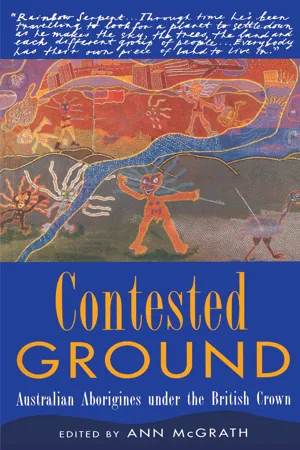
Contested Ground provides a comprehensive and up to date account of the processes and experiences which shaped the lives of Aboriginal Australians from 1788 to the present.
It integrates eye-witness accounts, oral histories and historical research to present the first colony-by-colony, state by state history of Aboriginal-white relations. Contested Ground tells a story of dispossession and denial but it is also a positive account, revealing the persistent struggles of Aboriginal communities for a better future.
Clearly written and generously illustrated, this book demonstrates why Australian Aboriginal history, like the very land itself, remains contested ground.
'Both indigenous and non-indigenous Australians have a lot to learn about each other before reconciliation between the two peoples can be realised. This book will go a long way towards achieving that end.' - Paul Behrendt.
- 448 pages
- English
- ePUB (mobile friendly)
- Available on iOS & Android
eBook - ePub
About this book
Information
1 A national story
TERRA nullius, or unoccupied land, was the legally endorsed premise of the British occupation of Australia. This convenient imperial fantasy has long shaped Australia's past, and history writing and teaching has provided it longevity in both law and the popular imagination. Dissenting voices were heard; humanitarians and experts in jurisprudence worried that the Australian colonies were out of step with other 'new world' countries such as North America and neighbouring New Zealand.1 Nonetheless, terra nullius remained firm, being only one of many hypocrisies implicit in colonialism. In Australia a collective consciousness of denial emerged. Unlike the 'dark continent' of Africa, full of its 'conquered' peoples, twentieth century Australia became the 'empty continent'. Its history books attempted to fill Australia's vast spaces with stories of male discovery, exploration and above all, with 'settlement', which became, in the Australian context, a euphemistic term for conquering by force and outnumbering the indigenous population.
Australian history can be summarised as the story of how Aboriginal peoples lost a continent and how the invaders gained one. While opponents of Aboriginal rights argue that land rights or native title will divide the nation, any study of the past reveals that from the earliest times, the British set about creating boundaries and social divisions; the land and its riches were divided up in increasingly uneven portions between the ncwcomers and the Aboriginal people.
It is deceptive to assume that 'colonial Australia' ended with the coming of the twentieth century, or that successful British settlement meant the end of 'colonial' relations between Aborigines and non-Aborigines. For the first three decades after Federation, the conflict over land, river and sea was still proceeding. Forced relocation and dispossession continued during the decades which followed. Since the British invasion, colonial relations were entrenched not only by land takeover but also by a wide variety of ideas and beliefs, and by the economic, legal, political and social structures which institutionalised and perpetuated them.2
Some areas have been more effectively colonised than others, and it is in the less populated regions such as the Kimberley, the Pilbara and Kakadu where Aboriginal traditional ties with the land are strongest. The success of colonialism therefore became a direct gauge of Aboriginal dislocation. First meetings between old and new residents were coloured by the forces and languages of imperialism and colonialism, although these encounters were sometimes the most open-hearted and hopeful moments of all: times of potential diplomacy before the use of capture or force.
In the short and long term, colonialism drastically jeopardised the personal liberty of Aborigines. They immediately lost choices over movement and residence, which was especially devastating for a people for whom travel was a necessity. Their lifestyle was frequently dictated by governments and Christian missionaries who wanted them to become sedentary, or remain under control on their 'settlements'. Aboriginal families also suffered the extreme trauma of having their children taken away to dormitories or distant towns. Association with their own Aboriginal parents and kin was said to be degrading or subjecting them to neglect. Girls and boys were segregated and taught to conform to sex roles approved by an outside culture.
The carve-up of Australia was thus not only about land and property. It separated Aboriginal families, and broke the hearts and minds of individuals—variously Aboriginal children, men and women. Kidnappings of both adults and children were frequent. Crippling changes to Aboriginal lifestyle and land-use patterns were imposed. Individual colonisers were horrifyingly brutal, but blame cannot rest solely on their shoulders, for Australia's colonisation originated in and was implemented by the State with popular endorsement.
It is a truism that colonial intrusions initially polarised those in Australia into two camps: the coloniser and the colonised. Yet paradoxically, the two camps could not remain totally divided physically or mentally; it was the very nature of colonialism that coloniser and colonised came together. In many such meetings, murder, rape, pillage, deceit occurred, but there was also co-operation, affection, generosity, loyalty, even love.
As well as a history of conflict and domination, there was also a history of negotiation, compromise and exchange between Aboriginal people and colonisers. Alliances were formed. Aboriginal midwives delivered white women's babies and Aboriginal women nurtured, even suckled, these children. Lonely white men relied upon Aboriginal women as lovers and de facto wives. Aboriginal women had children by white men. Bodies, words, culture, art, aesthetics, ideas, images became entwined in a complex physical and mental dialogue which continues today, and is most evident in human reproduction and cultural exchange.3 Children of mixed Aboriginal and European descent were born and grew up in varied contexts, but amidst the environment of Australian colonialism which generally defined them as illegitimate, partially or fully excluding them from the nation and full citizenship.
As well as creative exchanges and possibilities of cultural convergence, colonialism was delimiting. All Australians inevitably become prisoners of such forces. Aboriginal people recognise this, portraying their people, in literature and art, as prisoners in their awn country. Their high imprisonment rates make this more than i metaphor, yet the image is particularly appropriate for a nation which commenced as a prison colony. When the imported convicts were freed, the indigenous people bccame their captives. The history of colonial and State authority over Aborigines—of institutionalisation, law enforcement, detention, imprisonment, md the role of police—have been fundamental in shaping their lives. Aboriginal individuals and communities interacted with:hese systems of policing and control, co-operating with and resisting them according to their respective goals. Yet the confining power of government policies and practices often made it difficult for Aboriginal people to escape.
The overarching power relations of colonialism meant that the colonisers would win over the colonised. Yet, like all colonisers, there remained a nagging doubt about the tenure of their victory.4 Many Australians still feel an emotional need to protect their spoils, refusing to share the country with Aborigines. Others listen to pangs of conscience and yearn for a fairer country. The Mabo decision of the High Court in 1992 overruled the legality of terra nullius, but it has not yet erased its legacy from the present. Nor has it overturned non-Aboriginal understandings of Australian history, and these in turn shape present public opinion. As is discussed more fully in chapter 10, from Federation in 1901 until the 1970s, Aborigines hardly appeared in national history books except as a backward people easily 'pushed aside' by virile colonisers. The act of history writing has always been political, and Australian historians had and still have a special role in nation building.
Australia's past cannot be truly understood unless it is analysed as a colonial history, and as the founding premise of Australian colonialism, terra nullius shaped the way this history unfolded. It dictated the basis of property ownership, and influenced the structures of fundamental Australian institutions, including its government. Following British takeover of their land, Aboriginal peoples lost their sovereignty, or their dominion and authority over the land. Consequently, Australian colonialism made Aborigines foreigners in their own land, intruders in their own dwellings. To exemplify this, early governors such as Macquaric in New South Wales required Aborigines to carry passports in order to travel in their own lands. Otherwise they would be treated as enemy aliens. Significantly, these passports were conditional upon Aborigines agreeing to give up their hunting implements, their bush economy and to stop associating with their families. Governor Arthur had the same idea for Tasmanian Aborigines; he planned to capture Aborigines living near the settled districts, and compliant 'chiefs' were to be issued with 'a general passport' signed and sealed by the governor.5
In the next century, with national Federation, white Australians remained deeply insecure about their hold on the large continent, by then based not only upon terra nullius but upon a belief in racial superiority and an understanding that the land be fully colonised and developed. One of the first Bills passed bccame known as the 'White Australia Policy' and one of the earliest Royal Commissions which followed was into the white birthrate.6 Racial exclusion became central not just to the takeover of the land but to the self-image of the new nation. Although Aborigines were excluded from citizenship in this nation, white Australians saw fit to appropriate Aboriginal words, bushcraft skills and local knowledge and later their traditional art and symbolism. But the Aboriginal people were excluded from an active role in culture-making. Aborigines were literally a 'captivc audience' forced to look on as white Australians narcissistically admired themselves, constructing and defining the nation as a young country, as superior, as blessed.
When the new nation celebrated its unblemished whiteness amidst Asian seas, Aborigines became an annoying anomaly. In the nineteenth century it had been thought that Aborigines would eventually go away. Either they would follow Tasmania's lead and virtually disappear or they would eventually be 'bred out' through intermarriage. Whites and colonial governments often helped the process along. Against the tide of colonialism, Aborigines, defined as 'primitive', were the doomed race. In some areas, programmes were attempted to 'civilise' the women so they would be eligible for 'nice white men', eventually breeding out 'the colour'. In the 1950s, assimilation promised to destroy Aboriginality by enforcing social conformity. But Aborigines refused to go away. Indeed, there was virtually nowhere for them to go, and like many other indigenous people, they faced a long struggle for their rights.
Terra nullius provided a powerful rationale and became part of Australian nationalism. The all-white Australian Natives Association adopted the term 'natives' for themselves and from the 1880s wanted to define the non-Aboriginal Australian-born as Australia's only 'aborigines'.7 Even the bushman legend, with its image of the 'typical Australian man' grew out of such denial. Features of Aboriginality were borrowed so that white men could feel or prove themselves better Aborigines than the Aborigines themselves. The essence of Australian manhood, according to the working man's legend, was to be 'a rolling stone', a traveller, practical, laconic, collectivist, matey, the very image of 'the Aboriginal other' as perceived by white Australians. This white primitive, superior to Aborigines in the ever-threatening bush, was the Tarzan-like 'noble savage' recently inetamorphised as Crocodile Dundee.8
In line with such national ideals, Aboriginal mothers were excluded from the maternity bonus and their elderly from the pension. The well-being of the Aboriginal people, considered a dying race anyway, was thus best kept low on the national agenda, if not forgotten altogether. The states, rather than the nation, were given responsibility for Aboriginal policy, and Aboriginal people were not even counted in the National Census. Until 1967 Aborigines were excluded from Australian egalitarianism and from democracy; it was only with the referendum of that year that all Aborigines were officially enumerated and learnt of their right to vote in Commonwealth elections.9 Wage and other struggles followed.
Government policies frequently separated Aborigines from the wider communit...
Table of contents
- Cover
- Half Title
- Title Page
- Dedication
- Contents
- Maps
- Illustrations
- Acknowledgements
- Contributors
- Preface
- Introduction
- 1 A national story
- 2 New South Wales
- 3 Victoria
- 4 Queensland
- 5 South Australia
- 6 Western Australia
- 7 Northern Territory
- 8 Tasmania: 1
- 9 Tasmania: 2
- 10 Contested ground: what is 'Aboriginal history'?
- Select bibliography
- Index
Trusted by 375,005 students
Access to over 1.5 million titles for a fair monthly price.
Study more efficiently using our study tools.
Frequently asked questions
Yes, you can cancel anytime from the Subscription tab in your account settings on the Perlego website. Your subscription will stay active until the end of your current billing period. Learn how to cancel your subscription
No, books cannot be downloaded as external files, such as PDFs, for use outside of Perlego. However, you can download books within the Perlego app for offline reading on mobile or tablet. Learn how to download books offline
Perlego offers two plans: Essential and Complete
- Essential is ideal for learners and professionals who enjoy exploring a wide range of subjects. Access the Essential Library with 800,000+ trusted titles and best-sellers across business, personal growth, and the humanities. Includes unlimited reading time and Standard Read Aloud voice.
- Complete: Perfect for advanced learners and researchers needing full, unrestricted access. Unlock 1.5M+ books across hundreds of subjects, including academic and specialized titles. The Complete Plan also includes advanced features like Premium Read Aloud and Research Assistant.
We are an online textbook subscription service, where you can get access to an entire online library for less than the price of a single book per month. With over 1.5 million books across 990+ topics, we’ve got you covered! Learn about our mission
Look out for the read-aloud symbol on your next book to see if you can listen to it. The read-aloud tool reads text aloud for you, highlighting the text as it is being read. You can pause it, speed it up and slow it down. Learn more about Read Aloud
Yes! You can use the Perlego app on both iOS and Android devices to read anytime, anywhere — even offline. Perfect for commutes or when you’re on the go.
Please note we cannot support devices running on iOS 13 and Android 7 or earlier. Learn more about using the app
Please note we cannot support devices running on iOS 13 and Android 7 or earlier. Learn more about using the app
Yes, you can access Contested Ground by Ann McGrath in PDF and/or ePUB format, as well as other popular books in Social Sciences & Australian & Oceanian History. We have over 1.5 million books available in our catalogue for you to explore.