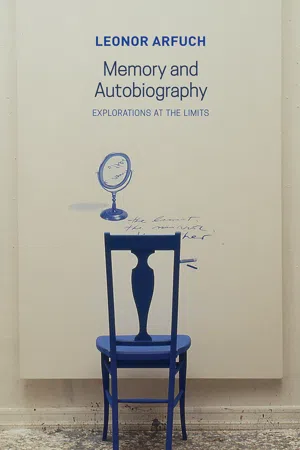
This book by one of Latin America's leading cultural theorists examines the place of the subject and the role of biographical and autobiographical genres in contemporary culture.
Arfuch argues that the on-going proliferation of private and intimate stories – what she calls the 'biographical space' – can be seen as symptomatic of the impersonalizing dynamics of contemporary times. Autobiographical genres, however, harbour an intersubjective dimension. The 'I' who speaks wants to be heard by another, and the other who listens discovers in autobiography possible points of identification. Autobiographical genres, including those that border on fiction, therefore become spaces in which the singularity of experience opens onto the collective and its historicity in ways that allow us to reflect on the ethical, political, and aesthetic dimensions not only of self-representation but also of life itself.
Opening up debate through juxtaposition and dialogue, Arfuch's own poetic writing moves freely from the Holocaust to Argentina's last dictatorship and its traumatic memories, and then to the troubled borderlands between Mexico and the United States to show how artists rescue shards of memory that would otherwise be relegated to the dustbin of history. In so doing, she makes us see not only how challenging it is to represent past traumas and violence but also how vitally necessary it is to do so as a political strategy for combating the tides of forgetting and for finding ways of being in common.
- English
- ePUB (mobile friendly)
- Available on iOS & Android
eBook - ePub
About this book
Information
1
A Beginning
Being at the limit: these words do not yet form a proposition, and even less a discourse. But there is enough in them, provided that one plays upon it, to engender almost all the sentences in this book.
Jacques Derrida (1982)
It is with these mysterious, thought-provoking words that Derrida begins ‘Tympan’, the first chapter of Margins of Philosophy,1 in both graphic and metaphorical counterpoint to a parallel, marginal text by Michel Leiris that, over the pages, speaks of curves, helicoids, spirals, snails, those natural and symbolic simulations of the ear and, therefore, the act of hearing, as philosophy’s impulse towards différence, the multiplicity of (also marginal) sounds and voices; in short, the refutation of the margin as marginality and decentralization in order to place it in opposition, in terms of a fully inhabited space, to the supposed centrality of philosophy as a founding discourse and the illusion of presence in that centre.
Given this incitement, it may be possible to see in the apparent centrality of the subject in contemporary culture, in its pre-eminence within the duplicitous splitting of the ego, in those biographical indications to be found in every type of discourse – from the most canonical to the most innovative; from classic autobiography to autofiction, from the intimate diary to the blog – a proliferation of voices striving to be heard, disputing ethical, aesthetic and political spaces, subverting the imprecise limits of the private and the public, and also making the distinction between centre and margin impossible to articulate.
Some time ago, the notion of the ‘return of the subject’ was celebrated in theories of difference and perceived – from another viewpoint – as the decline of public culture and the primacy of the social. Over the intervening years, this prominence has been increasingly asserted in the media, academic research and artistic experimentation without, however, being disconnected from other notions of sociality. Faces, voices, bodies take over the role of words; they sustain authorships, reaffirm positions of agency or authority, testify to having lived or having seen; they bare their emotions and underpin the politics of identity. It is a phenomenon which tends to be defined as the extension – or even removal – of the limits of ‘biographical space’,2 the ‘subjective turn’3 or a late effect of those ‘transformations of intimacy’4 that will lead to speaking without euphemism of ‘public intimacy’.5
Nevertheless, this often-excessive subjectivism – which can also include the expansion of the self-help genre – does not position the subject – the multiplicity of subjects – at centre stage. Conversely, that centre – whether termed the market, global capitalism or the metaphysical moment that regulates world stock markets, causing them to rise or fall at will – presents itself with no recognizable face, no subject, as the blind power behind mere puppets, defining the trends imposed on those who execute that will in their capacity as heads of governments, regions or international organizations, in which the tension between politics (as an administrative routine) and the political (the agonistic struggle for hegemony) generally settles in favour of the former.6
It is perhaps in exact counterpoint to this hypothetical centre (and its entropy), resistant to any adjectival qualification attempting to attenuate its devastating effects (what would a humane capitalism look like?), that the overwhelming emergence of subjectivity should be read, those small stories that – according to some – have substituted the grand narratives whose decline was foretold more than two decades ago by the controversial concept of postmodernity, the decline of the collective subjects that commemorations establish in the space of nostalgia – the fortieth anniversary of May 1968, for example – whose comparison to the present, with its unblemished individualism, is a constant source of deception.
Small stories we can hear – pricking up our ears in a sense given by Derrida – even in the silence of writing, in the testimony related to a traumatic shared memory in the story of a life offered to the researcher as the emblematic feature of the social, in the subjective documentary (no longer an oxymoron but a new genre), in the artistic installations composed of intimate objects, in theatre as biodrama or in images (often without voice) of catastrophes and suffering that the media have converted into one of the paradigmatic records of the age.
It could be argued that this heteroclite list does not do justice to the valuative differences between genres – testimony or life story as opposed to media sensationalism, for example; experimentation in writing and the visual arts as opposed to the explosion of the personal on the Web – but the truth is that – without any wish to asperse the pertinence of that venture – my gaze is not so much directed at the hierarchical ordering of the discursive genres involved in this reconfiguration of contemporary subjectivity as at the reconfiguration in itself in symptomatic terms.
But why the reconfiguration? What would be new – and symptomatic – about that tendency if there have always been self-referential voices, if the narration of a life can possibly be traced back to the distant ancestors of folk tales? In response to these questions, three signifiers can be posited: historicity, simultaneity and multiplicity.
First, genres that are considered as canonical – autobiography, memoirs, the personal diary, correspondence – have a precise historicity that marks a break with an earlier time: they were consubstantial with that invention of the modern subject which is generally agreed to have come about in the eighteenth century with Jean-Jacques Rousseau’s Confessions – the space of interiority and emotion which must be spoken in order to exist, the (consequent) public expression of the emotions and the restrictive weight of society on them.7 A new sensibility, an astute – and anguished – historical consciousness accompanied the consolidation of capitalism, the bourgeois world and its classic separation of the public and the private. And although it is true that those genres were never invalidated, that they were, through centuries, affirmed and transformed, adopting other formats and media, it was with the dizzying deployment of new communications technologies that their imprint became global, recognizable everywhere in astonishing simultaneity, without respect for physical frontiers, linguistic traditions or diverse cultural environments. This expansion is not only due to classic personal experience-based contents, modulated by the complexities of our times, but is also aesthetic, stylistic, manifested in multiple, innovative forms: autofiction, for example, which, in contrast to classic autobiography, offers the reader or addressee a series of equivocations, tricks, where the boundaries between real and fictitious characters and events are blurred; the docudrama, which also involves an erosion of boundaries; the media confessional, which oscillates between intimate revelation and staged spectacle; the multiple variants of the reality show; the online lives of social media ...
In the configuration of the symptomatic horizon, a number of factors come into play: a patent simultaneity linked to a journalistic emphasis on voice and presence, particularly in the interview, also a highly important genre of social research;8 an insistence on the figure of the speaker as a guarantor of authenticity – an I and another I, there is no substantial difference – and which even extends to creators of fiction;9 the temptation to reveal intimate details and the corresponding passion for glimpsing them; and, finally, the incessant multiplication of persons and characters from the famous – of every sphere – to ordinary people.
There are, therefore, different types of subjects on the margins: literally – in both senses of the word – in those inscriptions left by a nervous hand on the blank border of the manuscript...
Table of contents
- Cover
- Contents
- Series title
- Title page
- Copyright page
- Epigraph
- Acknowledgements
- Introduction by Michael J. Lazzara
- Prologue
- 1 A Beginning
- 2 The Gaze as Autobiography: Time, Place, Objects
- 3 Memory and Image
- 4 Women Who Narrate: Autobiography and Traumatic Memories
- 5 Political Violence, Autobiography and Testimony
- 6 The Threshold, the Frontier: Explorations at the Limits
- 7 The Name, the Number
- Bibliography
- Index
- End User License Agreement
Trusted by 375,005 students
Access to over 1.5 million titles for a fair monthly price.
Study more efficiently using our study tools.
Frequently asked questions
Yes, you can cancel anytime from the Subscription tab in your account settings on the Perlego website. Your subscription will stay active until the end of your current billing period. Learn how to cancel your subscription
No, books cannot be downloaded as external files, such as PDFs, for use outside of Perlego. However, you can download books within the Perlego app for offline reading on mobile or tablet. Learn how to download books offline
Perlego offers two plans: Essential and Complete
- Essential is ideal for learners and professionals who enjoy exploring a wide range of subjects. Access the Essential Library with 800,000+ trusted titles and best-sellers across business, personal growth, and the humanities. Includes unlimited reading time and Standard Read Aloud voice.
- Complete: Perfect for advanced learners and researchers needing full, unrestricted access. Unlock 1.5M+ books across hundreds of subjects, including academic and specialized titles. The Complete Plan also includes advanced features like Premium Read Aloud and Research Assistant.
We are an online textbook subscription service, where you can get access to an entire online library for less than the price of a single book per month. With over 1.5 million books across 990+ topics, we’ve got you covered! Learn about our mission
Look out for the read-aloud symbol on your next book to see if you can listen to it. The read-aloud tool reads text aloud for you, highlighting the text as it is being read. You can pause it, speed it up and slow it down. Learn more about Read Aloud
Yes! You can use the Perlego app on both iOS and Android devices to read anytime, anywhere — even offline. Perfect for commutes or when you’re on the go.
Please note we cannot support devices running on iOS 13 and Android 7 or earlier. Learn more about using the app
Please note we cannot support devices running on iOS 13 and Android 7 or earlier. Learn more about using the app
Yes, you can access Memory and Autobiography by Leonor Arfuch, Christina MacSweeney in PDF and/or ePUB format, as well as other popular books in Literature & Literary Criticism Theory. We have over 1.5 million books available in our catalogue for you to explore.