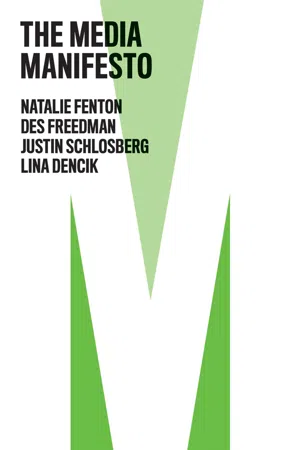
Our media systems are in crisis. Run by unaccountable corporations and dominated by agendas and algorithms that are shrouded in mystery, these formerly trusted sources of information and entertainment have lost their way. As consumers, we have plenty of choice, but as citizens we have an abundance of misinformation and misrepresentation.
In this incisive manifesto, four prominent media scholars and activists put forth a roadmap for radical reform of concentrated media power. They argue that we should put media justice, economic democracy and social equality at the heart of our scholarship and our campaigning.
The Media Manifesto delivers a sharp analysis of our communications crisis and a passionate call for urgent change. It provides resources of hope for media reform movements across the globe.
- English
- ePUB (mobile friendly)
- Available on iOS & Android
eBook - ePub
The Media Manifesto
About this book
Information
1
Challenging Media Power Today
Why a manifesto?
This is a time for manifestos: analyses that identify the faults and fissures of a divided world and declarations that propose strategies to put things right. We need narratives that articulate our rage against injustice and simultaneously evoke a spirit of optimism and the possibility of radical social change. This is not a time for studied neutrality, strategic ambivalence or cool indifference but an opportunity to diagnose problems and mobilize solutions.
The dominant neoliberal order has been widely discredited and its zombie form stumbles on, albeit with fewer and fewer supporters. Inequality and instability, discrimination and disillusion are rampant across much of the world and environmental disaster lurches ever closer. Public life has been hollowed out – increasingly administered by private companies and opportunistic elites in thrall to a blinkered market logic – while the dream of a digital nirvana appears to have turned into a cesspit of racist abuse, corporate surveillance and global bickering. Our universities are debt machines, our welfare systems are increasingly emaciated, and our systems of government are opaque to populations for whom direct democracy exists largely as a fairytale from Athenian times.
In response to the breakdown of what was always a fragile political consensus, we are now seeing worrying levels of nativism and xenophobia dressed up as ‘popular sentiment’. Authoritarianism – marked by states of emergency, pervasive surveillance regimes and intolerance towards minorities – is by no means a tendency confined to distant ‘illiberal’ states but finds an expression in traditional ‘liberal democratic’ nations. Walls, borders, profits and privileges preoccupy vested interests far beyond any meaningful commitment to diversity, equality, climate action and social justice.
Our communication systems are not exempt from these developments. In fact they are crucial vehicles through which misinformation, misrepresentation, misogyny and mischief are disseminated. For example, Ogilvy, one of the world’s largest and most prestigious advertising agencies, was happy to take $39 million from the American government in order to make commercials for US Customs and Border Protection at a time when it was forcibly separating children from their parents at the US–Mexico border and holding them in cages. Its CEO defended the agency’s actions by pointing out that CBP ‘is not necessarily a bad organization’ and that, in any case, Ogilvy had previously worked with other controversial companies like BP, big tobacco and Coca Cola.1 Moreover, the failure to predict, challenge or to make sense of apparently unprecedented events such as the election of Donald Trump, Brexit, climate catastrophe and the rise of the far right can’t be blamed solely on fringe purveyors of ‘fake news’ but reflects the insulation, complacency and commercial interests of our major legacy news organizations. As the then CEO of US network CBS famously put it during Trump’s 2016 presidential campaign: ‘It may not be good for America, but it’s damn good for CBS . . . The money’s rolling in and this is fun.’2
Presided over by unaccountable oligopolies fostering corporate-friendly agendas and deploying algorithms whose operations remain shrouded in mystery, our news media are in thrall to the very power that they once promised to challenge. Newsrooms now operate with fewer staff working across more platforms, desperately seeking the clicks and likes that will justify their wages, no matter whether this journalism serves the public interest or not. Meanwhile, giant media and tech companies who are either flush with cash (as of mid-2019, Apple and Alphabet alone had some $219 billion of cash holdings),3 or who are heavily indebted (like Netflix, Comcast and Disney), are splashing out enormous amounts of money to generate new content and make strategic acquisitions in order to squash their competition and accrue yet more power.
The US politician Bernie Sanders makes an important point when he argues that when ‘we have had real journalism, we have seen crimes like Watergate exposed and confronted, leading to anti-corruption reforms. When we have lacked real journalism, we have seen crimes like mortgage fraud go unnoticed and unpunished.’4 Yet this inability to hold power to account shouldn’t be seen as an unprecedented ‘failure’ of the media to perform its democratic role when, in fact, this has long been the media’s normal role under capitalism: to naturalize and legitimize existing and unequal social relations. It’s not about failing to hold banks to account but about the complicity of financial journalists and commentators in celebrating neoliberal economics ahead of the 2008 financial crash; it’s not about failing to be tough on racism but about the media’s historic perpetuation of racist stereotypes and promotion of anti-immigrant frames; it’s not about failing to recognize the challenges of apocalyptic climate change but about repeating tropes about ‘natural’ disasters such as hurricanes, heatwaves and forest fires, together with routine ‘balanced’ debates between climate change scientists and deniers. These are not examples of the media’s malfunctioning but of its default behaviour.
We need, therefore, to promote a different kind of media as a fundamental feature of a different kind of social system. Fortunately, the rising tide of racism and authoritarianism coincides and clashes with an appetite for collectivist approaches and an embrace of social justice. Despair and defeatism about current trends of polarization and illiberalism is matched by a growing enthusiasm for more radical and progressive solutions.
In this contradictory and volatile context, what form of writing is better placed to host imaginative and activist critique than the not-so-humble manifesto, the choice of groundbreakers, revolutionaries and iconoclasts for over 500 years? Left political movements, artistic currents, anti-colonial struggles and liberation campaigns have both used and, in part, been constituted by manifestos that proudly declare their provenance. Communism, nationalism, feminism, anti-colonialism, surrealism, dadaism, futurism, vorticism, situationism, slow tech and open access have all used the manifesto form as a launchpad and weapon of choice.
As with any manifesto, ours combines analysis and advocacy, critical theory and a call to action. The book analyses the pitfalls and priorities of contemporary media and tech in the context of our determination to secure a future based on the redistribution of society’s resources, in order to secure political and economic equality. It outlines the contours of an expansive media power in contrast to the fragmented and distributed character with which it is often associated; it explores the dangers of a dependence on data and highlights key myths that underpin today’s media and tech policy-making; and, crucially, it proposes a programme of media and data justice based on the identification of a ‘politics of hope’ that is itself inspired by emerging social movements and counter-hegemonic projects. As with any manifesto, its value can only be understood in relation to the solidarities it fosters, the energy it encapsulates and the change it promotes.
The triumph of executive power
Politicians, scholars and publics are all preoccupied with the media because they are seen to have enormous influence and power. But what is the nature of this influence and what does ‘media power’ actually mean? Does it refer to ability of major platforms and outlets to shape agendas and disseminate content in line with their own interests? Does it refer to the subtle ways in which some representations and narratives are normalized and others discredited? Does it refer to the control of a society’s symbolic resources and, in the words of the French sociologist Pierre Bourdieu, the capacity to ‘construct reality’ in line with dominant assumptions and to secure a ‘consensus which contributes fundamentally to the reproduction of the social order’?5 Is media power a property dominated by billionaire moguls and giant corporations, or a capacity distributed more generally and experienced more intimately to ‘make meaning’ and to cement identities? To what extent, to paraphrase an old sociological dilemma, does media power contribute to the domination of certain groups over others, or is it rather a means through which societies come to know themselves and share collective representations?
This book ar...
Table of contents
- Cover
- Front Matter
- 1 Challenging Media Power Today
- 2 Claiming Media Justice
- 3 Advancing Data Justice
- 4 Articulating a Politics of Hope
- 5 Conclusion: A Manifesto for Media Reform
- End User License Agreement
Trusted by 375,005 students
Access to over 1.5 million titles for a fair monthly price.
Study more efficiently using our study tools.
Frequently asked questions
Yes, you can cancel anytime from the Subscription tab in your account settings on the Perlego website. Your subscription will stay active until the end of your current billing period. Learn how to cancel your subscription
No, books cannot be downloaded as external files, such as PDFs, for use outside of Perlego. However, you can download books within the Perlego app for offline reading on mobile or tablet. Learn how to download books offline
Perlego offers two plans: Essential and Complete
- Essential is ideal for learners and professionals who enjoy exploring a wide range of subjects. Access the Essential Library with 800,000+ trusted titles and best-sellers across business, personal growth, and the humanities. Includes unlimited reading time and Standard Read Aloud voice.
- Complete: Perfect for advanced learners and researchers needing full, unrestricted access. Unlock 1.5M+ books across hundreds of subjects, including academic and specialized titles. The Complete Plan also includes advanced features like Premium Read Aloud and Research Assistant.
We are an online textbook subscription service, where you can get access to an entire online library for less than the price of a single book per month. With over 1.5 million books across 990+ topics, we’ve got you covered! Learn about our mission
Look out for the read-aloud symbol on your next book to see if you can listen to it. The read-aloud tool reads text aloud for you, highlighting the text as it is being read. You can pause it, speed it up and slow it down. Learn more about Read Aloud
Yes! You can use the Perlego app on both iOS and Android devices to read anytime, anywhere — even offline. Perfect for commutes or when you’re on the go.
Please note we cannot support devices running on iOS 13 and Android 7 or earlier. Learn more about using the app
Please note we cannot support devices running on iOS 13 and Android 7 or earlier. Learn more about using the app
Yes, you can access The Media Manifesto by Natalie Fenton,Des Freedman,Justin Schlosberg,Lina Dencik in PDF and/or ePUB format, as well as other popular books in Social Sciences & Media Studies. We have over 1.5 million books available in our catalogue for you to explore.