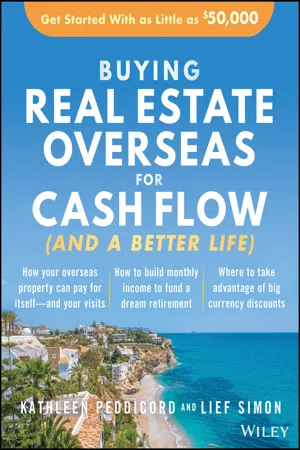
Buying Real Estate Overseas For Cash Flow (And A Better Life)
eBook - ePub

Buying Real Estate Overseas For Cash Flow (And A Better Life)

Get Started With As Little As $50,000

  1. English
  2. ePUB (mobile friendly)
  3. Available on iOS & Android
eBook - ePub

Buying Real Estate Overseas For Cash Flow (And A Better Life)

Get Started With As Little As $50,000

About this book

Buy real estate overseas to earn cash flow to fund your dream retirement

In Buying Real Estate Overseas For Cash Flow (And A Better Life): Get Started With As Little As $50,000, Kathleen Peddicord and Lief Simon explain how to incorporate an investment in foreign real estate into your portfolio for as little as $50,000. With a lifetime of experience on the subjects of living, retiring, and investing overseas, the authors delve deep into this complex topic. Simply put, this book is a practical guide to buying property overseas as a strategy for earning cash flow to fund your dream retirement.

In the book, the authors cover topics as wide-ranging as:

  • How to build the cash flow you need to fund the retirement you want
  • 8 markets offering the best current cash-flow opportunities
  • How to move money across borders in today's post-FATCA world
  • Plus: How to run the numbers to evaluate a potential cash-flow investment

Buying Real Estate Overseas includes a breadth and depth of information on the world's best markets for investing in real estate for cash flow. Its up-to-date information about this investment category puts to bed much of the outdated advice and guidance currently available in published materials.

The authors identify several hot, new markets where currency valuations and market conditions make the purchase of real estate an extremely wise investment decision in today's volatile investment climate.

Trusted by 375,005 students

Access to over 1.5 million titles for a fair monthly price.

Study more efficiently using our study tools.

Information

Publisher
Wiley
Year
2020
Print ISBN
9781119696209
eBook ISBN
9781119696230

IV
World's Top Cash Flow Markets—Where to Buy Whether You Have $50,000, $250,000, or $1 Million to Invest

After 64 property purchases over 30 years in 23 countries, we've found that it's possible to make a good property buy anywhere at any time if you look long and hard enough and have the experience and judgment to filter. However, on any particular day, it's easier to buy right in some places rather than others, and now and then we find a market where anyone could buy anything and profit.
Where should you consider buying?
If you're a retiree- or lifestyle-buyer shopping for a piece of property overseas that will generate cash flow when you're not using it yourself, the answer to the question is obvious. Direct your search according to your personal agenda. Where do you want to be? Target the country and the city where you'd like to spend time and then shop for a property with rental potential in that location.
If you're an investor buying strictly for cash flow, your challenge is greater. Following are the six best ways we've found to identify your top market options.

Top Tip from Kathleen

Here are the six factors to consider as you evaluate any market for potential investment:
  • Economic Outlook. Markets move up and down and then up again. At what point in this cycle is the market where you're thinking about buying right now? In which direction is it moving and why? If the market is moving up quickly because of foreign buyers (think the Spanish costas up until 2008), can you expect that foreign interest to continue? If not, who else might your eventual buyer be? Also, is there a reasonable expectation for appreciation in property values? If so, in what time frame—short, medium, or long term?
  • Inventory Supply and Demand. In expanding markets, supply typically takes time to catch up with demand, helping to create peaks and valleys in pricing even if the overall trend is up. In Panama City, right now, for example, a glut of high-rise condos is coming online. These units were launched and sold preconstruction over the past half-dozen years. Now they're being delivered, and their volume is one reason Panama's capital city's market continues soft.
  • The Path of Progress. Easier and better access opens up locations to broader markets. Therefore, one way to choose a market for investment is to identify a place where some important infrastructure improvement is planned. A new airport, new train station, new highway, new hospital, etc., can mean a new universe of potential buyers, and a newly paved road, for example, that cuts travel time in half, can make a location more accessible and therefore more valuable. All these things can translate into both expanding pools of potential renters and an exit strategy when the time comes.
  • Opportunity for Diversification. In terms of market, type of investment, type of property, and currency, a rental apartment in MedellĂ­n gives you an asset in Colombia that could generate cash flow in Colombian pesos. An agricultural investment in Brazil means another asset type, another economy, another currency, and so forth. The important thing to understand on the topic of diversification is that owning different kinds of properties in different cities and states across the United States isn't diversification. It's being invested in the United States.
    However, neither is moving all your real estate investment capital out of the United States and placing it in any other single market—Panama, for example, or Colombia, or Brazil. Many investors we speak with recognize that holding property investments in two or three different U.S. cities means they are still fully exposed and vulnerable to U.S. market and U.S. dollar risks. Many, though, don't see that selling off all U.S. assets and reinvesting the capital in property in a single other country—even if, again, in different kinds of properties in different cities or locations throughout that single other country—is a similarly vulnerable position.
    The point of diversification is to make sure you are not at the mercy of any single market, economy, political landscape, government, or currency. A global property diversification strategy could or could not include investments in the United States, but it must include investments in at least two (and preferably at least three) countries, ideally each with its own currency.
    Note that not all foreign property markets bring currency diversification, because some countries use the U.S. dollar (Panama and Ecuador); some peg their currencies to the U.S. dollar (Belize); and, in some countries, though they have their own currency, real estate is traded in U.S. dollars (Nicaragua and some parts of Mexico), meaning that your currency hedge isn't as clean as it could be.
    Also note that, while currency diversification can be one big benefit of investing in real estate overseas, we don't recommend you go chasing it. That is, don't try to time a property purchase based on moving exchange rates, not long term and not in the short term either. It's impossible to know which way any currency is going to move against any other currency day-to-day or month-to-month. Meantime, while you're trying to time the currency, the property market is moving, too.
    If you know that you're interested in a particular market and the local currency takes a sudden hit, you could take that opportunity to move money in anticipation of making a buy. However, waiting for the currency to do what you want it to do, you run the risk of missing out on a good investment just because the time isn't “right” from a currency point of view. You can't time when you'll find the piece of property that you're searching for unless you don't allow yourself to begin looking until the currency moves to where you want it. That's a backward approach. Much better to lock in a good deal on a property than worry too much about a few percentage points on a currency move that may or may not happen according to your timeline.
  • Costs of Acquisition and Disposal. Remember that these, which we refer to as the “round-trip costs” of making an investment, go beyond agent commissions and vary dramatically country to country. This is an important thing to research and understand in full no matter why you're making a purchase; however, the investor–buyer who underestimates or underplans for the costs of acquisition and of eventually reselling can undermine his investment before he makes it. Depending on the market, the costs of purchasing a piece of real estate in another country can include, in addition to agent commissions: legal fees, notary fees, registration fees, title insurance, and transfer taxes (sometimes called “stamp duty”). In Ireland, for example, stamp duty was as much as 9% of the purchase price when we bought, payable in cash upon closing and not a cost you wanted to overlook in your budgeting. (Today it's 1% if the purchase price is less than 1 million euros.)
    Again, though, remember, we're talking not only about the costs of acquisition, but the round-trip costs of a purchase. Exiting comes at a cost, too. When selling, you may have another agent commission to pay, and you'll likely have additional attorney fees. These are usually minimal, even negligible. The more significant cost associated with exiting a foreign property investment can be the tax hit. We discuss strategies for how to figure and how to minimize this in Appendix D.
    The total round-trip costs of investing in a piece of real estate overseas can range from a few percentage points to more than 25% at the extreme and that can be before taking into account capital gains taxes. These costs shouldn't keep you out of a market where you want to invest, but they definitely should be taken into account in your budget.
  • Carrying Costs. Including maintenance (a house on the beach requires a lot of it); a caretaker (if necessary); property taxes (not every country charges them, and, in some countries, they're negligible); income taxes (if you're earning rental income); capital gains taxes (when you eventually resell—again, not every country charges them); other local taxes; rental and property-management expense; and homeowner's association/building/condo fees.

13
Where a Strong Dollar Creates Opportunity

If you're holding U.S. dollars, you have a window of opportunity right now to take advantage of super-charged buying power in key overseas markets. The dollar's current strength is creating irresistible bargains in some countries where real estate trades in the local currency. We refer to this temporary distortion (no one can predict how long it will last but you can be sure it won't continue forever) as a “currency discount.” It's a metric we watch closely, and it amounts to a big, bold “Buy!” signal.
The difference of a percentage point or two in the rate at which one currency is able to buy another isn't going to change your lifestyle day to day, but, when buying property, even 1% can start to look like real money.
To put the current opportunity into perspective, the U.S. dollar is up a whopping 83% versus the Brazilian real, for example, since 2011.

Strong Dollar Buy #1: Brazil

Brazil is perhaps the world's best beachfront buy. How many places worldwide can you buy on the beach for $100,000 or less? That's the potential in Brazil, where beachfront property is not only super cheap but also ultra in demand. That bargain-priced beach house or apartment could earn you a double-digit net yield from rental.
Part of the reason beachfront can be so affordable is the country has so much of it, so you need to be discriminating. Don't settle for just any of Brazil's beaches. Research the rental demand and who your buyer might be when you decide you'd like to sell. Brazil has a huge internal tourism market fueled by its fast-growing middle class. The best buy is one that could appeal to both the local and also the expanding foreign-tourist demand. We like Fortaleza because it checks this box and its beaches are world-class.
Culturally, Brazil is one step beyond Latin America. The lifestyle and the language are more unfamiliar than elsewhere in the region and therefore more exotic and romantic. In parts, the climate is warm year-round; elsewhere changing, with seasons opposite those in the Northern Hemisphere. Culturally, Brazil is Germanic in the south, with French and Dutch influences up north.
One downside to Brazil can be its renowned bureaucracy. You might hear stories of foreign investors unable to get their money out of Brazil when trying to take their exits. Invariably, in our experience, these investors were either ignorant of or chose to ignore the process for registering investment funds when they brought theirs into the country. You need to follow the rules, filing the proper paperwork, to be sure you can repatriate your funds when you sell. The country's currency controls shouldn't put you off, but you must take the associated process seriously.
Historically, Americans and Canadians needed a visa to enter Brazil as a tourist. This was an annoying process that cost time and money. In July 2019, Brazil dropped all visa requirements for Americans and Canadians, making it that much easier for us to visit the country. Also, in 2019, Brazil introduced a new realestate-for-residency option. In Northeast Brazil, the region of the country we like best for a cash-flow inv...

Table of contents

  1. Cover
  2. Table of Contents
  3. Preface
  4. Introduction
  5. I: Buying Real Estate Overseas Is Not Only a Top Cash-flow Strategy—It's Also a Sure Way to Improve Your Lifestyle
  6. II: Start with This Key Question: How Much Can You Afford?
  7. III: Six Strategies for Earning Cash Flow from Property Overseas
  8. IV: World's Top Cash Flow Markets—Where to Buy Whether You Have $50,000, $250,000, or $1 Million to Invest
  9. V: How to Buy Real Estate Overseas in Eight Easy Steps
  10. VI: How to Sell for Top Dollar
  11. VII: How Not to Lose Money—Confessions of a Couple of Overseas Property Investors Who Have Made Costly Mistakes
  12. VIII: What Every Overseas Property Buyer Needs to Know About Transferring Money Across Borders in Our Post-FATCA, Anti-money-laundering Age
  13. Appendix A: How to Do Overseas Cash-flow Math—www.liveandinvestoverseas.com/howtodooverseascashflowmath
  14. Appendix B: Market Data
  15. Appendix C: Due Diligence Checklist
  16. Appendix D: Understanding Your Tax Burden
  17. Acknowledgments
  18. Index
  19. End User License Agreement

Frequently asked questions

Yes, you can cancel anytime from the Subscription tab in your account settings on the Perlego website. Your subscription will stay active until the end of your current billing period. Learn how to cancel your subscription
No, books cannot be downloaded as external files, such as PDFs, for use outside of Perlego. However, you can download books within the Perlego app for offline reading on mobile or tablet. Learn how to download books offline
Perlego offers two plans: Essential and Complete
  • Essential is ideal for learners and professionals who enjoy exploring a wide range of subjects. Access the Essential Library with 800,000+ trusted titles and best-sellers across business, personal growth, and the humanities. Includes unlimited reading time and Standard Read Aloud voice.
  • Complete: Perfect for advanced learners and researchers needing full, unrestricted access. Unlock 1.5M+ books across hundreds of subjects, including academic and specialized titles. The Complete Plan also includes advanced features like Premium Read Aloud and Research Assistant.
Both plans are available with monthly, semester, or annual billing cycles.
We are an online textbook subscription service, where you can get access to an entire online library for less than the price of a single book per month. With over 1.5 million books across 990+ topics, we’ve got you covered! Learn about our mission
Look out for the read-aloud symbol on your next book to see if you can listen to it. The read-aloud tool reads text aloud for you, highlighting the text as it is being read. You can pause it, speed it up and slow it down. Learn more about Read Aloud
Yes! You can use the Perlego app on both iOS and Android devices to read anytime, anywhere — even offline. Perfect for commutes or when you’re on the go.
Please note we cannot support devices running on iOS 13 and Android 7 or earlier. Learn more about using the app
Yes, you can access Buying Real Estate Overseas For Cash Flow (And A Better Life) by Kathleen Peddicord,Lief Simon in PDF and/or ePUB format, as well as other popular books in Betriebswirtschaft & Business allgemein. We have over 1.5 million books available in our catalogue for you to explore.