eBook - ePub
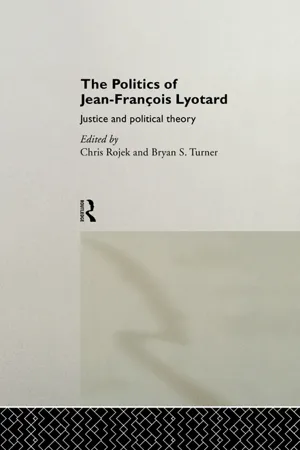
The Politics of Jean-Francois Lyotard
Justice and Political Theory
- 176 pages
- English
- ePUB (mobile friendly)
- Available on iOS & Android
eBook - ePub
The Politics of Jean-Francois Lyotard
Justice and Political Theory
About this book
Jean-Francois Lyotard is still considered to be the father of postmodernism. An international range of contributors in the field of cultural and philosophical studies, including Barry Smart, John O' Neill and Victor J. Seidler consider Lyotard's writings on justice and politics of difference, feminism, youth and Judaism.
Information
1
Lyotard and the Decline of ‘Society’
In reading Lyotard I am often reminded of the plays of Samuel Beckett. Both writers are profoundly interested in the metaphysics of communication; both mistrust organized politics while retaining an insistence on the need to judge what they see around them; and both retain a fierce optimism. We must go on. We can go on. We will go on. The work of each writer insistently calls into question the meaning of the personal pronoun ‘we’. Beckett disrupts it by demonstrating the falsity of the shared meaning that we assume underlies speech and writing. His characters are solipsists speaking into their own hats, their own tape-recorders, with their heads buried up to the neck in sand, never sure if anyone is listening or if anyone cares. For his part, Lyotard (1984a) repudiates ‘master narratives’ and ‘totalizing’ discourse. Yet he still comes down on the side of persistence and involvement as opposed, for example, to disinvolvement or suicide. He (1984a: 65–6) rejects Habermas’s commitment to emancipation on the grounds that it presupposes the possibility of using communication to achieve universal consensus. ‘It is clear’, writes Lyotard ‘that language games are heteromorphous, subject to heterogeneous sets of pragmatic rules’ (1984a: 65). The infinite diversity of human communication cannot be reduced to universal pragmatic rules of conduct. Indeed, one can sum up Lyotard’s main message by saying that he believes that contemporary culture consists of heterogeneous regimens/genres which complicate agreements. It is our lack of awareness or sensitivity to heterogeneous rules that is the root cause of violence and exclusion. Lyotard believes that we have reached a point of exhaustion with the all-embracing humanist solutions proposed by the Enlightenment. No one today accepts Comte’s neat equation of ‘order through progress’. Comte looked forward to the creation of the monotheistic positivist society in which science acts as the authoritative arbiter of human affairs. Against this, Lyotard scorns the ‘performative principles’ of the scientific enterprise and urges us to embrace polytheism. His political philosophy boils down to a form of radical pluralism in which the imperative is to guarantee the ‘narrative space’ to allow individual difference and the play of the différend to flourish. There is no promise of unity in this analysis; and no hint of transcendence. It may be futile to hope for binding life agreements based around universal categories. Even so, it is vital to defend the capacity for self-expression, the determination to survive, the commitment to keep the channels of communication in postmodern society open and the interest in developing the silences of centralized, authoritarian thought.
‘Totality’ and ‘Communication’ in Lyotard
Lyotard’s radical pluralism bluntly implies abandoning the concept of totality. This reflects a more general trend in the study of human life which is embodied in the concept of poststructuralism. It ill behoves us to apply a generic term to cover a variety of thinkers as militantly heterogeneous as Foucault, Derrida, Deleuze, Guattari, Levinas, Virillio, Baudrillard, and Lyotard. The only thing that outwardly unites the arguments of these writers is a belief in the necessity of difference. All the same, it is proper to claim a common chronology for the public recognition of these writers as scourges of structuralism. In intellectual circles they are the spearhead of the post-1968 reaction to the apparent failure of Marxism to achieve working class revolution in France. To the extent that they are part of the same moment their thought shares in common an evident mistrust of universalistic categories.
This moment carried deep implications for sociology, as we are only just starting to realize. Indeed, it hardly stretches the point to submit that the rise of culture and difference as crucial explanatory concepts in analysing human life coincided with the decline in the concept of ‘society’. Lyotard (1984b: 6) dates this crisis to the mid-twentieth century when confidence in reason as a universal category and ‘totalizing unity’ evaporated. Actually, as Frisby and Sayer (1986) make clear, the crisis in the concept of ‘society’ as an explanatory tool in the analysis of human life long predates the middle of the twentieth century. ‘Since 1918’, they write ‘ … though sociology may acknowledge, and study, social problems, society as such is no longer seen as a problem; indeed society as such is rarely glimpsed at all’ (1986: 121). The timing is significant. It coincided with the end of the First World War which was undoubtedly the first catastrophe of nation-centred models of society in the twentieth century. It is also only a year after the death of Emile Durkheim, who in the fin de stècle and the first decades of the new century, was the chief exponent of the proposition that society is sui generis, and is the subject matter of sociology. After 1918 the focus of sociology shifts from analysing society as the paramount ‘social fact’. Instead, the focus in sociological activity moves to social ‘interactions’, ‘representations’ of human life and ‘the intentional conscious orientations of individual actors’. The impressionist, phenomenological and Weberian traditions created influential and viable types of sociology in which the concept of ‘society’ has no significant part to play. Sociology, conclude Frisby and Sayer, can get by perfectly well without ‘society’. Yet as we shall see, it does not follow from this that it has no place for the concept of totality.
This suggests that Lyotard’s position is not as original or momentous as some of his admirers avow (Bennington 1988; Sim 1996). But of course Lyotard is claiming much more than the end of ‘society’ as a meaningful category in human explanation. His work suggests that human communication can no longer be trusted to clarify the human condition. There is no escape from the ‘opacity of language’. ‘Language’, he writes, ‘is not an “instrument of communication,” it is a highly complex archipelago formed of domains of phrases, phrases from such different regimes that one cannot translate a phrase, from one regime (a descriptive, for example) into a phrase from another’ (1993: 27–8). The ineffable has come to play a central part in our notion of the complexity of communication. Habermas (1979) regards language as the primary resource for clarifying and improving the human condition by producing consensus politics. Lyotard rejects this position. Instead, his view of language is that meaning and experience cannot be translated or ultimately pinned down. Hence, it is futile for Habermas to yearn for controlling and improving human affairs because no criteria of judgement exist. Lyotard speaks positively of the state of acting and judging ‘without criteria’. He (1985: 16) calls this state ‘paganism’. He regards it as a condition which fosters genuine critical thought since it is not grounded in foundational presuppositions or theses. Paganism enables the individual to respond to events as they happen, without preconceptions or worries about the ‘correctness’ of responses.
There is a strong note of liberation in Lyotard’s writing about paganism. Indeed his emphasis on pluralism, scepticism about totality, critique of cultural monotheism and doubts about universalism, are consistent with Humean liberalism. It is also present in his discussion of the différend. In a condition in which no criteria obtain, it follows that there is a sense of freedom in recognizing that disputants have no recourse to systems of finite arbitration that will produce rules of judgement. The legitimacy of one side is not affirmed by the attribution of a lack of legitimacy to the other side. To recognize, first, that there are different points of view; and second, that different views are often incommensurable, is to recognize a kind of freedom from what might be termed ‘the gladiatorial paradigm’ which is all too evident in academic and political debate. By the ‘gladiatorial paradigm’ I mean an approach to argumentation which insists that the truth of one position is only confirmed by the annihilation of all competing positions. For example, the argument that market society is superior to planned society often involves the assumption that positive moral and economic values thrive in market forms while defective moral and economic values fructify in planned forms. It is an either/or argument which raises the stock of one system by defining the stock of the system against which it competes as bankrupt. Similar forms of argumentation can be found in conservatism, radical feminism, exchanges between the races, status groups, political parties and classes. The principle of the unutterable nature of human meaning precludes notions of decisive debate resulting in simple solutions.
Although he does not use the term, Lyotard clearly regards the gladiatorial paradigm to be contemptible. He associates it with the domination of the ‘macro’ over the ‘micro’, crudity over complexity and might over virtue. At the same time, his work is so self-consciously set against the value of ‘totalizing concepts’ that it leads him into absurdities. For example, having decided that there are no criteria for judging under paganism, he refuses to abandon judgement as a necessary part of human affairs. Rather lamely he (1985: 6) concludes that, ‘I judge. But if I am asked by what criteria do I judge, I will have no answer to give.’ Increasingly, in his later writings, he advocates a sense of ‘touch’ or ‘svelteness’ as the only rationale to support the judgements that one makes. This is ultimately an appeal to aesthetics which, in psychological terms, Weber (1973) identified as the typical mark of an intellectual who had suffered a crisis of confidence in religious belief. Following Kant, Lyotard means touch to refer to the reception of sensible data. The singularity of these data prevents the individual from supplying a rule or concept to subsume them. Instead the individual is left with a sense of something that cannot yet be phrased. Lyotard’s treatment of touch derives from Kantian philosophy. One problem with extending it to general culture is that touch, in the colloquial sense, is compatible with a variety of unsavoury applications. Racial intolerance, the abuse of women and homophobia, to name but a few examples, can all be ‘supported’ on the basis that they express a sense of ‘touch’ or ‘svelteness’. They remain abhorrent because the sense of ‘touch’ which animates them is abhorrent.
We know that Martin Luther King and the American civil rights movement in the 1950s and 1960s were right to oppose white supremacy. And we know that this was not a question of ‘svelteness’, but measurable criteria of black lives maimed by the shackles of white racism. In short, our judgements are based on shared procedures of argument, common approaches to evidence and acceptance of humane values. Because Lyotard is popularized as a major cultural thinker, many problems ensue from applying his arguments which have been developed at the level of philosophy to everyday life (Sim 1996). The problem is not helped by Lyotard’s insistence that his central arguments have a general application. His ideas on the différend, postmodernity, incommensurability, judgement and paganism have all been presented as clarifying issues in contemporary culture. But not all of his readers carry the philosophical baggage of a training in classical philosophy with them. Popularizing Lyotard is therefore often dangerous.
To be fair, Lyotard’s (1990) splendid rebuttal of the revisionist historians who affirm that the Nazi concentration camps were a myth shows him to be repelled by reactionary manoeuvres. The same repulsion is evident in his denunciation of phallocracy. Lyotard writes:
Women are discovering something that could cause the greatest revolution in the West, something that (masculine) domination has never ceased to stifle: there is no signifier; or else, the class above all classes is just one among many; or again, we Westerners must rework our space-time and all our logic on the basis of non-centralism, non-finality, non-truth.
(1989: 118)
In these, and many other passages, Lyotard provides proof of his repugnance for the logic of the right. Yet the fact remains that the philosophical approach that he has fashioned is compatible with those holding questionable values such as women are inferior to men, whites are superior to non-whites, and that gay and lesbian practice represents a ‘perversion’ of God’s law. In other words, there is a yawning gap between Lyotard’s personal philosophical judgements and his insistence that no valid criteria for judgement exist under paganism. A sympathetic reading of Lyotard may contend that his commitment to judge ‘without criteria’ is simply a slogan. But if that is the case, the slogan does more to confuse than to clarify. The explanation for this apparent inconsistency lies in Lyotard’s break with Marxism.
Lyotard and Marxism
Lyotard was never a naive afficionado of Marxism. In 1958 he was already complaining of ‘a certain kind of patronizing Marxism’ (1993: 199). This was in the context of maintaining that the question of Algerian nationalism could not be neatly reconciled with Marxist categories. In retrospect, many of his contributions to Socialisme ou barbarie in the 1950s and 1960s smack of an insistence on ‘individuality’ and ‘difference’ which now seem out of joint with the revolutionary ‘scientific’ view of the times. In Peregrinations (1988: 63) he condemned the failure of the left to attack and reject the ‘perversions’ which had occurred in Eastern Europe under Stalinism. Even so, until the early 1960s Lyotard clearly believed in the central tenets of Marxist theory and actively worked to promote the working class transformation of society. As with Baudrillard, and many other left wing French intellectuals, the decisive break lies in the revolutionary événements of 1968. ‘Never work!’ declared the slogans of 1968, and for a moment Paris seemed to be the spark to the tinder box that would explode capitalist domination in Western Europe. But the capitulation of the French working class to the offer of higher wages and, by extension, the rule of consumer culture, devalued the promise of ‘fundamental and irreversible’ change contained in the Marxist programme for the transition to communism. Added to this loss of faith in proletarian class action was a sense of profound disillusion with the leaders of the working class and affiliated bourgeois student leaders and their ‘gestures’ towards revolution. May 1968 seemed to confirm the criticism that the ‘Soviet road’ to communism was not a ghastly deviation. Instead, there was something intrinsically wrong with the Marxist analysis of class society.
Lyotard’s transparent bitterness about the failure of the Marxist project is only comprehensible with reference to the avid dreams of completeness that it inspired in him and others of his generation. Marxism was supported as having discovered the fundamental laws of motion that governed capitalist society. While other political and artistic programmes of intervening in society were patently laden with values, Marxism offered the ‘objectivity’ of science. May 1968 provided a practical test for the tenets of Marxist theory and practice. For many of Lyotard’s generation, it failed the test. The revolutionary moment was not seized; the festivities and carnivalesque atmosphere generated by the student and worker sit-ins evaporated; and the rule of commodity culture was eventually, and all too swiftly, restored.
Lyotard fell in with a reaction against Marxist thought which was also pursued by Felix Guattari, Gilles Deleuze and Michel Foucault. The poststructuralist reaction sought to develop new accounts of how power operates and can be subverted. Poststructuralism reconceptualized power as working decisively at a molecular level. The idea of a single contradiction in the economic system was dismissed. Instead, poststructuralists emphasized the diversity and mobility of power relations. The 1968 revolutionary fervour which assumed that the power struggles in the factory would carry over into the university, city halls, offices, schools, amusement arcades, sports grounds and the shopping malls was summarily discarded. What Lyotard later dubbed the ‘archipelago’ of power relations was adopted as the first line of resistance against the juggernaut of structuralist theorizing. Insistence upon the tangible, the small and the concrete became ascendant. To understand why requires an account of the dovetailing of intellectual traditions that became ‘obvious’ after May 1968.
Structuralism had its roots in a linguistic theory which denied a correspondence between words and things. Experience and meaning were theorized as effects of pre-existing structures. For example, in the work of Saussure, meaning is analysed as the consequence of the interplay between binary terms in the linguistic system as opposed to a ‘real world’ which exists independently of language. This compromised the voluntarism of the human subject. Classical political economy had perceived the human subject as an independent agent imposing volition upon the world. Structuralism reformulated the concept of the human subject as constituted through language. The idea of ‘getting beyond’ the system of signs through revolutionary action was dealt a fatal blow in this strain of argument. Instead, theory and research were turned to the question of the play of signs through which the subject is constituted.
For all that, structuralism, which initially captivated the post-68 Lyotard, was open to serious reservations. Most prominently, by appealing to the significance of pre-existing social and linguistic categories it was unable to explain or predict change. Lyotard must have relished the paradox: structuralism was able to explain why the revolutionary ‘moment’ of 1968 was bound to pass, but it failed utterly to anticipate the train of events leading to revolutionary destabilization. For Lyotard, and others of his generation, the missing link was supplied through the rediscovery of Nietzsche. Nietzsche’s preoccupation with movement, becoming, difference, chance, chaos and the irrational seemed to shed contrasting and penetrating light upon the failures of May 1968. Nietzsche’s own epistemology and language theory provided a powerful attack on Truth and Beauty, and hence on the validity of grand narratives. Most obviously it represented an alternative to the certainties that Marxism had expressed in cha...
Table of contents
- Cover
- Half Title
- Title Page
- Copyright
- Contents
- List of contributors
- Introduction: Judging Lyotard
- 1. Lyotard and the decline of ‘society’
- 2. Forgetfulness and frailty: Otherness and rights in contemporary social theory
- 3. The politics of difference and the problem of justice
- 4. Saying goodbye to emancipation? Where Lyotard leaves feminism, and where feminists leave Lyotard
- 5. Narrative, knowledge and art: On Lyotard’s Jewishness
- 6. Identity, memory and difference: Lyotard and ‘the jews’
- 7. Lost in the post: (post)modernity explained to youth
- 8. Lyotard’s early writings: 1954–1963
- Index
Trusted by 375,005 students
Access to over 1.5 million titles for a fair monthly price.
Study more efficiently using our study tools.
Frequently asked questions
Yes, you can cancel anytime from the Subscription tab in your account settings on the Perlego website. Your subscription will stay active until the end of your current billing period. Learn how to cancel your subscription
No, books cannot be downloaded as external files, such as PDFs, for use outside of Perlego. However, you can download books within the Perlego app for offline reading on mobile or tablet. Learn how to download books offline
Perlego offers two plans: Essential and Complete
- Essential is ideal for learners and professionals who enjoy exploring a wide range of subjects. Access the Essential Library with 800,000+ trusted titles and best-sellers across business, personal growth, and the humanities. Includes unlimited reading time and Standard Read Aloud voice.
- Complete: Perfect for advanced learners and researchers needing full, unrestricted access. Unlock 1.5M+ books across hundreds of subjects, including academic and specialized titles. The Complete Plan also includes advanced features like Premium Read Aloud and Research Assistant.
We are an online textbook subscription service, where you can get access to an entire online library for less than the price of a single book per month. With over 1.5 million books across 990+ topics, we’ve got you covered! Learn about our mission
Look out for the read-aloud symbol on your next book to see if you can listen to it. The read-aloud tool reads text aloud for you, highlighting the text as it is being read. You can pause it, speed it up and slow it down. Learn more about Read Aloud
Yes! You can use the Perlego app on both iOS and Android devices to read anytime, anywhere — even offline. Perfect for commutes or when you’re on the go.
Please note we cannot support devices running on iOS 13 and Android 7 or earlier. Learn more about using the app
Please note we cannot support devices running on iOS 13 and Android 7 or earlier. Learn more about using the app
Yes, you can access The Politics of Jean-Francois Lyotard by Chris Rojek,Mr Bryan S Turner,Bryan Turner in PDF and/or ePUB format, as well as other popular books in Social Sciences & Sociology. We have over 1.5 million books available in our catalogue for you to explore.