The Critical Heritage gathers together a large body of critical sources on major figures in literature. Each volume presents contemporary responses to a writer's work, enabling student and researcher to read the material themselves.
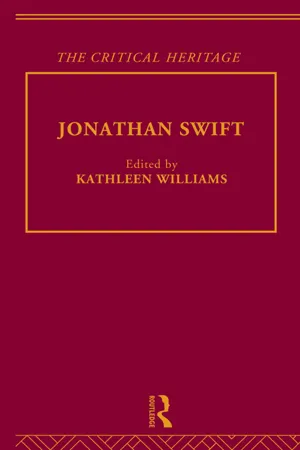
- 360 pages
- English
- ePUB (mobile friendly)
- Available on iOS & Android
eBook - ePub
About this book
Information
1. Dr. William King on A Tale of a Tub
1704
‘Some Remarks on A Tale of a Tub’, The Original Works in Verse and Prose of Dr. William King (3 vols), 177 6, i, 213–18.
Dr. William King (1663–1712) was an advocate at Doctors’ Commons and a writer of some wit and skill. Like Swift, he was an enemy of Richard Bentley, one of the butts in The Battle of the Books, and he and Swift were later on good terms. In this squib, however, he writes as a collector of night-soil who finds the Tale too dirty even for him.
It may lie in the power of the meanest person to do a service or a disservice to the greatest, according as his inclination or his due respect may lead him; which is the true occasion of my writing you this Letter, to shew you that a person in the lowest circumstances in the world may still have a concern to do good; as I hope it is yours to do so to every body else. Although I believe you know not me; yet I have known you from a child, and am certain you cannot forget Mr. Seyley the chimney-sweeper; any more than you can your neighbour the small-coalman at Clerkenwell, at whose musick-meeting I have often performed a part in your hearing, and have seen you several times at the auction of his Books, which were a curiosity that I could have wished you had been able to have purchased.
I own that I am a person, as far as my capacity and other circumstances will give me leave, desirous of my own improvement and knowledge, and therefore look into all Books that may contribute towards them. It is natural for every person to look after things in their own way.…
Now, Sir, I must own, that it has been my fortune to find very few that tend any way to my own employment; I have not been able to meet with Tartaretus, a Book mentioned by Dr. Eachard; nor with several Authors quoted by Mr. Harrington; that great commonwealth’s man, in his incomparable treatise of The Metamorphosis of A-Jax.
But at last it happened that, as I was returning from my nightly vocation, which, beginning between eleven and twelve in the evening, generally employs me till the dawn of the succeeding morning; and being melancholy that I had not found so much gold that night as I might be supposed to have done either by my wife or my neighbours; I saw a fellow pasting up the title-pages of Books at the corners of the streets; and there, among others, I saw one called A Tale of a Tub, which imagining to be a satire upon my profession, I ordered one of my myrmidons to attack the fellow, and not to box him, but give him two or three gentle strokes over the nostrils; till at last the fellow, being of a ready wit, as having to do with all sorts of Authors, promised to go to Mr. Nutt’s for one of the copies; and that, if he did not convince me that it was a more scandalous libel upon the Author of that foolish Tale, than it could be upon anyone else, he would engage that I should set him astride upon one of my barrels, whenever I should meet him publishing any thing printed for the same Stationer.
Sir, pardon me, if I fancy you may, by what I have said, guess at my profession: but I desire you not to fear, for I declare to you that I affect cleanliness to a nicety. I mix my ink with rose or orange-flower-water, my scrutoire is of cedar-wood, my wax is scented, and my paper lies amongst sweet bags. In short, I will use you with a thousand times more respect than the Bookseller of A Tale of a Tub does a noble Peer, under the pretence of a Dedication; or than the Author does his Readers.
It was not five o’clock when I had performed a severe penance; for I had read over a piece of nonsense, inscribed ‘To his Royal Highness Prince Posterity’; where there is so considerable an aim at nothing, and such an accomplishment of that design, that I have not in my library met any thing that equals it. I never gave over till I had read his Tale, his Battle, and his Fragment: I shall speak of the series and style of these three treaties hereafter. But the first remarkable story that I found was that, about the twenty-second page, concerning a fat fellow crowding to see a Mountebank. I expected to have found something witty at the end: but it was all of a piece; so stuffed with curses, oaths, and imprecations, that the most profligate criminal in New-prison would be ashamed to repeat it.
I must take notice of one other particular piece of nonsense, and no more; where he says, ‘That the ladder is an adequate symbol of faction and of poetry. Of faction, because … Hiatus in MS. … Of poetry, because its orators do perorare with a song.’ The true reasons why I do not descend to more particulars is, because I think the three treatises (which, by their harmony in dirt, may be concluded to belong to one Author) may be reduced to a very small compass, if the common-places following were but left out. But the Author’s first aim is, to be profane; but that part I shall leave to my betters, since matters of such a nature are not to be jested with, but to be punished.
The second is, to shew how great a proficient he is, at hectoring and bullying, at ranting and roaring, and especially at cursing and swearing. He makes his persons of all characters full of their oaths and imprecations; nay, his very spider has his share, and, as far as in the Author lies, he would transmit his impiety to things that are irrational.
His third is, to exceed all bounds of modesty. Men who are obliged by necessity to make use of uncommon expressions, yet have an art of making all appear decent; but this Author, on the other side, endeavours to heighten the worst colours, and to that end he searches his ancient Authors for their lewdest images, which he manages so as to make even impudence itself to blush at them.
His next is, a great affectation for everything that is nasty. When he spies any object that another person would avoid looking on, that he embraces. He takes the air upon dung-hills, in ditches, and common-shoars, and at my Lord Mayor’s dog-kennel. In short, almost every part has a tincture of such filthiness, as renders it unfit for the worst of uses.
By the first of these, he shews his religion by the second, his cornersation; by the third, his manners; and by the fourth, his education.
Now were the Crow, who at present struts so much in the gutter, stripped of these four sorts of feathers, he would be left quite naked: he would have scarce one story, one jest, one allusion, one simile, or one quotation. And I do assure Mr. Nutt, that, if he should employ me in my own calling; I would bargain not to foul my utensils with carrying away the Works of this Author. Such were my sentiments upon reading these pieces; when, knowing that no sponge or fair water will clean a Book, when foul ink and fouler notions have sullied the paper, I looked upon the fire as the properest place for its purgation, in which it took no long time to expire.
Now, Sir, you may wonder how you may be concerned in this long story; and why I apply myself to you, in declaring my sentiments of this Author. But I shall shew you my reason for it, before I conclude this my too tedious epistle.
Now, Sir, in the dearth of wit that is at present in the town, all people are apt to catch at any thing that may afford them any diversion; and what they cannot find, they make: and so this Author was bought up by all sorts of people, and every one was willing to make sense of that which had none in it originally. It was sold, not only at court, but in the city and suburbs; but, after some time, it came to have its due value put upon it: the Brewer, the Soap-boiler, the Train-oil-man, were all affronted at it; and it afforded a long dispute at our Coffeehouse over the Gate, who might be the Author.
A certain Gentleman, that is the nearest to you of any person, was mentioned, upon supposition that the Book had Wit and Learning in it. But, when I displayed it in its proper colours, I must do the company that justice, that there was not one but acquitted you. That matter being dispatched, every one was at liberty of guessing. One said, he believed it was a Journey-man-taylor in Billeter-lane, that was an idle sort of a fellow, and loved writing more than stitching, that was the Author; his reason was, ‘because here he is so desirous to mention “his Goose and his Garret’”: but it was answered, ‘that he was a member of the Society’; and so he was excused. ‘But why then,’ says another, ‘since he makes such a parable upon coats, may he not be Mr. Amy the Coat-seller, who is a Poet and a Wit?’ To which it was replied, ‘That that gentleman’s loss had been bewailed in an Elegy some years ago.’–‘Why may not it be Mr. Gumly the Rag-woman’s husband in Turnball-street?’ says another. ‘He is kept by her; and, having little to do, and having an Officer in Monmouth’s Army, since the defeat at Sedgemore, has always been a violent Tory.’ But it was urged ‘that his style was harsh, rough, and unpolished; and that he did not understand one word of Latin.’—‘Why then,’ cries another, ‘Oliver’s porter1 had an Amanuensis at Bedlam, that used to transcribe what he dictated: and may not these be some scattered notes of his Master’s?’ To which all replied, ‘that, though Oliver’s porter was crazed, yet his misfortune never let him forget that he was a Christian.’ One said, ‘It was a Surgeon’s man, that had married a Midwife’s nurse’: but, though by the style it might seem probable that two such persons had a hand in it; yet, since he could not name the persons, his fancy was rejected. ‘I conjecture,’ says another, ‘that it may be a Lawyer, that—’ When, on a sudden, he was interrupted by Mr. Markland, the Scrivener, ‘No, rather, by the oaths, it should be an Irish evidence.’ At last there stood up a sprant young man, that is Secretary to our Scavenger, and cries, ‘What if after all it should be a Parson!1 for who may make more free with their trade? What if I know him, describe him, name him, and how he and his friends talk of it, admire it, are proud of it.’—‘Hold, cry all the company; that function must not be mentioned without respect. We have enough of the dirty subject; we had better drink our coffee, and talk our politicks.’
I doubt not, Sir, but you wish the discourse had broke off sooner. Pardon it; for it means well to you, however exprest: for I am to my utmost, &c.
1 This man, whose christian naine was Daniel, learned much of the cant that prevailed in his master’s time. He was a great plodder in books of divinity, especially in those of the mystical kind, which are supposed to have turned his brain. He was many years in Bedlam, where his library was, after some time, allowed him; as there was not the least probability of his cure. The most conspicuous of his books was a bible given him by Nell Gwynn. He frequently preached, and sometimes prophesied; and was said to have foretold several remarkable events, particularly the fire of London. See Lesley’s Snake in the Grass, p. 33o; where we learn, that people went often to hear him preach, ‘and would sit many hours under his window with great devotion’. Mr. Lesley had the curiosity to ask a grave matron, who was among his auditors, ‘what she could profit by hearing that madman?’ She, with a composed countenance, as pitying his ignorance, replied, ‘That Festus thought Paul was mad!’ Granger, IV. 210. [King’s note.]
1 The Clergyman here alluded to is not the real Author, who was not at the time suspected, but Mr. Thomas Swift, rector of Puttenham in Surrey, whom the Dean, XVI, 2, calls his ‘parson cousin’, and who appears to have taken some pains to be considered as the author of the Tale of a Tub. See XVII, 528. [King’s note.]
2. Francis Atterbury on A Tale of a Tub
1704
The Epistolary Correspondence, Visitation Charges, Speeches, and Miscellanies of the Right Reverend Francis Atterbury, D.D., Lord Bishop of Rochester(vols), 1784, iii.
Atterbury (1662–1732) was made Dean of Carlisle in 1704 and Bishop of Rochester in 1713. All three of the letters quoted here are addressed to his close friend, Sir Jonathan Trelawny, Bishop of Exeter and later of Winchester. His fragmentary remarks on the then anonymous Tale seem especially significant, for here a prominent member of the religious and political ‘establishment’ is less concerned about the work’s ‘prophaneness’ and more sensitive to its wit and learning than many critics outside the clergy. In later years Atterbury and Swift became good friends and frequent correspondents.
15 June 1704
I beg your Lordship (if the book is come down to Exon) to read the Tale of a Tub. For, bating the profaneness of it in some places, it is a book to be valued, being an original in it’s kind, full of wit, humour, good sense, and learning. It comes from Christ Church; and a good part of it is written in defence of Mr. Boyle against Wotton and Bentley. The town is wonderfully pleased with it [203].
29 June 1704
The authors of A Tale of a Tub are now supposed generally at Oxford to be one Smith, and one Philips; the first a Student, the second a Commoner, of Christ-Church [254].
1 July 5704
The author ofA Tale of a Tub will not as yet be known; and if it be the man I guess, he hath reason to conceal himself, because of the prophane strokes in that piece, which would do his reputation and interest in the world more harm than the wit can do him good … Nothing can please more than that book doth here at London [218].
3. William Wotton on A Tale of a Tub
1705
A Defense of the Reflections upon Ancient and Modern Learning, In Answer to the Objections of Sir W. Temple, and Others. With Observations upon The Tale of a Tub, printed in A Tale of a Tub, ed. A. C. Guthkelch and D. Nicol Smith, 1920, 314–23.
William Wotton (1666–1727) is, naturally, ill disposed to A Tale of a Tub, since he and Dr. Bentley had both been ridiculed in The Battle of the Books, published with the Tale. Both had been involved in the dispute with Sir William Temple and others over the relative merits of ancient and modern learning, which had occasioned the Battle, and the Tale, too, may be regarded as an anti-modern work.
This way of printing Bits of Books that in their Nature are intended for Continued Discourses, and are not loose Apophthegems, Occasional Thoughts, or incoherent Sentences, is what I have seen few Instances of; none more remarkable than this, and one more which may be supposed to imitate this, A Tale of a Tub, of which a Brother of Dr. Swift’s is publicly reported to have been the Editor at least, if not the Author. In which Dr. Bentley and my self are coursely treated, yet I believe I may safely answer for us both, that we should not have taken any manner of notice of it, if upon this Occasion I had not been obliged to say something in answer to what has been seriously said against us.
For, believe me, Sir, what concerns us, is much the innocentest part of the Book, tending chiefly to make Men laugh for hal...
Table of contents
- Cover
- Halftitle
- Title
- Copyright
- Contents
- Introduction
- Note on the Text
- 1. Dr. William King on A Tale of a Tub: 1704
- 2. Francis Atterbury on A Tale of a Tub: 1704
- 3. William Wotton on A Tale of a Tub: 1705
- 4. Richard Steele on A Project for the Advancement of Religion: 1709
- 5. John Dennis on the Examiner: 1712
- 6. The aim of A Tale of a Tub: 1714
- 7. Sir Richard Blackmore on A Tale of a Tub: 1716
- 8. A translator’s opinions of A Tale of a Tub: 1721
- 9. A Swiss view of A Tale of a Tub and The Battle of the Books: 1721
- 10. The reception of Gulliver’s Travels: 1726
- 11. Lady Mary Wortley Montagu on Gulliver’s Travels: 1726
- 12. An anonymous opinion of Gulliver’s Travels: 1726
- 13. William Warburton on Swift and human nature: 1727
- 14. Voltaire on Swift: 1727, 1734, 1756, 1767, 1777
- 15. Abbé Desfontaines and Gulliver’s Travels: 1727, 1730, 1787
- 16. Jonathan Smedley on Gulliver’s Travels: 1728
- 17. Swift as political dictator: 1728
- 18. Anonymous criticisms of Houyhnhnmland: 1735
- 19. George Faulkner on Swift’s poetry: 1735
- 20. The Duchess of Marlborough on Swift: 1736
- 21. François Cartaud de la Villate on A Tale of a Tub: 1736
- 22. Samuel Richardson on Swift: 1740,1748,1752,1754
- 23. Paradis de Moncrif on Gulliver’s Travels: 1743
- 24. Henry Fielding on Swift: 1745, 1751,1752
- 25. David Hume on Swift: 1751,1752,1768
- 26. Lord Orrery on Swift: 1752
- 27. Patrick Delany on Swift: 1754
- 28. Deane Swift on Gulliver’s Travels and on Swift as a poet: 1755
- 29. John Hawkesworth on Swift: 1755
- 30. W. H. Dilworth on Swift: 1758
- 31. Edward Young on Gulliver’s Travels: 1759
- 32. George Lord Lyttelton on Swift: 1760
- 33. A French reissue of Gulliver’s Travels: 1762
- 34. Oliver Goldsmith on Swift: 1764
- 35. Ralph Griffiths on Swift’s ‘Cause’: 1765
- 36. Horace Walpole and his circle on Swift: 1771, 1780
- 37. Lord Monboddo on Gulliver’s Travels: 1776
- 38. James Beattie on Gulliver’s Travels, A Tale of a Tub, and The Day of Judgment: 1776, 1783
- 39. A French comment on A Modest Proposal: 1777
- 40. Dr. Johnson on Swift: 1779, 1785, 1791
- 41. Samuel Badcock on Swift’s ‘true wit’: 1779
- 42. James Harris on Gulliver’s Travels: 1781
- 43. Joseph Warton on Swift’s descriptions: 1782
- 44. Swift’s characteristics as a writer: 1782
- 45. Hugh Blair on Swift’s style: 1783
- 46. Thomas Sheridan on Swift: 1784
- 47. Incidental comments on Gulliver’s Travels: 1789
- 48. George-Monck Berkeley on Swift: 1789
- 49. Thomas Ogle on Swift and misanthropy: 1790
- 50. Swift as satirist and poet: 1790
- 51. William Godwin on Swift’s style: 1797
- 52. John Nichols on Swift: 1801, 1828
- 53. Alexander Chalmers on Swift’s style and character: 1803
- 54. Swiftiana: 1804
- 55. John Aikin on Swift’s poetry: 1804, 1820
- 56. Richard Payne Knight on the plausibility of Gulliver’s Travels: 1805
- 57. Nathan Drake on Swift: 1805
- 58. John Dunlop on the background of Gulliver’s Travels: 1814
- 59. Sir Walter Scott on Swift: 1814
- 60. Francis Jeffrey on Swift: 1816
- 61. William Hazlitt on Swift: 1818
- 62. Coleridge on Swift: 1818, 1825, 1830
- 63. William Monck Mason on Gulliver’s Travels and A Modest Proposal: 1819
- Bibliography
- Index
Trusted by 375,005 students
Access to over 1.5 million titles for a fair monthly price.
Study more efficiently using our study tools.
Frequently asked questions
Yes, you can cancel anytime from the Subscription tab in your account settings on the Perlego website. Your subscription will stay active until the end of your current billing period. Learn how to cancel your subscription
No, books cannot be downloaded as external files, such as PDFs, for use outside of Perlego. However, you can download books within the Perlego app for offline reading on mobile or tablet. Learn how to download books offline
Perlego offers two plans: Essential and Complete
- Essential is ideal for learners and professionals who enjoy exploring a wide range of subjects. Access the Essential Library with 800,000+ trusted titles and best-sellers across business, personal growth, and the humanities. Includes unlimited reading time and Standard Read Aloud voice.
- Complete: Perfect for advanced learners and researchers needing full, unrestricted access. Unlock 1.5M+ books across hundreds of subjects, including academic and specialized titles. The Complete Plan also includes advanced features like Premium Read Aloud and Research Assistant.
We are an online textbook subscription service, where you can get access to an entire online library for less than the price of a single book per month. With over 1.5 million books across 990+ topics, we’ve got you covered! Learn about our mission
Look out for the read-aloud symbol on your next book to see if you can listen to it. The read-aloud tool reads text aloud for you, highlighting the text as it is being read. You can pause it, speed it up and slow it down. Learn more about Read Aloud
Yes! You can use the Perlego app on both iOS and Android devices to read anytime, anywhere — even offline. Perfect for commutes or when you’re on the go.
Please note we cannot support devices running on iOS 13 and Android 7 or earlier. Learn more about using the app
Please note we cannot support devices running on iOS 13 and Android 7 or earlier. Learn more about using the app
Yes, you can access Jonathan Swift by Kathleen Williams in PDF and/or ePUB format, as well as other popular books in Literature & Literary Criticism. We have over 1.5 million books available in our catalogue for you to explore.