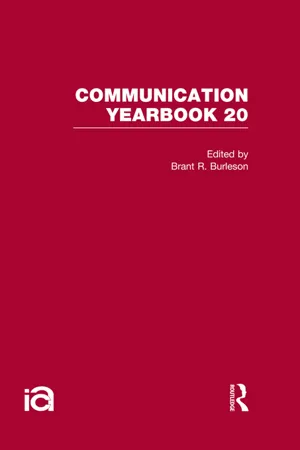
Communication Yearbook 20, originally published in 1997 contains ten major reviews that collectively span the discipline. Two of the reviews examine how consumption of television programs affects viewers. Other media-related chapters examine sex-role stereotyping in advertising, the role of the public relations professional in the production of the news, and the nature and effects of public opinion. This collection also includes review articles addressing attitude change and persuasion, participation in decision-making groups, social anxiety, the development of social competence in childhood and cross-sex friendships across the lifespan. The chapters in this volume present summaries of relevant findings as well as penetrating discussions of theories, methods, problems and directions for future research.
- 484 pages
- English
- ePUB (mobile friendly)
- Available on iOS & Android
eBook - ePub
Communication Yearbook 20
About this book
Information
1 Two Decades of Cultivation Research: An Appraisal and Meta-Analysis
This chapter presents a theoretical review and meta-analysis of cultivation research. The authors examine the roots of cultivation analysis, as developed by George Gerbner and colleagues, and review the progress made in cultivation research since its inception in the 1970s. They also review some of the critiques that have been made of cultivation theory over the years and provide their own critical review and responses. They then offer a meta-analysis of empirical findings from 20 years of cultivation research. This meta-analysis shows an average cultivation effect of .09. Much, but not all, of the variation in cultivation findings reported in the literature can be attributed to sampling error alone. Yet, although the authors tested a variety of hypothetical moderator variables, they found no specific moderator variables. The analysis suggests that many theoretical arguments tend to fade into the background when the corpus of cultivation findings is viewed from a meta-analytic perspective.
CULTIVATION analysis, pioneered by George Gerbner, is a well-known research paradigm for thinking about and studying the impacts of mass communication (Gerbner, 1973). Cultivation research examines the extent to which cumulative exposure to television contributes to viewers’ conceptions of social reality, in ways that reflect the most stable, repetitive, and pervasive patterns of images and ideologies that television (especially entertainment programming) presents (Morgan & Signorielli, 1990). Cultivation research is concerned with what it means to grow up and live in a symbolic environment where television tells most of the stories to most of the people, most of the time (Gerbner, Gross, Morgan, & Signorielli, 1994).
It has been about 20 years since the first cultivation findings were published (Gerbner & Gross, 1976). Since that time, many studies have explored, enhanced, critiqued, dismissed, or defended the conceptual assumptions and methodological procedures of cultivation analysis. In 1986, Bryant noted that cultivation was one of only three topics covered in more than half of the “mass media and society” courses offered at U.S. colleges and universities. He even quipped that studies of cultivation seem “almost as ubiquitous as television itself” (p. 231).
Although cultivation analysis was once closely identified with the issue of violence, over the years researchers have looked at a broad range of topics, including sex roles, aging, political orientations, environmental attitudes, science, health, religion, minorities, and occupations. Replications have been carried out in Argentina, Australia, Brazil, Canada, China, England, Hungary, Israel, the Netherlands, Russia, South Korea, Sweden, Taiwan, and other countries.
The results of these studies have been many, varied, and sometimes counterintuitive. Although there is some disagreement in the field of communication regarding the validity of cultivation findings, cultivation theory is arguably among the most important contributions yet made to general public understanding of media effects. Certainly, it is among the few approaches that have contributed to the public policy debate surrounding the impacts of television. As Newhagen and Lewenstein (1992) put it, “Despite criticism, the theory persists, perhaps because the social implications of the idea that a mass medium can define our culture [are] too important to dismiss” (p. 49).
Cultivation has indeed been a highly controversial approach. Although some detailed reviews have appeared (Hawkins & Pingree, 1982; Potter, 1993), no one has yet attempted to undertake a systematic, empirical assessment of what has grown into a massive body of research. In order to advance the debate, we offer here both a theoretical appraisal and a meta-analysis of the published cultivation literature.
Meta-analysis—“the statistical integration of the results of independent studies” (Mullen, 1989, p. 1)—is becoming increasingly important in the reanalysis of communication findings (Allen, Emmers, Gebhardt, & Giery, 1995; Herrett-Skjellum & Allen, 1996; Kim & Hunter, 1993). Meta-analysis has an advantage over the traditional narrative review: It provides an estimate of how much of the variation in results observed across studies simply reflects sampling error (Hunter & Schmidt, 1990). That is, we can see how much of the difference in reported cultivation findings is “real” after the variation due to sampling error is accounted for. If any “real” variation is left, we can then determine if results vary across different types of samples, different dependent areas, different analytic strategies, and so on.
Accordingly, we used the technique of meta-analysis to guide us through this assessment of cultivation theory and findings. Taken together, reanalysis of theory and criticism and meta-analysis of data provide a unique way to look at the accomplishments of cultivation research in its first 20 years.
Theoretical Review
Cultural Indicators
Cultivation analysis is one component of the long-term, ongoing research program called Cultural Indicators. The concept of a cultural “indicator” was developed to complement economic and social indicators, and to provide a barometer of important cultural issues. In the United States, the focus has been on television, because TV is the country’s most pervasive cultural institution and most visible disseminator of cultural symbols. Other media, however, can be studied as indicators of cultural patterns and trends (Rosengren, 1984).
As conceived by Gerbner (1969), Cultural Indicators uses a three-pronged research strategy. The first, called institutional process analysis, investigates the systemic pressures and constraints that affect how media messages are selected, produced, and distributed. The second, called message system analysis, quantifies and tracks the most stable, pervasive, and recurrent images in media content, in terms of the portrayal of violence, minorities, gender roles, occupations, and many other issues. The third, called cultivation analysis, explores the extent to which television viewing contributes to audience members’ conceptions about the real world.
Cultural Indicators research began with a profile of television violence in the 1967-1968 program season for the National Commission on the Causes and Prevention of Violence, and continued with support from the Surgeon General’s Advisory Committee on Television and Social Behavior in 1972. The cultivation analysis phase began with a national probability survey of adults during the early 1970s in a study funded by the National Institute of Mental Health (Gerbner & Gross, 1976). Many other agencies and foundations have supported the project over the years.
Each year since 1967, researchers have content analyzed a week-long sample of U.S. network television drama in order to delineate selected features and trends in the overall world that television presents to its viewers. In the 1990s, this analysis has been extended to include the Fox television network, “reality” programs, and various cable channels. Through the years, message system analysis has focused on the most pervasive content patterns that are common to many different types of programs but characteristic of the system as a whole, because these hold the most significant potential lessons that television cultivates. The specific questions used in cultivation analysis should be based on the overarching content patterns revealed by message system analysis, although this has not been the case in all studies.
The Development of Cultivation Theory
It is difficult to discuss cultivation theory without giving a sense of the controversy that has developed around the research. The theoretical roots of cultivation theory have at times been obscured in a thicket of debate and colloquy, charges and countercharges, attack and retort. This has been manifested in an ever-widening spiral of conceptual and analytic refinements from many quarters, as well as in some hearty doses of atheoretical tinkering. From our perspective, over the years, researchers have too often oversimplified the notion of cultivation and yet have both complicated and distorted its methodology. In the final analysis, of course, science is about debate, and we argue here that 20 years of progress and contention in research now give us an ideal perspective from which we may make some larger claims.
Gerbner’s original conception of cultivation was a break from conventional academic discourse about the social and cultural implications of mass communication. His goal was to develop an approach to mass communication distinct from the then-dominant paradigm of persuasion and propaganda research and to escape the scientism and positivism of the “effects” tradition. This meant dispensing with formal aesthetic categories and conventional concerns about style and artistic quality, along with questions of high culture versus low culture, selective exposure, and idiosyncratic readings and interpretations. It was not that Gerbner denied the existence or importance of these concerns and phenomena, but rather that he sought to go beyond them.
This required a reworking of the traditional methodological tactics that had been used to assess “effects.” In general, early mass communication research focused on prediction and control, with a clear-cut criterion for an effect: some change in attitude or behavior following exposure to some message. Gerbner’s early writings critiqued this, as he developed models of the communication process that distinguished it from purely persuasive exchanges (see, e.g., Gerbner, 1958). Rather than seeing communication research as a way to achieve a specific practical aim (e.g., selling soap, winning votes, improving public health), he saw it as a basic cultural inquiry. Above and beyond its communicative “power,” he argued, any message is a socially and historically determined expression of concrete physical and social relationships. Messages imply propositions, assumptions, and points of view that are understandable only in terms of the social relationships and contexts in which they are produced. Yet they also reconstitute those relationships and contexts. Messages thus sustain the structures and practices that produce them.
Communication, according to Gerbner, is “interaction through messages,” a distinctly human (and humanizing) process that both creates and is driven by the symbolic environment that constitutes culture. The symbolic environment reveals social and institutional dynamics, and because it expresses social patterns it also cultivates them. This, then, is the original meaning ofcultivation—the process within which interaction through messages shapes and sustains the terms on which the messages are premised.
Mass communication—the mass production of the symbolic environment—implies cultural and political power: the power to create the messages that cultivate collective consciousness. But this is a two-sided process: The right to produce messages stems from social power, but social power can be accrued through the right to produce messages. This confounds simplistic notions of “causality” and is a significant reason many “causal” critiques of cultivation have missed the point.
Cultivation is, most of all, about the cultural process of storytelling. Gerbner often quotes Scottish patriot Andrew Fletcher’s observation, “If a man were permitted to make all the ballads, he need not care who should make the laws of a nation.” That is, it matters crucially who gets to tell the stories, and whose stories do not get told.
Much of what we know and think we know comes not from personal experience but from the stories we hear. In earlier times, the stories of a culture were generally told face-to-face by members of a community, parents, teachers, or the church. Today, storytelling is in the hands of global commercial interests that in effect operate outside the reach of democratic decision making. The great cultural stories of mythology, religion, legends, education, art, science, laws, fairy tales, and politics are increasingly packaged and disseminated by television. The narrative world we are inhabiting and (recreating is one designed according to marketing strategies.
The impacts of stories are not hypodermic. Uncovering aggregate and implicit patterns in mass-produced messages “will not necessarily tell us what people think or do. But [it] will tell us what most people think or do something about and in common” (Gerbner, 1970). The messages set the hidden but pervasive boundary conditions for social discourse, wherein cultural ground rules for what exists, what is important, what is right, and so on, are repeated (and ritualistically consumed) so often that they become invisible. The model for cultivation is “enculturation,” not persuasion.
Therefore, “cultivation is what a culture does,” because “culture is the basic medium in which humans live and learn” (Gerbner, 1990, p. 249). Culture is a “system of stories and other artifacts—increasingly mass-produced—that mediates between existence and consciousness of existence, and thereby contributes to both” (p. 251). As our most pervasive and widely shared storyteller, television is likely to play a crucial role in the cultivation of common beliefs, values, and ideologies.
Cultivation Assumptions
Early research on media effects typically focused on the impacts of single programs or messages in the short term, usually based on experimental designs. The novelty of the cultivation approach was that it put aside the question of effects at the program level and concentrated on the level of the story system. The emphasis on overall exposure to television, regardless of genre, channel, or program type, is what is most unusual and important about cultivation analysis. It has also perhaps been its most nagging and persistent point of contention among critics.
It is not that cultivation theory simplistically asserts that “all programs contain exactly the same messages,” although that is a straw argument sometimes attacked. Cultivation theory does not deny that programs differ, that viewing can be selective, that variations in channels and genres exist, or that any of these are important. It just sees these as separate issues, as separate research questions, distinct from the questions explored through cultivation analysis.
Focusing primarily on selectivity and diversity (values privileged by the pluralist ideology of print culture) can blind us to subtle commonalities underlying superficially different program types. To focus only on specific types of programs is to risk losing sight of what is most significant about television as a system of messages. Whatever impacts specific programs may have are not meaningless, but they are analytically distinct from the consequences of cumulative exposure to the total world of television.
There may well be some “heavy viewers” who watch nothing but shopping channels, travel documentaries, golf tournaments, or weather forecasts (and this sort of viewing is now possible), but cultivation theory assumes that most regular and heavy viewers will, over time, watch...
Table of contents
- Cover
- Half Title
- Title Page
- Copyright
- Contents
- Editor’s Introduction
- 1. Two Decades of Cultivation Research: An Appraisal and Meta-Analysis
- 2. The Impact of Foreign TV on a Domestic Audience: A Meta-Analysis
- 3. Selling the Sex That Sells: Mapping the Evolution of Gender Advertising Research Across Three Decades
- 4. Public Relations and the Production of News: A Critical Review and Theoretical Framework
- 5. Public Opinion as a Normative Opinion Process
- 6. Attitude Accessibility and Persuasion: Review and a Transactive Model
- 7. Participation in Small Groups
- 8. Social and Communicative Anxiety: A Review and Meta-Analysis
- 9. The Development of Social and Communicative Competence in Childhood: Review and a Model of Personal, Familial, and Extrafamilial Processes
- 10. Communication and Cross-Sex Friendships Across the Life Cycle: A Review of the Literature
- Author Index
- Subject Index
- About the Editor
- About the Authors
Trusted by 375,005 students
Access to over 1.5 million titles for a fair monthly price.
Study more efficiently using our study tools.
Frequently asked questions
Yes, you can cancel anytime from the Subscription tab in your account settings on the Perlego website. Your subscription will stay active until the end of your current billing period. Learn how to cancel your subscription
No, books cannot be downloaded as external files, such as PDFs, for use outside of Perlego. However, you can download books within the Perlego app for offline reading on mobile or tablet. Learn how to download books offline
Perlego offers two plans: Essential and Complete
- Essential is ideal for learners and professionals who enjoy exploring a wide range of subjects. Access the Essential Library with 800,000+ trusted titles and best-sellers across business, personal growth, and the humanities. Includes unlimited reading time and Standard Read Aloud voice.
- Complete: Perfect for advanced learners and researchers needing full, unrestricted access. Unlock 1.5M+ books across hundreds of subjects, including academic and specialized titles. The Complete Plan also includes advanced features like Premium Read Aloud and Research Assistant.
We are an online textbook subscription service, where you can get access to an entire online library for less than the price of a single book per month. With over 1.5 million books across 990+ topics, we’ve got you covered! Learn about our mission
Look out for the read-aloud symbol on your next book to see if you can listen to it. The read-aloud tool reads text aloud for you, highlighting the text as it is being read. You can pause it, speed it up and slow it down. Learn more about Read Aloud
Yes! You can use the Perlego app on both iOS and Android devices to read anytime, anywhere — even offline. Perfect for commutes or when you’re on the go.
Please note we cannot support devices running on iOS 13 and Android 7 or earlier. Learn more about using the app
Please note we cannot support devices running on iOS 13 and Android 7 or earlier. Learn more about using the app
Yes, you can access Communication Yearbook 20 by Brant R. Burleson in PDF and/or ePUB format, as well as other popular books in Languages & Linguistics & Communication Studies. We have over 1.5 million books available in our catalogue for you to explore.