![]()
1 Nadia Then and Now
Nadia’s Development in Early Childhood
1967–1970: Her Family Background and Early Development
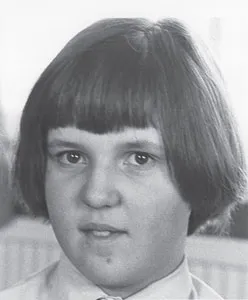
Nadia (Figure 1.1) was born in Nottingham in 1967. She was the second child in a family of three children, having an older brother and a younger sister. Both her parents were science graduates from the Ukraine, then part of the USSR, who had emigrated to Britain. Her father had a degree in engineering and her mother graduated in chemistry. Mr Chomyn came to Britain after the war. His wife completed her studies at the University of Lvov arriving in Britain sometime later. At home in Nottingham the family spoke Ukrainian so the other two children grew up to be bilingual. Nadia was born full term after a normal pregnancy but her mother reported that she was an unduly passive baby with poor muscle tone. Her developmental milestones were substantially delayed and she did not walk independently until she was 2 years old. However, she developed single words at around 9 months. When Nadia was 1 year old her mother commenced a full-time job and Nadia was looked after by her paternal grandmother. In Nadia’s second year of life Mr and Mrs Chomyn began to have increasing concerns about her development as her motor milestones were delayed. The single words she had spoken gradually petered out and two-word, generative language did not emerge so that by the age of 21/2 Nadia was virtually mute. Her ritualistic and restricted behaviours were also giving increasing cause for concern.
Figure 1.1 Nadia aged 6. Photograph by Sam Grainger.
Nadia’s younger sister was born when Nadia was 20 months old. When she was 2 years old Nadia had a particularly bad attack of measles and during this period her family noticed that she was becoming increasingly isolated and unresponsive. Just before Nadia was 3 years old her mother was diagnosed with breast cancer and had to begin a long period of hospitalisation and chemotherapy. Mrs Chomyn was in and out of hospital and away from home for 3 months. Her grandmother cared for the three children during this difficult period. During the time when Mrs Chomyn finally returned from hospital and was recuperating at home, Nadia began to draw. She was, therefore, 3 years old when she commenced her drawings and from the outset these were marked by their extraordinary visual realism. Nadia did not go through the usual stages of scribbling with the usual emergence of circles and prototype human tadpole figures typical of normal children, as described in Chapter 3 (see Figures 3.6–3.9.).
Nadia’s first subjects were horses and frequently fairground carousel horses (Figure 1.2). She had very limited actual experience of these, visiting the Goose Fair in Nottingham once or twice and a local large park that had a carousel. Her inspiration seems to have come mainly from picture books, especially the Ladybird series, whose pictures were frequently based on photographic images (Figure 1.3).
Figure 1.2 Two carousel horses drawn between 3 and 4 years.
Figure 1.3 Guardsman on a horse from a Ladybird book that inspired Nadia. Reprinted with kind permission of Ladybird Books Ltd, Loughborough, UK.
Her mother reported to me that she had been amazed at Nadia’s dexterity in drawing. Her manual skill was in stark contrast to the otherwise clumsy and poorly coordinated child who still had difficulties in feeding herself.
1971–1973: Her Early Diagnosis and Schooling
When Nadia was 4½ years old the local general practitioner referred her to a paediatrician who diagnosed severe learning difficulties and a place was found for Nadia in Clifton Day Special School in Nottingham. The headteacher of the school remembered that Nadia was toilet trained when she commenced school but could only feed herself with a spoon. She was physically large for her age and slow and ponderous in all her movements. She had occasional screaming tantrums and could be destructive. She had very little language with fewer than ten spoken single words, which would be heard occasionally. However, she showed persistence and interest in a range of perceptual motor activities including jigsaw and inset boards. It was quickly discovered that she had phenomenal drawing skills.
Nadia settled into school where her typical behaviour in the classroom was one of withdrawal into her own private world and passive cooperation with her teachers and occasional tantrums. Nadia would sit for a long time staring into space. She was excessively slow in all her movements and rarely initiated any contact with adults or children, although she developed a liking for one other child who she would follow about. Her behaviour at home at this stage was very similar.
When she was 5 in 1972 she was seen by a senior clinical psychologist in Nottingham who remarked on her exceptionally skilful drawings. Nadia was then referred to the Hospital for Sick Children in Great Ormond Street for further assessments. It was during this assessment that the suggestion of autism was first raised.
1974: The Child Development Research Unit
When Nadia was 6 years old she was referred to the Child Development Research Unit (CDRU) in the University of Nottingham and it was here that I first met her. The unit had been set up by Professor John and Dr Elizabeth Newson to assess individual children, conduct research on child development and to train postgraduate students. The diagnostic clinic at the CDRU was groundbreaking at that time and utilised state of the art equipment such as video cameras and a one-way vision screen. The set-up comprised an observation playroom, which had one wall as a one-way vision screen so that student psychologists, parents and academic staff could sit behind it and observe. I was one of these students who was expected to volunteer to observe or work directly with a child for an afternoon clinic session.
Nadia attended the unit with her mother. I remember meeting a stolid, silent little girl with short brown hair. I had volunteered to work directly with her and we went into the playroom while several students, the unit founders and directors, John and Elizabeth Newson and Nadia’s mother observed. Her behaviour was very much as described by her school. She was very slow and seemed to be in a world of her own, avoiding eye contact and staring into the middle distance for periods of time up to 1 minute. It was extremely difficult to get her attention although she would passively cooperate in being led around the playroom. She turned her head and looked fleetingly after coaxing and calling her name repeatedly, but she rarely maintained attention.
I attempted to engage her in a wide range of activities as the playroom had every conceivable toy and activity provided. Construction toys, inset puzzles, posting toys, bubble mixture, and the Wendy House were all utilised. I introduced dolls and cars for symbolic play and large apparatus, scooters, and tricycles to assess gross motor control. Nadia showed a fleeting interest in some of these but spent most of the time staring into space. Although she was passive and unresponsive she did not appear to be unduly upset or anxious. She did not attempt to look for her mother. One or two spoken utterances were heard all afternoon and these were unintelligible words. At one stage during the long play session Nadia was given a thick style wax crayon and paper for her to draw on. She scrubbed up and down on the paper using a fist grip and with no evident ability to draw. I formed the strong impression of a child with severe global developmental delay.
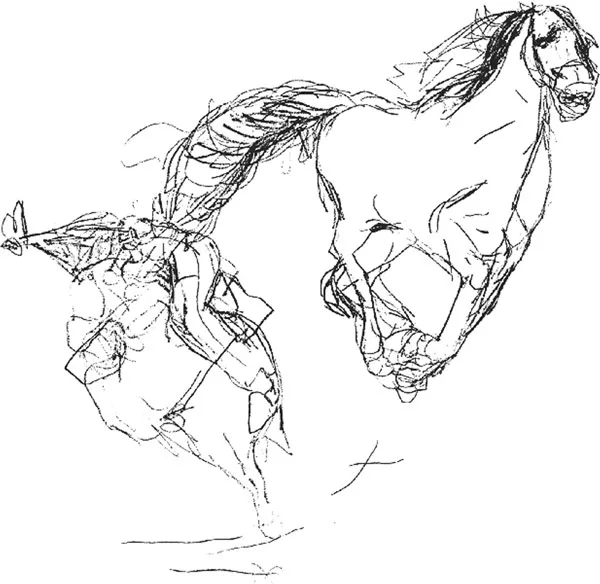
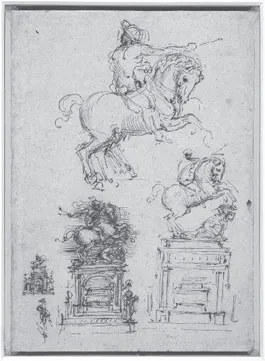
I was astonished and frankly sceptical after the session when Elizabeth Newson showed me a sheath of beautiful drawings of cockerels, horses and horse and riders. Nadia’s mother had told Elizabeth that Nadia had drawn these. Among the group of psychologists who stayed behind to discuss Nadia I was the ‘doubting Thomas’. I rashly stated, ‘If that little girl is capable of this work, I will study her for my Master’s project’. Elizabeth Newson challenged me to follow this up. The next day I drove out to Nadia’s school and the head, with a polite smile, took me to Nadia’s classroom. She explained that Nadia would only draw with a fine biro pen. I sat down beside Nadia and watched in wonder and astonishment while she drew a most beautiful cockerel followed by a horse and rider. There have been few such moments in my life of pure astonishment and this was one. I had been a primary school teacher for several years and I had considerable knowledge and experience of children’s drawings as well as of severe learning difficulties. Here was a clumsy, non-verbal child with severe learning difficulties drawing like Leonardo da Vinci (Figures 1.4 and 1.5).
Figure 1.4
Nadia’s Galloping Horse Drawn at the Age of 4. Contrast this with the Statuesque Horse and Rider Drawn by Leonardo da Vinci (Figure 1.5).
Figure 1.5
Horse and Rider by Leonardo da Vinci. Reprinted with Kind Permission from The Royal Collection (c) 2010 Her Majesty Queen Elizabeth.
I returned to the CDRU with the news and with a new topic for my dissertation. Elizabeth Newson wrote in her report at the time,
Nadia’s drawing is inspired by pictures and apparently sometimes solid objects, which she has seen. But she does not have a model in front of her while drawing, nor does she have had to have seen it recently. Different versions of the same model seem very similar in details. But it may be that she changes the orientation in some of the details. She sometimes scribbles finely on part of the model. Even if one posits the tracing of an eidetic image (which presents theoretical difficulties of time span and image dimension), her motor coordination is quite incredibly fine for a normal child of this age. She draws very fast, can return to the exact point necessary on an interrupted line, may ‘finish’ a picture and then return and add detail of decoration.
Elizabeth Newson concluded,
This extremely unusual child needs much more investigation. Her autistic features, as they stand, would probably not be sufficient to warrant a definite diagnosis of autism; yet her quite extraordinary drawing ability, however it is eventually explained, shows the label of non-specific, severe subnormality to be totally inadequate.
‘Subnormality’ was the official term used for severe learning difficulty at this time (1974) prior to the 1981 Education Act.
Original Study
I studied Nadia intensively for the next 5 months. My findings became the subject of a book published in 1977. Throughout the period in which I was working with her, she was drawing prolifically and with a wide variety of subject matter. Some of these drawings are presented in the next chapter together with drawings her mother had collected from earlier years. When I began working with Nadia she regularly drew cockerels and horses, especially horses and riders, but in addition I saw the evolution of several new subjects such as her drawings of a pelican (see Figure 2.21). These evolved from her examination of a cheap picture book illustration. A few weeks later she suddenly produced the image of a pelican which I recognised at once. Over the following few weeks the image appeared several times in different sizes and occasionally as a complete mirror image. She then stopped drawing pelicans and as far as I am aware, she never drew another one.
I also witnessed the evolution of a series of drawings of legs and shoes that may have been inspired from life. She became very interested in shoes (this was the era of high wedged heels and raised soles; see Figures 2.40, 2.41 and 2.42. But she did not look at these subjects when she was drawing and appeared to draw entirely from memory. She always drew with remarkable speed, rarely taking more than a few minutes to complete the drawing, which she would then cast aside. She could cover many sheets of paper in one session and would draw for up to an hour at a time but she always signalled the end of a session by getting up and pushing the paper aside. During the drawing session Nadia would become very animated and was evidently happy and excited to be drawing. At the height of her drawing phase she would draw on the walls and on cereal packets or any paper that was available so that her parents found it quite difficult to manage. On one occasion, when I was with her, she drew on a tablecloth. She chose the subjects but she would occasionally draw subjects to request usually prompted by a picture of a previous drawing and even drew my profile on one occasion (Figure 2.38).
Cognitive Assessment
Over the months I worked with Nadia I assessed her on a wide range of standardised tests. This was a very difficult task because her cooperation was extremely variable. Anyone who has worked with autistic children will recognise the problem of knowing whether the child ‘will not’ or ‘cannot’ do the task. Occasionally, there are moments of cooperation when an autistic child will suddenly do a task they have refused to do previously. Testing Nadia was protracted and the usual rules and time constraints were abandoned. At this age (6 years 9 months) Nadia would not cooperate with testing on any of the subtests on the Wechsler Intelligence Scale for Children (revised version, 1974) or the preschool version including the block design test, regularly reported to be a test in which autistic children do relatively well (Howlin et al., 2009). Nadia failed to understand and/ or cooperate with the Frostig Developmental Test of Visual Perception (Frostig, 1964) and the Columbia Mental Maturity Scale (Burge...