eBook - ePub
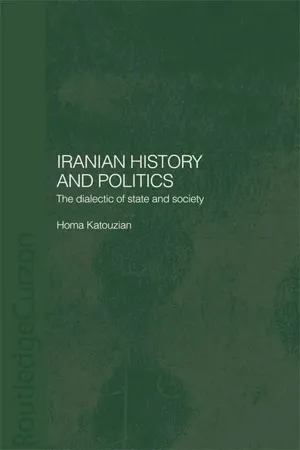
Iranian History and Politics
The Dialectic of State and Society
- 304 pages
- English
- ePUB (mobile friendly)
- Available on iOS & Android
eBook - ePub
About this book
This book contains the most detailed and comprehensive statement of Homa Katouzian's theory of arbitrary state and society in Iran, and its applications to Iranian history and politics, both modern and traditional. Every chapter is a study of its own specific topics while being firmly a part of the whole argument. The discussions include close comparisons with the history of Europe to demonstrate the diversities of the logic and sociology of Iranian history from their European counterparts. Being the first modern theory of Iranian history, it is highly regarded by Iranian historians and social scientists, especially as it has helped to resolve many of the anomalies resulting from the application of traditional theories.
Part I
ARBITRARY RULE
A theory of Iranian history and politics
1
THE THEORY OF ARBITRARY RULE
Status and implications
As a theory of history, the theory of arbitrary rule has the same scientific and epistemological status as any other such theory proposed from the classical age until our time, in providing an analytical framework – described in recent times as a ‘paradigm’ – for the study of the society or societies to which it refers through time as well as space. This may give rise to two types of questions, which are at opposite poles. First, why there should be any analytical framework at all for a study of history and society. Second, what justifies the construction of a new one for such studies given ‘the’ existing theory.
The answer to the first question is that every observation, including the evidence from empirical sources of history, is – either tacitly or explicitly – based on some such theory or analytical framework. One does not simply observe. One observes because one has questions, problems, hypotheses, all of which are a priori, prior to observation, theoretical. And this is true as much of history as of both natural and social sciences.1 This argument may be demonstrated at two levels. To give but one example at the first level, when it is said that classical feudalism began to decline from the mid-fourteenth century, the statement automatically implies a theory. For feudalism is not a fact, but a simple and abstract concept which corresponds to many – and otherwise diverse – societies over a long but certain period of history, and is, likewise, analytically distinguished from other periods in (European) history.
At the second – more mundane, more detailed, but no less important – level, when a scholar of history examines the sources – whether classical and traditional accounts, or public and private documents, or indeed both – she is not normally just looking, but looking for some evidence. And she is looking for that evidence, because, she has a theory, a hypothesis, a notion, a conception of the problem, for the testing of which – for determining the truth or falsehood of which – she is seeking evidence. That notion, view or whatever is prior to the examination of the sources, prior to the facts; and hence, it is theoretical. It is very rare, but it does happen, that a scholar reads a specialised source, or a document, simply for its own sake, just as it is rare, but it does happen, that someone reads a dictionary without wanting to look for the properties of specific words. But such reading does not lead to the formation of new knowledge. And if by chance the reader is suddenly struck by a special significance of something she comes upon, it will be related to a subject for which she has already had a question, a hypothesis, a ‘hunch’.
Even the legend that Newton discovered the law of gravity when he observed an apple fall to the ground, unquestionably implies that, for a long time, he had been thinking about the problem. Otherwise, he would have discovered the law of gravity the first time he had seen anything fall to the ground; more likely, this would have been discovered long before his time. Mere looking, mere observation of facts, does not lead to any knowledge beyond itself; it might do so only if there is an a priori question; only if the facts are sought for reasons which are prior to them.2
So much for the first of the two diametrically opposite objections, mentioned above, regarding the virtual necessity of the tacit or explicit use of concepts and categories in studies of history. The second question was that there already exists such a (presumably successful) theory, and that, therefore, the suggestion of another theory is irrelevant.
Here too, the matter may be dealt with at two levels. First, even at the level of very basic, very large, very general questions, there is not just one theory but several, perhaps many. As regards history, for example, there are a number of relatively successful theories, or broader approaches – successful, in the sense of having a large number of adherents among scholars, and hence having generated a large amount of work based on them. (Incidentally, this poses the question of competing frameworks, and whether or not these frameworks are bound to be incompatible, even incommensurable. But that is not of fundamental relevance to our present task.)3 Even regarding a single theoretical framework or approach, say Marxist theory, there are usually a number of alternative, sometimes even contradictory, interpretations, so that it would be virtually impossible to speak of ‘the’ Marxist, or whatever, theory.
Yet, it is at its second level that this objection is more often put forward against the suggestion of a new theory of history. It is this: the theories or approaches which have been so far developed for the study of history are general. Therefore, either one of them must be used for the study of all societies or a new general theory must be proposed for the same purpose. But in no case could there be one theory which would suit the study of – say European – and another, of – say – Iranian, societies.
This is a common methodological confusion which is frequently found among both natural and social scientists. It is a confusion between universal and general theories. There may be a general theory about European societies, which is fundamentally unsuited to the study of Iran or elsewhere, because of the basic differences in the historical realities – material, cultural, etc. – between the two types of society. Or, to give an example from the natural sciences, a theory may be generally true of a certain phenomenon or event on the earth, but untrue of innumerable places elsewhere in the universe. A remarkable contribution of Einstein's theory of relativity – certainly its most important single contribution to scientific method – was the demonstration of this fact: the demonstration, not that Newtonian physics was wrong, but that it lacked universal validity; the demonstration that the universe was open. I shall say no more here about this particular objection – the most frequently made by social scientists – to suggesting a theory of history for Iran, because it has been sufficiently dealt with in Chapter 3, in the section entitled ‘A note on method’.4
What then is the significance of the theory of Iranian history offered in these pages and, regardless of its being correct or incorrect, how novel may it claim to be? Is this not the same thing as ‘oriental despotism’, or as ‘the Asiatic mode of production’? The answer is ‘Yes’, if it may be also said that Marx's economic theory is the same as Ricardo's, and Ricardo's, of Smith's. That Rousseau's social contract theory is the same as Locke's, and Locke's, of Hobbes's. That St Thomas Aquinas's metaphysics is the same as Aristotle's, and Aristotle's, of Plato's. And so on. Otherwise, the answer is ‘No’. In other words, the subject is similar if not quite the same. But the theory is new. Apart from that, there are certain objections to concepts commonly known as oriental despotism, which I shall briefly mention later in this essay.
In the last decade or so, the theory of Iranian arbitrary rule has been attracting growing attention both outside and – especially – inside Iran, largely because established theories have been facing massive contrary evidence, and seen to lack fundamental explanatory and predictive powers. Therefore, it would be appropriate to say something about the history and background to it.
A basic familiarity with Greco-Roman sources of history – with Herodotus, Xenophon, Thucydides, Plutarch, etc. – and with Greco-Roman philosophical traditions, especially as they affected theories of government, politics, law, liberty, rights, citizenship, etc., shows that classical European thinkers and writers, either tacitly or explicitly, saw some basic and important differences between their societies and those of their eastern neighbours. The first time, perhaps, that the world was categorically divided between East and West was in reference to Greece and Persia.
These differences concerned many aspects of the two societies, though they could all be reduced to a fundamental fact. It was not that there was less corruption and cruelty in the West than in the East. It was that, in Greece, law as a framework established and defined the rights of both state and society, and provided a formal, long-term, and essentially inviolable justification for the independence of citizens and governing classes. It was, for example, that a citizen's life, freedom or property could not be officially violated without recourse to the established procedures, laid down in tacit or explicit forms, which it was unlawful to violate. It was that rulers were not in real danger, most of the time, of being assassinated, and replaced by whoever managed to seize power, without arousing much concern about the legitimacy of their rule. Or that the death of rulers did not normally create actual or potential chaos, even when it happened peacefully and without foul play, over who should or would succeed them.
Hence, it should perhaps be mentioned at this point that the issue has nothing whatever to do with race or nationality, or with claims of racial superiority, but with social structures which have given rise to different systems of government and what has sprung from them; and with material conditions, which have both contributed to the formation of those structures, and have been, in turn, influenced by them. Besides, whatever the motives of theorists, historians or philosophers – which are likely to have been varied, in any case – the scientifically important matter is the validity or otherwise of their arguments and evidence.
Apart from that, it must be noted that – at any given time, or indeed for longer periods – a society which was based in law might well have been poorer, or militarily weaker, even scientifically less advanced than one that was subject to arbitrary rule. Indeed, it is not impossible to imagine an ideal arbitrary ruler – wise, just, efficient, responsible, etc. – who will bring happiness to his society (although, by definition, this is unlikely to last after him; a matter which arises from the ‘short-term’ nature of the arbitrary society, discussed in some chapters of this volume).5
The debate regarding the nature of Iranian society – to the very limited extent to which the question has been posed at all – has been focused on ‘feudalism versus oriental despotism’ or – in Marxist jargon – ‘feudalism versus the Asiatic mode of production’. Whereas, as discussed above, the issue concerns a basic comparative study of traditional European society, whether ancient or feudal, with that of Iran (and perhaps other non-European societies as well, which is not the concern of our study, but to which a brief reference will be made later in this chapter).
Feudalism refers to just one period of European history. In its fully developed form it lasted perhaps from the ninth and tenth to the fourteenth and fifteenth centuries, although many of its structural remnants and cultural features survived until the eighteenth and even nineteenth centuries in western and central Europe, and, serfdom was, if anything, extended and reinforced in Russia and its domains, in the eighteenth century.6
The collapse of Roman Europe – the Europe of Pax Romana – was followed by the Dark Ages, so-called, in part, because of the great decline of the first few centuries; in part, because little detailed and reliable information exists about this long period. It was the Catholic Church which managed to fill some of the gap and bring a degree of order to western- and central-European society. Not only that, but also the feudal society and state which emerged from it in Medieval Europe were still less developed – in a number of important respects – than some Eastern societies of their time, notably the world of Islam, of which Iran was a part. Nevertheless, the classical feudal state was based in law. And so, in the case of the absolutist Renaissance and post-Renaissance, the liberal capitalist, etc., states that followed.7 Therefore, and this is the crucial point, the question is not one of European feudalism compared with Iranian ‘despotism’, it is one of law-based European states and societies of various types compared with Iranian, and perhaps other, arbitrary states and societies.
But why Iranian? Why not Eastern or Asiatic? It was mentioned above that some basic differences between East and West – notably between Greece–Rome and Persia – had been observed by Greco-Roman historians and philosophers. At the close of Medieval Europe two things in particular led to a renewal of attention to such differences between the two types of society: the cultural Renaissance or return to classical history, philosophy, etc., and the rise of Ottoman Turkey as a great power in eastern Europe. It was no longer Persia – then under the Safavids, and described in Europe as land of the Great Sophy – that (from the vantage point of Europe) provided the immediate example of ‘the Eastern type of society’. But the Ottoman empire, which on one or two occasions almost conquered Vienna itself, the capital of the vast Habsburg (Holy Roman) empire; the expanding power that western Europeans were praying the Great Sophy would be able to check from its eastern borders. Once again, fear and prejudice might have been an important motive in this, but, once again, what matters is the scientific significance – the compelling theory and evidence – which it may or may not possess.
Nevertheless, Persia was still in the background. And it was no coincidence that the author of Persian Letters, Montesquieu, was the same as that of The Spirit of the Laws, even though the former book was intended more as a critique of contemporary French society and politics. In the meantime, Western Europe had gained control of the high seas and extended its contact and influence to countries further east, notably India and, later, China. Thus, Montesquieu's observation of basic differences between different types of society, and his emphasis on climatic conditions as their main cause.8 Thus, Adam Smith's brief observations on China and India, especially the fact that the state drew most of its revenue from the land, and that it spent on large public projects.9 Thus James Mill's studies of Indian history, and his observations on so many relevant issues, whether land tenure or the extraordinary nature of power.10 Hence also Hegel's observations – based on the aforementioned and other previous authors – on oriental despotism; hence Marx's description of ‘the Asiatic society’ as a distinct type of its own, and his (and Engels's) intelligent but rather unsystematic, and unfinished, discussions of ‘the Asiatic mode of production’.11 The last concept is also largely based on the preceding ideas, especially from Montesqiueu to Hegel, expressed in terms of the Marxian ‘mode of production approach’ to historical dynamics. Except, of course, the implication that there is no dynamic in this case (as there was no dynamic in it either, in terms of Hegel's ‘idealistic’ scheme of the evolution of human society, by stages, towards the kingdom of Freedom and Reason).
It is worth pausing at this point for a moment. The Marxian concept of mode of production is, among one or two other things, but perhaps most important of all, a theoretical instrument through wh...
Table of contents
- Front Cover
- IRANIAN HISTORY AND POLITICS
- ROUTLEDGECURZON/BIPS PERSIAN STUDIES SERIES
- Title Page
- Copyright
- Dedication
- CONTENTS
- Acknowledgements
- Preface
- Introduction
- PART I Arbitrary rule: a theory of Iranian history and politics
- PART II Arbitrary rule: applications to Iranian history and politics
- Index
Trusted by 375,005 students
Access to over 1.5 million titles for a fair monthly price.
Study more efficiently using our study tools.
Frequently asked questions
Yes, you can cancel anytime from the Subscription tab in your account settings on the Perlego website. Your subscription will stay active until the end of your current billing period. Learn how to cancel your subscription
No, books cannot be downloaded as external files, such as PDFs, for use outside of Perlego. However, you can download books within the Perlego app for offline reading on mobile or tablet. Learn how to download books offline
Perlego offers two plans: Essential and Complete
- Essential is ideal for learners and professionals who enjoy exploring a wide range of subjects. Access the Essential Library with 800,000+ trusted titles and best-sellers across business, personal growth, and the humanities. Includes unlimited reading time and Standard Read Aloud voice.
- Complete: Perfect for advanced learners and researchers needing full, unrestricted access. Unlock 1.5M+ books across hundreds of subjects, including academic and specialized titles. The Complete Plan also includes advanced features like Premium Read Aloud and Research Assistant.
We are an online textbook subscription service, where you can get access to an entire online library for less than the price of a single book per month. With over 1.5 million books across 990+ topics, we’ve got you covered! Learn about our mission
Look out for the read-aloud symbol on your next book to see if you can listen to it. The read-aloud tool reads text aloud for you, highlighting the text as it is being read. You can pause it, speed it up and slow it down. Learn more about Read Aloud
Yes! You can use the Perlego app on both iOS and Android devices to read anytime, anywhere — even offline. Perfect for commutes or when you’re on the go.
Please note we cannot support devices running on iOS 13 and Android 7 or earlier. Learn more about using the app
Please note we cannot support devices running on iOS 13 and Android 7 or earlier. Learn more about using the app
Yes, you can access Iranian History and Politics by Homa Katouzian,Dr Homa Katouzian in PDF and/or ePUB format, as well as other popular books in History & Middle Eastern History. We have over 1.5 million books available in our catalogue for you to explore.