Archaeology and Language III interprets results from archaeological data in terms of language distribution and change, providing the tools for a radical rewriting of the conventional discourse of prehistory. Individual chapters present case studies of artefacts and fragmentary textual materials, concerned with the reconstruction of houses, maritime technology, pottery and grave goods.
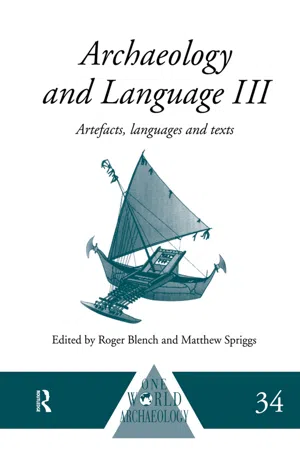
- 320 pages
- English
- ePUB (mobile friendly)
- Available on iOS & Android
eBook - ePub
About this book
Information
Part I
LINGUISTIC MODELS IN RECONSTRUCTING MATERIAL CULTURE
1 Early Oceanic architectural forms and settlement patterns: linguistic, archaeological and ethnological perspectives
ABBREVIATIONS
In citations of cognate sets the following abbreviations are used for names of subgroups and proto-languages.
| Adm | Admiralty Islands |
| An | Austronesian |
| CMP | Central Malayo-Polynesian |
| CPa | Central Pacific (Fijian, Polynesian, Rotuman) |
| EMP | Eastern Malayo-Polynesian |
| Fij | Fijian |
| Fma | Formosan |
| Mic | Nuclear Micronesian |
| MM | Meso-Melanesian (C. and E. New Britain, New Ireland, W. Solomons) |
| NC | New Caledonia |
| NCV | North & Central Vanuatu |
| NNG | North New Guinea (from Sepik to Huon Gulf, plus E. New Britain) |
| PAn | Proto-Austronesian |
| PCEOc | Proto-Central Eastern Oceanic |
| PCPa | Proto-Central Pacific |
| PCPn | Proto-Central Polynesian |
| PEOc | Proto-Eastern Oceanic |
| PEPn | Proto-Eastern Polynesian |
| PMP | Proto-Malayo Polynesian |
| PNPn | Proto-Nuclear Polynesian |
| Pn | Polynesian |
| POc | Proto-Oceanic |
| PPn | Proto-Polynesian |
| PT | Papuan Tip (S.E. Papua and Central Province of Papua New Guinea) |
| PWMP | Proto-Western Malayo-Polynesian |
| PWO | Proto-Western Oceanic (comprising MM, NNG and PT) |
| SES | South-east Solomonic (Guadalcanal, Nggela, Bugotu) |
| SHWNG | South Halmahera–West New Guinea |
| SV | Southern Vanuatu |
| WMP | Western Malayo-Polynesian |
AIMS AND METHODOLOGICAL PRELIMINARIES
Proto-Oceanic (POc) is the immediate common ancestor of the putative Oceanic subgroup, which comprises all the Austronesian languages of the Polynesian and Micronesian regions except Chamorro, Belau and possibly Yapese, and all those of the Melanesian region spoken east of 136 degrees E. This paper1 seeks to reconstruct something of the architectural elements and settlement patterns of speakers of Proto-Oceanic and its immediate descendants, speech communities that many associate with the colonisation of southwest Oceania by bearers of the archaeological culture known as Lapita in the second half of the second millennium BC (Bellwood 1978; Pawley and Ross 1995; Shutler and Marck 1975; Spriggs 1995).
Some methodological questions are in order. Are such culture historical reconstructions feasible? Which disciplines and methods can provide evidence relevant to this task? What is each method good for, and to what extent, if at all, can evidence provided by different methods be connected?
At least three distinct disciplines – historical linguistics, archaeology and comparative ethnology – are used to do culture history. Each discipline has particular strengths and limitations. Blust (1976) points out ways in which archaeological and linguistic evidence can be complementary, corroboratory or contradictory. Although their combined testimonies are likely to reveal a fuller picture than any yielded by a single discipline, synthesising evidence from diverse disciplines and methods is not a straightforward matter. A synthesiser can accept the testimony of different disciplines, but it is not easy to know when the witnesses are talking about the same historical events: a situation that recalls the story of the six blind philosophers, each of whom touched a different part of an elephant, who then equated the parts with six unrelated objects.
The richest primary data for culture historical reconstruction come from comparative ethnology (or comparative ethnography, if you prefer). This discipline has the advantage, under favourable circumstances, of starting with descriptions of contemporary or historical societies and cultures that are immensely more complete than anything the archaeologist can hope to recover. However, the historical method of comparative ethnology is a fairly blunt instrument. The nature of the contrast between the historical methods of comparative ethnology and linguistics is discussed in Blust (1980a), Green (1994a) and Pawley and Ross (1993, 1995). The method is based on general arguments from typology. From contemporary reports of cultures, the comparative ethnologist may arrive at a theory of earlier cultural types and their transformations or their directions of diffusion. The proofs for drawing such inferences are essentially statistical, based on the frequency and distribution of types and typological associations in contemporary societies: often the most common and/or most widely distributed type is assumed to be the oldest. A problem familiar to archaeologists and linguists who use ethnographic analogy is that the reconstructed past becomes simply an extension and reflection of one’s knowledge of present-day traditional societies. Quite different pasts are not easily recognised.
The following remarks by Waterson about the antiquity of houses on piles and roof styles are fairly typical of the kinds of argumentation used by historical ethnologists:
Architectural styles can change rapidly – but they can also maintain continuity over surprisingly long periods. The antiquity of some aspects of architectural style in the Austronesian world is undoubted. Elements such as pile building and the saddle roof with its extended ridge line are first to be seen on the bronze drums of the Dong Son era, but to judge from their appearance in regions as distant from the [South-east Asian] mainland as Micronesia and New Guinea, it is reasonable to assume they are much older than their earliest surviving pictorial representations; in other words, that this style is a genuinely Austronesian invention.(Waterson 1993: 221)
In her two-volume work, Kulthäuser in Nordneuguinea, Hauser-Schäublin writes of houses in a region that contains numerous non-Austronesian languages as well as a smaller number of Austronesian languages:
The hut on piles with supports carrying both the roof and the built-in floor seems to belong to Austronesian cultures. On the North Coast both elements are combined: the first floor platform is supported by its own poles, whereas the upper floors are slotted into the horizontal beams. In areas settled by non-Austronesian groups, all parts of the building are traditionally lashed with lianas. Pin and peg techniques are only known in those regions where Austronesian languages are spoken. The Middle Sepik cultures took over the idea of buildings with projecting gables from the Austro-nesians who settled at certain places on the North Coast. They adapted it to their own technology and architectural experience, giving it a new expression.Hauser-Schäublin 1989: 618, translated from the German, in Waterson 1993).
Note the temporal prior...
Table of contents
- Cover
- Half Title
- Title Page
- Copyright Page
- Table of Contents
- List of figures
- List of tables
- List of contributor
- Preface
- General introduction
- Introducing the papers
- Part I Linguistic models in reconstructing material culture
- Part II Interpreting text
- Index
Trusted by 375,005 students
Access to over 1.5 million titles for a fair monthly price.
Study more efficiently using our study tools.
Frequently asked questions
Yes, you can cancel anytime from the Subscription tab in your account settings on the Perlego website. Your subscription will stay active until the end of your current billing period. Learn how to cancel your subscription
No, books cannot be downloaded as external files, such as PDFs, for use outside of Perlego. However, you can download books within the Perlego app for offline reading on mobile or tablet. Learn how to download books offline
Perlego offers two plans: Essential and Complete
- Essential is ideal for learners and professionals who enjoy exploring a wide range of subjects. Access the Essential Library with 800,000+ trusted titles and best-sellers across business, personal growth, and the humanities. Includes unlimited reading time and Standard Read Aloud voice.
- Complete: Perfect for advanced learners and researchers needing full, unrestricted access. Unlock 1.5M+ books across hundreds of subjects, including academic and specialized titles. The Complete Plan also includes advanced features like Premium Read Aloud and Research Assistant.
We are an online textbook subscription service, where you can get access to an entire online library for less than the price of a single book per month. With over 1.5 million books across 990+ topics, we’ve got you covered! Learn about our mission
Look out for the read-aloud symbol on your next book to see if you can listen to it. The read-aloud tool reads text aloud for you, highlighting the text as it is being read. You can pause it, speed it up and slow it down. Learn more about Read Aloud
Yes! You can use the Perlego app on both iOS and Android devices to read anytime, anywhere — even offline. Perfect for commutes or when you’re on the go.
Please note we cannot support devices running on iOS 13 and Android 7 or earlier. Learn more about using the app
Please note we cannot support devices running on iOS 13 and Android 7 or earlier. Learn more about using the app
Yes, you can access Archaeology and Language III by Roger Blench,Matthew Spriggs in PDF and/or ePUB format, as well as other popular books in Social Sciences & Archaeology. We have over 1.5 million books available in our catalogue for you to explore.