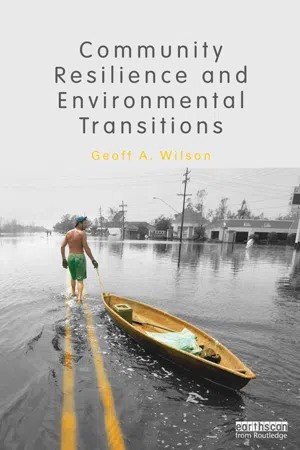
This book discusses the resilience of communities in both developed and developing world contexts. It investigates the notion of 'resilience' and the challenges faced by local communities around the world to deal with disturbances (natural hazards or human-made) that may threaten their long-term survival. Using global examples, specific emphasis is placed on how learning processes, traditions, policies and politics affect the resilience of communities and what constraints and opportunities exist for communities to raise resilience levels.
- 240 pages
- English
- ePUB (mobile friendly)
- Available on iOS & Android
eBook - ePub
Community Resilience and Environmental Transitions
About this book
Information
1
Introduction
The notion of ‘resilience’ is rapidly gaining ground as both a targeted process of societal development and as a research topic in its own right. Indeed, the notion of resilience may be beginning to replace ‘sustainability’ as the buzzword of political and policy-making rhetoric. Research has focused on different levels and scales of resilience. One strand has built on concepts established in research on the resilience of ecosystems (Holling, 1973) to understand resilience processes in interlinked social-ecological systems (Gunderson and Holling, 2002; Folke, 2006). Building on this work, in recent years increasing attention has been paid to issues of social resilience which attempts to understand how human systems respond to internal and external disturbances. As part of the latter, increasing focus has been placed on understanding the resilience of human communities, especially the analysis of resilience pathways at the local level where actions influencing resilience are among the most tangible (Chaskin, 2008; Gow and Paton, 2008). This book will focus on understanding community resilience, with specific emphasis on how complex environmental transitions increasingly shape communities’ abilities to respond and react towards disturbances threatening their survival.
Research on social resilience is still in its infancy, and many key questions still remain unanswered (Brand and Jax, 2007; Davidson, 2010). Despite a plethora of publications on resilience, three key arenas of investigation linked to community resilience have received little attention. First, due to the relative novelty of the research field of social resilience, theoretical discussions about processes, drivers and indicators of social resilience are not yet fully developed (Adger, 2000; Davidson, 2010). This book will argue that theoretical concepts such as transition theory provide a particularly novel and suitable lens through which resilience pathways at community level can be better understood, especially as transition theory allows detailed analysis of changes in community resilience over space and time based on different models of transitions and pathways of change.
Second, little work exists on the possible interlinkages between community resilience and different forms of human and environmental capital. Folke (2006, p. 260) argued that “efforts to understand [the resilience of social-ecological systems] are still in an exploratory stage and there is opportunity for creative approaches and perspectives”. As a result, this book will propose a novel framework focused on a social science approach for understanding community resilience as the conceptual space at the intersection between economic, social and environmental capital. It will be argued that this approach enables recognition of the importance of community-environmental interactions emphasized in work related to social-ecological resilience issues, but also acknowledging key resilience drivers linked to economic, socio-political, psychological and moral issues, as well as the importance of power relationships in human societies.
Third, while much work has discussed how communities respond and react towards sudden natural catastrophes such as hurricanes, earthquakes or volcanic eruptions (e.g. Pelling, 2003; Adger et al., 2005a; Cutter et al., 2008), there is much less work on resilience and ‘slow-onset hazards’ associated with anthropogenic drivers of change such as socio-political or economic change. This is despite the fact that, in recent history, anthropogenic drivers have led to the destruction of many more communities than natural catastrophes. For example, in the twentieth century alone, nearly 190 million people were killed in revolutions, wars and massacres (Pretty, 2007). Building on Berkes et al. (2003), this book is, therefore, concerned with discussing community resilience linked to both anthropogenic and natural disturbances that may have internal or external causes and that may be sudden or slow-onset disturbances.
There is no doubt that communities around the world are in transition. Drivers of change ranging from globalization, neo-liberal ideologies, to the spread of global capitalism to even the remotest parts of the world are amplified by climate change, population growth and the increasing movement of people within and across countries and continents. All these forces (and many others) act together in complex ways to influence development trajectories and, ultimately, resilience and vulnerability of communities. There is, therefore, increasing evidence that, at the beginning of the twenty-first century, humanity is at a crossroads with regard to environmental and societal transitions. After 10,000 years of environmental modification by agricultural societies, and over 200 years of industrial, social and environmental transformation, many studies point towards ‘irreversible’ degradation of many of Earth’s resources (Blaikie and Brookfield, 1987; Pretty, 2007). Most prominent are environmental and social problems linked to climate change associated with anthropogenic carbon emissions, loss of biodiversity (especially in tropical forest environments) linked to habitat destruction for agricultural and extractive purposes, and large-scale environmental pollution problems associated with consumer-oriented capitalist lifestyles (Wilson and Bryant, 1997; Pretty, 2007). These problems are exacerbated by predicted shortages in energy availability, especially with regard to ‘peak oil’ scenarios and the need to reduce global carbon emissions (Hopkins, 2008; Mazmanian and Kraft, 2009).
At community level, these disturbances pose enormous challenges about how to tackle environmental and social changes, who should be in charge of making key decisions about possibly altering current ‘unsustainable’ lifestyles, and what institutional and policy-related mechanisms should be used to influence decision-making processes associated with strengthening resilience processes. In many communities, global climate change is already threatening survival, especially in areas where agricultural production is jeopardized by increasing frequency of droughts (e.g. Australia, parts of Africa; Adger, 2003; Cline, 2007; Kelkar et al., 2008) or where sea-level rise is likely to destroy livelihoods (e.g. coral atolls in the Pacific Ocean) (Barnett and Adger, 2003). In developing countries, destruction of habitats and associated biodiversity reduction by agriculturalists needing to feed still rapidly rising populations (globally about 80 million more people have to be fed every year), or through multinational logging and mining companies often operating in weakly regulated environments (e.g. Papua New Guinea, Democratic Republic of Congo), is further threatening the livelihood base of many poor and politically/economically marginal communities (Bryant and Bailey, 1997; Pretty, 2007). In the developed world, and increasingly in many developing countries, environmental and social threats to communities are often associated with the dissolution of community networks and/or the outmigration of young people (Locke et al., 2000; Hamilton et al., 2004), leading to abandonment of complex environmental management systems (e.g. abandonment of terraced agricultural fields in the Mediterranean; lack of personpower to maintain wet rice terrace systems in south-east Asia), or to pollution problems associated with long-term exposure to threats such as pesticides, herbicides or industrial pollution (Wilson, 2007). In addition to environmental threats, many communities are also facing increasingly complex and severe social, political, cultural and economic disturbances that threaten community survival (Pelling, 2003).
This tension between social and environmental drivers of change and community resilience provides the framework for analysis in this book. How is community resilience influenced by these drivers of change? How can communities respond and adapt to such changes without sacrificing existing pathways of resilience? Who should be in charge at community level or beyond to tackle questions associated with community resilience? How can we better understand the complex interplay of factors, processes and drivers of change at community level, and what policy responses will be needed to raise the resilience of communities? How communities respond to these challenges will be at the heart of this book.
1.1 Resilience, Transition Theory, and Economic, Social and Environmental Capital
Much scientific work has discussed complex interactions with environmental and social drivers of change, both from a historical and contemporary perspective, and has analysed in detail the nature and extent of such interaction in different geographical settings (e.g. Turner et al., 1990; Simmons, 1996; Pretty, 2007). There is an equal plethora of work that has analysed key drivers of environmental and social change and how communities have attempted to respond to and regulate their interactions with such disturbances (e.g. Wilson and Bryant, 1997; O’Riordan, 2001). Some of the most interesting examples include Diamond’s (2006) analysis of anthropogenic environmental degradation and community collapse using a variety of case examples such as Easter Island (see Box 4.3), the Anaszasi in North America or Norse settlements on the west coast of Greenland (e.g. Seaver, 1996), or Gunderson and Holling’s (2002) ‘panarchic cycle’ which – using concepts and theories from ecology – attempts to provide a conceptual framework for understanding both transformations in human and natural systems and how human communities can adapt to rapidly changing environmental and social conditions over time (adaptive cycle in human-ecological systems). Gunderson and Holling particularly ask how much redundancy is required by human systems to sustain the capacity to adapt in flexible ways to unpredictable disturbances, how to develop adaptive capacity in a world of rapidly changing information, technology and homogeneity created by globalization processes, and, most controversially, how societies can fundamentally change the basis of popular and scientific...
Table of contents
- Cover
- Half Title
- Title Page
- Copyright
- Contents
- List of figures, tables and boxes
- Acknowledgements
- List of abbreviations
- 1. Introduction
- 2. Towards a framework for understanding community resilience
- 3. Transition theory: pathways of change and resilient communities
- 4. Social memory: community learning, tradition, stakeholder networks and community resilience
- 5. Path dependency: ‘lock-in’ mechanisms, power structures and pathways of the (im)possible at community level
- 6. Transitional corridors: macro-structural influences and community resilience
- 7. Community resilience and the policy challenge
- 8. Conclusions
- Notes
- Bibliography
- Index
Trusted by 375,005 students
Access to over 1.5 million titles for a fair monthly price.
Study more efficiently using our study tools.
Frequently asked questions
Yes, you can cancel anytime from the Subscription tab in your account settings on the Perlego website. Your subscription will stay active until the end of your current billing period. Learn how to cancel your subscription
No, books cannot be downloaded as external files, such as PDFs, for use outside of Perlego. However, you can download books within the Perlego app for offline reading on mobile or tablet. Learn how to download books offline
Perlego offers two plans: Essential and Complete
- Essential is ideal for learners and professionals who enjoy exploring a wide range of subjects. Access the Essential Library with 800,000+ trusted titles and best-sellers across business, personal growth, and the humanities. Includes unlimited reading time and Standard Read Aloud voice.
- Complete: Perfect for advanced learners and researchers needing full, unrestricted access. Unlock 1.5M+ books across hundreds of subjects, including academic and specialized titles. The Complete Plan also includes advanced features like Premium Read Aloud and Research Assistant.
We are an online textbook subscription service, where you can get access to an entire online library for less than the price of a single book per month. With over 1.5 million books across 990+ topics, we’ve got you covered! Learn about our mission
Look out for the read-aloud symbol on your next book to see if you can listen to it. The read-aloud tool reads text aloud for you, highlighting the text as it is being read. You can pause it, speed it up and slow it down. Learn more about Read Aloud
Yes! You can use the Perlego app on both iOS and Android devices to read anytime, anywhere — even offline. Perfect for commutes or when you’re on the go.
Please note we cannot support devices running on iOS 13 and Android 7 or earlier. Learn more about using the app
Please note we cannot support devices running on iOS 13 and Android 7 or earlier. Learn more about using the app
Yes, you can access Community Resilience and Environmental Transitions by Geoff Wilson in PDF and/or ePUB format, as well as other popular books in Scienze sociali & Ecologia. We have over 1.5 million books available in our catalogue for you to explore.