This book draws on work from across northern Europe and is parallel and complementary to the network itself. By establishing an intellectual and practically orientated framework and platform, and by bringing together contributions defining the state-of-the-art and potential development paths in the field, it is the first volume to offer a systematic and scientific view from the periphery.
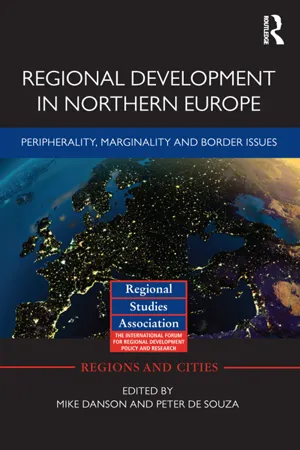
eBook - ePub
Regional Development in Northern Europe
Peripherality, Marginality and Border Issues
- 240 pages
- English
- ePUB (mobile friendly)
- Available on iOS & Android
eBook - ePub
Regional Development in Northern Europe
Peripherality, Marginality and Border Issues
1 Periphery and marginality
Definitions, theories, methods and practice
Aims of the book
This book is dedicated to the theme Peripherality, marginality and border issues. It has developed out of interests and concerns over the position and attention given to such regions across the globe, but particularly within a Europe where cities and city-regions are dominating the research and policy agenda. The chapters and arguments complement the work of the associated international research network (www.pemabo.net) which brings together facilities, expertise, experience and resources focused on peripheral and marginal communities and economies. This volume aims to support the dissemination of research from across northern Europe, foster knowledge exchange and contribute to more significant cooperation across borders.
Much research and attention has been paid to the regions in the core of Europe, and especially to cities, city-regions and old industrial areas and to some of their underlying characteristics – such as clusters, agglomeration phenomena generally and regional innovation systems. In this environment, the specific features of peripheral and marginal regions have been relatively neglected while many actors located in non-core areas of Europe face obstacles and challenges in applying locally the theories and strategies appropriate to the centre. To address this, there is a clear need for a theoretical and methodological foundation complemented by a systematisation of best-case and worst-case practices. Some researchers (e.g. Christaller, 1964; Erkut and Özgen, 2003; Dow and Dow, 2005; Eriksson, 2010) based in the periphery, of course, offer exceptions to the failure to define periphery and the peripheral and an example of research by and from the periphery. Others (e.g. Stephenson, 1999; Ballas et al., 2003) confound peripherality and rurality.
This book draws on work from across northern Europe and is parallel and complementary to the network itself. By establishing an intellectual and practically orientated framework and platform, and by bringing together contributions defining the state-of-the-art and potential development paths in the field, it is the first volume to offer a systematic and scientific view from the periphery.
The primary objectives of this book are to:
• define the state-of-the-art, when it comes to the concepts of periphery, marginality and border issues in theoretical, methodological and practical dimensions
• promote scientific discussions and contributions taking forward theoretical and methodological issues in relation to peripheral, marginal and border region issues
• create a platform for the combination of intellectual discussion and practical endeavours in this special and specialised field of regional development, issues and practice
• develop this discussion directly and through the presentation of empirical studies creating a foundation for comparative research on a wide geographical scale
• further contribution to the organisation of scientists and regional actors and policymakers in this field and complementary to the organisation of a scientific and practical network. So, it will contribute to a structured and long-term cooperation in this field where this book series can be established as the primary outlet for such debates and discussions.
The rationale derives from the current unsystematic and fragmentary nature of the literature on peripheral and marginal regional issues, exacerbated by the uncritical application of mainstream and core regional concepts in these environments.
Background
Analyses of the non-core areas of Europe face obstacles and challenges in applying locally the theories and strategies appropriate to the centre. The unmet demand to inform debates and policy formation in the periphery is confirmed by considering the literature underpinning peripherality and by anecdotal evidence collected from conferences across the continent and more widely in the Northern hemisphere. This suggests the need for more effective and dedicated networks to examine the particular issues of peripheral regions and marginality and to share their common lessons and experiences. In the context of competitiveness and centralisation, each enlargement of the EU has also included but also generated more peripheral regions. This makes the pursuit of this agenda within the specific context of the Northern Periphery of Europe all the more valuable and the stimulation of activities on this basis a worthwhile endeavour.
To introduce these discussions and concepts, this chapter sets the context by considering the existing literature and approaches adopted across disciplines, times and territories. The other chapters offer theoretical and descriptive insights into these issues but here we are especially interested in addressing these dimensions of Northern European regions from first principles.
The chapter is structured as follows: in the next section we explore the meaning of the keywords ‘peripheral’, ‘peripherality’, ‘margins’, ‘marginality’ and other derivatives of the roots of these terms. As they vary in definition and in interpretations, there is an examination of these terms in different languages. There is some discussion of synonyms and antonyms as it is anticipated that this will offer some illumination of the underlying meanings within and between usages. Similarly an assessment of Google hits and allied online catalogues is attempted.
This approach is extended by looking at how different disciplines theorise, use and apply these terms. Then there is a brief survey of examples of peripherality/marginality in practice – sampling papers, articles, etc. Next, the variation of methodologies and methods across subject areas and disciplines is covered. All the foregoing is a preamble to establishing a research agenda; that is, what still needs to be undertaken to understand/standardise/benefit from these terms in research on the periphery. Finally the chapter concludes with a summary of the issues identified and introduces the remainder of the book.
Introduction
The modern answer to the question of what drives economic growth and development is to be found in a combination of knowledge, creativity, innovation and entrepreneurship. Theories, ideologies and strategies are formed, to a high degree, by contexts and actors. Development and growth – in their preconditions and consequences – are differentiated geographically; they eventually appear somewhere and then, perhaps, filter outwards, downwards and possibly also upwards, wherever the observer is positioned in the mapping exercise. Places, areas and regions could be described by the nature of their preconditions in the way of resources and have different potentials to utilise, exploit or, in the case of path dependencies, be challenged by these prerequisites. They also appear in real or functional distances from each other, and in relation to the forces and resources that are promoting or hindering development. The pictures of the development potential of the place is determined by contextual (time-space defined) relationships.
‘Periphery’ and ‘marginality’ appear as special dimensions, versions or variants of this framework which are worth elaborating on afresh due to the following perspectives:
• not many studies do consider them generally
• they are, even as state-of-the-art, quite fuzzy concepts in spite of their noted presence
• they offer the opportunity to improve understanding of what promotes and hinders growth and development, particularly in the non-core regions but also more generally
• for better analysis and knowledge of the areas in the periphery themselves, although much of the interesting material describes the uniqueness of each and every region.
It is perhaps self-evident that the ultimate purpose in such developments will be in identifying the implications for practice and policy development. The questions of central importance in this approach include: Is the periphery (read periphery and marginality at this stage) a burden, or a contribution to a larger society? Should the periphery be seen as the container for a specific group/kind of people – the inhabitants of the periphery, and nothing more? Is the periphery the outcome of the centre’s development? Is the periphery the spoils of a special kind of historical and economic/political development? Should the analysis of the periphery be defined by what it was, what it is or what it is becoming? Could one identify different roles for the periphery in different stages of societal development – what is generalisable within the always unique trajectory? Depending upon the functional pattern and/or place in the geography, could something be said about the past, present and future – within the same kind of analytical framework?
What is of interest within these questions and among those questions not put forward? Do we care and for what do we care?
For one thing there are some people among us that grow up, eat, go to school, make love, that live there. Periphery is created, experienced and continuously present. There is always something to be done about the periphery in the periphery, whatever its appearances or circumstances, and this is also true – or maybe even more so – in an intellectual capacity.
The words ‘periphery’ and ‘marginality’ – basics
As already stated, both of these terms are extremely fuzzy concepts: lacking clarity and difficult to test or operationalise (Markusen, 1999). Similarly, all their potential derivations are usually exploited very loosely: ‘peripheral’, ‘peripheralisation’, ‘periurban’ (though such concepts with a more technical terminology usually seem to be applied more carefully), ‘marginal’, marginalisation’, etc. What seems evident from the day-to-day utilisation of the terms is that they seem to be applied to quite a wide range of issues, sometimes losing contact with what we want to discuss as their nucleus.
Considering thesaurus definitions, the authoritative Swedish Thesaurus published by the Swedish Academy recognises different types of periphery – using such words as ‘outer’, ‘in the outskirts’, circumference (‘omkretsen’) and ‘unimportant’ (Blom, 1996: 1). In relation to ‘margin’ there are a number of entries:
As in writing notes at the margin of the page.
As in a zone with a certain width, a beach.
Room to act, react in the essence of safety margin.
Similar to periphery, circumference, border, boundary can also be found but also as symbolic or non-material usages, like ‘living on the margins of society’.
In a spatial sense there is room (elbow room), as in allowing or leaving a margin.
In a functional sense there is finding or defining room to manoeuvre; and to estimate a margin, to include a margin of error.
Given the looseness in the way these terms are used, even in the academic and policy literature, it is appropriate to consider what another widely consulted source, Wikipedia, says. The following are edited from the online encyclopaedia:
Generally, a periphery is a boundary or outer part of any space or body. It is derived from the Greek word περιϕέρεια, meaning a circumference or outer surface.
• In biology, the periphery of the body is the part that is away from the central or core regions. For example, the peripheral nervous system is distinct from the central nervous system.
• Peripheral vision is that part of visual perception that occurs in the periphery, i.e., near the edges.
• A computer peripheral is added to a host computer in order to expand its abilities.
• Periphery countries include nations that are not core countries.
• The thirteen peripheries of Greece are sub-national subdivisions of that country, equivalent to regions.
• In Issac Asimov’s Foundation Series, the Periphery is that part of the Empire that lies on the very edge of the Milky Way Galaxy.
• Periphery also refers to the boundary of a town or city, also known as outskirts or suburbs; it also refers to what is not mainstream or central.
With regard to ‘margin’, in economics, marginal concepts refer to the effect of producing or consuming one more of a good, i.e. at the edge, or margin, of the total produced/consumed. For example, marginal cost refers to the cost of producing one more unit of some good. Marginal benefit is the extra utility accrued from one additional unit of a good. Similarly marginal utility is the additional utility (satisfaction or benefit) that a consumer derives from an additional unit of a commodity or service.
Utilising one of the primary search engines to find instances of the main terms and their derivatives drew forth the following results:

Etymology
These are significant numbers and demonstrate the broad usage of the terms, with the varying applications (Wi...
Table of contents
- Cover
- Title
- Copyright
- Contents
- Illustrations
- List of contributors
- Acknowledgements
- 1. Periphery and marginality: Definitions, theories, methods and practice
- 2. The development of the periphery in the experience economy
- 3. Regionalisation and marginalisation: Bridging old and new divisions in regional governance
- 4. Re-thinking ‘peripherality’ in the context of a knowledge-intensive, service-dominated economy
- 5. Conceptualising marginalisation in cities and regions
- 6. Dynamics of peripherality
- 7. Nations and regions in Northern Europe
- 8. Can peripheral regions innovate?
- 9. Proximity and distributed innovations: Innovations ‘in the shadow of the clusters’
- 10. Commercial counterurbanisation in the rural periphery
- 11. Entrepreneurship in the periphery: A resource perspective
- 12. Transcending orthodoxy: The multi-house home, leisure and the transformation of core periphery relations
- 13. Economic and enterprise development in community buy-outs
- 14. A domicile principle in farm policy: On farm settlement policy and experience in Norway
- 15. The political entrepreneur as an unconventional problem solver in a Northern Periphery
- 16. Concluding and looking at the border
- Index
Trusted by 375,005 students
Access to over 1.5 million titles for a fair monthly price.
Study more efficiently using our study tools.
Frequently asked questions
Yes, you can cancel anytime from the Subscription tab in your account settings on the Perlego website. Your subscription will stay active until the end of your current billing period. Learn how to cancel your subscription
No, books cannot be downloaded as external files, such as PDFs, for use outside of Perlego. However, you can download books within the Perlego app for offline reading on mobile or tablet. Learn how to download books offline
Perlego offers two plans: Essential and Complete
- Essential is ideal for learners and professionals who enjoy exploring a wide range of subjects. Access the Essential Library with 800,000+ trusted titles and best-sellers across business, personal growth, and the humanities. Includes unlimited reading time and Standard Read Aloud voice.
- Complete: Perfect for advanced learners and researchers needing full, unrestricted access. Unlock 1.5M+ books across hundreds of subjects, including academic and specialized titles. The Complete Plan also includes advanced features like Premium Read Aloud and Research Assistant.
We are an online textbook subscription service, where you can get access to an entire online library for less than the price of a single book per month. With over 1.5 million books across 990+ topics, we’ve got you covered! Learn about our mission
Look out for the read-aloud symbol on your next book to see if you can listen to it. The read-aloud tool reads text aloud for you, highlighting the text as it is being read. You can pause it, speed it up and slow it down. Learn more about Read Aloud
Yes! You can use the Perlego app on both iOS and Android devices to read anytime, anywhere — even offline. Perfect for commutes or when you’re on the go.
Please note we cannot support devices running on iOS 13 and Android 7 or earlier. Learn more about using the app
Please note we cannot support devices running on iOS 13 and Android 7 or earlier. Learn more about using the app
Yes, you can access Regional Development in Northern Europe by Mike Danson,Peter de Souza in PDF and/or ePUB format, as well as other popular books in Business & Business General. We have over 1.5 million books available in our catalogue for you to explore.