- 304 pages
- English
- ePUB (mobile friendly)
- Available on iOS & Android
eBook - ePub
About this book
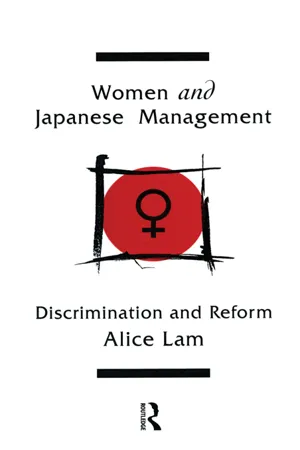
Standard works on the employment systems of Japanese companies deal almost exclusively with men. Women, however, constitute the vast majority of the low wage, highly flexible "non-core" employees.
This book breaks new ground in examining the role of Japanese women in industry. It assesses the extent to which growing pressure for equal opportunities between the sexes has caused Japanese companies to adapt their employment and personnel management practices in recent years.
The author puts the argument in an historical perspective, covering the employment of Japanese women from the start of Japan's industrialisation up to the turning point of the 1986 Equal Employment Opportunity (EEO) Law. She examines the background and execution of the legislation and she looks at the response of the business community. In her case study of the Seibu department store, which takes up the final part of the book, Lam concludes that the EEO Law has not had the desired effect.
Information
Chapter 1
Introduction and background
INTRODUCTION
It is often argued that the vitality of the Japanese employment system is sustained by personnel management rules and practices which make a clear distinction between the ‘core’ and the ‘non-core’ employees. The former, predominantly male, enjoy the privileges of long-term employment, wage increases and promotion based on age and length of service (nenko), and internal career progression through job rotation and in-company training; whereas the latter group is excluded (Galenson and Odaka 1976; Ishikawa 1980; Odaka 1984). Women workers constitute a high proportion of the latter category of employees. Their relatively low wages, high turnover and flexible entry and exit from the labour market play an especially important role in maintaining the flexibility of the employment system (Shinotsuka 1982; Kawashima 1987). Until very recently, direct exclusion and discrimination against women in all stages of employment was both legal and socially acceptable.
The picture began to shift from the mid-1970s. Social and economic changes gradually brought into question companies’ discriminatory employment policies against women. The advent of the ‘service economy’ has expanded women’s job opportunities and given them better access to the business world. Increased internationalisation of Japan also brought to the fore the low status of Japanese women in all aspects of the society, especially in the field of employment, compared with their counterparts in other advanced countries (The Economist 1988). Internal socio-economic changes, coupled with pressures from the international community, eventually led to the introduction of the Equal Employment Opportunity (EEO) Law in May 1985.
This law prohibits discrimination against women in vocational training, fringe benefits, retirement and dismissal. It also ‘exhorts’ (‘morally obliges’) employers to treat women equally to men with regard to recruitment, job assignment and promotion. The EEO Law marks an important turning point in the history of women’s employment in Japan. For the first time in Japanese history, formal guarantees of equal treatment between women and men at all stages of employment are enshrined in a single piece of legislation. The enactment of the EEO Law has aroused much controversy and debate which is unprecedented in the history of labour legislation in Japan. The Japanese government described the passing of the new legislation as ‘a great historical moment for all kinds of movements against discrimination in Japan’ (MOL 1986). Despite its apparent lack of legal teeth, the legislation has important political and symbolic significance. The application of ‘moral obligation’ as a kind of indirect sanction puts the employers in a defensive position. Employment practices which were accepted as a ‘natural’ result of social customs would have to be put on the agenda for discussion and negotiation. Japanese companies, which have for a long time built their high performance upon an employment system which offers men ‘lifetime’ career jobs, are confronted with a fundamental dilemma of how to make greater use of women in key business positions without destroying the distinctive features of the employment system.
The central aim of this book is to examine the extent to which the growing pressures for equal opportunities between the sexes have caused Japanese companies to adapt and modify their employment and personnel management practices in recent years. It analyses the major social and economic factors prompting Japanese companies to adopt more open employment policies towards women since the mid-1970s and the programmes of change introduced by management. It looks especially at how companies have reacted to the 1985 EEO Law and, in the light of this, considers how far the present legislation will bring about fundamental changes in the Japanese employment system towards a more egalitarian treatment of women. A detailed case study was conducted at Seibu Department Stores Ltd, before and after the introduction of the EEO Law, as a critical test of the possibility of introducing equal opportunities for women in a large Japanese company (see p.21).
The theoretical approach of this study is located in the context of a major debate central to contemporary studies on the Japanese employment system: whether the drift away from the ‘traditional’ Japanese model of employment and personnel management as a result of socio-economic changes and external challenges is inevitable. This question has preoccupied many Japanese and foreign scholars. In the 1950s, when the ‘Japanese employment system’ was first perceived as distinctively different from the systems prevailing in western countries, it was seen as a hangover from the feudal past, destined to give way to more modern, ‘rational’ systems (Tsuda 1959). The continuous high performance of the Japanese economy led to a subsequent re-evaluation and to the recognition that the Japanese system has many merits, compared with those of the West (Nakayama 1975; OECD 1977). This positive re-evaluation has not eliminated recurrent prophecies about the inevitable change of the Japanese system in a ‘western’ direction. In the 1980s, the challenge of equal opportunities for women added extra impetus to the speculation about the eventual collapse of the Japanese employment system. How far and in what direction is the Japanese employment system changing? Is it changing in a direction which offers more egalitarian employment and career opportunities for women?
Equal employment for women is not an independent social or human rights issue. Companies’ personnel policies for women constitute an integral part of the empoyment and labour market systems. Changes to women’s labour market position would require major structural adjustments in the established employment system. The future of equal employment for women is greatly dependent on how far major Japanese companies are prepared to modify many of their core employment practices.
This book is a study of how Japanese companies have adapted their employment policies and practices in response to the growing pressures for more egalitarian treatment of women. It is also about the possibility of bringing about change in an employment system which has brought about the world’s most closed and male-dominated internal labour markets.1 From the theoretical and policy point of view, Japan provides a particularly interesting case study for examining the dynamics of change. There are three reasons for this.
First, internal labour market theorists argue that the rules and procedures which define the internal labour markets and govern their operation, once institutionalised, tend to be self-perpetuating and are difficult to change (Doeringer and Piore 1971). The Japanese employment system has been under increasing pressure for change as a result of many social and economic changes in recent years. Equal opportunities for women is one of the new challenges confronting Japanese management. The emerging situation in the 1980s provides an excellent opportunity to examine the interplay between social and economic forces in shaping employers’ policies and practices—their strategies for change and adaptation in response to growing pressures for sexual equality. Japan, thus provides an interesting case for examining how an employment system with well-developed internal labour markets responds to the pressures for change.
Second, there are reasons to expect the process of change to be more complex in Japan. It is a country which is uniquely situated between the advanced industrial societies of the West and the less-developed countries. Japan emerged as a modern state after World War II. Economically, it is an advanced industrialised country. Socially, it shares many similar characteristics with other developing countries. Particularly illustrative is the position of women in the society. Further, the continued high performance of the economic system means that the desire among policy makers to maintain the present employment system is strong. This makes demands for equal employment a much more sensitive and complex issue than elsewhere.
Third, Japan also provides an excellent case to ‘test’ whether politics and policy intervention matter in equal employment issues. The struggle for equal employment for women in many western, advanced industrial societies has its base in economic and social changes, but the main force for propelling it to the level of state policies has been largely political. In the United States, the politics of the civil rights and women’s movement have played an important role in transforming the demands for equal opportunities into public policies (Burstein 1985). In Japan, the economic conditions which are pushing Japanese companies to adopt more egalitarian employment policies for women are present. However, government intervention has been minimal; the EEO Law is an outgrowth of internal socioeconomic changes and external pressures from the international community, not a result of an indigenous women’s movement. Whether economic and commercial pressures alone can bring about changes in employment practices will reveal the degree to which equal opportunity strategies are needed.
The ultimate goals of equal opportunity policies involve normative choices which tend to vary from society to society. Moreover, the direction of change in the area of sexual equality also reflects the political strength and power balance of different social groups in a society and the demands of the economy. Despite the existence of many country-specific factors which may determine the ultimate shape of equal opportunity for women in different social systems, there are also many common fundamental issues facing all advanced industrialised countries. Japan, which is often regarded as representing an extreme case of sexual inequality and is often criticised as building its economic vitality upon the exploitation of women workers, provides a particularly interesting case for the examination of equal opportunity issues.
Before looking at the developments of recent years, a brief account is given of the origin and changing pattern of Japanese women’s employment to set the scene.
A BRIEF HISTORICAL OVERVIEW OF WOMEN’S EMPLOYMENT IN JAPAN
Historically high participation but poor working conditions
Japanese women’s entry into wage employment started in the early Meiji period and they constituted a much larger share of the industrial workforce than men during the first phase of industrialisation (1894–1913). The textile industry, the core industry in Japan during the first phase of industrialisation, employed a large number of women workers from the rural areas. In 1909, women comprised about 62 per cent of all factory workers and they comprised 86 per cent of the workforce in the textile industry (Takenaka 1983:47). Female textile workers represented the first widespread category of wage employment in Japan, and they remained a major group in the industrial workforce until the 1930s. During the inter-war period (1914–37), some Japanese women began to enter clerical jobs but their number was rather small. In 1920, of the 4 million women in gainful employment, only 500,000 (12.5 per cent) were employed in offices. Males dominated clerical jobs, females accounted for a mere 6.5 per cent in 1930. Thus, the predominant form of female employment before World War II was in unskilled blue-collar jobs in the low-paying textile industry.
The majority of female workers in the textile mills were daughters of poor farming families who worked in the factories away from home for a few years before they returned to marry in their villages. Most of them were forced to work in the factories by their elders in the family in order to help the family finances. Okouchi (1959) described this type of worker as ‘dekasegi gata chinrodo’ (household supplementary type labour migration). The working conditions of the female textile workers were extremely poor and wages exceedingly low.2 The majority of the female workers were housed in dormitories and lived under the entire control of the factories. Women workers during this period had no independence. The working conditions were so poor that many girls quit by running away. The turnover rate of these workers was extremely high. Saxonhouse (1976:100) described the Japanese textile industry’s labour force as the ‘most female and the most transient’ in international comparisons.
Despite their high participation in industrial work in pre-World War II Japan, women workers were not able to gain economic independence. In both Britain and the United States, the experiences of the ‘working girl’ in the textile industry did eventually lead to the increasing economic independence of women and their freedom as individual wage earners (Matthaei 1983:153; Pinchbeck 1930:313). In the case of Japan, the women workers’ strong ties with their rural families and their subservience to the patriarchal family system prevented them from establishing themselves as independent workers in the urban areas. Unlike the European countries where industrialisation led to the disintegration of patriarchy, the patriarchal family system in Japan, prescribed in the Meiji Civil Code (1898), persisted until the end of World War II.3 The patriarchal family system supported the early formation of capitalism in Japan and women workers were exploited by both systems (Kobayashi 1976:74).
World War II and the democratisation policies
As elsewhere, Japanese women were mobilised to take part in a wide range of economic activities during the war when men were recruited to the army. However, the impact of the war economy on the work experience of Japanese women was not as great as that in the European countries. This was partly because Japan did not have the history of relying on the female labour force during World War I, and partly because the government’s effort in mobilising the female workforce was delayed during World War II. Despite the need to rely on the female workforce, the government’s attitude towards mobilisation of women was rather ambivalent. There was strong concern that women’s participation in the labour force might lead to a reduction of the population. The government issued a national mobilisation directive early in 1938, but the final decision to mobilise women did not come into effect until as late as the autumn of 1943. By that time, there was already a shortage of raw materials and the productive capacity of the economy was declining. During the brief period when women took part in the war economy, they continued to be treated as an auxiliary labour force. The policy statements issued by the government at that time specified that women were to be used only for ‘simple and easy work’, for ‘light handwork calling for dexterity’ and ‘as semi-skilled or unskilled workers’ (Akamatsu 1977:33–5).
The greatest impact of the war on Japanese women came not so much through their direct work experience during the war but through the post-war reforms imposed by the Allied Occupation which lasted from 1945 until 1952. The sweeping reforms carried out by General MacArthur, as Supreme Commander for the Allied Powers (SCAP), brought about dramatic changes in the legal status of Japanese women. For the first time in history, women were granted equal rights with men under the new constitution of 1946. The constitution declared equality of all people before the law. Article 14 of the constitution prohibited discrimination in political, economic and social relations because of race, creed, sex, social status or family origin. Article 24 stipulated equality of the sexes in family life. Based on this principle of equality between the...
Table of contents
- Cover
- Halftitle
- Title
- Copyright
- Dedication
- Contents
- List of figures
- List of tables
- Acknowledgements
- Introduction
- 1 Introduction and background
- Part I Discrimination against women in employment: theory and practice
- Part II Legislation and reform
- Part III A case study
- Part IV Conclusions
- Appendix A
- Appendix B
- Notes
- Bibliography
- Index
Trusted by 375,005 students
Access to over 1.5 million titles for a fair monthly price.
Study more efficiently using our study tools.
Frequently asked questions
Yes, you can cancel anytime from the Subscription tab in your account settings on the Perlego website. Your subscription will stay active until the end of your current billing period. Learn how to cancel your subscription
No, books cannot be downloaded as external files, such as PDFs, for use outside of Perlego. However, you can download books within the Perlego app for offline reading on mobile or tablet. Learn how to download books offline
Perlego offers two plans: Essential and Complete
- Essential is ideal for learners and professionals who enjoy exploring a wide range of subjects. Access the Essential Library with 800,000+ trusted titles and best-sellers across business, personal growth, and the humanities. Includes unlimited reading time and Standard Read Aloud voice.
- Complete: Perfect for advanced learners and researchers needing full, unrestricted access. Unlock 1.5M+ books across hundreds of subjects, including academic and specialized titles. The Complete Plan also includes advanced features like Premium Read Aloud and Research Assistant.
We are an online textbook subscription service, where you can get access to an entire online library for less than the price of a single book per month. With over 1.5 million books across 990+ topics, we’ve got you covered! Learn about our mission
Look out for the read-aloud symbol on your next book to see if you can listen to it. The read-aloud tool reads text aloud for you, highlighting the text as it is being read. You can pause it, speed it up and slow it down. Learn more about Read Aloud
Yes! You can use the Perlego app on both iOS and Android devices to read anytime, anywhere — even offline. Perfect for commutes or when you’re on the go.
Please note we cannot support devices running on iOS 13 and Android 7 or earlier. Learn more about using the app
Please note we cannot support devices running on iOS 13 and Android 7 or earlier. Learn more about using the app
Yes, you can access Women and Japanese Management by Alice C L Lam in PDF and/or ePUB format, as well as other popular books in Social Sciences & Ethnic Studies. We have over 1.5 million books available in our catalogue for you to explore.