eBook - ePub
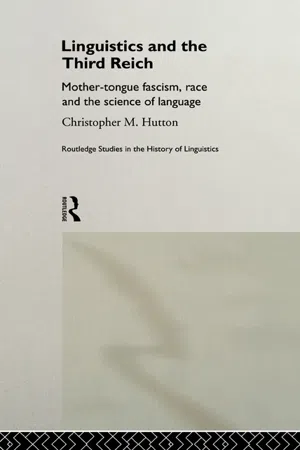
Linguistics and the Third Reich
Mother-tongue Fascism, Race and the Science of Language
- 432 pages
- English
- ePUB (mobile friendly)
- Available on iOS & Android
eBook - ePub
Linguistics and the Third Reich
Mother-tongue Fascism, Race and the Science of Language
About this book
This book presents an insightful account of the academic politics of the Nazi era and analyses the work of selected linguists, including Jos Trier and Leo Weisgerber. Hutton situates Nazi linguistics within the politics of Hitler's state and within the history of modern linguistics.
Information
1
Whose History?
Introduction
The question of ‘historicization’ has come to be central to debates about the historiography of Nazism, not least the ‘historians’ controversy’ (Historikerstreit). The Historikerstreit involved a polemical debate chiefly among German historians and intellectuals about how or whether the National Socialist era could be written into general history, and how different regimes were to be evaluated in relative terms (Stalinism versus Hitlerism, etc.). In a commentary on this debate Friedländer summed up the objectives of historicization as the attempt to make the study of the Nazi era ‘similar to that of any other historical phenomenon’, without pre-set limitation on the questions that can be asked and the methodology used:
It should be understood that the Nazi era cannot be judged only from the viewpoint of its catastrophic end, and that many aspects of life and social development during that era were not necessarily linked to bolstering the regime and its aims.
(1987: 313)
The Nazi era should be reinserted into its context in German and world history, and ‘the complex and contradictory aspects of that era’ recognized as ‘the only possible basis for anchoring a renewed moral evaluation of history in general in light of the lessons drawn from the historicization of National Socialism’. While Friedländer is not opposed to the comparative perspective on the Third Reich, he is concerned about the ease with which historicization can lead to relativization.
In addition to the Historikerstreit controversy, there occurred a Volkskundlerstreit in the discipline of folklore studies or Volkskunde (Dow and Lixfeld 1994: 273–4). This controversy concerned the careers of individual folklorists before after and during the Third Reich, and the question of whether one could speak of two Volkskunden, one that sold out its academic ideals and became corrupt, and another that retained its integrity (Brückner 1988; Emmerich 1968, 1971; Lixfeld 1994: 64–5; Strobach 1994). Ideological disputes between academics of the two post-war German states also became tangled in the historiography of the Nazi period (Jacobeit 1994).
The question of relativization and historicization is an extremely difficult one. For it is right that the ultimate judgement of the Nazi regime should be determined by the crimes it committed, crimes which have come to be symbolized by the name Auschwitz; yet one cannot read the writings of academics in that period solely through the ‘catastrophic end’ of the regime. Their work must also be read together with the histories of their disciplines. Nor should they be seen en bloc as faceless representatives of an authoritarian state: each individual scholar is different, and, for all the mass of material available, there is much that we do not understand.
The extraordinary case of Hans Ernst Schneider, the SS-Hauptsturmführer, Germanist and Nazi cultural activist who reinvented himself after the war as Hans Schwerte, and went on to a successful career in the German Federal Republic, can stand as emblematic for the enigma of National Socialist scholarship as a whole (see König et al. 1997). That enigma concerns inner life and private authenticity and the question: ‘Who is the real self?’, the National Socialist or the liberal democrat, or neither.
These questions are of relevance to all scholarly activity, unless we wish to hide behind a protective myth of unconstrained and disinterested free thought.
Structuralism Oppressed?
At the turn of the century, German scholars could have justifiably claimed leadership in Western linguistics, with their domination of historical linguistics (the Neogrammarians or Junggrammatiker) and their pre-eminence in fields such as psychology, ethnology, folklore studies and speech sciences. In the inter-war years this pre-eminence was lost as the different forms of European structuralism began to emerge and the United States began to gain importance as a centre for academic research into language, benefiting in this ultimately from various waves of scholarly emigration from Germany and Eastern Europe. The United States was an attractive goal not only for the impoverished masses of Eastern Europe but also for young Jewish scholars like Franz Boas (1858–1942), whose career paths were blocked by anti-Semitism in Germany. While the Neogrammarians retained considerable influence over German linguistics in the inter-war years, this period also saw the rise of a German school of organicist linguistics associated with the names of Leo Weisgerber and Jost Trier. These linguists rejected what they saw as the atomism, materialism and methodological individualism of the Neogrammarians to embrace various forms of collectivity, and this stance was maintained during the Nazi period (e.g. De Vries 1945: 49).
Relatively little attention has been paid to the history of twentieth century German linguistics in general histories and surveys of the discipline. In part this reflects the perception that European structuralism had at best a tentative and ambiguous hold on German linguistic thought in a century when structural (and synchronic) linguistics became for a time nearly synonymous with the discipline. While it is true that an obsession with a particular Germanic-cultic vision of the past was one expression of academic National Socialism, many of the younger German academics of the National Socialist period saw themselves as modernizers and innovators, anxious to sweep away old methodologies and entrenched privileges. They saw themselves as in opposition to the conservative academic establishment, and sought to establish the relevance and importance of scholarship for the national cause and the ‘New Germany’, to make the study of the past relevant to the present. In the Nietzschean tradition, they opposed dry philology and pedantry as the study of ‘dead languages’, and sought a role for scholarship in the revitalized ‘New Germany’.
The interdisciplinary disciplines of germanische Philologie and deutsche Philologie certainly loomed large in the academic study of language in Germany. They were not clearly distinguished from Germanistik, a term which had been in use since the 1840s (Maas 1993: 386). However it should be emphasized that other disciplines also played an important role. Between 1933 and 1945 the study of language in Germany fell under the various European national philologies (Romanistik, Anglistik, Slawistik), it came as part of social scientific disciplines, particularly folklore (Volkskunde), but also ethnology (Völkerkunde), sociology (Soziologie), pedagogy and education (deutsche Bildung, Deutschkunde), geography, physical anthropology (Anthropologie), race studies (Rassenkunde), historical disciplines like prehistory and archaeology, classics, oriental studies, psychology and philosophy. Phonetics provided a bridge to psychology, as well as to the natural sciences. Linguistics also had a strong role in normative approaches to language (Sprachpflege). General linguistics (allgemeine Sprachwissenschaft) tended to be linked with historical and comparative linguistics, in particular Indo-European linguistics (Indogermanistik), a discipline with the Germanic languages at its core. But a form of general linguistics on Saussurean lines, associated with linguists in Switzerland, Paris, Prague, Copenhagen and Vienna, also played an important role. For example, Fritz Stroh used the term allgemeine Sprachwissenschaft in this sense in his contribution to Otto Behaghel’s 1924 Festschrift (Stroh 1924). There was in any case no clear boundary between Indo-European general linguistics and Saussurean general linguistics. Leo Weisgerber, for example, was both a trained Indo-Europeanist and someone engaged with Saussure’s ideas. It is therefore difficult, when dealing with the first half of the twentieth century, to determine who should be termed a linguist and who not. Maas talks of a ‘semi-professionalization’ of the discipline in that period (Maas 1988a: 256). Simon estimates the number of linguists who were active in the Third Reich to have been about 250 (1986a: 527).
Intellectual questions about the nature of language, language in history and language in relation to Geist were part of shared intellectual baggage in the humanities (Geisteswissenschaften), and might be addressed by literary critics, sociologists, historians, folklorists or philosophers in addition to linguists. Often such discussions centred on the works of Herder and Humboldt, both founding fathers of German linguistics, but also central to the intellectual culture as a whole. As illustration of this tradition of language study, one could cite one work from the 1920s and one from the late 1930s: Otto Funke’s historical study of the philosophy of language (Funke 1927) and Hanna Weber’s account of Herder’s philosophy of language (Weber 1939).1 Funke discussed the eighteenth century, James Harris’ Hermes and then gave an overview of the modern scene, dividing it into three groups: the ‘romantic’ group (Humboldt, Steinthal, Wundt, E. Cassirer, W. Porzig and L. Weisgerber), the aesthetic–idealist tendency (Vossler) and the empirico-psychological group (H. Paul, Fr. Brentano, A. Marty, K. Bühler).2 Funke was also the author of an introduction to Anton Marty’s philosophy of language (Funke 1924; Otto 1941/2). Among others, Weber looked at Herder in relation to linguistic works by the following: Ernst Cassirer, Hans Freyer, Gunther Ipsen, Hans Naumann, Georg Schmidt-Rohr, Hugo Schuchardt, Fritz Stroh, Karl Vossler, Leo Weisgerber and Wilhelm Wundt (Weber 1939: 97–8).
The names listed above include both Nazis and victims of Nazism. For example, Ernst Cassirer, a Jew, was forced into retirement in 1933 and eventually reached the United States in 1941; Gunther Ipsen became a member of the NSDAP on 1 May 1937.3 Karl Bühler was arrested by the Gestapo on 23 March 1938, released on 7 May and subsequently allowed to emigrate (Sebeok 1981).4
How can the history of linguistics, a discipline that holds to the view that it is a science of unbiased description, be written so as to include linguistics under National Socialism? In post-war German linguistics, general European structuralism came to be seen as ideologically neutral. It was felt to be distinct from ‘native’ German traditions of linguistic investigation that looked back to figures such as Herder, Humboldt and Grimm and the ambivalences of German linguists’ allegiance to structuralism became for many an index of their commitment to a dispassionate investigation of language. Peter von Polenz appeals to just such an opposition in his discussion of Saussure’s place in German linguistics (1968). For von Polenz, the late date of the German translation of Saussure’s Cours de linguistique générale (1931) and the isolation of German linguistics – even after 1945 with Weisgerber’s ‘Humboldt-Renaissance’ – are symptoms of a lack of rigour in German linguistics. He argues that 1931 was an inauspicious year for the reception of the Cours in Germany, and that ‘one sided diachronic thinking’ is related to historicism and conservatism, since it involves judging the value of words according to their past (Polenz 1967: 148). Polenz thus links the ‘etymological fallacy’, the idea that the true meaning of a word is to be found in its original or historically established meaning, to political conservatism and anti-Semitism (1967: 148–9). As illustration he cites etymological sketches published by the linguist Alfred Götze in the journal Muttersprache in the early years of National Socialist rule (1967: 128).5
Newmeyer argues that the distinction between structural linguistics and National Socialist linguistics was officially defined:
The political opposition to structural linguistics was strong enough to keep it from gaining a foothold in other places as well. Both nazi Germany and fascist Italy had officially condemned structuralism as incompatible with the ideology of the state. During the nazi period, the pages of German linguistic journals were filled with vivid descriptions of how the German soul manifests itself in its people’s masterful language.
(1986: 37)
However any notion that structuralism was repressed under National Socialism must be dismissed as a complete myth (Simon 1989b), as is the notion of a delayed reception of the Cours in Germany (Maas 1993: 406n). Nor is there any corollary between the holding of racist views and anti-structuralism: Eberhard Zwirner, the founder of a specific branch of structuralist linguistics (Phonometrie), is a case in point (see Chapter 9).
Saussure’s significance as a linguistic theorist was recognized in Germany immediately on the publication of the Cours, as the perceptive review by Schuchardt (1917) shows.6 Saussure’s Cours had been assimilated without too great difficulty into inter-war neo-Kantian ‘organicist’ linguistics, as Stroh (1924: 231, 1934: 231) illustrates. In Weisgerber’s writings of the late 1920s and early 1930s Saussure’s Cours is taken for granted as part of the intellectual background. Mathesius (1935/6) used the term ‘synchronisch’ without direct reference to Saussure. Trier (1932b) – a critic of Saussure – lamented however that the Saussurean notion of the interrelatedness of word meanings had been neglected; this paper was republished in 1939. Funke (1944: 23, 23n) noted that Humboldt, Marty, de Saussure and Bally had articulated the notion of a language as a system. In an explicitly structuralist article, Funke, writing from Bern, recorded in a footnote (1944: 21n) that he had presented the material in talks at the universities of Bonn and Marburg in 1942, i.e. in the heart of the German academic establishment at the height of the war.
The late 1930s and the war years also saw intense discussion of Saussure as a general linguistic theorist in the journals Acta Linguistica of Copenhagen and the Cahiers Ferdinand de Saussure in Geneva.7 Lerch’s discussion of the Saussurean theory of the sign (1939) was part of this forum, one which involved for example linguists from Belgium8 (Buyssens 1940/1, 1942/3), Switzerland (Sechehaye, Bally and Frei 1940/1), France (Pichon 1940/1) and Denmark9 (Hjelmslev 1942) as well as Germany. Volume 2 of Acta Linguistica includes a contribution co-authored by one Swiss and two German academics on the Saussurean concept of the sign (Borgeaud, Bröcker and Lohmann 1942/3). One of the German contributors, Walter Bröcker, was professor of philosophy in Rostock, and a member of the NSDAP.10
The literature on the linguistic sign and Saussure therefore involved active Nazi academics (Bröcker), a dismissed German professor still actively publishing in Germany (Lerch), academics from neutral countries (Bally, Frei, Sechehaye), and academics from occupied countries (Buyssens, Hjelmslev). It also included the British linguist Alan Gardiner (1944).11
This is not to say that Saussure was uncritically accepted in Germany. Clearly discussion of Saussure as a foundational theorist was more prevalent in Geneva, Copenhagen and Paris than in German universities. One critical voice within Germany was Emil Winkler12 (1937, 1938), who rejected the ‘méthode statique’ of French linguistic theory (1937: 439–40) and promoted a view of linguistics as Geisteswissenschaft based on ‘inner form’. This inner form was ‘the surviving element of the creative linguistic act’ which was left in language in its ‘debased’ function as a medium of communication (Winkler 1933: 29, quoted in Glässer 1942: 455). Winkler (1938) sought to characterize the difference between French and German thinking about language. He contrasted Saussure and Bally’s view of language with the Herder–Humboldt tradition that dominated in Germany, and suggested that the linguists of these two nations are influenced by their respective mother-tongues. Saussure claimed in making the distinction between langage and langue to be defining things, not words. But, Winkler points out, the linguistic means to make this distinction exist only in French. In the German tradition the emphasis is on the unity of Volk and language, and on language as constituting social unity; Frenc...
Table of contents
- Cover
- Half Title
- Title Page
- Copyright
- Contents
- Acknowledgements
- Introduction
- 1. Whose history?
- 2. The defence of cultural diversity
- 3. Academic politics
- 4. Etymology as collective therapy: Jost Trier’s leap of faith
- 5. The strange case of Sonderführer Weisgerber
- 6. ‘A complicated young man with a complicated fate, in a complicated time’: Heinz Kloss and the ethnic missionaries of the Third Reich
- 7. Yiddish linguistics and National Socialism
- 8. Vitalist linguistics, linguistics as theosophy and characterology
- 9. Linguistics, race and the horror of assimilation
- Appendix
- Notes
- Bibliography
- Index
Trusted by 375,005 students
Access to over 1.5 million titles for a fair monthly price.
Study more efficiently using our study tools.
Frequently asked questions
Yes, you can cancel anytime from the Subscription tab in your account settings on the Perlego website. Your subscription will stay active until the end of your current billing period. Learn how to cancel your subscription
No, books cannot be downloaded as external files, such as PDFs, for use outside of Perlego. However, you can download books within the Perlego app for offline reading on mobile or tablet. Learn how to download books offline
Perlego offers two plans: Essential and Complete
- Essential is ideal for learners and professionals who enjoy exploring a wide range of subjects. Access the Essential Library with 800,000+ trusted titles and best-sellers across business, personal growth, and the humanities. Includes unlimited reading time and Standard Read Aloud voice.
- Complete: Perfect for advanced learners and researchers needing full, unrestricted access. Unlock 1.5M+ books across hundreds of subjects, including academic and specialized titles. The Complete Plan also includes advanced features like Premium Read Aloud and Research Assistant.
We are an online textbook subscription service, where you can get access to an entire online library for less than the price of a single book per month. With over 1.5 million books across 990+ topics, we’ve got you covered! Learn about our mission
Look out for the read-aloud symbol on your next book to see if you can listen to it. The read-aloud tool reads text aloud for you, highlighting the text as it is being read. You can pause it, speed it up and slow it down. Learn more about Read Aloud
Yes! You can use the Perlego app on both iOS and Android devices to read anytime, anywhere — even offline. Perfect for commutes or when you’re on the go.
Please note we cannot support devices running on iOS 13 and Android 7 or earlier. Learn more about using the app
Please note we cannot support devices running on iOS 13 and Android 7 or earlier. Learn more about using the app
Yes, you can access Linguistics and the Third Reich by Christopher Hutton in PDF and/or ePUB format, as well as other popular books in Lingue e linguistica & Linguistica. We have over 1.5 million books available in our catalogue for you to explore.