This volume centers on theories and methodologies for postgraduate feminist researchers engaged in interdisciplinary research. In the context of globalization, this book gives special attention to cutting-edge approaches at the borders between humanities and social sciences and specific discipline-transgressing fields, such as feminist technoscience studies.
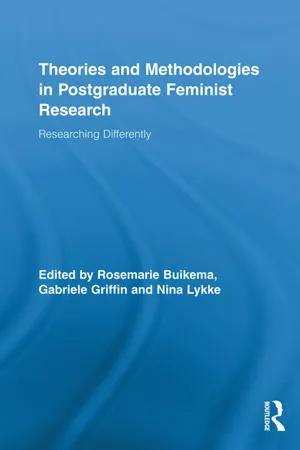
eBook - ePub
Theories and Methodologies in Postgraduate Feminist Research
Researching Differently
- 292 pages
- English
- ePUB (mobile friendly)
- Available on iOS & Android
eBook - ePub
Theories and Methodologies in Postgraduate Feminist Research
Researching Differently
About this book
Information
Part I
Feminist Theories
1 Gender Research with ‘Waves’
On Repositioning a Neodisciplinary Apparatus
Developments in feminism are generally narrated according to a model of two or three waves. The waves function as metaphors for feminist movement in which crests and undercurrents alternate. A ‘crest’ then refers to heightened or intensified feminist movement. It refers to ‘the’ feminist movement at a certain time and place. Feminist waves are successive (they presume a progress narrative) and are supposed to respond to one another in a dualist way (they imply a pattern of sequential negation). The first feminist wave crested around 1900 and concerned the struggle for North American and Northern and Western European women’s right to vote, for women’s access to education, and for changing matrimonial law. The second wave of feminism is generally dated between 1968 and 1980 and again was located in the United States and Northern as well as Western Europe. Second-wave feminists are supposed to have objected to the equality feminism of the first wave; the rights gained had not changed the minds, and practices of men (and women). During the second wave, theories of the body, sexuality, and relationships were revolutionised (‘the personal is political’). The third wave is supposed to have started in the US in the 1980s and has a strong relationship to popular culture (e.g., music and on-line fanzines). This last wave is still in the making; despite the fact that an encyclopaedia of third-wave feminism has been published (Heywood 2005), Anglo-US and Western and Northern European feminists under thirty struggle to re/ claim the term ‘feminism’ for their activities. Notwithstanding the overlap between the third- and second-wave feminist agenda (proponents of third wave also politicise the personal), third-wave feminism is often questioned owing to its seemingly individualistic and populist methodologies. If we look at the ways in which the term ‘feminist wave’ is used nowadays in popular as well as academic discourses, we see that feminist movements seem to be taking place along the ‘trans-Atlantic dis-connection’ (Stanton 1980). Also, the movement itself is usually narrowed down to second-wave feminism. In other words, when using the wave model, feminism appears spatiotemporally fixed.
Re/describing the history of feminism according to a model of waves, scholars tend to assign individual feminists and feminist groups to certain waves, and vice versa. The waves then become denominators; and despite the continuous movement suggested by the metaphor itself, waves become locatable in time and space. Dutch feminist Anja Meulenbelt for instance has become an archetypical second-wave feminist on the basis of her autobiographical, self-revealing writings, and as such, is compared to North American Kate Millett. German Verena Stefan is added to this list; all three feminists have engaged with the same writing practice and are from the same age group (the ‘baby boomers’). My feminist peers and I are excluded from this writing practice, simply because we are from a different age group (‘Generation X’). According to a progressive and dualist spatiotemporal logic, we are differently located from Meulenbelt, Millett, and Stefan; second-wave feminism and its practices are out of reach for us.
Academic feminists of today also question the wave model as a canonised device for feminist theorisation (Aikau 2007). According to these analyses, the waves as descriptive terms are historically inadequate and have become prescriptive. It is sometimes said that doing research with waves has resulted in biased readings as the wave model erases certain (black, lesbian, Southern and Central European) feminists from feminist history. A more personal approach to the normativity of feminist waves results in questions such as, ‘Why can’t I be a second-wave feminist? I feel closer to Meulenbelt than to the writers of postfeminist chick lit!’ Feminist waves are also used normatively to differentiate between feminist theory and feminist practice, between activism and academia. In this case, the second feminist wave is made responsible for the epistemic twist in Western feminism, and its members are blamed for having taken the activism out of feminism as a result of ‘the long march through the institutions’ (Hemmings 2005). This evaluation can be seen as an equally paralyzing effect of doing research with waves; as feminism gains ground in the academic world, there is supposed to be a loss of activism in the supposedly real world, and second-wave feminists are supposed to comply with the corporate academy. The concept of the feminist wave thus seems to have lost all of its visionary power. Doing research with waves has become in many ways a stifling exercise.
The spatiotemporal fixity becomes fully apparent when we add post-feminism to our toolbox. Whereas third-wave feminism has the potential to become many things, postfeminism only repeats the pattern of progress narrative and sequential negation assumed by scholars doing research with feminist waves. Affirming postfeminism alongside second-wave feminism is the most explicit strategy for freezing feminism in the past and for essentialising not only the 1970s, but also the here and now. I would like to suggest naming the postfeminist appeal ‘narcissistic’ as it is predicated on a celebration of our current times as having reached equality between the sexes (read: as having transcended the need for feminism). This strategy is not necessarily different from a—what I would like to call—‘nostalgic’ outlook. Nostalgia underlies the reduction of feminism to second-wave feminism. From a nostalgic point of view, a contemporary feminism is not within our reach; rather, it is something that belongs to the past. Researching nostalgically, the 1970s are celebrated as the prototypical feminist times: at best, contemporary feminism can be a bad copy of what was done back then. Thus, according to both narcissism and nostalgia, we are cut off from feminism in the here and now. The two tendencies are thus ‘false opposites’ or ‘non-exhaustive dichotomies’ (Nelson 1993). In both cases, feminism translates into second-wave feminism. In both cases, feminism is no longer in movement; feminism is simply something that has been.
In this chapter I engage with the suspicion that has arisen around researching with waves. I approach the feminist wave model as a neodisciplinary apparatus that needs to be repositioned in order for the virtuality of feminist movement to make a comeback. I argue that the wave model as well as the disciplinisation of gender research has restrictive rather than enabling effects. This chapter is thus written in what Nina Lykke calls a ‘postdisciplinary’ mode (chapter 9, this volume): I critically engage with ways of organising feminist academic knowledge production. ‘Disciplinary apparatus’ is a Foucauldian concept. Karen Barad uses it as a synonym of ‘agency of observation,’ a concept that she has adapted from Niels Bohr. Adapting it, the concept becomes a tool for understanding (trends in) scholarship in an ‘ontoepistemological’ manner (Barad 2003, 829; 2007, 409n10), which is to say that not only do we study the epistemological aspect of researching with waves (waves as mapping feminist thought and movement), but also their effect (i.e., the resulting paralysis, whether there actually is feminist movement nowadays). In this chapter, I will talk about the wave model as a neo-disciplinary apparatus because contemporary gender studies sometimes acts as a neodiscipline in Anglo-American and European academia. Gender studies is a relatively young branch of the academic tree that nonetheless uses apparatuses such as the wave model for streamlining its debates. Here it should be noted that my use of ‘neo-’ should not be seen as invoking a progress narrative and a dualism between gender-sensitive and genderblind academic practices. Both Barad and Elizabeth Grosz, whose work is also important for the argument made in this chapter, do not allow for thinking ‘the new’ in terms of causal linearity or predictability. They are interested in a continuous rethinking of (feminist) revolutions in thought. Theorising the wave model as an apparatus in gender research, I continue assigning it a central place in feminist theorising. However, I also recognise the importance of studying, not the wave model as such—i.e., if the idea of waves describe or prescribe feminist movement or if it is a metaphor that correctly reflects feminist movement—but rather its ontoepistemic effects. In other words, the claim about the nonexistence of feminism in the here and now should be seen as a claim effected by the use of a scholarly model of waves, not as one of which the (preferred) truth-value can be verified or falsified. In the next section I will introduce the methodology for studying the effects of scholarly apparatuses.
Theorising the Disciplinary Apparatus
Barad has adapted the work of Michel Foucault and Bohr while inventing the theoretical framework of ‘agential realism.’ Agential realism addresses the interplay of the material and the discursive/semiotic, the ontological and the epistemological, and the so-called ‘end’ of (feminist) postmodernism. She aims at overcoming the assumption that once ontological issues are addressed positivist modernism is the only option, whereas for epistemological issues only social constructivist postmodernists are on track. This is her argument:
[T]here is a tension set up between realism and social constructivism that is an acknowledgment of the dichotomous portrayal of these positionings—a polarization that itself relies upon the ambiguity of both terms. The dichotomized positions of realism and social constructivism—which presume a subject/object dichotomy—can acknowledge the situated/constructed character of only one of the poles of the dualism at a time. Realists do not deny that subjects are materially situated; constructivists insist upon the socially or discursively constructed character of objects. Neither recognizes their mutually constitutive ‘intra-action’ (Barad 1999, 2).
The fact that two seemingly opposite traditions can understand only one pole at a time and not the ways in which they are actually predicated on (the exclusion of) the other pole is a result of dualism (Van der Tuin, 2011). Barad counteracts this tradition by explaining the assumption of ‘representationalism’ that is shared by the two poles. Barad argues that traditionally realist approaches to academic work (assuming the mirror of nature in which scientific claims reflect nature ‘out there’) and social constructivist ones (according to a charged reading, social constructivism assumes the mirror of culture in which scientific claims reflect academic culture and are cut off from what is ‘out there’) pursue a correspondence theory of truth. She states that the representationalism that is shared construes the opposition between realism and constructivism as a nonexhaustive one (Barad 2003, 802). In other words, Barad develops agential realism by bridging (feminist) positivism’s realist approaches and (feminist) postmodernism’s constructivist approaches. Barad’s ontoepistemological framework is non-representationalist.
Barad’s ‘disciplinary apparatus’ is developed using agential realism. Agential realism, in turn, is rooted in Barad’s study of Bohr’s revolutionary insight into physics experimentation. Bohr looked at laboratory instruments as an integral part of both the process of experimentation and its outcomes. He rescued lab instruments from physicists’ and philosophers’ ignorance and theorised them as influencing what Barad calls, following Donna Haraway, ‘world-making practices.’ The idea is that instrumentation does things; that it produces the ontology that we are working with (realism) or cut off from (social constructivism). Barad contends that an interdisciplinary space that is neither pure philosophy nor pure physics enabled Bohr to construct the formula ‘measurement = matter + meaning’ (1996, 165–66). It is in the act of measurement that theory (meaning, epistemology) and practice (matter, ontology) meet. In other words, matter gets meaning just as meaning gets its embodiment/materialisation in measurement. In order to move away from traditional approaches to measurement, Bohr uses the concept ‘phenomenon’ for instances of measurement. According to Barad, Bohr’s view consists of the following:
[S]ince observations involve an indeterminable discontinuous interaction, as a matter of principle, there is no unambiguous way to differentiate between the ‘object’ and the ‘agencies of observation’—no inherent/naturally occurring/fixed/universal/Cartesian cut exists. Hence, observations do not refer to objects of an independent reality. (Barad 1996, 170; emphasis in original)
Observed objects and the apparatuses or agencies of observation can only be distinguished artificially through a constructed ‘cut’ (see also Lykke, chapter 9, this volume). Barad adapts Bohr’s concept of the apparatus to show that just as the observer is both the scientist and her instrumentation, the thing measured is both the object and the instrumentation (Barad 1996, 172). Hence ontology and epistemology are inseparable. The object and the subject of knowledge, thing and word, nature and culture (ibid., 173, 175; Barad 1999, 2) are material-discursive.
In this chapter I assume that the concept of the disciplinary apparatus can be transposed from the experimental sciences to the interdisciplinary space of women’s/gender/feminist studies. This kind of transposition is valid when working in a postdisciplinary mode: as Lykke states, the critical questioning of ways of organising academic knowledge production is accompanied by a creative experimentation with disciplinary boundary crossing and transversal openness (chapter 9, this volume). After all, (academic) feminism is a matter of criticism and creativity (Braidotti 1991, 164). Moreover, the transposition can be found in the work of Barad herself.
Let us start by looking at Barad’s use of the concept of ‘agency,’ a concept from the (feminist) human sciences that she applies to the natural sciences. Barad does not assume a world ‘out there’ that exists prior to language and that comes wholly unmediated to scientists. Nor are we fundamentally cut off from the real. Agential realism relies on Barad’s neologism ‘intra-action’ (1996, 179; see also McNeil and Roberts, chapter 2, this volume). Pairs such as subject/object and thing/word do not exist independent of one another before they are brought into contact (interaction) in measurement; and because subject/object and thing/word intra-act from the start, we cannot think in terms of original and copy or a simple cause and effect relation between the two. What we theorise here is effectuation, or productivity, and ‘what is produced is constrained by particular material-discursive factors and not arbitrarily construed’ (Barad 1999, 2). Barad’s definition of ‘objectivity’ summarises the theorisation of productivity as follows:
[M]aterial apparatuses produce material phenomena through specific causal intra-actions, where ‘material’ is always already material-discursive—that is what it means to matter [W]hat is important about causal intra-actions is the fact that marks are left on bodies. Objectivity means being accountable to marks on bodies. (Barad 2003, 824; emphasis in original)
‘Marks on bodies’ consist of graphs on paper but also include concrete bodies of persons who are literally affected by (sexist, racist, heterosexist, ageist, etc.) theories and other doings. Agency is positioned in scientists’ intra-action with the world and in the possibilities of scientists acting on the marking process (Barad 2003, 827). Agential realism thus allows for thinking change.
Scientists are constantly engaged in world-making practices by enacting (always provisional) cuts (ibid., 817). Barad locates openings for change in the enactment of worlds through the incision of certain cuts and not others (ibid., 827). Barad thus affirms it is not that we, as scientists or as subjects of knowledge, have the agency fo...
Table of contents
- Cover Page
- Half Title Page
- Series Page
- Title Page
- Copyright Page
- Contents
- List of Figures and Tables
- Series Editors’ Foreword
- Preface: Editors' Note on Naming Practices
- Acknowledgments
- Editorial Introduction Researching Differently
- Part I Feminist Theories
- Part II Methodologies
- Part III Research Methods
- Part IV Multi-, Inter-, Trans- and Postdisciplinarity
- Part V Professionalisation
- Part VI The Choice of Topic and Research Questions Some Examples
- Part VII Coda The Desires of Writing
- Contributors
- Index
Trusted by 375,005 students
Access to over 1.5 million titles for a fair monthly price.
Study more efficiently using our study tools.
Frequently asked questions
Yes, you can cancel anytime from the Subscription tab in your account settings on the Perlego website. Your subscription will stay active until the end of your current billing period. Learn how to cancel your subscription
No, books cannot be downloaded as external files, such as PDFs, for use outside of Perlego. However, you can download books within the Perlego app for offline reading on mobile or tablet. Learn how to download books offline
Perlego offers two plans: Essential and Complete
- Essential is ideal for learners and professionals who enjoy exploring a wide range of subjects. Access the Essential Library with 800,000+ trusted titles and best-sellers across business, personal growth, and the humanities. Includes unlimited reading time and Standard Read Aloud voice.
- Complete: Perfect for advanced learners and researchers needing full, unrestricted access. Unlock 1.5M+ books across hundreds of subjects, including academic and specialized titles. The Complete Plan also includes advanced features like Premium Read Aloud and Research Assistant.
We are an online textbook subscription service, where you can get access to an entire online library for less than the price of a single book per month. With over 1.5 million books across 990+ topics, we’ve got you covered! Learn about our mission
Look out for the read-aloud symbol on your next book to see if you can listen to it. The read-aloud tool reads text aloud for you, highlighting the text as it is being read. You can pause it, speed it up and slow it down. Learn more about Read Aloud
Yes! You can use the Perlego app on both iOS and Android devices to read anytime, anywhere — even offline. Perfect for commutes or when you’re on the go.
Please note we cannot support devices running on iOS 13 and Android 7 or earlier. Learn more about using the app
Please note we cannot support devices running on iOS 13 and Android 7 or earlier. Learn more about using the app
Yes, you can access Theories and Methodologies in Postgraduate Feminist Research by Rosemarie Buikema, Gabriele Griffin, Nina Lykke, Rosemarie Buikema,Gabriele Griffin,Nina Lykke in PDF and/or ePUB format, as well as other popular books in Scienze sociali & Studi di genere. We have over 1.5 million books available in our catalogue for you to explore.