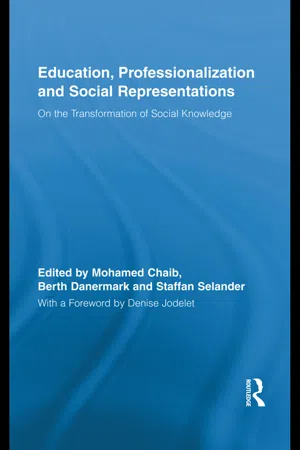
This book presents a broad range of research related to how social knowledge is shared, transmitted and transformed in the context of education and professional formation. The chapters of this edited collection reflect different theoretical and empirical approaches to that form of common-sense knowledge called social representations, the theory of which was developed almost a half-century ago by Serge Moscovici. Scholars from various research institutions in Brazil, France and Sweden, spanning a wide variety of disciplines within the social sciences, have contributed chapters that are grouped into three main categories related to education, professionalization and transformation of knowledge. Part I covers theoretical approaches to understanding the transformation of social knowledge from the perspective of social representations. Part II analyzes the impact of the theory of social representations on the transformation of knowledge in the field of education and professional formation. Finally, Part III presents several empirical studies focused on the social and cultural frames that condition the transformation of knowledge. While the book is devoted to education and the emerging field of research on professionalization, it will also appeal to anyone with a general interest in how people acquire their worldviews and how these views influence their actions.
eBook - ePub
Education, Professionalization and Social Representations
On the Transformation of Social Knowledge
- 252 pages
- English
- ePUB (mobile friendly)
- Available on iOS & Android
eBook - ePub
Education, Professionalization and Social Representations
On the Transformation of Social Knowledge
About this book
Information
Part I
Theoretical Approaches
1
Transformations and Changes in Social Knowledge
Towards the Dynamics of Meaning Making
Anders Gustavsson and Staffan Selander
THE SCOPE
The general scope of this chapter is social knowledge, with a special interest in its dynamics. How does social knowledge change, and how can such processes of change be understood? In a recently published book, Ivana Marková (2003) addresses these questions from within the theory of social representations and states: “Although we have numerous theories about stable universals, their nature, content and form, we do not have theories of social knowledge based on concepts of change” (p. 5). The issue of change versus stability has for a long time been an issue in the literature on social representation (see Marková & Wilkie, 1987; McKinlay & Potter, 1987; Perez Campos, 1998; Purkhardt, 1993). Even if our interest in social knowledge is broader than the field of social representation, we will use the theoretical development of social representation as our special case in exploring transformations and changes of social knowledge. The more precise scope of this chapter is the relation between change and stability, with a special focus on processes of construction, transformation and evolution of social knowledge.
EDUCATION AS A PRIVILEGED FIELD FOR THE STUDY OF TRANSFORMATIONS OF SOCIAL KNOWLEDGE
Our own research has its roots in the field of education sciences. Michel Gilly (1989) described the state of the art of research on social representation in education and concluded that “there is still little research in the education field, where social representations occupy a central position” (p.383). At the same time, he outlined education as a privileged perspective on social representations:
Beyond the interest for education [in a narrow sense], work in the field of education contributes to the study of very general questions concerning the construction and the functions of social representations … education appears to be a privileged field to see how social representations are constructed and how they develop and are transformed in the heart of social groups, and to illuminate the role of these constructions in the relations of these groups and their representations. (Gilly, 1989, p. 384, our translation)
This understanding of the general educational perspective on social representation is very close to our own perspective. Most of the theoretical development so far, has been related to the fields of social psychology and sociology; however, empirical and theoretical studies within the whole field of education seem to contribute significantly to our understanding of transformations of social representations in particular and of social knowledge in general.
FROM SOCIETAL (COLLECTIVE) AND SOCIAL REPRESENTATIONS TO DIALOGICAL REPRESENTATIONS
Three major theoretical steps can be identified in the theoretical understanding of transformation and change of social representations. The first step is described by Emile Durkheim in his article “Représentations individuelles et représentations collectives” (1898) and his book Les formes élémentaires de la vie religieuse: Le système totémique en Australie (1912). These texts do not primarily address the issue of change; on the contrary, a major theme in Durkheim’s work was the analysis of stability in social knowledge even though the background was the dramatic changes of the European societies from traditional to modern, industrial, urban societies. In L’Éducation Morale (1902–1903) Durkheim analyzed the upholding of moral values in societies undergoing such changes. Another of his key projects, outlining the foundations of sociology, was to show and describe the importance of societal processes in understanding individual, social, and societal actions and events. Thus, his representational unit was society and he introduced several concepts describing societal phenomena on a societal level, opposing the reduction of these phenomena to psychology or biology. He presented the concept of “social facts”, for example, in Le Suicide, étude sociologique (1911) in order to explain the societal realities of the collective mental processes in “a thinking society”.
Durkheim’s most important concept is collective representation. The best example is probably religion, which influenced society as a whole during the 19th century, but Durkheim also refers to mythology, science, and the collective understanding of space and time. In describing the development of theory from one of collective representation to one of social representation, Moscovici (1961) points to the influence of Simmel and his analyses of the processes of individualization during the second half of the 19th century, especially Simmel’s analyses of the link between individualization and the need for separate individuals to represent the experiences and knowledge of others. According to Moscovici, Durkheim was also influenced by Weber and his idea that individual action could be understood against the background of current societal representations.
In the program to illustrate the importance of societal representations, Durkheim made a sharp distinction between individual and collective representation. The “thinking society” must, he argued, be understood as a phenomenon in itself, that functions according to its own logic and principles. Its main function is to maintain the social bonds between individuals and to prepare them for uniform action. Collective representations are stable across generations and socialize each new generation into traditional ways of thinking and acting. Collective representations have certain stability, as they are produced and maintained collectively and not influenced by an individual’s deviance. Once established, collective representations gain certain autonomy, undergoing transformations only according to their own special conditions and principles. When, and if, collective representations change, they change through the transformation of the whole society.
When Moscovici (1961) introduced the concept of social representation—the second major step in a theoretical understanding of change and transformation of social knowledge—he linked on to Durkheim’s classical concept and at the same time presented a new concept that was addressed to the question of how social knowledge is transformed and understood in different social groups in modern societies. In a historical overview of the development of theory from collective to social representations, Moscovici pointed out that most of Durkheim’s examples of collective representations came from traditional societies (often referred to as primitive), while examples from modern societies constituted exceptions. By means of the concept of social representation, Moscovici (1961) wanted to emphasize the diversity of the origins of social knowledge, which depend on differences between both individuals and groups, and he especially wanted to emphasize the importance of social relations and communication. One of the key points of the new concept is that social knowledge in modern societies, in the form of social representations, is constantly created and recreated through the social interaction of people sharing positions, experiences, and perspectives concerning themselves and the world around them.
In conclusion, Moscovici’s introduction of the concept of social representation marked an important step in our understanding of the issues of change and transformation of social knowledge, as it emphasized that stable societal mythologies, religious beliefs, and other collective representations are, in modern societies, replaced by a diversity of representations—that is, social representations—that are created and maintained by individuals interacting in groups of different kinds where they are able to communicate and share experiences and to develop perspectives of their own. These perspectives undergo constant changes according to the experiences and interests of the persons involved, limited by the special principle that social representations are often anchored in the previous knowledge and experiences of the individuals and groups concerned. This shift in focus from society to social groups was illustrated in Jodelet’s almost prototypical study (1989) of social representations of madness in a small French village, where families had a long history of accepting former psychiatric patients as lodgers.
Still another important step in the theoretical understanding of representational change and transformation can be identified in the late 1980s and early ‘90s, a period of time in which not a few researchers were associated with the prefix post, as in post-modernism or post-structuralism. A common characteristic of these theories is a radical breaking away from global, societal, and cultural structures, stability and grand stories to local actions, situations, and local stories. 1 This new interest in the local highlights the boundaries, the unique, the tensions and fragmentations as well as the exceptional.
SITUATED AND DIALOGICAL KNOWLEDGE
A recently published book by Marková (2003) illustrates this theoretical development within the framework of social representation, drawing primarily on the theories of dialogue. Here, Marková uses the concept of dialogue, and especially dialogical communication, as a springboard for understanding the transformations of social knowledge. In introducing what we regard as a third major step in social representation theory, Marková argues for a dialogical understanding of human thinking, breaking away from the understanding of the social as an exchange between individuals:
In contrast to the position of “exchange”, Rommetveit (1974) argues that both participants jointly generate all dialogical and interactional contributions. Human cognition and communication is dual, always oriented both towards the speaker and the listener, who adopt simultaneously the roles of active participants. Self and others always dyadically share social realities because the human mind is dialogically constituted. In communication the participants reciprocally adjust their perspectives by drawing the focus of attention to what is being talked about from the position of the temporal attunement to the atonement of the other. (Marková, 2003, p. 15)
Some of the main characteristics of the three steps in the theoretical development concerning representational change and transformations are summarized in Table 1.1. Here, Durkheim’s concept of collective representation is compared to that of social representation as it has been pr...
Table of contents
- Routledge International Studies in the Philosophy of Education
- Contents
- Figures
- Tables
- Foreword
- Acknowledgments
- Introduction
- Part I Theoretical Approaches
- Part II Education and Professional Formation
- Part III Socio-Cultural Contexts
- Contributors
- Index
Trusted by 375,005 students
Access to over 1.5 million titles for a fair monthly price.
Study more efficiently using our study tools.
Frequently asked questions
Yes, you can cancel anytime from the Subscription tab in your account settings on the Perlego website. Your subscription will stay active until the end of your current billing period. Learn how to cancel your subscription
No, books cannot be downloaded as external files, such as PDFs, for use outside of Perlego. However, you can download books within the Perlego app for offline reading on mobile or tablet. Learn how to download books offline
Perlego offers two plans: Essential and Complete
- Essential is ideal for learners and professionals who enjoy exploring a wide range of subjects. Access the Essential Library with 800,000+ trusted titles and best-sellers across business, personal growth, and the humanities. Includes unlimited reading time and Standard Read Aloud voice.
- Complete: Perfect for advanced learners and researchers needing full, unrestricted access. Unlock 1.5M+ books across hundreds of subjects, including academic and specialized titles. The Complete Plan also includes advanced features like Premium Read Aloud and Research Assistant.
We are an online textbook subscription service, where you can get access to an entire online library for less than the price of a single book per month. With over 1.5 million books across 990+ topics, we’ve got you covered! Learn about our mission
Look out for the read-aloud symbol on your next book to see if you can listen to it. The read-aloud tool reads text aloud for you, highlighting the text as it is being read. You can pause it, speed it up and slow it down. Learn more about Read Aloud
Yes! You can use the Perlego app on both iOS and Android devices to read anytime, anywhere — even offline. Perfect for commutes or when you’re on the go.
Please note we cannot support devices running on iOS 13 and Android 7 or earlier. Learn more about using the app
Please note we cannot support devices running on iOS 13 and Android 7 or earlier. Learn more about using the app
Yes, you can access Education, Professionalization and Social Representations by Mohamed Chaib,Berth Danermark,Staffan Selander in PDF and/or ePUB format, as well as other popular books in Education & Education General. We have over 1.5 million books available in our catalogue for you to explore.