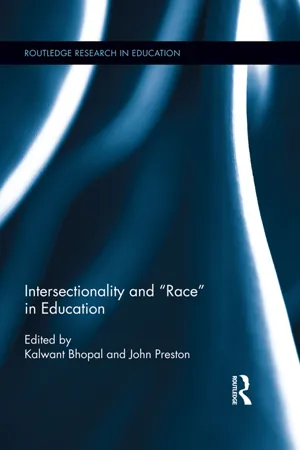
Education is a controversial subject in which difficult and contested discourses are the norm. Individuals in education experience multiple inequalities and have diverse identifications that cannot necessarily be captured by one theoretical perspective alone. This edited collection draws on empirical and theoretical research to examine the intersections of "race," gender and class, alongside other aspects of personhood, within education. Contributors from the fields of education and sociology seek to locate the dimensions of difference and identity within recent theoretical discourses such as Critical Race Theory, Judith Butler and 'queer' theory, post-structural approaches and multicultural models, as they analyze whiteness and the education experience of minority ethnic groups. By combining a mix of intellectually rigorous, accessible, and controversial chapters, this book presents a distinctive and engaging voice, one that seeks to broaden the understanding of education research beyond the confines of the education sphere into an arena of sociological and cultural discourse.
eBook - ePub
Intersectionality and Race in Education
- 228 pages
- English
- ePUB (mobile friendly)
- Available on iOS & Android
eBook - ePub
Intersectionality and Race in Education
About this book
Information
1 The Unhappy Marriage Between Marxism and Race Critique
Political Economy and the Production of Racialized Knowledge Zeus Leonardo
Abstract
In educational theory, orthodox Marxism is known for its commitment to objectivism, or the science of history.1 On the other hand, race analysis has been developed in its ability to explain the subjective dimension of racial oppression. The two theories are often at odds with each other. This chapter is an attempt to create an integrated theory by focusing on the intersection between Marxist objectivism and race theory’s focus on subjectivity. This suggests neither that Marxism neglects the formation of subjectivity nor that race theory ignores material relations. It is a matter of emphasis and the historical development of each discourse. In attempting to integrate them, intellectuals recognize their frequent appearance on the historical stage together. As a result, both Marxism and race analysis are strengthened in a way that maintains the integrity of each discourse. This intersectional framework benefits educational theory because praxis is the dialectical attempt to synthesize the inner and external processes of schooling.
Heidi Hartmann (1993) once argued for a more progressive union in the ‘unhappy marriage’ between Marxism and feminism. Along the same lines, this chapter argues for a similar intersectional theory between race and class analysis in education. Often, when Marxist orthodoxy takes up the issue of race, it reduces race relations to the status of a reflex within class dynamics. In short, orthodox Marxism economizes the concept of race and the specific issues found within themes of racial identity, development and representation become subsumed in modes of production, the division of labour, or worse, as an instance of false consciousness. On the other hand, when race analysis takes up class issues, it sometimes accomplishes this by reifying race as something primordial or fixed, rather than social and historical. Indeed, in the social science literature there is both a general consensus that race amounts specifically to skin color stratification with black and white serving as the litmus test for other groups and more generally as a proxy for ‘group’ that includes any social identity under the sun, which could be construed as a race. The former perspective has been criticized for its dichotomizing tendencies, whereas the latter is guilty of too expansive of a definition of race. Moreover, uncritical engagement of class issues within race discourse fails to incorporate the historical explanations found in Marxism and ends up projecting the ‘naturalness’ or ‘foreverness’ of racial categories. In this chapter, I attempt to maintain the conceptual integrity of both Marxist and race discourses through a synthesis of their strengths, the first a material, objective analysis, the second through an analysis of subjectivity, or how the historical conditions of class are lived in existentially racial ways. In order to advance the theoretical understanding of educational analysis, I will pursue the historical and conceptual integration of race and Marxist discourse.
It is now a well-acknowledged social scientific fact that class status remains one of the strongest, if not the strongest, predictor for student achievement. In short, there is a positive correlation between the class status of a student’s family and that student’s success in schools. The higher the student’s family class status, the higher the chances for school success. It is also an equally well-acknowledged fact that people of color disproportionately comprise the working-class and working-poor groups when compared to their White counterparts. In schools, Latino and African American students face the interlocking effects of racial, economic and educational structures. From the outset, this establishes the centrality of both class and race analysis concerning school outcomes and policies designed to address them (Leonardo 2002, 2003, 2009).
The field of orthodox Marxist studies is dominated by the elucidation of the objective conditions of capital at the expense of the subjective, or ideological, dimensions of race within capitalism. It covers racism not as a field of contestation among racial groups for power but as an ideological distraction from the inner workings of capitalism. In short, racism is not at all about race but capital. With the advent of Western Marxism, especially under the influence of Lukács’ (1971) humanism, Gramsci’s (1971) notion of a cultural revolution and Frankfurt critical theory, Marxist concepts about subjectivity came to the fore. In contrast, race theory analysis of the subjective experience of race has been developed at least as much as studies that map its institutional, material basis. Du Bois’s (1989) concept of ‘double consciousness’ and Fanon’s (1967) psychology of race are invoked as widely as talks of institutional ‘discrimination’ or ‘segregation’. Du Bois’s search for the ‘souls of black folk’ signals his concern for the subjective existence of a people whose worth is ‘measured by the tape of another man’ through a school system that denies their true participation as intellectual citizens. Similarly, Fanon’s journey into the essence of the Black psyche, or his appropriation of Aimé Césaire’s concept of negritude, finds this subjectivity routed through the distorting effects of a colonial education. Orthodox Marxism is conceptually silent on these issues because it brackets the subjective in order to explain the objective, much the same way Piaget brackets the objective to explain the subjective development of the child (Huebner 1981). Marrying Marx with Piaget, Huebner introduces a brand of ‘genetic Marxism’ as a way to bridge the objective and subjective correlates of history. It is through this synthesis that critical pedagogists arrive at the political economy of curricular knowledge. Huebner does not address the racial form of genetic Marxism but he is instructive in addressing the blind spots of orthodox Marxism and Piagetian epistemic theory. The marriage between objective and subjective analysis represents the cornerstone of educational praxis since at least as far back as Dewey.
Links Between Orthodox Marxism and Race Critique
In the field of educational theory it is apparently unfashionable to revisit Bowles and Gintis’s (1976) original insights because of the assumption that theoretical knowledge has advanced beyond their conceptual monism. The return to Bowles and Gintis is a fashionable faux pas as out of step as disco is in today’s dance clubs, although one can expect the Gap clothing company to exploit it for nostalgia. In addition, with the popularity of various post-ism’s, post-al’s, or posties, Marxist structuralism appears imperialistic and conceptually flawed by its determinisms. Raymond Williams (1977) puts it best when he says that Marxism without determinations is a useless theory, but, were it to retain them in their current forms, Marxism would become a crippled intervention. That said, Marxist resiliency seems alive and well, judging from McLaren’s (2000) reinvigoration of it in his book on Che Guevara and Paulo Freire; Cultural Logic, an online education journal dedicated to the vision of Marx; and countless claims that despite the marginalisation of Marxism in academe within the rise of neoliberalism, it maintains a privileged status as a revolutionary explanation and intervention, especially in these times of global economic instability. The neoconservative, neoliberal, and postmodern attempts to displace global critique of capitalism seems only to reinvigorate Marxist commitments to a perspective that responds with a vengeance, much like a boomerang that returns to hit its thrower in the face (see Harvey 1989; Eagleton 1996; Ebert, 1996; San Juan, Jr. 1999; Buroway 2000). No doubt, post-Marxism would be more attractive in a world of post-exploitation. But for now, Marxism is like blue jeans, refusing to fade away.
Under the structuralist wing of orthodox Marxism, schools are said to reproduce the social relations of labour through the correspondence between school and work structures (Bowles and Gintis 1976). Schools neither add nor take away from economic inequality at large; they reproduce labour relations through homology. Like a factory, schools welcome students as inputs to the juggernaut of capitalism, where they learn dispositions necessary for the reproduction of capital, then leave the school site twelve years or so later as outputs of the system. Bowles and Gintis share Althusser’s (1971) theory of the reproduction of the relations of production. They provide an innovation within Marxist theory by emphasising the state apparatuses’ ability to reproduce the division of labour not so much through material processes but through ideology. Although critiques of reproduction theory abound, this phenomenon does not refute the fact that reproduction occurs in schools (Leonardo 2000).
Students take their place in the work world and the economico-educational process that puts them there is depicted as relatively smooth and uninterrupted. Although they differ in their orientation toward economic determinism, such that Althusser (1969) believes the superstructure rebounds and affects the economic infrastructure (i.e., overdetermines it), Bowles and Gintis and Althusser commit to the science of Marxism, earlier defined by Lukács (1971) as the ‘scientific conviction that dialectical materialism is the road to truth’ (p. 1). Dubbed as ‘critical functionalism’ by Carnoy and Levin (1985), Bowles and Gintis’s correspondence principle differs from the functionalism of Durkheim (1956, 1973) and Dreeben (1968) insofar as Bowles and Gintis are critical of capitalist structures and the general division of labour. However, critical functionalism shares a common conceptual assumption with structural functionalism to the extent that both discourses assume schools serve a predetermined social function. Although Bowles and Gintis focus on the school as their primary unit of analysis (a superstructural feature), they privilege the industrial labour force as the necessary, causal mechanism that gives form to school structures. It is for this reason that their perspective belongs to Marxist orthodoxy.
The role of race or racial groups in orthodox class analysis is significant but secondary, at best. The racial experiences of African Americans, Latinos and Asian Americans are determined by the economy, reduced to reflex status and fragmented by the effects of ideology. As Bowles and Gintis (1976) observe, ‘Blacks certainly suffer from educational inequality, but the root of their exploitation lies outside of education, in a system of economic power and privilege in which racial distinctions play an important role’ (p. 35). It would be a mistake to conclude that the authors trivialize the structures of race and racism; as Bowles and Gintis say, they play a ‘role’. But as in a play, race and racism are not the star of the show. In effect, Bowles and Gintis conceptually dissolve race into class relations, a move common to other Marxists not necessarily from the Bowles and Gintis school of thought. Other Marxists may be more graceful in their uptake of race but nevertheless share Bowles and Gintis’s problematic and commitments. It becomes clear that race relations are products, effects of and determined by the objective laws of economic processes. Though not usually perceived as a Marxist, Oakes (2005) later modifies this position through her studies of tracking by suggesting that ‘school matters’. She finds that the institutional practice of tracking exacerbates, at times creates, class and race differences. She confirms Cornel West’s (1994) simple but straightforward contention that ‘race matters’. From this, we can infer that working-class students of colour face ‘double jeopardy’ as they confront the specific interlocking conditions of class exploitation and racial stratification. Orthodox Marxist analyses of schooling pay respect to race as an important ‘distinction’, but not a decisive, certainly not a determining, one. Thus, they forsake the racial concepts that would otherwise help students make sense of their racialized class experiences.
The racialized experience, while possessing an objective character because it finds its form in material relations, strengthens the subjective understanding of class relations. In effect, race is a mode of how class is lived (Hall 1996). As such, class is lived in multiple ways, one of them being racial. Students of colour, like many scholars of colour, find it unconvincing that they are experiencing only class relations when the concepts used to demean and dehumanize them are of a racial nature. As Fanon (1967) finds, ‘A white man addressing a Negro behaves exactly like an adult with a child and starts smirking, whispering, patronizing, cozening’ (p. 31). Thus, it is not only understandable but reasonable that the orthodox branding of the racial imagination as ‘false consciousness’ does not sit well with non-White subjects. It occludes White power and privilege, and the interests that maintain them. It is conceptually misleading as well.
In Ladson-Billing’s (1998) studies of colonial education from ‘Soweto to South Bronx’, African Americans experience daily psycho-cultural assaults that cannot be explained purely through economism because it does not propose a convincing explanation as to why African Americans and other students of colour should be the targets of deculturalization (see also Spring 2000). This has led Fanon (1963) to the conclusion that ‘Marxist analysis should always be slightly stretched everytime we have to do with the colonial problem’ (p. 40). Fanon’s (1967) endorsement of Marxist critique is very clear when he says,
If there is an inferiority complex, it is the outcome of a double process:
—primarily, economic;
—subsequently, the internalization—or, better, the epidermalization—of this inferiority (p. 11).
Stretching the conceptual tendons of orthodox Marxism makes it flexible in accommodating the subjective experience of students of colour as they navigate through an educational system hostile to their worldview. Although Fanon was speaking of the decolonisation struggle during the 1960s, his insights are valid today because internal colonies like ghettos, barrios and reservations bear the material and psycho-cultural marks of colonial education within a nation that daily reminds their subjects of the rightness of whiteness.
Like Hartmann’s (1993) charge that orthodox Marxism’s conceptual universe is ‘sex blind,’ one can lay a similar charge that it is also ‘color blind’. Marxism lacks the conceptual apparatus to explain who exactly will fill the ‘empty places’ of the economy. Its discursive structure does not provide compelling reasons for women’s relegation to housework or non-White overrepresentation in the working class, buttressed by an educational system that appears to reproduce the dispositions for such a sorting of workers. Regardless of their class status, students of colour show an incredible amount of resilience in an educational process that undervalues their history and contribution. Economic analysis conveniently forgets that when labour organizes itself into a subject of history, this subject is often constructed out of the White imagination (Roediger 1991). In other cases, White labour organizes to subvert the interests of people of colour, as in the case of the Irish, choosing their whiteness alongside their working-class interests, elbowing out Blacks for industrial jobs. It is a sense of naturalised entitlement that White labourers, even against the objective and long-term interests of the White working class, choose whiteness in order to preserve their subjective advantage, or what Du Bois calls Whites’ ‘public and psychological wages’ (cited in Roediger 1991). The wages of White skin advantage is so pervasive, it is well-represented even within non-White communities. Hunter (1998, 2005) finds that the ‘lighter the berry’ the more privileges one garners, such as higher rates of education and status. In addition, lighter-skin-toned African American and Mexican American women bear the privilege of being regarded as beautiful, as in the case of la güera, or ‘fair skinned’. Here, ‘fair’ takes on the double entendre of light and pretty. Of course, the point should be clear that they are not regarded as White subjects, but approximations of whiteness.
Race theory is not the only discourse to critique orthodox Marxism. With the development of neo-Marxist educational theory, Marxist economism becomes a target of cultural materialism. Arising out of the conceptual space that emphasises the superstructure rather than the base in historical materialism, neo-Marxists like Bourdieu (1977, 1984) and Lareau (2000, 2003) mobilize concepts, like ‘cultural capital’ and ‘habitus,’ to explain the conversion of economic capital to cultural practices that favour the life chances of middle- to upper-class students. Here, the focus is less on the objective structures of labour and more on the rituals and cultural repertoire that reify class privileges. Said another way, neo-Marxism is concerned with cultural reproduction in schools rather than the social reproduction previously described by Bowles and Gintis. Thus, a latent correspondence principle is still at work and discursively in place, this time with culture as the operating principle. For example, Lareau documents the difference in school participation between modestly middle- and upper-middle-class parents. Appropriating Bourdieu’s framework, Lareau finds that, among other consequences, modestly middle-class parents lack both the institutional confidence and cultural pedigree to influence the school bureaucracy during school activities, like open house or parent-teacher conferences. In contrast, upper-middle-class parents possess the cultural repertoire and resources that position their children in advantageous ways in school, such as the academic abi...
Table of contents
- Cover
- Half Title
- Title Page
- Copyright
- Contents
- Permissions
- Introduction: Intersectionality and ‘Race’ in Education: Theorising Difference
- 1. The Unhappy Marriage between Marxism and Race Critique: Political Economy and the Production of Racialized Knowledge
- 2. The White Working Class, Racism and Respectability: Victims, Degenerates and Interest-Convergence
- 3. Interrogating Pigmentocracy: The Intersections of Race and Social Class in the Primary Education of Afro-Trinidadian Boys
- 4. A Critical Appraisal of Critical Race Theory (CRT): Limitations and Opportunities
- 5. Race Slash Class: Mixed Heritage Youth in a London School
- 6. ‘If You’re Holding a Degree in This Country No-One’s Gonna Ask No Questions’: Intracategorical Intersectionality and BAME Youth Postcompulsory Educational Achievement in the UK
- 7. Intersections of “Race,” Class and Gender in the Social and Political Identifications of Young Muslims in England
- 8. Understanding Class Anxiety and ‘Race’ Certainty in Changing Times: Moments of Home, School, Body and Identity Configuration in ‘New Migrant’ Dublin
- 9. Beyond Culture: From Beyoncé’s Dream, ‘If You Thought I Would Wait for You, You Got It Wrong’ (2008), to the Age of Michelle Obama
- 10. Intelligibility, Agency and the Raced-Nationed-Religioned Subjects of Education
- Conclusion: Intersectional Theories and ‘Race’: From Toolkit to ‘Mash-Up’
- Contributors
- Index
Trusted by 375,005 students
Access to over 1.5 million titles for a fair monthly price.
Study more efficiently using our study tools.
Frequently asked questions
Yes, you can cancel anytime from the Subscription tab in your account settings on the Perlego website. Your subscription will stay active until the end of your current billing period. Learn how to cancel your subscription
No, books cannot be downloaded as external files, such as PDFs, for use outside of Perlego. However, you can download books within the Perlego app for offline reading on mobile or tablet. Learn how to download books offline
Perlego offers two plans: Essential and Complete
- Essential is ideal for learners and professionals who enjoy exploring a wide range of subjects. Access the Essential Library with 800,000+ trusted titles and best-sellers across business, personal growth, and the humanities. Includes unlimited reading time and Standard Read Aloud voice.
- Complete: Perfect for advanced learners and researchers needing full, unrestricted access. Unlock 1.5M+ books across hundreds of subjects, including academic and specialized titles. The Complete Plan also includes advanced features like Premium Read Aloud and Research Assistant.
We are an online textbook subscription service, where you can get access to an entire online library for less than the price of a single book per month. With over 1.5 million books across 990+ topics, we’ve got you covered! Learn about our mission
Look out for the read-aloud symbol on your next book to see if you can listen to it. The read-aloud tool reads text aloud for you, highlighting the text as it is being read. You can pause it, speed it up and slow it down. Learn more about Read Aloud
Yes! You can use the Perlego app on both iOS and Android devices to read anytime, anywhere — even offline. Perfect for commutes or when you’re on the go.
Please note we cannot support devices running on iOS 13 and Android 7 or earlier. Learn more about using the app
Please note we cannot support devices running on iOS 13 and Android 7 or earlier. Learn more about using the app
Yes, you can access Intersectionality and Race in Education by Kalwant Bhopal, John Preston, Kalwant Bhopal,John Preston in PDF and/or ePUB format, as well as other popular books in Education & Education General. We have over 1.5 million books available in our catalogue for you to explore.