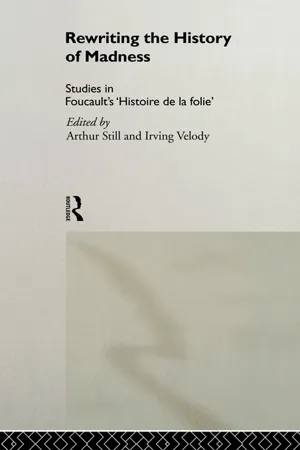
Michel Foucault has had an extraordinary impact on writers in the human sciences since his first book Madness and Civilization appeared in English. This title assesses the reactions to Madness and Civilization.
eBook - ePub
Rewriting the History of Madness
Studies in Foucault's `Histoire de la Folie'
- 240 pages
- English
- ePUB (mobile friendly)
- Available on iOS & Android
eBook - ePub
Rewriting the History of Madness
Studies in Foucault's `Histoire de la Folie'
About this book
Information
Part I
Reading Foucault
1 Histoire de la folie
An unknown book by Michel Foucault
Mais le malheur a voulu que les choses soient plus compliquées. (132)
So I have kept just one rule and method, the one contained in a passage by Réné Char which can be read as both the most exacting and the most restrained definition of truth: ‘I will take from things the illusion they produce to save themselves from us, and let them keep the part of themselves which they offer us.’ (x)
Michel Foucault’s Madness and Civilization (1965) is a famous book. What is less well known is that it is a translation which omits well over half of its original, the book published in France in 1961 under the title Folie et déraison: histoire de la folie à l’âge classique. In the pagination of the almost unmodified main text of the second French edition (Foucault 19721), the parts of Histoire de la folie included in Madness and Civilization amount to 236 pages, and the parts omitted (excluding the appendices) to 299. The abridgement of the book’s scholarly apparatus is even more severe. Out of more than a thousand footnotes in the original, 149 are retained; a bibliography comprising over two hundred primary and secondary sources is omitted altogether. The untranslated part of Folie et déraison is roughly equivalent in length to (for example) the complete text of Discipline and Punish.
It is therefore not altogether surprising that a similar, and equally seldom noticed, disparity exists between the responses of French and English-speaking historians to these respective editions of Foucault’s book. Annales E.S.C. published in 1962 a review by Robert Mandrou, to which was added a note by Fernand Braudel (Mandrou 1962).2 Neither critic was stinting in his praise: ‘Un très beau livre’ (Mandrou); ‘ce livre magnifique’ (Braudel). Both express the perception that the book is original in the complexity of its method and that this complexity brings a certain elusiveness: Mandrou warns against seeking for a simple narrative unity, and Braudel remarks that close attention is sometimes needed to follow the work’s expository thread. But neither leaves any doubt that they view the work as successful in conception and execution both as an intellectual construction and as a work of historical scholarship, whose author is, in Mandrou’s words, ‘à la pointe de recherches qui le passionnent et qui nous passionen’.
No English-speaking historian of comparable standing within the academic mainstream has subscribed to anything like so cordial an assessment of this book. Given the extent and duration of the Annales school’s influence on historians in the English-speaking world, such a disparity might seem, prima facie, puzzling, and impossible to explain solely by the above-mentioned facts about the translation. A number of further factors suggest themselves.
For one thing, the Annales historians were of a somewhat more wholeheartedly interdisciplinary temper than their British and American colleagues: Lucien Febvre actually recognized a need, within the study of mentalités, for historians with a philosophical training (Febvre 1973: 248). Again, the climate of reception of Foucault’s book was changed dramatically between the early and later 1960s by the coming of antipsychiatry. Historians reading Madness and Civilization after 1970 would be aware of its impact on a contemporary non-scholarly or non-specialist audience, a factor apt, especially in this case, to stimulate misgivings about its specialist and scholarly merits: the more so because of the very characteristics of the English version which made it accessible to a general readership unconcerned with, or actively indifferent to, the routine constraints of scholarship. Historians, of course, do not judge a work solely by the volume of its footnotes. But such factors undoubtedly have an effect.
Foucault himself made the abridgements in Madness and Civilization and the (now long out of print) 10/18 French pocket version which this was based on. The fact that his cuts were skilfully carried out is presumably evidenced by the fact that their extent is far from obvious or frequently remarked upon. The omissions do not make historical nonsense of what remains. Quite simply, the shorter version is considerably less rich than the longer one: my concern will be to show here that the absent 300 pages contain material which is not only crucial to some detailed English-language debates about Foucault’s achievement, but also decisive for the way one views the overall shape and course of his career.
Why, in that case, has a complete translation never been produced? Histoire de la folie is Foucault’s longest book; there is said to have been difficulty in finding a French publisher for it in 1961; publishers may well, especially in the case of a hitherto little-known author, have balked at the venture of a 600-page translation; later on, when these reservations might have ceased to operate, Foucault himself may well have preferred to leave the initiative to others. In any event, the deciding influence on publishers in such matters may be expected to come, and generally does come, not from the author of a work but from concerned members of its potential audience. The tenor of the secondary literature around Madness and Civilization does not lead one to imagine that over the past twenty years Random House or Tavistock Press can have come under much pressure from within the English-speaking academic community to undertake a completed translation. The great majority of published contributions to scholarly criticism of Madness and Civilization, along with the great majority of book-length expositions of Foucault’s thought, provide little or no inkling of the drastic difference between its French and English versions. Moreover, it can easily be established, as I will show, that a series of critics whose declared object has been to measure Foucault’s accomplishment as a historian against the standards of serious scholarship have dispensed with the preliminary task of reading the unabridged text of his book.
One of the reasons why the book is dealt with so cursorily even by sympathetic commentators on Foucault is the currency of various scenarios of intellectual biography, in terms of which Histoire de la folie predates several of Foucault’s major conceptual and methodological advances. The main evidence adduced for this view is a series of brief self-critical remarks in Foucault’s The Archaeology of Knowledge, published in 1969. But the scope and force of these self-criticisms turn out on close examination to be considerably less complete or damaging than an incautious reader might suppose: Gilles Deleuze (1986: 22) doubts whether Foucault’s repentances are very seriously meant. Rather in the same way that the innovative achievement in each of Foucault’s successive works is almost invariably supplemented by a set of proposals or announcements of further, subsequent investigations to be undertaken in related domains, many of which were never to be completed, his urge to sharpen a fresh perspective may have sometimes impelled him to overstate the shift which this departure signified relative to his previous thinking. Whether out of a polemical appetite for indications of unstable oscillation and damaging retreat, or through an inclination to apply the (often misunderstood) Foucauldian thematic of discontinuity to Foucault’s own thought, or simply out of the need for a striking story-line, the evidences of a strong continuity from Histoire de la folie through to the end of Foucault’s output have generally been paid too little critical attention.
A second and obvious hazard to understanding of this book is the involvement of its reception not only with the politics of psychiatric affairs but also with the roughly parallel emergence as a specialist academic sub-discipline of the historiography of insanity and its treatment. If one suggests to practitioners in the latter area that Foucault’s contribution has received less than its due, one is often answered with emphatic personal testimony of his book’s decisive and inspiring influence; words to this effect are indeed commonly to be read in prefaces. On the other hand, a settled community of expertise and inquiry may come to think that the achievement of heroic forerunners can be surpassed or made obsolete by subsequent advances. For at least one generation, it is hard to separate Madness and Civilization from the memory of a period where its ideas commingled with those of Laing and Cooper, Illich, Szasz, Fanon and Reich – a time which posterity now readily regards as half-crazed. However often Foucault expressed his surprise and vexation at the degree of animosity provoked in its present-day practitioners by his treatment of the historical beginning of the psychiatric discipline, and although his book was written some years in advance of the cultural movements within which it was taken up, he would have had no regret about the possibility of his work’s influence contributing to a movement of practical criticism and reform which he undoubtedly supported; in later years he was quite prepared to say that improvements had been made in society’s treatment of clients of mental medicine, and that the movements of critique were entitled to some credit for these changes. From the present point of view, however, it needs to be pointed out that in the course of all this the specific terms of Foucault’s analyses became, in places, conflated with philosophical and sociological notions quite different from, and indeed strictly incompatible with, his own; and that some of these confusions persist in the conceptual framework of subsequent work in the field.3 One reason, then, why Foucault’s work may not have been altogether surpassed in this field is that its contribution has been often praised but seldom clearly grasped.
These points can conveniently be illustrated in terms of three key notions of the post-antipsychiatric lingua franca: deviancy, medicalization and Cartesian dualism.
In George Rosen’s book Madness in Society (Rosen 1968) one can find elements both of a deviancy-theory view of psychiatry and of what reads in places like a deviancy-theoretical paraphrase of Foucault (though Rosen does not mention Foucault). After relating some biblical and classical anecdotes of insanity, Rosen comments that ‘the behaviour of the people cited above was regarded as more than merely perplexing or perverse. They were regarded as deranged because their behaviour and, inferentially, their orientation to reality were considered excessively divergent from socially accepted norms’. He remarks that: ‘At any given period certain criteria are employed to establish normal human nature, as well as any deviation from it’. Concerning the French decree of 1656 creating the hôpitaux généraux, a landmark, according to Rosen, in public policy for the treatment of the insane, Rosen writes that ‘All individuals who were defined as asocial or socially deviant were segregated by internment. This procedure is analogous to the manner in which the leper was treated in the mediaeval period’ (97, 163f).
One can divine here both the way in which Foucault was to be read by adherents of the theories of deviancy and social control current in the 1970s, and the intellectual vulnerability of such theories. To undertake a history of the treatment of the insane by recourse to the concept of deviancy is an effort at phenomenological subtlety which carries the cost of a peculiar ahistorical naïvety, in so far as it is certainly not the case that, as Rosen suggests, citizens in antiquity would have formed an opinion concerning (to take one of Rosen’s instances) an individual who ‘fancied himself a brick’, by consideration of whether that person’s ‘behaviour’ or ‘orientation to reality’ was ‘excessively divergent from socially accepted norms’. And it is equally plainly the case that the French decree of 1656 did not and could not address itself to a category of individuals defined as ‘asocial or socially deviant’, because the latter concepts, unlike those of madness or vagabondage, were not available in 1656.
Foucault’s dissent from this form of sociological relativism dates back to his short first book published in 1954, Maladie mentale et personnalité: here, after a consideration of the positions of Durkheim and Ruth Benedict, Foucault proposes to treat the notion of deviancy as part of the problem, rather than part of the answer, in the history of madness: one of the two key historical questions which this book proposed for analysis was: ‘How did our culture come to give mental illness the meaning of deviancy, and to the patient a status that excludes him?’ (1954, trans. 1976: 63).
‘Le monde correctionnaire’, one of the chapters of Histoire de la folie which is completely omitted from the English edition, deals with this question of the genealogy of the category of deviancy. Foucault begins here (pp. 92–4) by taking issue with an earlier generation of progressively minded psychiatrist-historians writing in the early decades of this century (Sérieux and Libert, Chatelain, Henry, Vié, Bonnafous-Sérieux and Tardif) who in fact did much of the groundwork in the history of the internment practices of the ancien régime. Their objective, Foucault writes, was ‘to “rehabilitate” the internment under the ancien régime, and to demolish the myth of the Revolution liberating the mad, a myth constructed by Pinel and Esquirol which was still alive at the end of the nineteenth century’ (92n). For these writers the decrees of 1656 corresponded to a ‘spontaneous elimination of the “asocial”, the inarticulate perception of, and response to a social malaise which the subsequent advances of science refined to the articulateness of medical knowledge’.
Robert Castel’s The Psychiatric Order, which can in many ways be read as a historical sequel to Histoire de la folie, provides an account of these author’s own policy orientation. As successors of Morel and his theories of degeneracy, they taxed the Pinelian school with laxity: ‘classical alienism had postulated too narrow a definition of the populations to be taken in charge. The category of the “abnormal” must be distinguished from that of the mentally ill’ (Castel 1986: 188–90, 285). The combined resources of psychiatry, justice and legal medicine remained, it was held, far from equal to mastering the social plague of congenital deviancy.
Foucault remarks on these authors’ special perspective that ‘the fact that we can find a resemblance between the internees of the Eighteenth century and our own contemporary figure of the asocial individual is indeed a fact, but probably one belonging only to the order of results: for that figure was brought into being as an effect of the act of internment itself’ (93–4). The Sérieux school wanted a range of internment institutions more differentiated, if not more comprehensive in their catchment, than the hôpitaux généraux; but Foucault’s point is that it was the homogenizing influence of the great internment that made possible the eventual formation of a single, overarching concept of deviancy, through a process of what might be called the reciprocal disenchantment of transgressions: the common element of déraison neutralizes the distinct ethico-theological meanings attached to the different personages (the venereal, the sodomist, the alchemist, the suicide, the blasphemer, atheist, libertine and debauchee) who inhabit with the insane the spaces of eighteenth-century administrative detention. Unbelief, for instance, comes to be seen as no more than the sequel to a life of science. Foucault writes that internment produces ‘a certain style of being which a person already possesses prior to being interned, and which makes internment finally necessary’ (121f). He sees the ways in which the rationale of internment establishes a kind of promiscuous complicity between the different forms of unreasonable social existence as ‘a subterranean network which marks out something like the secret foundations of our modern experience of madness’ (119).
This is, then, a distinctly different analysis from the one, recognizable in some historical work influenced by Foucault and sometimes mistakenly attributed to Foucault himself, which considers the category of mental illness as itself correlated with a practice of relabelling as insane individuals whose conduct is perceived as deviant.
A further and rel...
Table of contents
- Cover
- Halftitle
- Title
- Copyright
- Contents
- Notes on contributors
- Preface
- Introduction
- Part I Reading Foucault
- Part II Responses
- Part III Review
- Name index
- Subject index
Trusted by 375,005 students
Access to over 1.5 million titles for a fair monthly price.
Study more efficiently using our study tools.
Frequently asked questions
Yes, you can cancel anytime from the Subscription tab in your account settings on the Perlego website. Your subscription will stay active until the end of your current billing period. Learn how to cancel your subscription
No, books cannot be downloaded as external files, such as PDFs, for use outside of Perlego. However, you can download books within the Perlego app for offline reading on mobile or tablet. Learn how to download books offline
Perlego offers two plans: Essential and Complete
- Essential is ideal for learners and professionals who enjoy exploring a wide range of subjects. Access the Essential Library with 800,000+ trusted titles and best-sellers across business, personal growth, and the humanities. Includes unlimited reading time and Standard Read Aloud voice.
- Complete: Perfect for advanced learners and researchers needing full, unrestricted access. Unlock 1.5M+ books across hundreds of subjects, including academic and specialized titles. The Complete Plan also includes advanced features like Premium Read Aloud and Research Assistant.
We are an online textbook subscription service, where you can get access to an entire online library for less than the price of a single book per month. With over 1.5 million books across 990+ topics, we’ve got you covered! Learn about our mission
Look out for the read-aloud symbol on your next book to see if you can listen to it. The read-aloud tool reads text aloud for you, highlighting the text as it is being read. You can pause it, speed it up and slow it down. Learn more about Read Aloud
Yes! You can use the Perlego app on both iOS and Android devices to read anytime, anywhere — even offline. Perfect for commutes or when you’re on the go.
Please note we cannot support devices running on iOS 13 and Android 7 or earlier. Learn more about using the app
Please note we cannot support devices running on iOS 13 and Android 7 or earlier. Learn more about using the app
Yes, you can access Rewriting the History of Madness by Arthur Still,Irving Velody in PDF and/or ePUB format, as well as other popular books in Social Sciences & Sociology. We have over 1.5 million books available in our catalogue for you to explore.