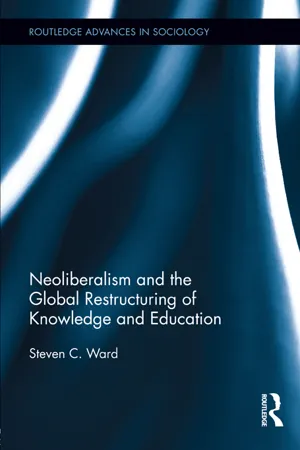
This book examines the influence of neoliberal ideas and practices on the way knowledge has been conceptualized, produced, and disseminated over the last few decades at different levels of public education and in various national contexts around the world.
- 254 pages
- English
- ePUB (mobile friendly)
- Available on iOS & Android
eBook - ePub
Neoliberalism and the Global Restructuring of Knowledge and Education
About this book
Information
1 Changing the Soul
The Contours, Currents and Contradictions of the Neoliberal Revolution
Democracy is the road to socialism. (Karl Marx)
The socialists believe in two things which are absolutely different and perhaps even contradictory: freedom and organization. (Halévy, 1966)
Fundamentally, there are only two ways of co-ordinating the economic activities of millions. One is central direction involving the use of coercion—the technique of the army or the modern totalitarian state. The other is the voluntary co-operation of individuals—the technique of the marketplace. (Friedman, 1962: 13)
As the physical world is ruled by the laws of movement so is the moral universe ruled by laws of interest. (Helvetius, De l’ esprit)
Practical men, who believe themselves to be quite exempt from intellectual influences, are usually the slaves of some defunct economist. (Keynes, 1964 [1936]: 383)
It is not an exaggeration to say that once the more active part of the intellectuals have been converted to a set of beliefs, the process by which these become generally accepted is almost automatic and irresistible. (Hayek, 1949)
When the capital development of a country becomes the by-product of the activities of a casino, the job is likely to be ill-done. (Keynes, 1964 [1936]: 142)
In the late 1970s and early 1980s a series of bold new social, political and economic experiments were introduced in societies throughout the world. These experiments, which as a collective project came to be labeled by most of the world as neoliberalism, sought to resurrect and extend some of the insights and practices of eighteenth- and nineteenth-century liberalism and apply them to host of late twentieth- and early twenty-first-century problems. Much like the socialist and Keynesian revolutions that remolded many societies in the first half of the twentieth century, this late twentieth-century “neoliberal revolution” sought to fundamentally reconfigure the relationship between society, economy and the state. More importantly, perhaps, it also sought to redefine the relationship between the individual and society—to forge a return to what proponents argued was a more responsible, resilient and independent mode of personhood and self-care. As Margaret Thatcher described the central moral goal of this new liberal project, “economics are the method [but] the object is to change the soul.”
Changing something as consequential as the soul involved the introduction of a dramatic new, neoliberal project to “govern the soul” (Rose, 1990). This neoliberal project spawned a series of broad-reaching reconstructive projects that worked simultaneously at the levels of politics, economics and culture. Most important and easily recognizable among these projects were the creation and expansion of a new, more intensified and less regulated “Atlantic” or Anglo-American style of capitalism; the dismantling or “rolling back” of the welfare state and its reconstitution in a new neoliberal state form; new styles of corporate and public management and administration; a casualization and flexiblization of work, firms and organizations; a much more market- and consumer-centered society and the creation of a new entrepreneurial, self-reliant, risk aware and consumer-minded subject.
Like most social movements, neoliberalists spun their own complex and self-serving origin story to both denigrate the status quo and legitimate the need for their particular new political, economic and cultural projects. According to this story as the twentieth century had unfolded, the Keynesian and socialist policies that had prevailed in many Western societies since the Global Depression of the 1930s had, by the 1970s, severely bogged down economic growth, diluted shareholder value, stymied competition and created bloated and crisis prone governments and governmental institutions. Economically, these policies had created a capitalism that was at a “tipping point” as it sought to negotiate the increased taxation brought about by the demands of social movements and the expanding welfare functions of the state within the context of the increasingly global competitive market pressures to provide profits to share and bond holders.
At a more cultural or moral level, this neoliberal origin story contended that socialist and Keynesian policies had lead people to become much too collectivistic and, as a result, much too dependent on “society” and the welfare state, both much maligned terms in neoliberal circles, and their entitlements and social programs to guide their lives and solve their problems. Instead of the state or “society,” people needed to look to themselves and their own individual initiatives, or in Thatcher’s ironical phrasing their own “personal society,” in order to make their way in the world. To do this, people needed to deliberately adopt “the ethos and structure of the enterprise form” (Gordon, 1991: 41). They needed to rediscover the self-affirming and self-deterministic philosophy and independent moral virtues embedded in the long-standing tradition of Anglo-American liberalism—a set of political ideals and practices that neoliberals felt had been washed over, or at the very least, overwhelmed by the socialistic or collectivist leaning philosophies that had prevailed for at least fifty years. For neoliberals, the disciplining and sorting of the market economy was just the tonic individuals needed to rediscover their inner moral virtues of independence and self-reliance. It was also the elixir institutions, governments and societies needed to energize their sluggish, unproductive and over-regulated economic systems and reform their severely over-extended and dependency generating social welfare systems.
As was the case with variants of classic eighteenth- and nineteenth-century liberalism, the late twentieth-century neoliberal conceptualization of the autonomous and free subject was accompanied by the idea of an unfettered or less -regulated “free market” for the exchange of goods and services. Following closely Locke (1980), the ownership of property was envisioned in both classical and neoliberalism as providing the underlying basis of freedom. Property was, as Ludwig von Mises (1983: 21) framed it, “the single word” of the program of liberalism. For neoliberal theorists, such as von Mises, Friedrich Hayek and Milton Friedman, political freedom and free markets require the existence of property-owning individuals and these individuals can only flourish and practice their freedom in a relatively “unfettered” and self-regulating market-style economy. Indeed, neoliberalists wanted to push all this property-based freedom even further than what was advocated in classical liberalism into areas where it only had limited existence before, such as the dramatic expansion of global free trade, the running and reorganization of the public sector, such as hospitals and schools, and the privatization of many social services and public programs, such as public housing, prisons and mental health services (see Sen, 2009; Bourdieu, 2003). For neoliberals, markets, with their internal equilibrium, heightened competition and optimizing effects provided the most rational and efficient pathway available for conducting human affairs. This included not just economic activities but also governance, public and social services and education. In their more utopian moments, neoliberals, particularly beginning in the 1990s, even viewed economic individualism and the markets it spawned as a panacea for correcting a host of difficult and long-standing social issues and problems, such as inadequate housing, urban deterioration, poor education, poverty, the low status of women, underdevelopment, global inequality and pollution—problems the socialist state with its collectivist focus and command economy was supposed to have solved long ago (see, for example, United Nations Development Program, 2004; Sachs, 2005; Yunus, 2009).1 In neoliberalism’s capitalist utopia, these problems could finally be solved if the stifling effects of governments were forever removed and market incentives and the profit motive were unleashed. In the neoliberal framing, “human beings make a mess of it when they try to control their destinies” (Jameson, 1991: 273), as in planned socialist societies. Consequently, markets, with their invisible ordering of things generated by what Hayek (1979: 153) phrased “the spontaneous process of the interaction of the individuals” should become both a source of social order and a mechanism for ameliorating long-standing and intractable social problems.
In this first chapter I want to examine the origins and the central characteristics of neoliberalism, as well as some of the contours it has taken over the last few decades. It is my contention that in order to grasp the contemporary global transformations taking place in knowledge creation and transmission, it is important to situate them within the broader political and economic theories and practices that have shaped and that are currently shaping states and economies. These political and economic doctrines provide the backdrop from which, and in many cases the legitimation for, the specific epistemic and pedagogical outcomes and practices of the last few decades, such as the introduction of new public management in education, the move toward an auditing and assessment oriented managerial state, changes in intellectual property law, the privatization of knowledge, education reform and global knowledge society and creative economy policies—all issues to be examined in more detail in the new few chapters.
I begin this chapter by briefly situating neoliberal theory and policy in the context of twentieth-century debates over the direction of politics and the economy. Here I look at some of the different forms neoliberalism has taken over the last few centuries, from the classic liberalism of the eighteenth and nineteenth centuries to the so-called “roll back” neoliberalism associated most closely with Ronald Reagan and Margaret Thatcher and the shrinking of the state in the late 1970s and 1980s to the “third way” brand or “roll out” phase of neoliberalism first introduced by Bill Clinton, Tony Blair, the New Democrats and New Labour in the 1990s and 2000s (see Peck and Tickell, 2002). Afterward, I outline what I consider to be ten defining features and characteristics of contemporary neoliberal theory and policy. Finally, I conclude with an examination of the rise of the neoliberal “managerial state” and its role in establishing and expanding markets and auditing and overseeing expenditures in order to control and limit the impact of the public sphere on the private market. I also consider the sometimes conflicting strains within liberalism and how today’s political landscape reflects the strange and ironic amalgamation and contradictions of liberal, neoliberal, Keynesian and socialist theories and practices.
NEOLIBERALISM IN THE CONTEXT OF TWENTIETH-CENTURY POLITICAL ECONOMY
As a reaction to the Global Depression of the 1930s, many governments in the West embraced a moderate Keynesian economic policy that sought to put in place “improvements in the techniques of modern capitalism by the agency of collective action” (Keynes, 1926: 13).2 Keynesianism was, in essence, a “third way” of its own time that sought to forge a middle path between a wholesale socialistic involvement in managing and steering the economy that had emerged in the USSR and a classic liberalist hands off policy that had prevailed in some Western societies during the late nineteenth and early twentieth centuries. In the Keynesian approach, markets were seen as volatile, monopolistic and prone to the radical business cycles of overproduction and retrenchment. These swings would not “clear on their own,” as described by the father of general equilibrium theory Leon Walras (1984) in the nineteenth century, but needed active state intervention to right the market’s course. Markets, consequently, needed regulation and the guiding hand of the state to operate more efficiently and less erratically. The state form introduced by these policies was not just concerned with purely economic management, however. It also mobilized progressive ideas of social reform to promote the general social welfare and the protection of workers from the swings of the market in order to preserve the state’s own legitimacy and that of the economic system. In the Keynesian system it was imperative “to work out a social organization which shall be as efficient as possible without offending our notions of a satisfactory way of life” (Keynes, 1926: 14).
During this Keynesian “high period,” the central doctrines of classic liberalism, such as those found in John Locke, Adam Smith, J. S. Mills, Jean-Baptiste Sey, Leon Walras, Herbert Spencer and David Ricardo, often seemed as either ideological justifications for capitalist exploitation by those on the left or as outmoded and impractical doctrines that had outlived their usefulness in the new age of corporate and managerial style capitalism. Instead, the “Keynesian Compromise,” as it came to be referred, and its “semi-socialism” as Keynes referred to it (Keynes, 1926: 12), would allow for the functioning of a more moderate, regulated form of capitalism that, under careful government “demand side” management, would be much less susceptible to the radical boom and bust swings of business cycles (Shonfield, 1965). This compromise would also help ameliorate the social upheavals and vast equalities in wealth and income that these swings had caused and would serve as a foundation for what would come to be referred to simply as the welfare state. It would also allow the state to place restrictions on the some of the unwieldy speculative activities of the market; provide backup financial and social support in situations when the market failed or was working ineffectively; help temper and redistribute large discrepancies in wealth through progressive forms of taxation; ease unemployment, social unrest and deprivation through a variety of social welfare and work programs and promote a style of slow and steady economic growth for corporations and their shareholders.
Particularly affected by actions undertaken in the Keynesian compromise were financial institutions such as banks and investment firms. Under Keynesian-influenced controls, these organizations were separated and tightly regulated with regard to backup cash reserves. Their actions were also curbed by both specific state regulators and the regulatory activities of the Federal Reserve or Central Banks. Under the Glass-Steagall Act of 1933 in the U.S., for example, the financial activities of banks and investments firms were separated in order to ensure that banks would stay out of the more speculative and riskier investment side of finance. This would make them less prone to failure during future economic downturns.
Toward the end of World War II, Keynesian economic policy became further ensconced in the monetary policy developed as part of the 1944 Bretton Woods Agreement. Under this agreement that established the World Bank and what became known later as the International Monetary Fund (IMF), gold would be used to create and maintain a fixed exchange rate for each national currency. Under the Keynesian influenced Bretton Woods model, economies would be steered by governments working in concert with corporations to assure steady growth and minimal market disruptions. As described in Article IV of the Articles of Agreement, each member states agreed “to direct its economic and financial policies toward the objective of fostering orderly economic growth with reasonable price stability, with due regard to its circumstances; seek to promote stability by fostering orderly underlying economic and financial conditions and a monetary system that does not tend to produce erratic disruptions” (International Monetary Fund, n.d.). To accomplish these monetary goals, post–Bretton Woods era governments would focus on “capital controls, full employment policies, progressive taxation and expanded social welfare expenditures” (Felix, 2005: 391). Such practices would become the hallmark of the “embedded liberalism” (Harvey, 2005) that came to define the post–World War II welfare state and the “command-and-control economies” found in many Western nations. Capitalism would live on but with slower growth, less profit and more state regulation.
Despite the apparent failures of classic liberal doctrines of unrestricted markets and its version of the laissez-faire state, as well as the ascendancy of Keynesian and socialist economic policies in their wake, liberalist theory did not disappear from the intellectual scene during the period of Keynesian dominance from the 1930s through the early 1970s. It was clearly evident in particular policy areas such as the development of U.S. housing policy in the 1940s and 1950s (see Baxandall and Ewen, 2001) and was a key set of ideas mobilized in the McCarthy Hearings of the 1950s. In academic circles, the Austrian-born Friedrich Hayek, a London School of Economics and later a University of Chicago economist and a student of Austrian economist Ludwig von Mises, began in the 1940s to revive and promote a new, revised brand of liberalism by adapting it to some of the lessons created by Soviet-style communism, Nazism and the Global Depression and the Keynesian response to it. Shortly after the Bretton Woods economic conference, in 1947, Hayek convened his own mountainside gathering of economists in a hotel in Switzerland. The group formed there became known as the Mount Pelerin Society (MPS) and would subsequently become key theoreticians and promoters of neoliberal ideas and policies for the later half of the twentieth century (see Hayek, 1984).3 In addition to Hayek, the Society included both the father of neoliberal thought, Ludwig von Mises, and those who would become its future leaders, including University of Chicago economists, Milton Friedman, and a bit later Gary Becker. At the organization meeting, the MPS decried “the decline of belief in private property and the competitive market” (in Hartwell, 1995: 11). The members dedicated themselves to providing a politically viable liberal alternative to the dominance of Keynesianism and socialism in academia and politics.
Three years prior to the meeting, in 1944, Hayek had published what would become his most influential work and the central theoretical document to guide this resurgent liberalism, The Road to Serfdom. Initially the work received only scant academic attention, mostly in the United Kingdom; however, with its publication in the U.S. by the University of Chicago Press and the subsequent printing of shortened version in Reader’s Digest in 1945, the book began to gain a much wider audience (see Fox, 2009: 90–91). In the work, Hayek, borrowing heavily from von Mises, sought to reconstruct the liberal creed by arguing that all managed economies, whether Keynesian, socialist or nationalist in form, were both the enemies of individual freedom and doomed to economic failure. In this new form of liberalism the enemies of freedom were not the mercantilists, aristocrats and monarchs as they had been for early liberals, such as Adam Smith, but the socialist and totalitarian regimes of the 1930s and 1940s who foolishly believed they could manage their way to happiness and prosperity.
For Hayek managed economies had two interrelated problems: one primarily political in origin and the other one more economic in nature. Politically speaking, managed economies, in every form, create an ever-creeping authoritarian control over people’s lives. In this sense, as Hayek (1944: 25–26) remarked, “the Road to Freedom was in fact the High Road to Servitude.” In the quest to control production and manage consumption, the state’s bureaucratic economic experts had to set limits on profits, production levels, career pathways and pay, among other things, and over time they had to do this across all areas of the economy. They were also required to become “all knowing” and able to “out-guess” demand and the movement of the economy. Accomplishing this elaborate economic management required an increasingly bloated bureaucracy of economic managers and experts and an overtaxed state composed of burgeoning numbers of technocrats and civil servants whose concentrated planning power undermined democracy, individual freedom and the free market. Economically speaking, and flowing directly from the first problem, managed economies were also untenable because they were unable to effectively determine the price of any commodity. Following a earlier paper by von Mises’s (1935) that established what became known as the “socialist calculation debate” (Hodgson, 1999: 33) in economics, Hayek argued that socialist efforts to tightly manage production and consumption disrupted the flow of the market and its unique, dispersed and uncoordinated method of determining the value of things. When this occurred the economic actor did not know how to behave toward a commodity, whether to buy, sell, or hoard it, since it was literally without value. In this arrangement, economic activity and price, therefore, must be artificially and continuously created and sustained by even more state intervention and management, this time on the consumption side. The end result of all this escalating economic managing and adjusting was that innovation, motivation and freedom died. In the end, people existed in a totally planed economy and an increasing authoritarian political order where the state was required to manage all activities in order to keep prices and wages stable, production going and the economy functioning. Instead of this totalitarian economic and political system, Hayek (1944: 157) argued that we need “freedom to order our own conduct in the sphere where material circumstances force a choice upon us, and responsibility for the arrangement of our life according to our own conscience.” The exercise of this freedom to choose, what to consume and what ideas to support, in turn, would create a functioning economy and society that met the needs of individuals and wider social harmony and balance. There could be no comprise in such a situation either since the mixture of capitalism and socialism was “unthink...
Table of contents
- Cover
- Halftitle
- Title Page
- Copyright
- Dedication
- Contents
- Acknowledgments
- Introduction
- 1 Changing the Soul: The Contours, Currents and Contradictions of the Neoliberal Revolution
- 2 The Machinations of Managerialism: New Public Management and the Diminishing Power of Knowledge Professionals
- 3 The Neoliberalization of Knowledge: Privatization and the New Epistemic Economy
- 4 The New Marketplace of Ideas: The New Knowledge Makers and Their New Knowledge
- 5 Creating the “Clever Country”: Neoliberalism, Knowledge Society Policies and the Restructuring of Higher Education
- 6 “An Island of Socialism in a Free Market Sea”: Building the Market-Oriented School
- 7 Aligning Markets and Minds: The Responsibilized Self in the New Entrepreneurial Culture
- Notes
- References
- Index
Trusted by 375,005 students
Access to over 1.5 million titles for a fair monthly price.
Study more efficiently using our study tools.
Frequently asked questions
Yes, you can cancel anytime from the Subscription tab in your account settings on the Perlego website. Your subscription will stay active until the end of your current billing period. Learn how to cancel your subscription
No, books cannot be downloaded as external files, such as PDFs, for use outside of Perlego. However, you can download books within the Perlego app for offline reading on mobile or tablet. Learn how to download books offline
Perlego offers two plans: Essential and Complete
- Essential is ideal for learners and professionals who enjoy exploring a wide range of subjects. Access the Essential Library with 800,000+ trusted titles and best-sellers across business, personal growth, and the humanities. Includes unlimited reading time and Standard Read Aloud voice.
- Complete: Perfect for advanced learners and researchers needing full, unrestricted access. Unlock 1.5M+ books across hundreds of subjects, including academic and specialized titles. The Complete Plan also includes advanced features like Premium Read Aloud and Research Assistant.
We are an online textbook subscription service, where you can get access to an entire online library for less than the price of a single book per month. With over 1.5 million books across 990+ topics, we’ve got you covered! Learn about our mission
Look out for the read-aloud symbol on your next book to see if you can listen to it. The read-aloud tool reads text aloud for you, highlighting the text as it is being read. You can pause it, speed it up and slow it down. Learn more about Read Aloud
Yes! You can use the Perlego app on both iOS and Android devices to read anytime, anywhere — even offline. Perfect for commutes or when you’re on the go.
Please note we cannot support devices running on iOS 13 and Android 7 or earlier. Learn more about using the app
Please note we cannot support devices running on iOS 13 and Android 7 or earlier. Learn more about using the app
Yes, you can access Neoliberalism and the Global Restructuring of Knowledge and Education by Steven C. Ward in PDF and/or ePUB format, as well as other popular books in Education & Education Theory & Practice. We have over 1.5 million books available in our catalogue for you to explore.