P&P Brantingham's enormous contribution to criminology has paved the way for major theoretical and empirical developments in the understanding of crime and its respective patterns, prevention, and geometry. In this unique collection of original essays, Andresen and Kinney bring together leading scholars in the field of environmental criminology to honour the work of P&P Brantingham with new research on the geometry of crime, patterns in crime and crime generators and attractors.
Chapters include new perspectives on the crime mobility triangle, electronic monitoring, illegal drug markets, the patterns of vehicle theft for export, prolific offender patterns,crime rates in hotels and motels, violent crime and juvenile crime. A final chapter gathers together a collection of letters to P&P Brantingham, from key scholars reflecting on and celebrating their important contribution.
This volume provides essential readings for those interested in the field of environmental criminology.
This volume contains nine chapters of original research from authors who include the major contributors to the field of (environmental) criminology. Though there are no defined sections of this volume, the contributions are organized along three main themes: the geometry of crime, patterns in crime, and crime generators and attractors. These distinctions are somewhat artificial because of the overlap in subject matter across the chapters in this volume, but these three themes helped the organization of the volume.
The first three chapters are related to the geometry of crime. Marcus Felson and colleagues extend the use of the crime mobility triangle to include co-offenders – the crime mobility polygon – as well as incorporating area calculations rather than a five-point typology. This work is tied to the geometric theory of crime and the authors find that the area covered by offenders does not increase linearly as offender group size increases. The chapter written by Kim Rossmo and colleagues is the first known research paper to analyze the geography of crime through the electronic monitoring of parolees. This allows the authors to depict criminals’ movements over time, mapping out their awareness/activity spaces. Within this context, these authors find interesting spatial movement patterns for particular types of offenders. George Rengert and colleagues investigate the importance of edges in understanding illegal drug markets. Generally speaking, they find that Caucasian drug dealers who operate outside of their home neighborhood (outsiders) are pushed to the edges of neighborhoods while insiders are not, whereas African-American drug dealers are always pushed to the edges of neighborhoods.
The following two chapters relate to patterns in crime. The first considers spatial patterns and the second considers offender patterns. The chapter written by Steven Block and colleagues analyzes theft of vehicles for export using the location quotient. They find a significant geographical pattern of vehicle theft at state, county, and city levels. Through the use of the location quotient, Block and colleagues are able to highlight the importance of proximity to the U.S.–Mexico and U.S.–Canada borders for understanding the pattern of theft of vehicles for export. Tim Croisdale examines the importance of prolific offending by invoking crime pattern theory. He then identifies the number of charges necessary for the classification of a prolific offender in both an aggregate sense and within a given year.
The final theme consists of chapters that all relate to crime generators and crime attractors. James LeBeau employs regression tree analysis to investigate the nature of hotels and motels as crime attractors and/or crime generators. He finds that a small number of explanatory variables account for much of the variation in crime rates, but also that crime attractors appear to become crime generators; most often, crime generators are found to become crime attractors. Jerry Ratcliffe investigates the strength of distance decay around the crime generators and crime attractors of alcohol outlets. He finds that violent crime clusters within a couple of blocks of these outlets, declining rapidly thereafter, providing some parameters for the strength of distance decay using a change-point regression procedure. Gisela Bichler and colleagues analyze juvenile crime and show that the underlying urban structure and the flow of people are important for understanding crime patterns. Notably, urban structures that draw juveniles to recreational facilities experience more crime. Therefore, it is not just the flow/increase of people to an area, but the concentration of facilities that matter as well. Lastly, Jennifer Robinson and colleague investigate the distance decay of crime around transit stations. They find general support for distance decay, but also identify deviations from that general trend that are explained by the presence of crime generators and crime attractors.
The last chapter in this volume is a brief introduction and collection of letters to P. and P. Brantingham. Rather than writing about the importance and influence of P. and P. Brantingham here, we thought it would be best for those that know them in the roles of colleague, supervisor, and teacher to say this in their own words. The contributors to this last chapter are most of the authors in this volume, two other academics who were not able to contribute a chapter to such a volume at this time, and the editors.
The undertaking of this volume of chapters in honour of P. and P. Brantingham was truly a pleasure. We would like to thank all of the contributors for making the process of putting together this volume such an easy task. Finally, most significantly, we would like to thank P. and P. Brantingham for making it so easy to honour them and their work.
J. Bryan Kinney and Martin A. Andresen
2 Mobility polygons and the geometry of co-offending
Marcus Felson, Martin A. Andresen, and Richard Frank
Introduction
Scientists often learn to summarize a lot of information with a single scale. The Kelvin temperature scale, the Gini ratio of inequality, life expectancy at birth, the Richter seismic intensity scale, and the Fujita scale of tornado intensity – all of these serve a summary purpose for their respective disciplines. None of these indicators crowd out other research or measures, but each one helps synthesize and focus a good deal of information.1 Our concern in this chapter is to find a general indicator for the spatial analysis of crime events, drawing upon what is already in the crime analytical literature. We do not declare that we have found a single indicator that does the job – time will tell whether that is true. Nor do we claim first credit – that belongs to Burgess (1925) and more recently to Groff and McEwen (2007). But in this chapter we broaden their work and propose a more general scale to summarize a good deal of information about the spatial span for a single crime event. We hope this scale helps compare crime events in their spatial reaches. We demonstrate this comparison using real data on over 4,000 crime events within a single city.
Begin with the journey to crime
The journey to crime is one of the better general indicators that crime analysts have developed to date.2 This journey is a measure of the distance between the offender's residence and the location of his criminal action. This distance can be zero, and it can be nearly zero, but it also can reflect substantial distances and reveal the use of motorized transport. This indicator can be calculated for individual incidents or for any population of incidents, making possible standard statistical summaries of distances travelled. That allows comparing and contrasting epochs and nations, crime types and offender groupings, on a single quantitative dimension. Thus we can study whether the journey to crime grows as youths age, or as societies develop, or as transit systems are extended, or whether males and females differ. However, the journey to crime does not bring the offender and victim within the same system, because it leaves out the victim's own journey. Even when the journey to victimization is studied, it is usually separate from the journey taken by the offender. The larger challenge is to assemble a single summary indicator of crime geometry, one that focuses on the criminal event rather than the criminal, taking into account the geometry of the event itself.
Burgess understood, but did not have much data
Among criminologists, Ernest W. Burgess is most famous for introducing the concentric zone summary of the city. He also invented the mobility triangle (Burgess, 1925). He did so while analyzing the geography of juvenile delinquency in terms of three locations: the residence of the offender, the residence of the victim, and the location where the delinquent act occurred. These three points in space define a triangle. Although Burgess was studying sexual delinquency, and reflected the moral views of his day, the method he devised is useful for summarizing the geometry of diverse criminal behaviors in diverse eras.
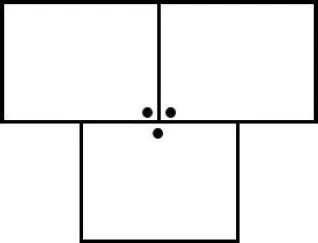
Burgess was limited by the data and computation technology of his era. The original crime mobility triangle was not really measured as a triangle at all. The researchers were lucky to have data disaggregating crime or delinquency by local urban tracts,3 and were in no position to calculate the actual distances of journeys taken, or the area covered. As a result, they asked simpler empirical questions. Did all three points lie within the same local urban tract? If so, the illicit act is considered entirely local. If none of these points was located in the same local tract, the illicit act is coded as non-local. Sometimes two of the three points are together but the third is not, requiring an intermediate coding. Figure 2.1 illustrates the limitations of the original Burgess approach. Although the three points in this triangle are actually quite near, they are defined to be in three separate local tracts, pointing toward a false conclusion that they are non-local. Conversely, a large social area might have all three points dispersed within it but defined as if they are contiguous.
Figure2.1 The Burgess area-based “crime mobility triangle” allocated by local tracts within a city
Although the Burgess method had practical shortcomings, we have to give credit for its innovation, especially taking into account the data available to him at the time. He helped to found crime geography and crime geometry, providing us ideas that we can now use with much greater precision. Thus he set the stage for subsequent work, pointing the way towards a single basic indicator to assist crime analysis.
The theoretical significance of the Burgess crime mobility triangle was brought out in subsequent work by Brantingham and Brantingham (1981a). They discussed how offenders move about in space, finding targets and crime sites. They also worked out several alternative offender-target dispersal patterns. These efforts help us to analyze not only the common geometrical patterns for certain types of crime, but also the diverse possibilities that such crimes fill out.
The challenge now is to combine the basic insight offered by Burgess, the theoretical and empirical contributions by the Brantinghams, and more recent research experience on the journey to crime. Groff and McEwen (2007) did just that. Their paper assists our efforts to find a single summary spatial indicator for crime analysts, the problem posed at the start of this chapter. ...
Table of contents
Cover
Half Title
Crime Science Series
Title Page
Copyright Page
Dedication
Table of Contents
List of figures
Notes on contributors
Preface
1 Editors’ introduction: Patterns, prevention, and geometry of crime
2 Mobility polygons and the geometry of co-offending
3 Spatial-temporal crime paths
4 The edge of the community: drug dealing in a segregated environment
5 Estimating the number of U.S. vehicles stolen for export using crime location quotients
6 Crime patterns and prolific offending
7 Sleeping with strangers: hotels and motels as crime attractors and crime generators
8 How near is near? Quantifying the spatial influence of crime attractors and generators
9 Urban backcloth and regional mobility patterns as indicators of juvenile crime
10 Spatial interplay: interaction of land uses in relation to crime incidents around transit stations
11 Letters to P. and P. Brantingham
References
Index
Trusted by 375,005 students
Access to over 1.5 million titles for a fair monthly price.
Study more efficiently using our study tools.
Frequently asked questions
Yes, you can cancel anytime from the Subscription tab in your account settings on the Perlego website. Your subscription will stay active until the end of your current billing period. Learn how to cancel your subscription
No, books cannot be downloaded as external files, such as PDFs, for use outside of Perlego. However, you can download books within the Perlego app for offline reading on mobile or tablet. Learn how to download books offline
Perlego offers two plans: Essential and Complete
Essential is ideal for learners and professionals who enjoy exploring a wide range of subjects. Access the Essential Library with 800,000+ trusted titles and best-sellers across business, personal growth, and the humanities. Includes unlimited reading time and Standard Read Aloud voice.
Complete: Perfect for advanced learners and researchers needing full, unrestricted access. Unlock 1.5M+ books across hundreds of subjects, including academic and specialized titles. The Complete Plan also includes advanced features like Premium Read Aloud and Research Assistant.
Both plans are available with monthly, semester, or annual billing cycles.
We are an online textbook subscription service, where you can get access to an entire online library for less than the price of a single book per month. With over 1.5 million books across 990+ topics, we’ve got you covered! Learn about our mission
Look out for the read-aloud symbol on your next book to see if you can listen to it. The read-aloud tool reads text aloud for you, highlighting the text as it is being read. You can pause it, speed it up and slow it down. Learn more about Read Aloud
Yes! You can use the Perlego app on both iOS and Android devices to read anytime, anywhere — even offline. Perfect for commutes or when you’re on the go. Please note we cannot support devices running on iOS 13 and Android 7 or earlier. Learn more about using the app
Yes, you can access Patterns, Prevention, and Geometry of Crime by Martin A. Andresen,J. Bryan Kinney in PDF and/or ePUB format, as well as other popular books in Social Sciences & Criminology. We have over 1.5 million books available in our catalogue for you to explore.