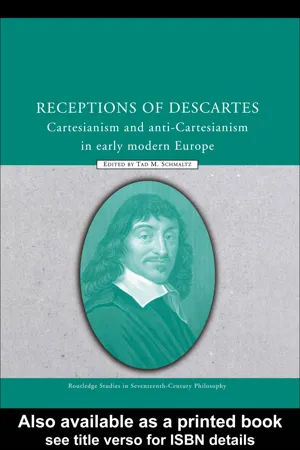
Receptions of Descartes is a collection of work by an international group of authors that focuses on the various ways in which Descartes was interpreted, defended and criticized in early modern Europe. The book is divided into five sections, the first four of which focus on Descartes' reception in specific French, Dutch, Italian and English contexts and the last of which concerns the reception of Descartes among female philosophers.
eBook - ePub
Receptions of Descartes
Cartesianism and Anti-Cartesianism in Early Modern Europe
- 272 pages
- English
- ePUB (mobile friendly)
- Available on iOS & Android
eBook - ePub
About this book
Information
Part I
The Initial Reception Among Women Philosophers
1
Women Philosophers and the Early Reception of Descartes
Anne Conway and Princess Elisabeth
Philosophy the great and only Heir
Of all that Human Knowledge which has bin
Of all that Human Knowledge which has bin
Unforfeited by Mans rebellious sin,
Though full of years He do appear,
(Philosophy, I say, and call it, He,
For whatso’ere the Painters Fancy be,
It a Male-virtue seemes to me)
Has still been kept in Nonage till of late
Nor manag’d or enjoy’d his vast Estate.
Though full of years He do appear,
(Philosophy, I say, and call it, He,
For whatso’ere the Painters Fancy be,
It a Male-virtue seemes to me)
Has still been kept in Nonage till of late
Nor manag’d or enjoy’d his vast Estate.
(Abraham Cowley,
“Ode to the Royal Society”)
“Ode to the Royal Society”)
So wrote Abraham Cowley, celebrating the newly founded Royal Society of London. History seems to endorse Cowley’s seventeenth-century claim that philosophy is a masculine enterprise. In spite of the heroic efforts of modern scholars to recover from oblivion the women philosophers of the past, it is painfully evident that women have little or no place in the existing philosophical canon and are practically invisible in the history of the subject. In particular, the key contribution of the philosophical developments of the seventeenth century to the formation of modernity seems to justify the charge that the very developments in philosophy which paved the way for the age of Enlightenment were ones that excluded women and female ways of thinking. The period bristles with the names of canonical figures: Hobbes, Descartes, Spinoza, Locke, Berkeley, Hume; yet in this period there were strikingly few women who practiced philosophy, and none who have been accorded any significance in the shaping of the philosophical canon. From within philosophy, two related explanations have been offered for the absence of women from philosophy: first of all that there is something in the nature of philosophy, something intrinsic to philosophy, which has excluded women and continues to exclude them. This appears to be confirmed by the fact that, when one looks at the few accredited woman philosophers, there appears to be something about particular types of philosophy which has resulted in women’s marginalization by the male-dominated mainstream.
According to a tradition dating back at least as far as Hegel, and accepted by most philosophers today, it was the Cartesian revolution which marked the starting point of modern philosophy.1 In this scenario, Descartes bears a heavy responsibility for the absence of women from philosophical history, and Descartes has come to be viewed as “the epitome of the alleged maleness of philosophy.”2 In identifying Cartesianism as the root of the problem, feminist philosophers have singled out for critique the Cartesian emphasis on the power of transcendent reason and mechanical models of natural philosophy.3 Above all, Descartes’s mind-body dualism has come to figure as the central component of the unfeminine direction in which philosophy is perceived to have developed. This is the process dubbed by Susan Bordo as “the Cartesian masculinization of thought.”4 Among many variants on these, Joanna Hodge argues, it is Descartes “who installs the theme of subjectivity at the centre of philosophical enquiry,” and that the resulting concept of the subject “has served both to exclude women from philosophy and to obscure how that exclusion has taken place.”5 Until recently, feminist thinkers have been reluctant to acknowledge that the impact of Cartesianism was not as baleful as their earlier analyses suggested. Though Genevieve Lloyd, for example, is more forgiving than many in so far as she recognizes that Descartes offered a new egalitarianism in knowledge through a philosophical method accessible to all, including women, she nonetheless argues: “But in practice, sharp separation of truth-seeking (reason) from practical affairs of everyday life reinforced already existing distinctions between male and female roles, opening the way to the idea of distinctive male and female consciousness.” The resulting sexual division of labor assigned women to the sensuous, and man to transcendent reason.6 Even Erica Harth, who acknowledges a liberating role for early Cartesianism (as a “university without walls” for educated women) in her historically grounded study of Cartesian women, argues for the negative impact of Cartesianism, claiming that the Cartesian denial of sexual difference of the mind entrapped women in an essentially masculine universalism.7
This negative view of Cartisianism is beginning to change. Even the most forceful champions of the “masculinization” thesis acknowledge diversity of views within their ranks: Susan Bordo prints alternative views alongside her own in her Feminist Interpretations of Descartes (1999), allowing that the problem is not Descartes himself, but the appropriation of Cartesianism. Geneviève Lloyd’s Feminism and the History of Philosophy (2002) goes further by proposing that the Meditations affords two contrasting interpretations of Descartes. This change comes in response to two recent developments which have complicated the received picture of the impact of Cartesianism. First, the tide is beginning to turn against the reductionist view of Cartesianism on which the “masculinization” thesis rests: new work on Descartes’s conception of body and, above all, on his theory of the passions are beginning to make headway against the metonymy that makes Cartesian reason stand for the whole Descartes.8 Second, historical studies of early women philosophers have begun to look closely at the philosophical formation of Descartes’s female contemporaries. In recent years the work of Eileen O’Neill, Susan James, Patricia Springborg and others has been immensely productive in tracking down and publishing the work of the forgotten female philosophers of the seventeenth century.9 To the pantheon of better-known figures like Queen Christina and Margaret Cavendish is now added a constellation of salonistes such as Madame de Sevigné and Madame de la Sablière, and Cartésiennes including Anne de la Vigne, Marie Dupré and Descartes’s own niece, Catherine Descartes. The availability of modern editions of texts by these women (where they exist) and the appearance of studies of the women in question by scholars like Ruth Perry, Eileen O’Neill, Margaret Atherton, and Jacqueline Broad have greatly increased our knowledge of the context in which they practiced philosophy.10 This new research shows that, although their numbers were small, there were more female philosophers in the seventeenth century than in any previous century. Furthermore, if we look at the small band of seventeenth-century woman philosophers in terms of the kind of philosophy in which they engaged, it is an inescapable fact that most of this tiny number were highly receptive of new developments in contemporary philosophy. Although their numbers were few, a significant proportion of them found a route to philosophy through Cartesianism: Princess Elisabeth, Anne Conway and Mary Astell all found a way to philosophy via Descartes.11 Even Queen Christina was sufficiently interested in Descartes to summon him to Sweden to discuss philosophy with her. The receptivity of women to Cartesianism is something to weigh in the balance when considering the claims of those who argue that it either destroyed the inherently female elements in philosophy as it had hitherto been practiced, or that it conspired with other philosophical developments to discourage women from becoming philosophers.
The conclusion to be drawn from these twin developments is that, at the very least, we need to review the charge that any inherent misogyny in modern philosophy derives from its Cartesian foundations. In this paper I propose to take a step in that direction by examining two of the most important woman philosophers to figure in the early reception of Descartes, Princess Elisabeth of the Palatinate (1630–1714) and Lady Anne Conway (1630–79), both of whom were younger contemporaries of Descartes. I shall argue on the basis of these two examples that far from impeding or preventing women from becoming philosophers, Cartesianism was more woman-friendly than has hitherto been allowed. Furthermore, since both Princess Elisabeth and Anne Conway advanced objections of Descartes, even his critics can still be said to owe much to Cartesianism. I shall place both in the context of the earliest reception of Descartes, in particular the role of Cartesianism in the circumstances within which they practiced philosophy, particularly in relation to philosophical education and the discursive framework within which philosophical debate was conducted. To place them in that context requires both recognizing the particular circumstances which applied to them as women, but also viewing them in relation to the broader historical narrative of early Descartes reception, and not as separate from it. By focusing on historical Cartesianism, I shall argue that, in its earliest reception, Cartesianism made openings for women. I hope in this way to offer a corrective to a number of modern misconceptions of Descartes.
Of the two female philosophers I shall discuss, Princess Elisabeth was the only one to have had personal contact with Descartes, and the only one to have had a shaping impact on Descartes’s thinking. For it was as a result of his discussions with her that he wrote Les passions de l’âme, with its important clarifications of soul-body interaction. Princess Elisabeth was the daughter of Frederick, the exiled elector Palatine, and his wife, Elizabeth Stuart, the so-called Winter Queen. Her interest in philosophy is known largely through her correspondence with Descartes, which she commenced in 1643, when she was twenty-three years of age and he was old enough to be her father. They exchanged letters until his death, and also met on a number of occasions, the last being in the summer of 1646. Their correspondence has attracted the attention of Descartes scholars largely on account of the light it sheds on the writing of Les passions de l’âme. From Descartes’s replies and the discussion that ensues emerge the first sketches of that treatise, of which he sent her a draft version in April 1646. It is probably no exaggeration to say that we owe to her his taking his philosophy in the direction of ethics, and, indeed, his having completed a treatise on the subject of the passions.
Anne Conway would appear to be a prima facie case of female anti-Cartesianism. For she proposed a metaphysical system which dispensed with soul-body dualism altogether. Her anti-Cartesian stance is announced in the subtitle of her posthumously published Principles of the Most Ancient and Modern Philosophy. In place of the dualism of soul and body, spirit and matter of Descartes, she propounds a vitalist philosophy that attributes life to body, rejecting the Cartesian mechanist conception of matter as inert extension, differentiated by shape, size and position. As in the case of Elisabeth, one of the main grounds of her objection to dualism is that Descartes cannot account for soul-body interaction. In this respect there is a striking parallel between the grounds of her objections to Cartesian dualism and those advanced by Princess Elisabeth.
The Condition of Philosophy
The reason for an increased participation of women in philosophy in the seventeenth century may be attributed, in part, to non-philosophical factors pertaining to the circumstances under which philosophy was practiced. These are factors which Cartesianism shared with the other new philosophies of the seventeenth century. First of all, the preferred language of philosophy was, increasingly, the vernacular. Second, in the seventeenth century philosophy became an extra-mural activity: Hobbes, Descartes and Locke were not university professors. To this may be added the point that philosophy at this time was more open than ever before to those without specialist academic training in philosophical discourse. All the new philosophies just mentioned adopted radically simplified logical apparatuses, and eschewed the kind of specialist vocabularies and logical procedures which characterized scholastic philosophy, and by definition excluded non-initiates. These factors meant that these new philosophies were more accessible to lay people—at least to literate lay persons—a category which included women or, to be more exact, literate women. In point of historical fact, many of the supposed characteristics of masculine reason which are said to characterize Cartesianism are unquestionably features of the syllogistic reasoning that was the hallmark of the scholastic philosophy which antedated Cartesianism, and which were repudiated during the so-called Cartesian revolution. By comparison with the thorny rigors of scholastic exercises in logic, which characterize the philosophy taught in universities, Cartesianism was closer to experience and common sense.
Notwithstanding the fact that the seventeenth century apparently offered a more conducive environment for the lay study of philosophy, we should not overstate the advantages that seventeenth-century philosophical women had over their Renaissance forbears. We should not forget the limitations of circumstances and sources that obtained for women philosophers in the seventeenth century. Even if there was an increase in numbers, the smallness of that number cannot be denied. Nor can the fact that none of them is considered today to be of the first rank. It is undeniable that the philosophical environment of Descartes’s time was a male environment, for philosophy and the institutions of learning were the preserve of men. This...
Table of contents
- Cover
- Half Title
- Title Page
- Copyright
- Contents
- Contributors
- Acknowledgments
- References and abbreviations
- Introduction
- Part I: The initial reception among women philosophers
- Part II: The French reception and French Cartesianism
- Part III: Spinoza and the Dutch reception
- Part IV: The reception in Rome and Naples
- Part V: The reception across the Channel
- Bibliography
- Index
Trusted by 375,005 students
Access to over 1.5 million titles for a fair monthly price.
Study more efficiently using our study tools.
Frequently asked questions
Yes, you can cancel anytime from the Subscription tab in your account settings on the Perlego website. Your subscription will stay active until the end of your current billing period. Learn how to cancel your subscription
No, books cannot be downloaded as external files, such as PDFs, for use outside of Perlego. However, you can download books within the Perlego app for offline reading on mobile or tablet. Learn how to download books offline
Perlego offers two plans: Essential and Complete
- Essential is ideal for learners and professionals who enjoy exploring a wide range of subjects. Access the Essential Library with 800,000+ trusted titles and best-sellers across business, personal growth, and the humanities. Includes unlimited reading time and Standard Read Aloud voice.
- Complete: Perfect for advanced learners and researchers needing full, unrestricted access. Unlock 1.5M+ books across hundreds of subjects, including academic and specialized titles. The Complete Plan also includes advanced features like Premium Read Aloud and Research Assistant.
We are an online textbook subscription service, where you can get access to an entire online library for less than the price of a single book per month. With over 1.5 million books across 990+ topics, we’ve got you covered! Learn about our mission
Look out for the read-aloud symbol on your next book to see if you can listen to it. The read-aloud tool reads text aloud for you, highlighting the text as it is being read. You can pause it, speed it up and slow it down. Learn more about Read Aloud
Yes! You can use the Perlego app on both iOS and Android devices to read anytime, anywhere — even offline. Perfect for commutes or when you’re on the go.
Please note we cannot support devices running on iOS 13 and Android 7 or earlier. Learn more about using the app
Please note we cannot support devices running on iOS 13 and Android 7 or earlier. Learn more about using the app
Yes, you can access Receptions of Descartes by Tad M. Schmaltz in PDF and/or ePUB format, as well as other popular books in Philosophy & Philosophy History & Theory. We have over 1.5 million books available in our catalogue for you to explore.