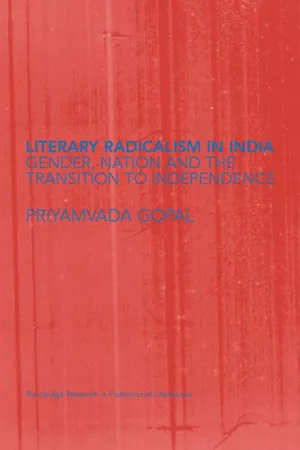
Literary Radicalism in India situates postcolonial Indian literature in relation to the hugely influential radical literary movements initiated by the Progressive Writers Association and the Indian People's Theatre Association. In so doing, it redresses a visible historical gap in studies of postcolonial India. Through readings of major fiction, pamphlets and cinema, this book also shows how gender was of constitutive importance in the struggle to define 'India' during the transition to independence.
eBook - ePub
Literary Radicalism in India
Gender, Nation and the Transition to Independence
- 192 pages
- English
- ePUB (mobile friendly)
- Available on iOS & Android
eBook - ePub
About this book
Information
1 The critical spirit
Decolonisation and the Progressive Writers Association
On August 14, 1947, a few hours before India attained formal independence from British rule at midnight, Jawaharlal Nehru addressed the constituent assembly of India in a now famous speech:
Long years ago we made a tryst with destiny, and now the time comes when we shall redeem our pledge, not wholly or in full measure, but very substantially. At the stroke of the midnight hour, when the world sleeps, India will awake to life and freedom. A moment comes, which comes but rarely in history, when we step out from the old to the new, when an age ends, and when the soul of a nation, long suppressed, finds utterance. It is fitting that at this solemn moment we take the pledge of dedication to the service of India and her people and to the still larger cause of humanity.(Nehru 1965: 336)
To present-day readers, after many such midnight ceremonies, inaugural trysts and speeches across decolonising regions of Asia and Africa, the metaphors and gestures of Nehru's speech are familiar ones: an awakening from slumber, the dawn of a new era, the assertive, unitary vox populi and the rebirth of a nation. Several such scenes in which the motif of national emergence on to the world stage would recur were also played across Africa from 1957 onwards: ‘With the passing of the world-historical era of colonialism a new world-historical era would dawn. In this new era, the slumbering giant of Africa would awaken and leave the imprint of its decisive action upon the world’ (Lazarus 1990: 2–3). As Neil Lazarus has pointed out, these ceremonies were all imbued with a ‘special aura of timelessness’ testifying to ‘the headiness of initial expectations of independence’ (ibid. 3).
Some ten years before Nehru gave his fabled speech, a group of young Indian writers issued a manifesto that also spoke of transition:
Radical changes are taking place in Indian society…. We believe that the new literature of India must deal with the basic problems of our existence to-day [sic] – the problems of hunger and poverty, social back-wardness, and political subjection. All that drags us down to passivity, inaction and un-reason we reject as re-actionary [sic]. All that arouses in us the critical spirit, which examines institutions and customs in the light of reason, which helps us to act, to organize ourselves, to transform, we accept as progressive.(Anand 1979: 20–1)
The differences between the two calls to national action are marked even as both draw on an epochal sense of transition and on similar vocabularies of transformation. If Nehru is cautious about the extent to which India's ‘pledge’ can be redeemed as her ineluctable destiny unfolds, his words nevertheless speak to an inevitable renaissance, a national self-actualisation that is now unstoppable. The 1936 manifesto drafted by Mulk Raj Anand and others to commemorate the inauguration of the All-India Progressive Writers Association (PWA) is also optimistic in its epochal vision but emphatic about the self-critique and work that postcolonial reconstruction (as opposed to rebirth) will take. Despite its own schematic and teleological undertones, this document conveys a sense of the challenges involved in such a project.1 The new, if it is to be brought into being, requires the development of a critical awareness of all that needs to be changed or reworked and of the labours that such transformations will require. The new is not the opposite of the old; instead, the latter is to be examined ‘in the light of reason’ and reworked into the future. Where Nehru's speech is replete with references to a singular national history to which national self-‘discovery’ is integral, the PWA manifesto speaks of a dynamic process of recognising problems and working through them. The structure of the former is teleological; the latter is driven by utopian impulse but not a sense of manifest destiny.
The distinction between these two inaugural gestures is not unlike one that Lazarus, drawing on Anouar Abdel-Malek, maps between ‘nationalists’ and ‘nationalitarians’ in anti-colonial struggles in Africa. Nationalitarians (Frantz Fanon is one example) criticise ‘nationalists for conflating independence with freedom’ and for not undertaking the radical social and economic restructuring that would mean real freedom (Lazarus 1990: 11). Nationalitarians, such as the founders of the PWA, do see the moment of independence as one with revolutionary potential; the postcolonial era must bring with it ‘a wholesale reconstruction of society’ (ibid. 5). If Nehru's words have come to represent a certain kind of nationalism emblematic of the newborn Indian state itself, for the writers who came together to found the PWA, the nascent nation state in 1936 was ‘a terrain of struggle’ (Ahmad 1993: 48). Rather than take the ‘long-suppressed soul’ of the nation for granted, a fundamental and urgent question here is how to democratically build an all-India character. If for Nehru, despite cautionary disclaimers, ‘the past is over and it is the future that beckons us now’, the PWA manifesto eyes the future with a radical sense of the present and its challenges. Certainly, both sides share the urgent sense that the day must be seized in the interests of bringing utopian visions to fruition.
For Nehru, this vision is troped as a quest, the discovery of an idyll that is always already part of India's historical being. Change has already occurred (‘we have endured all the pains of labour and our hearts are heavy with the memory of this sorrow’) and what follows in its wake are the labours of ensuring its fruits: ‘The future is not one of ease or resting but of incessant striving …the ending of poverty, and ignorance and disease and inequality of opportunity’ (Nehru 1965: 336). The PWA manifesto, in contrast, interprets the moment as one that demands active intervention in the interests of broadening the meanings and scope of ‘freedom’. Even as it highlights oppression, the manifesto is a call to agency. The task of the radical writer is not the benevolent one of ‘wiping tears from eyes’, but one of active self-transformation (Nehru 1965: 336). Where Nehru uses the relatively benign phrase with a missing agent of action – ‘inequality of opportunity’ – to indicate the challenges at hand, the manifesto speaks more forcefully of ‘political subjection’ as a problem. In the final instance, its polemical target is not all that ‘we’ve endured’ but all that enables ‘us’ to be passive, reactionary and inactive.
Without overemphasising the distinctions between these Progressive writers and mainstream nationalists (for there were also significant overlaps between the two groups), it is clear that the motley crowd who came to constitute the PWA were concerned with a diversity of issues beyond nationalism that they saw as integral to the transitional period of decolonisation. Though deeply invested in anti-colonial activity, they spoke of an ‘institutional change’ that was to take place at several different levels. The writer's primary task in this context of the ‘radical changes’ already under way was to counter backlash, or ‘reactionary and revivalist tendencies on questions like family, religion, sex, war and society’ (Anand 1979: 20). The ‘struggle’ itself was framed not as a dyadic one of coloniser against colonised, but as a war to be waged against a range of social and political forces. Much of the output in this newly radicalised literary climate mandated that ‘a critique of others (anti-colonialism) be conducted in the perspective of an even more comprehensive, multifaceted critique of ourselves: our class structures, our familial ideologies, our management of our bodies and sexualities, our idealisms, our silences’ (Ahmad 1992: 118). In contrast to the axioms underlying Nehru's discourse of freedom at midnight, the initial work of many writers associated with the PWA does militate against any kind of ‘sustained, powerful myth of a primal innocence’ when it comes to the colonial encounter (ibid. 118).
The formation of the All-India Progressive Writers Association in 1936 points to a crystallisation of radicalising trends begun in the years before.2 Many critics and writers, including founder members of the PWA, trace the literary radicalism of this period back to the publication in 1932 of a controversial anthology of short stories, Angarey [Live Coals]. This anthology contained some ten short stories contributed by four authors who would then go on to be involved with the PWA: Sajjad Zaheer, who edited it, Ahmed Ali, Mahmuduzzafar and Rashid Jahan, the lone woman in this group. Both its many detractors and its enthusiastic supporters saw Angarey as the result of cultural and intellectual contact with Europe: ‘It would be hard to say’, writes critic and translator, Shakeel Siddiqui, ‘whether the vision for Angarey or an anthology like Angarey was conceived in Lucknow or London’ (Siddiqui 1990: 12). Siddiqui observes that both Zaheer and Ahmad Ali had been studying in England at the time; both were drawn to the radical and avant-garde literary movements that were gaining momentum in the Europe of the 1930s.3 All four contributors were, however, members of the upper strata of the Muslim community in Lucknow. The publication of the stories, all of which thematise the morals and mores of this community, drew upon the authors the charge that they were ‘intoxicated’ by English education and brainwashed into attacking Islam and its tenets. Some religious leaders denounced the collection and even an official ‘anti-Angarey’ campaign was inaugurated; Ahmed Ali writes that he and his fellow authors ‘were lampooned and satirised, censured editorially and in pamphlets and, were even threatened with death’ (Ali 1974: 35). This campaign was ultimately successful in getting the British government to ban the collection and confiscate remaining copies almost six months after its publication.
The question of location is an important one with regard to this collection and the radical literary production that followed in the next two decades. Given the status of north Indian Muslims as a minority community and the overdetermined nature of any emancipatory project in colonial polities – where it inevitably overlaps with civilising missions – the charges against the collection bear some reflection. What are the valences of self-criticism within minority communities in such a context? The answer that the authors gave through Mahmuduzzafar's letter to the editor in The Leader, dated 5 April, 1933, was simple:
The authors of this book do not wish to make any apology for it. They leave it to float or sink of itself … They have chosen the particular field of Islam not because they bear it any ‘special’ malice, but because, being born into that particular Society, they felt themselves better qualified to speak for that alone. They were more sure of their ground there.(Alvi 1995: 102)
This idea that a self-critical literature or, more precisely, writing that critically identified an ‘us’ and an ‘our’ in the interests of reconstruction needed to be developed was one of the defining features of this emergent radical tradition. If the Angarey writers had chosen their natal religious community and class as the target of critique, in the radical literature that was to follow, such acts of identification and self-criticism would take place along other axes, including gender and caste. Critical identification, a radical reappropriation of the communal ‘we’ and ‘us’, was a particularly difficult and yet especially necessary task in contexts where homogenised ‘selves’ defined themselves against equally homogeneous ‘others’ – coloniser and colonised, Hindus and Muslims, minority and majority. Angarey was to inspire a body of literature that, by interrogating the ‘we’ of both communal and national collective identities, attempted to break away from dyadic models of conflict and oppression. As Aijaz Ahmad has suggested, this literature – especially in the bloody wake of Partition – did not ‘construct fixed boundaries between the criminalities of the colonialist and the brutalities of all those indigenous people who have had power in our own society … No quarter was given to the colonialist; but there was none for ourselves either’ (Ahmad 1992: 118).
Some four years after the publication of the Angarey collection, the All-India Progressive Writers Association was formally inaugurated in April, 1936 at a large conference in Lucknow. The primary goal was to consolidate the gains of the last few years – to open up institutional spaces where diverse issues pertinent to regenerating nation and national culture could be discussed and to create support networks for writers concerned with social and cultural change. While it is certainly true that the PWA had links to the Communist Party of India (CPI) (through influential founder members such as Zaheer), it is incorrect to reduce the organisation's mandate, as Aijaz Ahmad does, to that of a cultural front for or of the CPI. Many leading figures at that first conference, even those deeply sympathetic to communism, were not affiliated to the party and certainly did not see the organisation as a front for the party. In fact, founder members such as Mulk Raj Anand often went to great lengths to point out the respect for political heterogeneity that the organisation would maintain.
[T]he title of ‘Progressive Writers' Association’ has led to some confusion by suggesting some kind of regimentation of writers or at least by giving the appearance of a clique … actually we were a collection of readers and writers groping together, in spite of our different individualities, towards the realisation of certain facts.(Anand 1979: 2)
Anand also pointed out that, unfortunately, ‘the naiveté of our catch penny formalists’ and ‘vulgar sociologists’ allowed reactionary forces to dismiss Progressive and Marxian thought; he urged Progressive writers to ‘be strongly on our guard against cheap simplifications and sensationalism’ (ibid. 8–9). Meanwhile, writers such as Chughtai and Manto had deeply contentious relationships with the party and often distanced themselves from it, even as they retained a commitment to radical politics. In a famous essay entitled ‘Progressives Don’t Think’, Manto wrote bitterly about the dismissive treatment he had received from more orthodox socialist and communist writers. Ismat Chughtai – who unhesitatingly described lifelong party member, Rashid Jahan, as her mentor – was also emphatic about her own independence: ‘no association could dictate to me what I could or could not write’ (Tharu and Lalita 1993: 128).
In ascribing the development of what he terms ‘critical realism’ primarily to the party's influence, Ahmad weakens his own salutary insights about the importance of leftist and Progressive writing during this period in two ways. His claim that ‘critical realism’ became a ‘fundamental form of narrativity’ in response to the CPI's ‘United Front’ strategy seems suspiciously close to an endorsement of party-line aesthetics (Ahmad 1992: 118). This delineation also militates against the attempts of many in the PWA not to be regimented in this way, either aesthetically or ideologically. Although Ahmad's claim honours the role of organised communism and the CPI in forging cultural resistances and alliances (a necessary gesture in a contemporary critical climate that is marked by a sweeping and undifferentiated hostility towards communism), so schematic a causal linkage fails to provide us with a historicised account of why such a diversity of writers and intellectuals were prompted to come together at this particular historical conjuncture. Michael Denning has pointed to a similar blindness in readings of Popular Front public culture in the USA; he argues that the politics of anti-fascist solidarity with Soviet socialism has erroneously ‘led many historians to see the Popular Front, not as a social movement, but simply as a strategy of the Communist Party, a political line dictated by the Moscow-controlled Communist International’ (Denning 1997: 11). While the PWA and its more mass-based sister organisation, the Indian People's Theatre Association (IPTA, established in 1942), were not social movements in the strict sense of the term, they certainly had broader roots and a more heterogeneous membership in their heyday than a singular emphasis on the CPI's role would indicate. As David Roediger has noted, again in the context of the Popular Front in the USA, a cultural moment with striking affinities to the moment of the PWA and IPTA: ‘A fixation on the Party … has left enormous gaps in our knowledge of the radical past’ (cited in Denning 1997: 5). The task of the radical critic and historian is to reconstruct this past without undermining either the role of organised party politics or the enormous efforts of those who were not affiliated to the party or who worked in a kind of contentious solidarity with it.4
‘Radical changes are taking place’: the historical conjuncture of transition
While it is beyond the scope of this chapter to reconstruct in full the historical conjuncture that gave rise to the cultural radicalism of the PWA and IPTA, I will try to show here how it was that this conjuncture came to be seen as a transitional one that needed to be seized in the interests of social transformation. The ‘terrain of the conjunctural’, as Gramsci defines it, is one where incurable structural contradictions have revealed themselves (reached maturity), and that, despite this, the political forces that are struggling to conserve and defend the existing structure itself are making every effort to cure them, within certain limits, and to overcome them (Gramsci 1971: 178).
This is ‘the terrain [upon which] the forces of opposition organize’ (ibid. 178). In the context of India's transition from colony to nations, the Gramscian dyad of ‘existing’ versus ‘oppositional’ forces was marked by a certain fluidity of position. If, for instance, Gandhian nationalism functioned as an oppositional force in relation to the colonial government, it is also true that the same force could and did take a reactionary role with regard to, for instance, peasant militancy. Despite this fluidity – or perhaps as a consequence of it – the decades just prior to formal independence were marked by a proliferation of oppositional forces and social movements. Additionally, in 1935, the India Act gave a certain limited autonomy to provincial governments run by Indians and increased the electoral franchise from 6.5 to 30 million. The new constitutional structure, historian Sumit Sarkar has suggested, provided a frame around which a major confrontation between left and right within the national movement could play itself out (Sarkar 1983: 336). The India Act consolidated the terrain of ‘nation’ within which various struggles would now be enacted.
In his influential work on the discursive contours of Indian nationalism, Partha Chatte...
Table of contents
- Cover
- Half Title
- Postcolonial Literatures
- Full Title
- Copyright
- Dedication
- Contents
- Acknowledgements
- Note on translations
- Introduction
- 1 The critical spirit
- 2 Gender, modernity and the politics of space
- 3 Habitations of womanhood
- 4 Dangerous bodies
- 5 Straight talk or spicy masala?
- Afterword: ‘Sustaining Faith’ and the legacy of Progressive writing
- Notes
- Appendix
- Bibliography
- Index
Trusted by 375,005 students
Access to over 1.5 million titles for a fair monthly price.
Study more efficiently using our study tools.
Frequently asked questions
Yes, you can cancel anytime from the Subscription tab in your account settings on the Perlego website. Your subscription will stay active until the end of your current billing period. Learn how to cancel your subscription
No, books cannot be downloaded as external files, such as PDFs, for use outside of Perlego. However, you can download books within the Perlego app for offline reading on mobile or tablet. Learn how to download books offline
Perlego offers two plans: Essential and Complete
- Essential is ideal for learners and professionals who enjoy exploring a wide range of subjects. Access the Essential Library with 800,000+ trusted titles and best-sellers across business, personal growth, and the humanities. Includes unlimited reading time and Standard Read Aloud voice.
- Complete: Perfect for advanced learners and researchers needing full, unrestricted access. Unlock 1.5M+ books across hundreds of subjects, including academic and specialized titles. The Complete Plan also includes advanced features like Premium Read Aloud and Research Assistant.
We are an online textbook subscription service, where you can get access to an entire online library for less than the price of a single book per month. With over 1.5 million books across 990+ topics, we’ve got you covered! Learn about our mission
Look out for the read-aloud symbol on your next book to see if you can listen to it. The read-aloud tool reads text aloud for you, highlighting the text as it is being read. You can pause it, speed it up and slow it down. Learn more about Read Aloud
Yes! You can use the Perlego app on both iOS and Android devices to read anytime, anywhere — even offline. Perfect for commutes or when you’re on the go.
Please note we cannot support devices running on iOS 13 and Android 7 or earlier. Learn more about using the app
Please note we cannot support devices running on iOS 13 and Android 7 or earlier. Learn more about using the app
Yes, you can access Literary Radicalism in India by Priyamvada Gopal in PDF and/or ePUB format, as well as other popular books in Literature & Literary Criticism. We have over 1.5 million books available in our catalogue for you to explore.