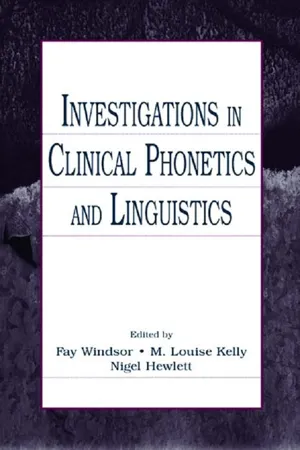
Investigations in Clinical Phonetics and Linguistics is a sequel to the eighth meeting of the International Clinical Phonetics and Linguistics Association, attended by delegates from 26 different countries. This book reflects the scope of the subject area of clinical phonetics and linguistics, the balance of input into it with respect to the different kinds of research being carried on, and the representation of researchers from different parts of the world. Its scope includes the application of all levels of linguistic analysis and the chapters of the book have been ordered as far as possible according to linguistic level, beginning with pragmatics and ending with acoustics. It will be immediately apparent that a greater number of chapters are concerned with applications of phonetics and phonology then with any other levels.
eBook - ePub
Investigations in Clinical Phonetics and Linguistics
- 520 pages
- English
- ePUB (mobile friendly)
- Available on iOS & Android
eBook - ePub
Investigations in Clinical Phonetics and Linguistics
About this book
Information
Table of contents
- Front Cover
- Half Title
- Title Page
- Copyright
- Contents
- Contributors
- Preface
- Chapter 1 An Emergentist Approach to Clinical Pragmatics
- Chapter 2 Defining Trouble-Sources in Dementia: Repair Strategies and Conversational Satisfaction in Interactions with an Alzheimer's Patient
- Chapter 3 Evidence for a Direct Orthography-to-Phonology Route in Reading
- Chapter 4 Past Tense Expression in a Norwegian Man with Broca's Aphasia
- Chapter 5 Sentence Comprehension in Greek SLI Children
- Chapter 6 The Importance of Input Factors for the Acquisition of Past Tense Inflection: Evidence from Specifically Language Impaired Norwegian Children
- Chapter 7 Morphosyntactic Problems in Children with Specific Language Impairment: Grammatical SLI or Overload in Working Memory?
- Chapter 8 How Do Preschool Language Problems Affect Language Abilities in Adolescence?
- Chapter 9 Comprehension of Resultative Verbs in Normally Developing and Language Impaired German Children
- Chapter 10 Learning the H(e)ard Way: The Acquisition of Grammar in Young German-Speaking Children with Cochlear Implants and with Normal Hearing
- Chapter 11 Acquisition of the Novel Name–Nameless Category (N3C) Principle by Young Korean Children with Down Syndrome
- Chapter 12 Acquisition of Syllabic Structure in Egyptian Colloquial Arabic
- Chapter 13 Phonological Breakdowns in Children with Specific Language Impairment
- Chapter 14 Phonological Saliency and Phonological Acquisition by Putonghua Speaking Children: A Cross-Populational Study
- Chapter 15 Typological Description of the Normal Acquisition of Consonant Clusters
- Chapter 16 Effects of Oral Language on Sound Segmentation Skills: Crosslinguistic Evidence
- Chapter 17 Onset Clusters and the Sonority Sequencing Principle in Spanish: A Treatment Efficacy Study
- Chapter 18 The Realization of English Liquids in Impaired Speech: A Perceptual and Instrumental Study
- Chapter 19 Vocal Development in the Human Infant: Functions and Phonetics
- Chapter 20 Speech Motor Subprocesses in DAS Studied with a Bite-Block
- Chapter 21 Spectral Contrast Sensitivity of Lateralized /s/ Spectra Produced by High School Lateralizers
- Chapter 22 Speech Errors in Japanese
- Chapter 23 Segment Production in Mono-, Di- and Polysyllabic Words in Children Aged 3;0 to 7;11
- Chapter 24 Features of Impaired Tongue Control in Children with Phonological Disorder
- Chapter 25 Phonemic Integrity and Contrastiveness in Developmental Apraxia of Speech
- Chapter 26 Voice Onset Time in Normal Speakers of a German Dialect: Effects of Age, Gender and Verbal Material
- Chapter 27 Voice Onset Time Patterns in Bilingual Phonological Development
- Chapter 28 Quantitative Aspects of Glossectomy Speech Production
- Chapter 29 Acceptability and Intelligibility of Moderately Dysarthric Speech by Four Types of Listeners
- Chapter 30 The Use of Prosody in Interaction: Observations from a Case Study of a Norwegian Speaker with a Non-Fluent Type of Aphasia
- Chapter 31 Learning to Apprehend Phonetic Structure from the Speech Signal: The Hows and Whys
- Chapter 32 Intelligibility and Acceptability in Speakers with Cleft Palate
- Chapter 33 Voicing Contrasts and the Deaf: Production and Perception Issues
- Chapter 34 Otitis Media and the Acquisition of Consonants
- Chapter 35 The Voice of Polypoid Vocal Folds before and after Surgery
- Chapter 36 Acoustic Characteristics of the Voice in Young Adult Smokers
- Chapter 37 Perceptual, Acoustic and Electroglottographic Analyses of Dysphonia Subsequent to Traumatic Brain Injury
- Chapter 38 Automatic Estimation of Vocal Harmonics-to-Noise Ratio using Cepstral Analysis
- Author Index
- Subject Index
Trusted by 375,005 students
Access to over 1.5 million titles for a fair monthly price.
Study more efficiently using our study tools.
Frequently asked questions
Yes, you can cancel anytime from the Subscription tab in your account settings on the Perlego website. Your subscription will stay active until the end of your current billing period. Learn how to cancel your subscription
No, books cannot be downloaded as external files, such as PDFs, for use outside of Perlego. However, you can download books within the Perlego app for offline reading on mobile or tablet. Learn how to download books offline
Perlego offers two plans: Essential and Complete
- Essential is ideal for learners and professionals who enjoy exploring a wide range of subjects. Access the Essential Library with 800,000+ trusted titles and best-sellers across business, personal growth, and the humanities. Includes unlimited reading time and Standard Read Aloud voice.
- Complete: Perfect for advanced learners and researchers needing full, unrestricted access. Unlock 1.5M+ books across hundreds of subjects, including academic and specialized titles. The Complete Plan also includes advanced features like Premium Read Aloud and Research Assistant.
We are an online textbook subscription service, where you can get access to an entire online library for less than the price of a single book per month. With over 1.5 million books across 990+ topics, we’ve got you covered! Learn about our mission
Look out for the read-aloud symbol on your next book to see if you can listen to it. The read-aloud tool reads text aloud for you, highlighting the text as it is being read. You can pause it, speed it up and slow it down. Learn more about Read Aloud
Yes! You can use the Perlego app on both iOS and Android devices to read anytime, anywhere — even offline. Perfect for commutes or when you’re on the go.
Please note we cannot support devices running on iOS 13 and Android 7 or earlier. Learn more about using the app
Please note we cannot support devices running on iOS 13 and Android 7 or earlier. Learn more about using the app
Yes, you can access Investigations in Clinical Phonetics and Linguistics by Fay Windsor,M. Louise Kelly,Nigel Hewlett in PDF and/or ePUB format, as well as other popular books in Education & Inclusive Education. We have over 1.5 million books available in our catalogue for you to explore.