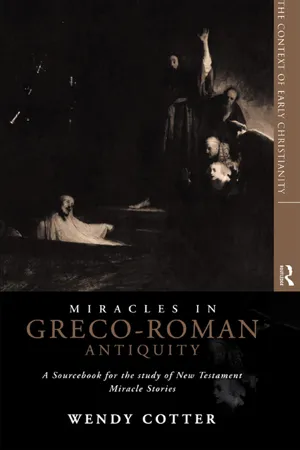
Miracles in Greco-Roman Antiquity presents a collection in translation of miracle stories from the ancient world. The material is divided up into four main categories including healing, exorcism, nature and raising the dead.
Wendy Cotter, in an introduction and notes to the selections, contextualizes the miracles within the background of the Greco-Roman world and also compares the stories to other Jewish and non-Jewish miracle stories of the Mediterranean world. This sourcebook provides an interdisciplinary collection of material which will be of value to students of the New Testament.
eBook - ePub
Miracles in Greco-Roman Antiquity
A Sourcebook for the Study of New Testament Miracle Stories
- 288 pages
- English
- ePUB (mobile friendly)
- Available on iOS & Android
eBook - ePub
Miracles in Greco-Roman Antiquity
A Sourcebook for the Study of New Testament Miracle Stories
About this book
Part I
GODS AND HEROES WHO HEAL
1
GODS WHO HEAL
INTRODUCTION
The significance of a hero’s healing miracle is profoundly affected by any likeness it bears to actions of gods or heroes already known to the audience. Part 1 presents a selection of texts which represent those favorite gods and heroes who were attributed with the power to heal. Since it is particularly helpful if a narrator comments about the significance of the hero or god’s miracle, I also include any interpretive remarks attached to the story’s presentation. In this way we can better reconstruct the “lens” of the Greco-Roman world, better understand why certain tellings of miracle stories were especially popular so that they survived. The particular telling of the Jesus miracles that survived until the writing of the gospels must have held special significance. The texts in this part help to create a set of meanings and “echoes” that were available as reasons, at least in part, for the unforgettable character of those gospel accounts.
THE HEALING GODS: HERCULES, ASCLEPIUS AND ISIS
In principle, any deity or any divinely empowered hero of the GrecoRoman period could be claimed to have performed a healing miracle. But in fact, there are only a few deities who were regularly attributed with healings. In the Greek pantheon, Heracles/Hercules is famous for his enormous compassion for humanity. Once human, he was eventually raised to the status of a god. Yet, he never forgets the pains and troubles of the human condition. Among the foreign deities, it is the Egyptian goddess Isis who is worshiped for her beneficence toward humanity and can be approached for healings, especially in her role as loving mother to all her devotees, no matter what their social rank or status.
But the greatest of all the healing deities, Greek or foreign, is Asclepios (Asclepius or Aesculapius), the Greek physician who is raised to the status of a god. He is the one who guides the hands of all the physicians, the one to whom all the sick may turn hopefully. The shrine at Epidaurus, the many references to him in commemorative inscriptions and plaques, the amulets and statues all testify to his reputation as the healing god throughout the Greco-Roman world.
It is intriguing that the legends of all three deities, Hercules, Isis and Asclepius also feature a story of their raising someone from the dead. Thus, the particular type of miracle that Bultmann identified as “raising from the dead” belongs naturally in the section on healing. It seems that this type of miracle is a healing gone to its extreme.
Greek heroes now divine: Hercules and Asclepius
Hercules
Heals diseases
AELIUS ARISTIDES
1.1.1. Hercules, a Hero Now Divine, is Beyond Human Nature
Aelius Aristides, Heracles 40.111
For when Heracles, purified in the manner told, left the human race, Apollo immediately proclaimed the establishment of temples to Heracles and that sacrifices be made to him as to a god, and at that he revealed it to Athens which was the oldest Greek city, and as it were, a guide for all men in the matter of piety toward the gods and in all other serious activities. Further it also had many other ties of friendship with Heracles, including the fact that he was the first foreigner to be initiated,2 while he was among men. And the manifestation of the Athenians’ zeal was so great and his position was adjudged as so very much superior that they even changed all the shrines built in honor of Theseus throughout the demes and made them shrines in honor of Heracles instead of Theseus in the belief that Theseus was the best of their citizens, but that Heracles was beyond human nature.
1.1.2. Even Now Hercules Heals All Diseases
Aelius Aristides, Heracles 40.12
But why should we speak of ancient history. For the activity of the god is still now manifest. On the one hand, as we hear he does marvelous deeds at Gadira3 and is believed to be second to none of all the gods. And on the other hand, in Messene in Sicily he frees men from all diseases, and those who have escaped danger on the sea attribute the benefaction equally to Poseidon and Heracles. One could list many other places sacred to the god, and other manifestations of his power.
Raises the dead
APOLLODORUS (CIRCA FIRST CENTURY CE)
1.2. Hercules Fought with Hades and Brought Alcestis Back to Life
Apollodorus, The Library, 1.9.154
Now Pelias had promised to give his daughter [Alcestis] to him who should yoke a lion and a boar to a car, and Apollo yoked and gave them to Admetus, who brought them to Pelias and so obtained Alcestis. But in offering a sacrifice at his marriage, he forgot to sacrifice to Artemis; therefore when he opened the marriage chamber he found it full of coiled snakes. Apollo bade him appease the goddess and obtained as a favour of the Fates that, when Admetus should be about to die, he might be released from death if someone should voluntarily choose to die for him. And when the day of his death came neither his father nor his mother would die for him, but Alcestis died in his stead. But the Maiden [Artemis] sent her up again, or as some say, Hercules fought with Hades and brought her up to him.
EURIPIDES (485–406 BCE)
The text from Euripides will be placed after Apollodorus, because the latter provides a fine review of the story’s background. Euripides’ play Alcestis reaches its climax with Hercules’ restoration of the loving wife to her bereaved husband. In this last scene, Hercules meets Admetus, Alcestis’ husband, as he returns from the funeral of his wife. He is especially grief-stricken because Alcestis has given her life in his place. With Hercules is a veiled woman, who stands by silently as he and Admetus enter into the telling conversation that will reveal the miraculous event.
Hercules brings back from the dead Admetus’ wife, Alcestis
1.3.1. Hercules Explains to Admetus that He Ambushed Hades at the Tomb
Euripides, Alcestis 1136–11425
Admetus: O scion nobly-born of Zeus most high,
Blessings on thee! The Father who begat thee
Keep thee! Thou only has restored my fortunes.
How didst thou bring her from shades to light?
Hercules: I closed in conflict with the Lord of Spirits.
Admetus: Where, say’st thou, didst thou fight this fight with Death?
Hercules: From ambush by the tomb mine hands ensnared him.
1.3.2. Alcestis Must Wait Till the Third Day to be Unconsecrated to the Powers Beneath the Earth
Euripides, Alcestis 1143–1150
Admetus: Now wherefore speechless standeth thus my wife?
Hercules: ’Tis not vouchsafed thee yet to hear her voice,
Ere to the Powers beneath the earth she be
Unconsecrated, and the third day come.
But lead her in, and, just man as thou art,
Henceforth, Admetus, reverence still the guest.
Farewell. But I must go, and work the work
Set by the king, the son of Sthenelaus.
1.3.3. Hercules Takes His Leave While Admetus Promises Sacrifices of Praise and Rejoicing
Euripides, Alcestis 1151–1158
Admetus: Abide with us, a sharer of our hearth.
Hercules: Hereafter this: now must I hasten on.
Admetus: O prosper thou, and come again in peace!
(Exit Hercules)
Through all my realm, I publish to my folk
That, for these blessings, dances they array,
And that atonement-fumes from altars rise.
For now to happier days than those o’erpast
Have we attained. I own me blest indeed.
1.3.4. The Chorus Praises this “Marvellous Thing,” a Path Undiscerned in our Eyes
Euripides, Alcestis 1159–1163
Chorus: O the works of the Gods—in manifold forms they reveal them:
Manifold things unhoped-for the Gods to accomplishment bring.
And the things that we looked for, the Gods deign not to fulfil them;
And the paths undiscerned of our eyes, the Gods unseal them.
So fell this marvellous thing.
Asclepius
1.4. Asclepius is worshipped everywhere
Of these [good daimones] they deem gods only those who,
having guided the chariot of their lives wisely and justly
and having been endowed afterward by men as divinities
with shrines and religious ceremonies
are commonly worshipped as Amphiaraus in Boeotia
Mopsus in Africa, Osiris in Egypt,
one in one part of the world and another in another part,
Asclepius everywhere.
(Apuleius)6
The most thorough treatment of this important deity is the twovolume work Asclepius by Emma J.Edelstein and Ludwig Edelstein.7 This exhaustive collection of ancient texts (volume 1) and discussion of their significance (volume 2) is the treasure from which I have drawn a few especially pertinent references and translations for the contextualization of the Jesus miracles.
The physician Asclepius (Aesculapius for the Romans) first appears in Homer as a human being who would attend the Argonauts. But his legend would alter his status to that of a semi-divine being, the product of a union between Apollo and his human mother, Coronis.8 Raised by a Thessalian centaur, Chiron, Asclepius learned from him the arts of healing. Asclepius’ legend holds that it was his own compassionate raising of the dead that roused Zeus’s anger to slay him with lightning. Asclepius was revered for his reliable philanthropy; Aelian describes him as “the god most loving towards humanity.”9
In the hellenic period, his shrine at Epidaurus was already famous as a place for miraculous healings. The main feature of the rite involved a preliminary purification of the devotee and an “incubation,” sleeping in the temple of the deity. During the night, the priest, embodying the presence of the god, moved through the temple, while the faithful slept, hoping for a dream in which the god would reveal the necessary measures to ensure prompt healing.
By the Imperial period, Asclepius was so elevated that his statue stood in the temple of Apollo, who in legend was his father.10 The easy association...
Table of contents
- Cover Page
- Half Title page
- Title Page
- Copyright Page
- Dedication
- Contents
- Preface
- Introduction
- Part 1 Gods and Heroes Who Heal
- Part 2 Exorcists and Exorcisms
- Part 3 Gods and Heroes Who Control Nature
- Part 4 Magic and Miracles
- Appendix A Diseases and doctors
- Appendix B Jesus, Torah and Miracles
- Bibliography
- Index of Texts
- Index of Texts of the Jesus Miracles
- General Index
Trusted by 375,005 students
Access to over 1.5 million titles for a fair monthly price.
Study more efficiently using our study tools.
Frequently asked questions
Yes, you can cancel anytime from the Subscription tab in your account settings on the Perlego website. Your subscription will stay active until the end of your current billing period. Learn how to cancel your subscription
No, books cannot be downloaded as external files, such as PDFs, for use outside of Perlego. However, you can download books within the Perlego app for offline reading on mobile or tablet. Learn how to download books offline
Perlego offers two plans: Essential and Complete
- Essential is ideal for learners and professionals who enjoy exploring a wide range of subjects. Access the Essential Library with 800,000+ trusted titles and best-sellers across business, personal growth, and the humanities. Includes unlimited reading time and Standard Read Aloud voice.
- Complete: Perfect for advanced learners and researchers needing full, unrestricted access. Unlock 1.5M+ books across hundreds of subjects, including academic and specialized titles. The Complete Plan also includes advanced features like Premium Read Aloud and Research Assistant.
We are an online textbook subscription service, where you can get access to an entire online library for less than the price of a single book per month. With over 1.5 million books across 990+ topics, we’ve got you covered! Learn about our mission
Look out for the read-aloud symbol on your next book to see if you can listen to it. The read-aloud tool reads text aloud for you, highlighting the text as it is being read. You can pause it, speed it up and slow it down. Learn more about Read Aloud
Yes! You can use the Perlego app on both iOS and Android devices to read anytime, anywhere — even offline. Perfect for commutes or when you’re on the go.
Please note we cannot support devices running on iOS 13 and Android 7 or earlier. Learn more about using the app
Please note we cannot support devices running on iOS 13 and Android 7 or earlier. Learn more about using the app
Yes, you can access Miracles in Greco-Roman Antiquity by Wendy Cotter in PDF and/or ePUB format, as well as other popular books in History & Ancient History. We have over 1.5 million books available in our catalogue for you to explore.