This set comprises 40 volumes covering 19th and 20th century European and American authors. These volumes will be available as a complete set, mini boxed sets (by theme) or as individual volumes.
This second set compliments the first 68 volume set of Critical Heritage published by Routledge in October 1995.
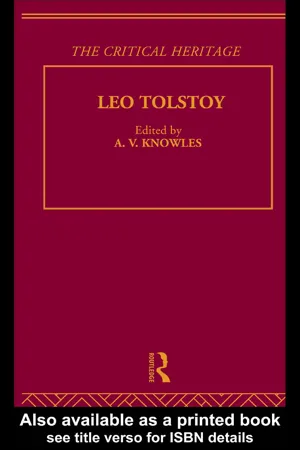
eBook - ePub
Count Leo Nikolaevich Tolstoy: The Critical Heritage
- 476 pages
- English
- ePUB (mobile friendly)
- Available on iOS & Android
eBook - ePub
Count Leo Nikolaevich Tolstoy: The Critical Heritage
About this book
Trusted by 375,005 students
Access to over 1.5 million titles for a fair monthly price.
Study more efficiently using our study tools.
Information
Subtopic
Literary CriticismIndex
Literature21. Botkin, From a Letter to A.A. Fet
1865
14 February 1865. V.P. Botkin (1811–69) was a critic and publicist of the ‘art for art’s sake’ school. A friend and correspondent of Tolstoy’s, it was he who talked Tolstoy into publishing ‘Family Happiness’ in 1859 after Tolstoy had decided it was worthless. Botkin’s view of ‘War and Peace’ changed after he had read it all; it was ‘a work, exceptional from every point of view’.
I have started to read Tolstoy’s new novel. The most striking thing is how subtly he describes the various inner movements of the soul. In spite of the fact that I have read more than half of it, the thread is still not at all clear; this is because of the predominance of detail. Besides this, why is there all that conversation in French? It is enough to say that the conversation takes place in French. It is all quite superfluous and has an unpleasant effect. And he is rather careless with his Russian. This is evidently the introduction, the background for the future picture. However marvellously he may depict the merest detail, though, it must be said that this background takes up too large a place.
22. Unsigned Review of ‘1805’
1866
The ‘Book Messenger’, 1866, nos 16–17.
The first parts of ‘War and Peace’ were originally entitled ‘1805’ (see Introduction).
In the same volume before us at the moment we have the first two parts of ‘1805’, which first appeared in the ‘Russian Messenger’, but we have just read them for the first time, and not without pleasure. Several pages remind us in their freshness of this author’s best works and several of the characters (e.g. Prince Vasiliy, Princess Drubetskoy and Captain Tushin) are depicted in masterly fashion. In general, though, ‘1805’ seems strange and indeterminate. Evidently the author himself does not know what it is he is writing: the title merely says ‘“1805” by Count Lev Tolstoy’, and indeed it is neither a novel nor a novella; it is rather some sort of attempt at a military and aristocratic chronicle of the past, wonderful in places, but in others dry and tedious. When one is reading these two parts one just cannot make out either the basic idea behind the work or why and for whom the author brings in all those poor little Nikolenkas, Natashas, Mimis and Borises, on whom it is impossible to focus one’s attention amid all the descriptions of military actions and a kind of fictional relating of the times in which it seems the work’s main interest lies. One does not even know whether these characters figure as heroes or whether in their individual insignificance they form but the background. The character of Prince Andrey is more successful but leads one to the same questions and perplexities; the author has also been unsuccessful with the phantoms from the aristocracy of a former age, with the exception of the afore-mentioned Prince Vasiliy, Princess Drubetskoy and the old Rostov, and what is more, besides these, many more are introduced and some of them (Anatole Kuragin, Dolokhov, etc.) appear to be the main personages in the story; because of their multiplicity the opening of the story becomes a little fragmented and the unsatisfied interest of the reader flags. From reading these two parts one is also unsure of whether the end has been reached or are they but the prologue for some huge epic, for something original albeit somewhat tedious and a little tendentious? The language in which ‘1805’ is written is good, as in all the author’s works; but for some unexplained whim half his characters speak in French and all their correspondence is in the same language, so that a good third of the work is written in French and whole pages are covered in it (albeit with a translation at the bottom). This original innovation also strikes the reader as something odd and one just cannot understand why the author needed it all. If he wanted through these words to prove that our aristocratic ancestors at the start of this century, these various Bolkonskys and Dru-betskoys, spoke a pure and good French, then all that was needed was for one or two phrases to appear and then we would all have believed him willingly, scarcely anyone would have doubted his word; but to read a book which has this mixture of French and Russian without the slightest need for it is indeed neither pleasant nor comforting; it might be all very well on the aristocratic pages of the ‘Russian Messenger’ but in a separate edition the French texts should have been left out.
23. Akhsharumov, Review of ‘1805’
1867
‘Universal Labour’, 1867, no. 6. N.D.Akhsharumov (1819–93) was a critic and minor novelist.
… We cannot place this work categorically in any of the usual literary genres. It is neither a chronicle nor an historical novel. Although in form it is fairly close to the latter, in content it lacks any dramatic unity; the action has no central point; an opening, an intrigue, and a denouement are all missing; also it is clearly unfinished; but its general sense does not suffer in any way from these faults, and which we therefore cannot call faults. On the contrary it seems to us that a more strict framework would have been inhibiting and in order to be complete would have demanded things which the author neither had nor should have had in mind. His object was to write about Russian society sixty years ago, and we must admit to the correctness of the taste with which he rejected all superfluous decoration and every attempt at effect, sacrificing all to the demands of strict historical truth. The story has lost very little because of this, and has gained much.
[Omitted: discussion of the previous fifty years of Russian history.]
In this progressive development a period such as 1805 is of great interest. It was a time of golden childhood in which the child’s character had already formed and his personality was already present. If we look at the story from this point of view all the members of society depicted by Count Tolstoy seem to be children. Their attitude to life is naive and ingenuous; they have made no compromises with their position nor have they yet chosen any path for themselves; they are unacquainted with that de-moralising mental activity which forces so many of us to stand in perplexity before a problem for many years, grumbling, looking askance at it and being unable to do anything. They all believe in something whole-heartedly, one in the heroes of his fatherland, another in Napoleon or Jean-Jacques Rousseau and a third unthinkingly in his Sonya or his Natasha; some believe in military glory or in their own witticisms, others in their great daring and strength; and lastly there are those who might be the greatest of all, those who believe in the possibility of living for ever as they live now, on the income from their patrimonial estates amid endless feasts and carefree leisure in the lap of the limitless hospitality of the Russian land.
Let us look more closely at these children. Most of them are so nice that it is a pleasure to look upon them and in many of them we can see characteristics we recognize. In one we can see the rounded youthful portrait of a father or an uncle; another reminds us distantly and vaguely of a future Chatsky or Onegin. We cannot see enough of that young girl with the thin, round little face and bright fiery eyes and something tells us that we have met her more than once since, in her maturity, or at least someone very much like her, someone who belongs to us.
But let us go up to these children and look more attentively at them.
The story begins in the Winter Palace at an evening reception given by one of the dowager empress’s ladies-in-waiting. The most brilliant members of society are gathered there and rumours of the coming war with France form the background for all the conversations which, by the way, do not all have the mark of patriotism. Almost all of them are in French with the rare dash of an untrans-lated Russian word. But this mixture which today sounds passé and incurably childish to our old ears had in those days its childlike, naive comicality and very understandable justification. We recall that we are in Petersburg and at court and that for more than a century all of Europe, in the form of its upper classes, had been under the sway of the glitter of the court of France, her glory and enlightenment, and that the echo of the time of Louis XIV had not died away like the fires of revolution, and that right after the Revolution the great deeds of a new Caesar had taken their place. Our own Russian society and especially that part of it which was gently pushing us towards Europe, the highest circle in Petersburg and the court, all of this was at that tender stage of growth where independence is unthinkable and the force of impressions from outside is not counterbalanced by any internal convictions. To demand that at that time we should have had our own originality is as unreasonable as to expect a clean sheet of paper in a press not to receive the imprint of the letters. The irritating inclinations of children are well known. Their imaginations are filled with what surrounds them daily, with what shines the most brightly and sounds the most loudly. They try to be like adults, copy their tone and mannerisms and instinctively parody them in their games. For this simple reason the tone of our high society in Petersburg at that time could of course be no other than an echo of the external, superficial side of things outside Russia, more rarely of Bona-partism and more rarely still of those liberal ideas which at the very start of the revolution were held by the best sections of French aristocratic youth. All these nuances and all that superficial, naive and purely childish affectation is expressed in masterly fashion in the first few chapters of the book. You will see at once that this small collection of people have not yet developed their own distinctive physiognomy. They are neither Russians nor Frenchmen, but naughty children who play a minor role with an air of amusing importance. They are all saturated with the arrogance of the most refined taste and irreproachable respectability, but it has not occurred to any of them to be respectable in their own way and not according to the traditions of the Faubourg St Germain. These traditions and even the gossip are known to them by heart as something it would be shameful not to know and they behave with the amusing enthusiasm of schoolboys vying with each other to show that they have learnt their lessons well. In order further to establish the plausability of the game a real live Frenchman, and not simply anyone but one of the best, Vicomte Mortemart (allié aux Montmorencys par les Rohans, tout ce qu’il y a de plus Faubourg St Germain), is served up by the considerate hostess for her guests as something supernaturally refined, as a real live model of the way one should act in society; and our children play their small parts before this paragon as they would before a real expert and connoisseur with such a lively childlike zest that one just cannot be cross with them for their pranks. The parts are not distributed but simply and enthusiastically taken; by some unspoken agreement each takes one on without asking himself which he would prefer or which would suit him best. There is the mournful, disenchanted society lion and salon clown, a fool with his hair done à la Titus with his cuisse de nymphe effrayée coloured pantaloons and a lorgnette; there is the pretty princess who behaves as if everything that she had done had been partie de plaisir for her and for everyone else, the princess about whom the vicomte said indulgently that she was ‘bien, mais très bien et tout à fait Française’, and so on. Comedies of this nature have been endlessly repeated since then and have been not infrequently successful, the only difference being that in those days they were fresh and natural while today they have aged, lost any meaning and have become distasteful to all of us who have ever thought about them. There were even then, though, some clever children who disliked them. Although playing at Frenchmen in their drawing-rooms and imitating from an early age all their external mannerisms, they none the less realized that it was all a childish game and that it was high time to cease, because a more serious affair awaited them and to act as children in the face of it would be quite shameful. The fact of the matter is that neither they nor those surrounding them had ever been French nor could they ever become so. An open, adaptable attitude to external forms, the ability to forget their own and adopt the alien but just as quickly and easily to reject it all, in short the very fact that they were so capable of adopting foreign ways is what dif-ferentiated them from foreigners and from the French in particular. Not one of them, however he might have appeared from the outside to be alien to everything Russian, however attracted he might have been to current fashions, could ever identify himself with his role to such a degree that it would be difficult for him to cast it off at a moment’s notice and appear as a completely different person. This fleeting and natural appearance of the slightly rough but energetic Russian face showing beneath its tight-fitting and scrupulously correct mask has been subtly grasped by the author and spread throughout the the whole book. But in places the actors take off their masks themselves. No sooner have the guests managed to disperse from Anna Scherer’s reception than we see from two different sides a protest against that characteristic of contemporary life which the author has depicted in the reception. On the one hand the sincere and serious confession of Prince Andrey, full of proud consciousness of his own worth; and on the other that wild explosion of youthful strength and whole-hearted daring at the flat of the young Kuragin after cards and an evening’s drinking. Here there is nothing of the spirit of St Germain correctness and bon ton; it has rather the odour of the fire of Moscow and that unexpected, discourteous welcome, far removed from any conceptions of European decorum, with which we greet our guests seven years later.
From Petersburg the action moves to Moscow; but the move is hardly felt. Princess Anna Mikhaylovna Drubetskoy, a persistent suppliant who had at Anna Scherer’s reception dragged from Prince Kuragin a promise to arrange the transfer of her son into the Guards, returns after this victory to Moscow and the family of her friends the Rostovs and we go with her to be the guests of Count Rostov. There is a completely different atmosphere here, as everywhere in Moscow, from Petersburg. People live without straining every muscle to be like others or worrying about how one ought to behave. It is possible to define this even more accurately but this would take too much time and would anyway be superfluous because it is better to feel it than define it. and in the story one feels it extremely strongly. Rumours about the coming war are the subject of conversation here too but they have a completely different character. In Petersburg it is a piece of court news and provides the setting for beautiful French phrases but here it is part of the domestic scene going hand in hand with other cares and interests—with visits, gossip, meetings and dinner parties. The troops have been moved abroad; the young men have given up their studies and enlisted—the son has left; but in the family there is a name day and so the house is full of visitors and best wishes, the mistress is almost rushed off her feet and in the marble hall a long table is laid out for twenty people and the father of the house has his mind full of some grouse sauté au madère or the value of his serf cook for whom he has paid a thousand roubles. How our modern preachers would have thundered about this! How they would have attacked poor Count Rostov and his good lady the Countess with all their offspring, the members of their household, their guests, their serf maids, grouse sauces and ‘la santé à maman’ and ‘la comtesse Apraksine’ and all this nonsense of Moscow’s idle life! But times change and when we read Count Tolstoy’s story about the past we travel back sixty years and understand the people to such a degree that we neither hate them nor feel repugnance for their lives. We say: tout compte, they were all good people, warm-hearted people and no worse than you, inexorable censor and preacher. And the main reason why we cannot judge them in any other way is that they are children. This time, though, among the grown-up children we have before us some real children and they are drawn by the author with such fascinating delight that we cannot see enough of them. They also play their parts, parodying their elders but their parody is gentler and simpler. They fall in love and are jealous of each other and before parting they give each other vows of faithfulness even unto the grave. Here we have no vicomtes, no prattle of a passé aristocracy, none of that nauseating affectation of French bon ton; here we have simply pranks, but they are so charming, so natural and open-hearted that they only need time to ripen and enter fully into real life…. And then as we are feasting our eyes upon them, the picture again slightly changes and moves into a different sphere.
From the gossip of a name day in the Rostov household we discover that the illegitimate son of Count Bezukhov, Pierre, whom we met in Petersburg at Anna Scherer’s reception and in Prince Andrey’s study, has been expelled for some misdemeanour he committed after a drunken party. The position of this young man in society is insecure and ambiguous and his life is evidently ruined; but fate is preparing a surprise for him. His father Count Bezukhov, one of those important people during the reign of Catherine the Great who managed one way or another to make their way from darkness and ignorance to the heights of wealth and power, lies at death’s door and the problem is who should inherit his huge fortune after his death. An intrigue is afoot around the dying man’s bed. A relation of his, another person the reader met in Petersburg, Prince Vasiliy Kuragin, whose nieces, the Mamonovs, live with the count, is explaining to one of them that in the count’s will everything is left to his illegitimate son Pierre and that there is a letter to the tsar requesting the legiti-mization of his son and that if what is in these documents is set in motion then everything will go to Pierre and no one else will get a penny. Pierre is there himself but Pierre is a ninny, brought up abroad, in Paris; he is captivated by the glory of Napoleon and dreams of his conquest of England at the very moment when his inheritance is about to be taken from under his nose. He suspects nothing, but happiness is decidedly to be his. That same persistent suppliant and distant relative of his father’s, whom we already know, Anna Mikhaylovna Drubetskoy, bursts into the dying man’s house with his godson, her son Boris, who lacks an inheritance himself. Fired with maternal concern she hopes to get a few crumbs from the legacy for her Boris and, seeing no means to achieve her aim other than joining forces with the good-hearted Pierre, she rushes to his defence. With an inimitable combination of cunning and dexterity she worms herself into the circle of the relations, divines all their plots and destroys them in favour of her protégé. All of this together forms the only dramatic episode in the story. But it is carried through to perfection. It is haute comédie, comedy of the highest type. In spite of its fragmentary and condensed nature, the characters of those participating in it stand out against the action and these characters are conceived so deeply and drawn so successfully that we can see right through them. The role of the prince and the old princess, their explanations to each other about the will and the role of Pierre and Anna Mikhaylovna are all things that once you have read them remain in the memory for ever as examples of a first-class talent.
[Quotation omitted.]
No less wonderful but completely different in character is the scene which follows. From Moscow the picture moves to the estates of old Prince Bolkonsky. Prince Andrey is taking his pregnant wife there to stay with his father while he goes to join his regiment. Just as in Moscow we see no foreign influence here, except for a French companion and the superficial signs of a French upbringing. The way of life, the people, their relation— ships one with the other, all have a clear Russian nature. Their full lives, the typical faces of the Bolkonskys, father and son, and the deep sympathy and interest they arouse in the reader all make us sigh deeply. Where have such people gone? Why do we not see them in our midst today? Especially Prince Andrey: his sharp, clear mind which is taken in by nothing, the unspotted purity of his soul, that ability to see things not as he would like to see them but as they really are with nothing obscuring their true sense. This is all possibly an ideal, of course, but it may well be that the model standing before the author was rather inferior to the portrait, that he improved him a little, made him more good-looking, an...
Table of contents
- Cover
- Half Title
- Title Page
- Copyright
- Contents
- Preface
- Acknowledgments
- Note on the Text
- Introduction
- Before ‘War and Peace’ (1852–65)
- ‘War and Peace’ (1865–9)
- ‘Anna Karenina’ (1875–7)
- After ‘Anna Karenina’ (1886–1910)
- Appendix: Russian literary and historical references
- Bibliography
- Select Index
Frequently asked questions
Yes, you can cancel anytime from the Subscription tab in your account settings on the Perlego website. Your subscription will stay active until the end of your current billing period. Learn how to cancel your subscription
No, books cannot be downloaded as external files, such as PDFs, for use outside of Perlego. However, you can download books within the Perlego app for offline reading on mobile or tablet. Learn how to download books offline
Perlego offers two plans: Essential and Complete
- Essential is ideal for learners and professionals who enjoy exploring a wide range of subjects. Access the Essential Library with 800,000+ trusted titles and best-sellers across business, personal growth, and the humanities. Includes unlimited reading time and Standard Read Aloud voice.
- Complete: Perfect for advanced learners and researchers needing full, unrestricted access. Unlock 1.5M+ books across hundreds of subjects, including academic and specialized titles. The Complete Plan also includes advanced features like Premium Read Aloud and Research Assistant.
We are an online textbook subscription service, where you can get access to an entire online library for less than the price of a single book per month. With over 1.5 million books across 990+ topics, we’ve got you covered! Learn about our mission
Look out for the read-aloud symbol on your next book to see if you can listen to it. The read-aloud tool reads text aloud for you, highlighting the text as it is being read. You can pause it, speed it up and slow it down. Learn more about Read Aloud
Yes! You can use the Perlego app on both iOS and Android devices to read anytime, anywhere — even offline. Perfect for commutes or when you’re on the go.
Please note we cannot support devices running on iOS 13 and Android 7 or earlier. Learn more about using the app
Please note we cannot support devices running on iOS 13 and Android 7 or earlier. Learn more about using the app
Yes, you can access Count Leo Nikolaevich Tolstoy: The Critical Heritage by Mr A V Knowles,A. V. Knowles,A V Knowles in PDF and/or ePUB format, as well as other popular books in Literature & Literary Criticism. We have over 1.5 million books available in our catalogue for you to explore.