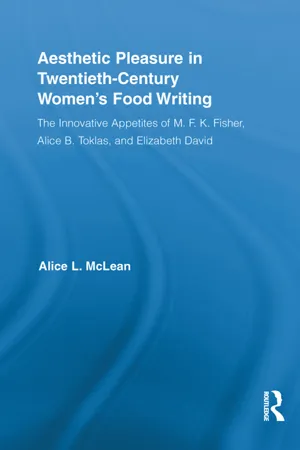
This book explores the aesthetic pleasures of eating and writing in the lives of M. F. K. Fisher (1908-1992), Alice B. Toklas (1877-1967), and Elizabeth David (1913-1992). Growing up during a time when women's food writing was largely limited to the domestic cookbook, which helped to codify the guidelines of middle class domesticity, Fisher, Toklas, and David claimed the pleasures of gastronomy previously reserved for men. Articulating a language through which female desire is artfully and publicly sated, Fisher, Toklas, and David expanded women's food writing beyond the domestic realm by pioneering forms of self-expression that celebrate female appetite for pleasure and for culinary adventure. In so doing, they illuminate the power of genre-bending food writing to transgress and reconfigure conventional gender ideologies. For these women, food encouraged a sensory engagement with their environment and a physical receptivity toward pleasure that engendered their creative aesthetic.
eBook - ePub
Aesthetic Pleasure in Twentieth-Century Women's Food Writing
The Innovative Appetites of M.F.K. Fisher, Alice B. Toklas, and Elizabeth David
- 196 pages
- English
- ePUB (mobile friendly)
- Available on iOS & Android
eBook - ePub
Aesthetic Pleasure in Twentieth-Century Women's Food Writing
The Innovative Appetites of M.F.K. Fisher, Alice B. Toklas, and Elizabeth David
About this book
Information
1 The Gendering of Appetite in Nineteenth-Century Food Writing
Cooking is an art, but the artistry lies as much in the eating as in the preparing of food.
—Alin Laubreaux, The Happy Glutton
Over the course of the nineteenth century, a rigid gender gap solidified between men’s and women’s food writing. Men sought to determine public taste and to refine the aesthetic pleasures of eating. Professional chefs authored cookbooks that codified the culinary arts and gastronomes wrote literature that worked to establish gastronomy as an art form and the gourmand as an artist in his own right. Women provided instruction on managing the household and worked to define and promote domestic ideology. They wrote domestic manuals and cookbooks, which included practical instruction for daily home cooking and promoted the principles of duty, economy, and practicality. Beginning at the close of the nineteenth century, however, the occasional woman had begun to articulate an aesthetics of pleasure in keeping with the male-authored tradition, effectively expanding women’s food writing beyond the home kitchen. These women did so by blending elements of male-authored gastronomic literature into the women’s tradition. A comparison of men’s and women’s food writing traditions not only illustrates why women who chose to celebrate an undomesticated appetite found elements of gastronomy essential to the task, but also reveals striking details about the construction of gender in nineteenth-century food writing and its strong distaste of female pleasure.
Taken as a whole, nineteenth-century gastronomic literature worked to define gastronomy and to codify gourmand etiquette, articulating an aesthetics of eating that strives to maximize pleasure and conviviality. According to gastronomic literature, the gourmand not only nourishes sensual and social pleasures through the act of eating, but also hones his capacity to appreciate and to exhibit good taste. The educated palate and conviviality of the gourmand was rewarded with social currency; a repository of wit, a fluent conversationalist, and an aesthete attuned to the nuances of the flavors, composition, and progression of the meal, the gourmand was in high demand as a dining companion.
In its emphasis on poetic self-expression and pleasure, gastronomic literature stood in ideological opposition to the nineteenth-century women’s food writing tradition that developed in England and the United States. Beginning in the eighteenth century, women’s food writing in these two countries largely consisted of domestic cookbooks. Such cookbooks focused on economy, order, and practicality, not only promoting these traits in the home kitchen, but also embodying them stylistically. These traits epitomize one of the most popular cookbooks on both sides of the Atlantic, Hannah Glasse’s Art of Cookery Made Plain and Easy. First published in 1747 in London, where it was to remain a best seller for close to a hundred years, Glasse’s Art of Cookery was adopted wholeheartedly by Americans at the turn of the century; George Washington and Thomas Jefferson owned copies (Hess, Art of Cookery v). Although Glasse’s personality slips through every now and again, much of her prose epitomizes the no-nonsense streak that coursed throughout domestic cookbooks. To wit, she offers the following instruction on roasting a hare:
Take your hare when it is cased; truss it in this manner, bring the two hind legs up to its sides, pull the fore legs back, your skewer first into the hind-leg, then into the fore leg, and thrust it though the body; put the fore-leg on, and then the hind-leg, and a skewer through the top of the shoulders and back part of the head, which will hold the head up. (21)
Glasse’s pragmatic and frugal style would reverberate throughout nineteenth-century domestic cookbooks.
Whereas female cookbook authors helped to define middle-class domesticity, promoting familial duty, practicality, and economy of self-expression, male authors of gastronomic literature promoted playful self-indulgence, wit, pleasure-seeking, elegant self-expression, and a cosmopolitan sensibility. Certainly, not all authors exhibited such neatly gendered characteristics. For example, numerous authors of gastronomic literature fell far short in their attempts to extend Grimod’s and Brillat-Savarin’s literary inheritance; at its worst, the gastronomic essay substitutes what M. F. K. Fisher describes as “whimsy” for “wit,” “dull reminiscences” for “delightful anecdotes,” and “blunt statistics” for “piercing observations” (Serve It Forth v).
As for the domesticated genre, some female cookbook authors rivaled or outstripped many of their male counterparts in luxuriousness of expression, sense of humor, and savoir vivre. For example, Eliza Acton’s Modern Cookery for Private Families from England and Eliza Leslie’s Directions for Cookery from the United States remain two of the most elegantly written cookbooks to date, while the anonymous author of Domestic Economy and Cookery for Rich and Poor (1827), by “A Lady,” includes recipes gathered first-hand from Europe as well as “mulakatannes and curries of India,” “cold soups and mixed meats of Russia,” and “cuscussou and honeyed paste of Africa” (iv). Taken as a whole, however, nineteenth-century cookbooks focused tightly on the domestic realm and on its economic management, remaining markedly devoid of pleasure, while nineteenth-century male “gastronomers stressed the value of appetite, the importance of maintaining and pampering, rather than denying it” (Gigante, Gusto xxxviii). As Priscilla Parkhurst Ferguson summarizes the distinction: gastronomes, invariably men, concerned themselves with “the public pursuit of sensual pleasures,” whereas women dealt with “the private satisfaction of physiological need” (Accounting for Taste 93).
The absence of physical pleasure in women’s food writing reflects the cultural constraints on female appetite that rigidified over the course of the nineteenth century. By the mid-nineteenth century, middle- and upper-class American and English convention had coded the appetites for food, for sex, and for power as masculine. Unlike their male counterparts, who were understood to have inherently large appetites, middle- and upper-class Victorian women were encouraged to suppress and to regulate their own hungers—for food, for sex, and for public acclaim.1 Toward that end, cookbooks modeled and reproduced heteronormative domesticity, an ideological dynamic that defined a woman’s role as obtaining and keeping a husband, bearing his children, and nourishing the nation’s moral values. This ideology permeates seven of the most popular and influential domestic cookbooks of the century, including Maria Eliza Rundell’s A New System of Domestic Cookery, Eliza Acton’s Modern Cookery for Private Families, Isabella Beeton’s Book of Household Management, Mary Randolph’s Virginia Housewife, Lydia Maria Child’s The Frugal Housewife, Eliza Leslie’s Directions for Cookery, and Marion Harland’s Common Sense in the Household.
Although domestic ideology dominated nineteenth-century women’s food writing, the rare author would pen a gastronomically grounded work. In particular, three American authors stand out for their focus on gastronomy—Julia C. Andrews, Catherine Owen, and Elizabeth Robins Pennell.2 Andrews and Owen each penned cookbooks that showcase the author’s deep familiarity with gastronomic literature. Andrews authored Breakfast, Dinner, and Tea: Viewed Classically, Poetically, and Practically (1859), which draws on gastronomic literature as well as a variety of widely-flung travelogues and cookbooks to craft what well might be the first gastronomic cookbook authored by a woman. Catherine Owen, the pen name of Helen Alice Matthews Nitsch, wrote Culture and Cooking; or, Art in the Kitchen (1881), which clearly aligns cookery with the arts, enlisting gastronomic literature and literary gourmands in order to do so. In the 1890s, Elizabeth Robins Pennell turned her back on the cookbook format altogether, penning instead a series of gastronomic essays that flout the domesticated genre in order to celebrate female appetite. Originally written for London’s Pall Mall Gazette, Pennell’s essays were collected as the Feasts of Autolycus (1896), a collection that simultaneously showcases Pennell’s defiance of domestic ideology and illustrates the difficulty she encountered voicing female pleasure at the turn of the century.
GASTRONOMIC LITERATURE: A MALE TRADITION
Gastronomic literature, which first developed in France after the Revolution, included books and essays focused on the palate’s education as an essential component of self-knowledge.3 Food criticism dates back to Alexandre Balthazar Laurent Grimod de la Reynière’s eight volume Almanach des Gourmands (1803–1812), the first Parisian food guide to review restaurants, caterers, and their goods. Within the Almanach, Grimod worked to promote an aesthetic sensibility, to define good taste, and to create a standard of etiquette for the gourmand. Jean Anthelme Brillat-Savarin fathered a form of gastronomic memoir in his Physiology of Taste (1826), which blends personal anecdote with abstract reflection to assert: “Gastronomical knowledge is necessary to every man, because it tends to add to the sum of his predestined pleasure” (53). The influence of Grimod and Brillat-Savarin would permeate gastronomic literature as it developed over the nineteenth and early twentieth centuries. As sociologist Stephen Mennell explains, “Virtually everything of the sort written since quotes or harks back to these two authors one way or another” (267). Grimod’s Almanach des Gourmands and Manuel des Amphitryons along with Brillat-Savarin’s Physiology of Taste exemplify gastronomic literature at its best, illustrating the wit, intelligence, and elegant self-expression expected of a true gourmand.
While France gave birth to and skillfully nourished the genre, it was soon adopted by England, where writers altered it to suit English sensibilities. Authors such as the pseudonymous Launcelot Sturgeon as well as Charles Lamb penned partially tongue-in-cheek essays, simultaneously creating a tradition of gastronomic literature in England and playfully underscoring the egotism and self-indulgence of Grimod’s Almanach. Other English authors modeled their writings after the French tradition, encouraging their compatriots to introduce key aspects of French gastronomy to the English table. Among such writings can be found Thomas Walker’s Aristology, or the Art of Dining (first published as The Original in 1835), A. V. Kirwan’s Host and Guest (1864), John Cordy Jeaffreson’s A Book About the Table (1875), and Eneas Sweetland Dallas’ Kettner’s Book of the Table (1877). Americans were slower to take up the genre and contributed to it less prolifically than their English counterparts. Three American gastronomic works stand out, however, as exemplars of the aesthetically oriented genre, Joseph Barber’s Crumbs From the Round Table (1866), Theodore Child’s Delicate Feasting (1890), and George Ellwanger’s The Pleasures of the Table (1902).4
Grimod de la Reynière
A man poised between the ancien regime and post-revolutionary France, Grimod fathered food criticism as we know it today. Along with the other members of a “Tasting Jury,” Grimod critiqued Parisian food purveyors and their products. The results were published annually in the Almanach des Gourmands (1803–1812), the first book-length series devoted to “the critical appraisal of the food then available to [its] readers” (Davidson 355). In addition to such critiques, the Almanach included restaurant reviews; recipes; seasonal charts; essays and poetry on serving, cooking, hosting, and dining; and commentary on recent trends in the culinary sciences.5 With the Almanach, Grimod developed a literature of gastronomy characterized by linguistic playfulness, eccentric wit, mercurial form, and an authoritative command over public taste.
According to Grimod, the Almanach was driven by the Revolution and the resulting redistribution of wealth, which
has transferred old riches into new hands. As the mentality of the majority of these overnight millionaires revolves around purely animal pleasures, it is believed that a service might be rendered them by offering them a reliable guide to the most solid part of their affections. (MacDonogh 196)
In other words, Grimod educated the post-Revolutionary consumer in matters of taste. The democratization of taste, however, was only the most explicit of Grimod’s goals.6 Grimod received repeated censorship for his theater and literary criticism, which often contained jabs directed at the oppressive French state. In 1798 the administration went as far as to shut down Grimod’s theater magazine, Censeur Dramatique. Soon after, Grimod began the Almanach. Inspired, in part, by state censorship, Grimod’s Almanach harnessed gastronomic discourse as a means of delivering strong political and cultural commentary.7 As Alice Arndt succinctly explains: “Through the lens of food, Grimod scrutinized literature, history, and the contemporary world. Through the metaphor of gastronomy, he critiqued commercialism at home in France as well as Napoleon’s policy of military expansionism across Europe” (191).
Despite the irony, satire, and hyperbole that characterizes Grimod’s writing, the Almanach worked seriously and effectively to raise dining and, by extension, the practice of gourmandise to an art form and to dissociate the gourmand from the glutton in order to define him as a man of taste.8 Toward that end, Grimod posits that the gourmand, like the Enlightenment man of taste, is not born, but cultivated. The finely tuned senses of the gourmand are honed through experience and reflection; the body and its pleasures nourish the mind, engaging it in philosophical exploration. Not everyone, however, who studies gourmandise can achieve the status of a gourmand, who must come equipped with an innate sensibility to complement his proper training.
Above all, the accomplished gourmand must possess a finely tuned palate, a keen aesthetic sensibility, and an eloquent, witty mode of self-expression. He must know how to function as an impeccable host and how to behave as the ideal guest—to orchestrate dinners and to participate in them. When a gourmand plays host, his finely tuned aesthetic becomes materialized in the décor of the dining room, the shape and setting of the table, and the appearance, progression, and flavor of the dishes served. Such attention to the dinner table nourishes the ultimate goal of gourmandise—to maximize aesthetic pleasure and social well-being. As Grimod explains:
Fine food and wine are the very wellspring of wit, pleasure, and good cheer. … [T]he Gourmand … is congenial by nature, indeed his first priority is to ingratiate himself, and he has all that it takes to accomplish this: his playfulness, his sparkling wit, and his infectious cheerfulness make him the life of the party, its very heart and soul. (24)
Despite his congenial, ingratiating nature, however, the gourmand must, according to Grimod, place his own pleasure above all other concerns. Toward that end, he must “know how to carve and serve well. This offers a quite natural opportunity to get one’s hands on the dish, in which case one would have to be most unskillful not to set aside the best pieces for oneself” (29). In other words, the gourmand must be self-indulgent and place his own palate’s pleasure above all others. Grimod implies that the gourmand’s “playfulness, his sparkling wit, and his infectious cheerfulness” as well as his exquisitely trained palate entitle him to the choicest morsels.
Grimod not only defined the gourmand and his aesthetic sensibilities but also fashioned a gourmand’s code. Many of the rules discussed by Grimod and repeated, sometimes verbatim, in nineteenth-century gastronomic essays, establish protocols for the gourmand host as well as for his guests. Grimod surmises the importance of these rules:
the dining table is a country which, like all others, has its ways and customs, and the Gourmand’s Code contains an abundance of rules that one must follow so as to not seem like a savage, but which would lead a reserved gentleman who observed these laws faithfully to die of starvation at a four-course dinner. (28)
On one hand, Grimod codifies dining etiquette in order to train the nouveaux riches to pass as men of taste. On the other hand, he states that the gourmand must break these rules if they interfere with his right to pleasure, such as when he is faced with an unaccomplished host who does not “anticipate [his] guests’ every wish” (29)....
Table of contents
- Cover
- Halftitle
- Title
- Copyright
- Contents
- Acknowledgments
- Introduction
- 1. The Gendering of Appetite in Nineteenth-Century Food Writing
- 2. Forging a Space for Female Desire: M. F. K. Fisher on the Art of Eating
- 3. A Queer Appetite: The Alice B. Toklas Cook Book
- 4. A Sensual Engagement: Elizabeth David’s Gastronomic Cookbooks
- 5. From “Aesthetic Choice” to a “Diasporic Aesthetic”: Patience Gray, Vertamae Smart Grosvenor, and Monique Truong
- Bibliography
- Index
Trusted by 375,005 students
Access to over 1.5 million titles for a fair monthly price.
Study more efficiently using our study tools.
Frequently asked questions
Yes, you can cancel anytime from the Subscription tab in your account settings on the Perlego website. Your subscription will stay active until the end of your current billing period. Learn how to cancel your subscription
No, books cannot be downloaded as external files, such as PDFs, for use outside of Perlego. However, you can download books within the Perlego app for offline reading on mobile or tablet. Learn how to download books offline
Perlego offers two plans: Essential and Complete
- Essential is ideal for learners and professionals who enjoy exploring a wide range of subjects. Access the Essential Library with 800,000+ trusted titles and best-sellers across business, personal growth, and the humanities. Includes unlimited reading time and Standard Read Aloud voice.
- Complete: Perfect for advanced learners and researchers needing full, unrestricted access. Unlock 1.5M+ books across hundreds of subjects, including academic and specialized titles. The Complete Plan also includes advanced features like Premium Read Aloud and Research Assistant.
We are an online textbook subscription service, where you can get access to an entire online library for less than the price of a single book per month. With over 1.5 million books across 990+ topics, we’ve got you covered! Learn about our mission
Look out for the read-aloud symbol on your next book to see if you can listen to it. The read-aloud tool reads text aloud for you, highlighting the text as it is being read. You can pause it, speed it up and slow it down. Learn more about Read Aloud
Yes! You can use the Perlego app on both iOS and Android devices to read anytime, anywhere — even offline. Perfect for commutes or when you’re on the go.
Please note we cannot support devices running on iOS 13 and Android 7 or earlier. Learn more about using the app
Please note we cannot support devices running on iOS 13 and Android 7 or earlier. Learn more about using the app
Yes, you can access Aesthetic Pleasure in Twentieth-Century Women's Food Writing by Alice McLean in PDF and/or ePUB format, as well as other popular books in Literature & Feminist Literary Criticism. We have over 1.5 million books available in our catalogue for you to explore.