- 308 pages
- English
- ePUB (mobile friendly)
- Available on iOS & Android
eBook - ePub
Family Planning in the Legacy of Islam
About this book
How has the Islamic view of marriage, family formation and child rearing developed and adapted over the centuries? Is contraception just permitted or actively encouraged?
The family is the basic social unit of Islamic society. Even without compelling population pressures, there has been concern with spacing and family planning. This book is the result of a massive research project, gathering fourteen centuries (the seventh to the twentieth) of views on family formation and planning, as expressed by leading Islamic theologians and jurists. The work has been discussed and shaped at each stage by a committee of Islamic experts representing the majority of the Muslim countries.
The book provides a much needed source of reference and will be of equal value and interest to professionals in health care and development work and to those working in the academic disciplines of Middle East studies, religion and population studies.
Information
PART I
The Islamic Context
1
Family and marriage in Islam
The family is the basic social unit in Islamic society, and marriage is the fundamental Islamic institution. Marriage and family formation are grave responsibilities and are subject to specific regulations. Their planning is, therefore, in order.
THE FAMILY IN ISLAM
Role of the family
Islam has a pervasive social character and the family is the core of its society. Islam tends to consider the family as something absolutely good and almost sacred. Besides providing tranquility and mutual support and understanding between husband and wife, the obvious function of a family is to provide a culturally and legally acceptable way of satisfying the sexual instinct as well as to raise children as the new generation. Islam has more essential roles for the family, however. It is within the family system that Muslims acquire their religious training, develop their moral character, establish close social relationships and sustain loyalty both to the family and to society at large. The support system in the family (both financial, social and emotional) is paramount in establishing the peace of mind and security needed for the journey of life. This is particularly important for the socially dependent members, namely the children, the elderly, the single adults (especially females), as well as the sick or handicapped.
The family in Islam includes both the nuclear (husband, wife and their children) and extended varieties by caring for all the relatives (ahl). There are special laws governing family relations, details of which are beyond this account.
The relationship between husband and wife
The husband and wife are the principals of family formation. Their relationship in marriage is described in the Qur'an as of two major qualities: love (passion, friendship, companionship) on the one hand, and mercy (understanding, reconciliation, tolerance, forgiveness) on the other within the overall objective of tranquility. The Qur'an says

And one of [Allah's] signs is, that He has created for you mates from yourselves, that you may dwell in tranquility with them, and has ordained between you Love and Mercy.
al-Roum (Sura 30:21)
This is a verse frequently quoted to describe one of the purposes of family life. It starts by referring to the unity of origin of husband and wife, which is a confirmation of equality and a basis for harmony between them. It must follow then that both husband and wife will find tranquility (sakan) in one another. This key verse concludes by referring to the social relationships within the family, which range from love and tenderness, to understanding, empathy and mercy.
There can be no better expression of the relationship between two human beings living together in blessed marital bondage. Such a relationship is so highly valued that Allah made it among His signs, and it is.
This is confirmed further by another verse in which Muslims are reminded in the same manner of the first human family.

It is He who created you from a single soul (nafs) and therefrom did make his mate, that he might dwell in tranquility with her.
al-Aeraf (Sura 7:189)
It is ironic that neither verse mentioned children or procreation. This suggests that tranquility is an overall purpose of marriage, which is more equitable since all couples can achieve tranquility, but not all couples are fertile. Procreation is also important to maintain the human race. Other verses in the Qur'an do mention procreation. For example,

And Allah has made for you mates from yourselves and made for you out of them, children and grandchildren.
al-Nahl (Sura 16:72)
Taking the three verses together, it is possible to infer that, while procreation is an expectation in marriage, it is not its exclusive purpose. When procreation takes place, however, it should support and endorse tranquility rather than disrupt it. It also means that sexual relations in marriage need not always be for the purpose of having children. This is a point of departure from other religions where procreation is the exclusive purpose of marital relations.
MARRIAGE IN ISLAM
General summary
Marriage is basic to family formation in Islam. When Islam came to Arabia, there were several forms of marriage. All were banned save one—a marriage with the free consent of the wife, as practiced today. Polygyny is allowed but monogamy is preferred. An equity condition (to treat all wives equally) is an important restriction and suggests that pologyny is conditionally allowed. Marriage is to be made public; the dowry and financial and household needs are the responsibility of the husband.
Parents are held responsible for the social, cultural and moral training of children as well as for their physical and health care. Those unable to undertake these responsibilities should postpone marriage. In return, parents (especially mothers) are held in great esteem and should receive respect and tender loving care from their children. As they grow old and fail to support themselves, the children (or adults) should provide shelter and adequate financial support for their parents in addition to continuing social support. Ageing, sick or handicapped parents should never be abandoned. This is the built-in social security system in Islamic society.
Marriage is a solemn covenant; divorce is possible but is strongly discouraged unless there is no alternative.
Contemporary Muslim families are undergoing change, becoming less extended, with more wives educated and gainfully employed. Arranged marriages are declining and the age of marriage is rising; modern contraceptives are slowly becoming more prevalent in certain communities.
Marriage as a basic institution
Marriage is basic to family formation in Islam. It has been hailed by the Prophet (PBUH) as a part of his way (Sunnah). Self-imposed permanent celibacy is not the Islamic way. It was solemnly prohibited by the Prophet. Some of the Companions of the Prophet, in their zeal for devoted, uninterrupted worship, wanted to wear rough wool clothes (wool in Arabic is suf, hence Sufism), abandon sex (actually be castrated), fast continuously, etc. When this was related to the Prophet he became angry and reprimanded those concerned in no kind words, as shown below.
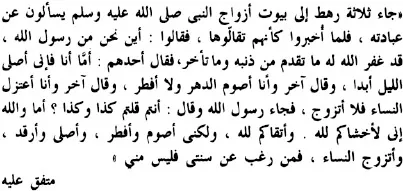
Three groups of people came to the residence of the Prophet to ask about his mode of worship. When they were told of it, they seemed to have belittled it [they expected more]. Then they said ‘Where are we compared to the Prophet (PBUH)? He has already been forgiven by Allah for anything that he did or would do.’
Then one of them said ‘As far as I am concerned, I will pray all night forever’; another said ‘And I will fast continuously’; still another one said ‘I will desert women and will never marry’.
When the Prophet (PBUH) returned, he asked them ‘Are you the ones who said so and so?’ And solemnly stated: ‘By Allah, I am more God-fearing and devout than you. Nevertheless, I fast and I break my fast, I pray and I go to sleep, and I marry. He who deviates from my way is none...
Table of contents
- Front Cover
- Half Title
- Title Page
- Copyright
- Dedication
- Contents
- Figures
- Tables
- Foreword: Nafis Sadik, UNFPA
- Foreword: H.Munawir Sjadzali, Republic of Indonesia
- Foreword: Professor Gamal Serour, Al-Azhar University
- Preface
- Acknowledgments
- Introduction
- Prologue:
- Part I The Islamic Context
- Part II Family Planning in the Qur’an and the Sunnah
- Part III Family Planning in Islamic Jurisprudence
- Part IV Islam and Family Planning in the Twentieth Century
- Epilogue:
- Notes
- Bibliography
- Index
Trusted by 375,005 students
Access to over 1.5 million titles for a fair monthly price.
Study more efficiently using our study tools.
Frequently asked questions
Yes, you can cancel anytime from the Subscription tab in your account settings on the Perlego website. Your subscription will stay active until the end of your current billing period. Learn how to cancel your subscription
No, books cannot be downloaded as external files, such as PDFs, for use outside of Perlego. However, you can download books within the Perlego app for offline reading on mobile or tablet. Learn how to download books offline
Perlego offers two plans: Essential and Complete
- Essential is ideal for learners and professionals who enjoy exploring a wide range of subjects. Access the Essential Library with 800,000+ trusted titles and best-sellers across business, personal growth, and the humanities. Includes unlimited reading time and Standard Read Aloud voice.
- Complete: Perfect for advanced learners and researchers needing full, unrestricted access. Unlock 1.5M+ books across hundreds of subjects, including academic and specialized titles. The Complete Plan also includes advanced features like Premium Read Aloud and Research Assistant.
We are an online textbook subscription service, where you can get access to an entire online library for less than the price of a single book per month. With over 1.5 million books across 990+ topics, we’ve got you covered! Learn about our mission
Look out for the read-aloud symbol on your next book to see if you can listen to it. The read-aloud tool reads text aloud for you, highlighting the text as it is being read. You can pause it, speed it up and slow it down. Learn more about Read Aloud
Yes! You can use the Perlego app on both iOS and Android devices to read anytime, anywhere — even offline. Perfect for commutes or when you’re on the go.
Please note we cannot support devices running on iOS 13 and Android 7 or earlier. Learn more about using the app
Please note we cannot support devices running on iOS 13 and Android 7 or earlier. Learn more about using the app
Yes, you can access Family Planning in the Legacy of Islam by Abdel-Rahim Omran in PDF and/or ePUB format, as well as other popular books in Politics & International Relations & Politics. We have over 1.5 million books available in our catalogue for you to explore.