- 358 pages
- English
- ePUB (mobile friendly)
- Available on iOS & Android
eBook - ePub
About this book
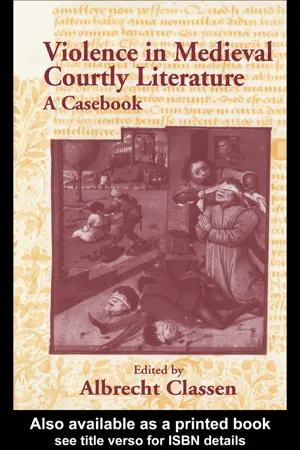
Although courtly literature is often associated with a chivalrous and idyllic life, the fifteen original essays in this collection demonstrate that the quest for love in the world of medieval courtly literature was underpinned by violence. Lovers were rejected, mistrust ruled, rape was a rampant problem, and marriage was often characterized by brutality. Albrecht Classen brings together an outstanding group of historical, cultural, and literary scholars in this volume to investigate the complicated, nuanced, and often surprising unions of love and violence in courtly medieval literature.
Information
1
Authority, Violence, and the Sacred at the Medieval Court
LEO D.LEFEBURE
The legitimation of governing authority and of certain uses of violence was central to the life of the medieval court. Since ancient times and throughout the Middle Ages, religion played the dominant role in either authorizing or challenging the exercise of authority and violence. During the early Middle Ages, Christianity came to shape and eventually dominate more and more of the life of Europe outside of Muslim-ruled Spain and Sicily.1 While pre-Christian cultic practices often lingered among the lower classes, by roughly 1000 C.E., the rulers of Western and Northern Europe had largely embraced the Christian faith and used Christian symbols to buttress their authority. Early medieval Christian missionaries used a “trickle-down” approach to conversion, focusing attention on kings and nobles and trusting that other classes of society would follow their lead. The conversion of the early medieval courts was the gateway to establishing a Christian culture.
Since ancient times religions had proclaimed paths of peace and visions of harmony; nonetheless, the history of religions, including Christianity, is steeped in violence and bloodshed, often justified in the name of God's will. Religious beliefs and practices often have had a powerful force in shaping society for both better and worse. Indeed, sociologist Rodney Stark has argued that the social effects of monotheism are among the most powerful in all of human history, leading both to missionary impulses and to violent conflicts.2 One of the most striking characteristics of medieval courtly culture is the religious valorization of military service and the selective authorization of violence. Often candidates for knighthood passed a night vigil in church, went through a ceremonial bath reminiscent of baptism, were knighted with the sign of the cross, and had their swords blessed for holy use.3 Medieval crusaders went into battle wearing the sign of the cross with the motto, “Deus vult!” (God wills it).
Violence can be defined as “the attempt of an individual or group to impose its will on others through any nonverbal, verbal, or physical means that inflict psychological or physical injury.”4 From at least the dawn of recorded history, religious traditions have played a major role in justifying violent attacks on others. Religious symbols are profoundly ambiguous: they can mediate the power of healing love and foster healthy communities, and they can serve to foment hatred and warfare and to buttress unjust social, economic, and political structures.
The medieval court inherited a complex and conflicting heritage of perspectives on legitimate authority and violence from the Bible and early Christianity. The Bible both praised kings as the specially chosen representatives of God and excoriated them as sinful products of a disobedient people. In different settings, the Christian tradition variously forbade all violence as contrary to the will of God or directly commanded it as the will of God. Medieval kings and knights looked to biblical models such as Abraham, Gideon, David, and Judas Maccabeus, who were believed to have fought and triumphed through God's help. Statues of the kings and queens of Israel looked down on those entering medieval cathedrals, offering venerable precedents for the sacred exercise of royal power.
The sacralization of religious violence at the medieval court has its roots in the complex and conflicting relationships that have connected and divided the three Abrahamic traditions from the beginning. Judaism, Christianity, and Islam present themselves as paths of peace with visions of reconciliation and harmony for the entire human community. The three traditions intertwine in many important ways. Christianity has an internal relationship to Judaism because Jesus and his first followers were themselves Jews and because Christians accept the Jewish scriptures as part of their own Bible. Nonetheless, the New Testament frequently criticizes Jewish leaders and, at times, “the Jews” in very harsh terms. Islam has an internal relationship to both Judaism and Christianity because the Qur'an accepts many Israelite leaders and Jesus as genuine prophets sent by God. The Qur'an harshly attacks Jews and Christians for distorting the earlier revelations given by God to Moses and Jesus and for rejecting the message delivered by Muhammad.
From the beginning, the relationships among these three traditions have been troubled. Each tradition has at times viewed the others extremely negatively and has understood God's will to justify and even demand violent attacks upon other religious traditions. Medieval Christians believed that the Jews were condemned by God to continued existence in misery in punishment for the crime of killing Christ, and they saw Muslims as enemies of God and representatives of the Antichrist who were to be resisted and, in many cases, put to death. Muslim attitudes were ambivalent. On the one hand, the Qur'an urges Muslims to have good relations with Jews and Christians; on the other hand, certain passages forbid friendship or contact with them. Even though each tradition clearly rejects attacks on civilian populations, all three traditions have at times violated their own best moral principles and invoked God's will as support for indiscriminate violence.
This chapter begins by examining various models for viewing kingly authority and violence in the Christian Bible and the history of early Christianity. It will then explore perspectives on sacred governing authority and violence in early medieval Europe. The Gregorian Reform of the eleventh century profoundly transformed Western European understandings of both authority and violence, secularizing the rule of emperors and kings, sacralizing the wars against Muslims, introducing a new era of persecutions of Jews, and preparing the way for Pope Innocent III's unprecedented exercise of power over earthly courts. This chapter closes by examining some aspects of the ideal of chivalry that developed in the twelfth and thirteenth centuries.
Perspectives on Authority and Violence in the Jewish and Christian Scriptures
The Hebrew Bible is profoundly ambivalent about human kings. The earliest traditions of Israel viewed God alone as king; and the prophet Samuel, who anointed the first monarchs, was very skeptical concerning the prospects of kingship in Israel, When Israelites asked him to select a king, he warned them that kings would draft their sons as soldiers, take their daughters to be servants, confiscate their fields and orchards for his courtiers, and steal their slaves and livestock (1 Sam 8:11–18). Samuel interpreted the people's desire for a king as a direct rejection of God's rule over them (1 Sam 8:7–8). One trajectory of the Hebrew Bible views kings as a concession to human sinfulness, a necessary evil in a world in which the Israelites refused to be ruled directly by God. A long line of prophets, from Samuel to Nathan, Isaiah, Jeremiah, Ezekiel, Hosea, and Amos, stood up to earthly monarchs and denounced their conduct. The biblical view of monarchy as the result of sin and pride would echo centuries later in the perspectives of Augustine of Hippo and Pope Gregory VII, fornishing the most powerful biblical critique of the sacred claims of medieval emperors and kings.
In sharp contrast, another strand of the Hebrew Bible delights in kings as the specially chosen representatives of God's power in this world, as mediators between YHWH and Israel who are to bring about order and justice.5 The psalms repeatedly echo the praises of God and the king together. God proclaims: “I have set my king on Zion, my holy hill” (Ps 2:6). The king in response rejoices: “I will tell the decree of the Lord: He said to me, ‘you are my son; today I have begotten you. Ask of me, and I will make the nations your heritage, and the ends of the earth your possession’” (Ps 2:7–8). Sigmund Mowinkel noted that ancient Israel oscillated between the older ideal of a desert chieftain who ruled because of his corporate identity with the tribe and the Canaanite and Mesopotamian view of the king as a ruler with a special relation to God or the gods.6 The desert ideal was relatively more democratic, viewing the king as a representative of the people; the Canaanite and Mesopotamian ideal saw the king as representing the gods and in some way as divine.
Long before there were human kings in Israel, there was a strong sense that God alone was king, a mighty warrior who fought on behalf of the Israelites. The roots of sacralized violence in the Abrahamic traditions reach back to earliest accounts of the history of Israel. Early Israelite attitudes to violence were shaped by the tradition of the holy war, which was common throughout the ancient Near East. It was widely believed that as human kings and warriors marched out to battle on Earth, gods and heavenly armies also participated in the conflict.7 The victors ruled through the good pleasure of their gods. Ancient Israelites believed that YHWH went to war on their behalf (cf. Judg 5:19–20; Is 14:21). Biblical hymns often praise God's victorious power in battle (Deut 33:2–3; Num 10:35–36; Ps 24; Isa 35; Hab 3:3–60).
Ancient Israel saw God as a warrior who intervened in historical events, shaping the outcome of human struggles.8 Immediately after the deliverance of the Israelites at the Sea of Reeds, Moses and the Israelites sing: “The Lord is a warrior; the Lord is his name. Pharaoh's chariots and his army he cast into the sea” (Exod 15:3). It is characteristic of the early holy war tradition that God intervenes directly, fighting for the Israelites and striking Israel's enemies with terror (Exod 15:4–16).
In later generations, God is said to call forth judges like Gideon (Judg 6:11–18) and to have supported them in battle. When Gideon protested that his clan was the weakest in the tribe, God responded: “But I will be with you, and you shall strike down the Midianites, every one of them” (Judg 6:16). Gideon and his army later triumphed against overwhelming odds (Judg 7). God also reportedly instructed the prophet Samuel on the anointing of Saul and David as kings (1 Sam 12:6–25; 16:1–13).
Centuries later, Judas Maccabeus led the Jewish army against the Syrians. When his soldiers were dismayed by the overwhelming might of the Syrian army, Judas Maccabeus told them: “It is easy for many to be hemmed in by few, for in the sight of Heaven there is no difference between saving by many or by few. It is not on the size of the army that victory in battle depends, but strength comes from Heaven…. He himself will crush them before us; as for you, do not be afraid of them” (1 Macc 3:18, 22). In this struggle God no longer intervenes directly in the fighting as in Exodus, but the soldiers are confident of God's support.9 They meet in a solemn assembly, put on sackcloth and ashes and fast; they study the scriptures to learn the will of God (1 Macc 3:46–60). Strengthened by the memory of the victory over the Egyptians at the Sea of Reeds, Judas Maccabeus led his forces to victory, slaughtering thousands along the way (e.g., 2 Macc 12:17–28; 15:25–30).
According to the Hebrew Bible, at least some ancient Israelites believed that in holy wars God demanded the complete or near complete extermination of enemy tribes. Susan Niditch has described the variety of attitudes toward war in the Hebrew Bible.10 Sometimes the slaughter of enemies was justified as a sacri0ce pleasing to God (Deut 2:34–35; Josh 6:17–21; 8:2, 24–28; 10:28–40; 11:14). At other times the members of the enemy tribe appear as sinners deserving of death, for example, because they were idolaters who would tempt the Israelites to worship false gods (Deut 13:12–18; 20:16–18). The Book of Deuteronomy orders the Israelites to slay all the inhabitants of the Promised Land “so that they may not teach you to do all the abhorrent things that they do for their gods, and you thus sin against the Lord your God” (Deut 20:18). The priestly tradition of ancient Israel saw the enemy tribe as unclean and thus deserving of death, although sometimes there were a few exceptions. According to the Book of Numbers, Moses demanded that all males of the Midian tribe of whatever age be killed, along with all women who have known sexual intercourse; only female virgins were to be spared (Num 31:17–18). Presumably, these could be purified, made strictly clean, joined in marriage to Israelite men, and thereby incorporated into the people. Meanwhile, the bardic tradition of Israel glorified war as beautiful and noble, honoring the courage and heroism of warriors (1 Sam 17:1–54; 2 Sam 2:12–16; 2 Kings 6:22–23; 2 Chron 28). In this perspective war appears as a game that must be played according to the rules for the sake of glory and honor. Instead of the mass slaughter of the holy war tradition, prisoners were allowed to return home. There...
Table of contents
- Front Cover
- Half Title
- ROUTLEDGE MEDIEVAL CASEBOOKS
- Title Page
- Copyright
- Contents
- Introduction: Violence in the Shadows of the Court
- 1 Authority, Violence, and the Sacred at the Medieval Court
- 2 Brutality and Violence in Medieval French Romance and Its Consequences
- 3 Turnus in Veldeke’s Eneide: The Effects of Violence
- 4 Violence and Pain at the Court: Comparing Violence in German Heroic and Courtly Epics
- 5 Violence Stylized
- 6 Violence at King Arthur’s Court: Wolfram von Eschenbach’s Perspectives
- 7 Violence in La Queste del Saint Graal and La Mort le roi Artu (Yale 229)
- 8 Violence and Communication in Shota Rustaveli’s The Lord of the Panther-Skin
- 9 Constructive and Destructive Violence in Jean d’Arras’ Roman de Mélusine
- 10 The Violent Poetics of Inversion, or the Inversion of Violent Poetics: Meo dei Tolomei, His Mother, and the Italian Tradition of Comic Poetry
- 11 Violent Magic in Middle English Romance
- 12 Why Is Middle English Romance So Violent? The Literary and Aesthetic Purposes of Violence
- 13 Destruire et disperser: Violence and the Fragmented Body in Christine de Pizan’s Prose Letters
- 14 Mimetic Crisis in the Medieval Mass: A Sequence for the Feast of St. Thomas of Canterbury and Its Liturgical Function, ca. 1230
- 15 Violence in the Spanish Chivalric Romance
- Contributors
- Index
Trusted by 375,005 students
Access to over 1.5 million titles for a fair monthly price.
Study more efficiently using our study tools.
Frequently asked questions
Yes, you can cancel anytime from the Subscription tab in your account settings on the Perlego website. Your subscription will stay active until the end of your current billing period. Learn how to cancel your subscription
No, books cannot be downloaded as external files, such as PDFs, for use outside of Perlego. However, you can download books within the Perlego app for offline reading on mobile or tablet. Learn how to download books offline
Perlego offers two plans: Essential and Complete
- Essential is ideal for learners and professionals who enjoy exploring a wide range of subjects. Access the Essential Library with 800,000+ trusted titles and best-sellers across business, personal growth, and the humanities. Includes unlimited reading time and Standard Read Aloud voice.
- Complete: Perfect for advanced learners and researchers needing full, unrestricted access. Unlock 1.5M+ books across hundreds of subjects, including academic and specialized titles. The Complete Plan also includes advanced features like Premium Read Aloud and Research Assistant.
We are an online textbook subscription service, where you can get access to an entire online library for less than the price of a single book per month. With over 1.5 million books across 990+ topics, we’ve got you covered! Learn about our mission
Look out for the read-aloud symbol on your next book to see if you can listen to it. The read-aloud tool reads text aloud for you, highlighting the text as it is being read. You can pause it, speed it up and slow it down. Learn more about Read Aloud
Yes! You can use the Perlego app on both iOS and Android devices to read anytime, anywhere — even offline. Perfect for commutes or when you’re on the go.
Please note we cannot support devices running on iOS 13 and Android 7 or earlier. Learn more about using the app
Please note we cannot support devices running on iOS 13 and Android 7 or earlier. Learn more about using the app
Yes, you can access Violence in Medieval Courtly Literature by Albrecht Classen in PDF and/or ePUB format, as well as other popular books in Literature & Literary Criticism. We have over 1.5 million books available in our catalogue for you to explore.