eBook - ePub
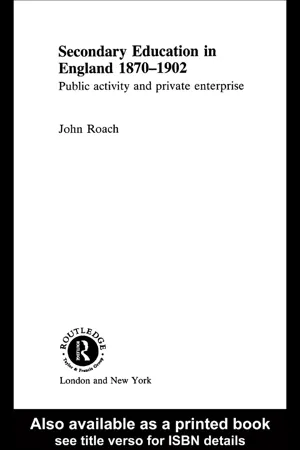
Secondary Education in England 1870-1902
Public Activity and Private Enterprise
- 296 pages
- English
- ePUB (mobile friendly)
- Available on iOS & Android
eBook - ePub
Secondary Education in England 1870-1902
Public Activity and Private Enterprise
About this book
In this comprehensive and extensively researched history, John Roach argues for a reassessment of the relative importance of State regulation and private provision. Although the public schools enjoyed their greatest prestige during this period, in terms of educational reform and progress their importance has been exaggerated. The role of the public school, he suggests, was social rather than academic, and as such their power and influence is to be interpreted principally in relation to the growth of new social elites, the concept of public service and the needs of the empire for a bureaucratic ruling class. Only in the modern progressive movement, launched by Cecil Reddie, and the private provision for young women, was lasting progress made. Even before the 1902 Education Act however the State had spent much time and effort regulating and reforming the old educational endowments, and it is in these initiatives that the foundations for the public provision of secondary educational reform are to be found.
Part I
The endowed schools
1 The work of the Endowed Schools Commission 1869–74
The Liberal victory in the general election of 1868 began a new period in British political history. Among the major reforms of Gladstone's first government (1868–74) was the Education Act of 1870, which created the nucleus of the modern state system of education. It looked for a brief period as if state intervention in secondary education would also achieve major changes. The report of the Schools Inquiry Commission (1868) had shown both the importance of the grammar school endowments and the many abuses which needed reform. The report had made radical recommendations for change: a system of graded schools; a central body with provincial authorities; and a national council for examinations with power to examine teachers.
When W.E.Forster, vice-president of the committee of council on education, introduced the second reading of the Endowed Schools Bill on 15 March 1869, he emphasized many of the same points. Free education should not be given unless it was the reward of merit. The poor should benefit from endowments, not by favour but as the reward of their own achievements. The interests of the middle classes, who needed good education for their children, should be carefully preserved. The ideal of the future should be that no one class should guide the destiny of England, ‘but that England for the future is in truth to be self-governed; all her citizens taking their share, not by class distinctions, but by individual worth’ (Hansard 194:1382). The task of reform was put into the hands of three Endowed Schools Commissioners, chaired by Lord Lyttelton. They achieved a great deal and set on foot a major process of change, but in so doing they raised massive opposition, and their work was brought to an end, in its original form, by Disraeli's Conservative administration in 1874. Progress continued to be made, though at a slower rate, by the Charity Commissioners, first created in 1853, who inherited important powers under the Endowed Schools Acts. Much was done to improve individual foundations, but the objective of a new national structure disappeared from sight until it was revived under the very different conditions of the early twentieth century.
Forster told the House of Commons that the proposed reorganization would be completed in four to five years. He and those who worked with him seriously underestimated the complexity of the task. Not only was the passage of each scheme a lengthy and often controversial process, but, as the years went on, it proved necessary to alter and amend earlier schemes. Perhaps the greatest problem, which neither the Endowed Schools Commissioners nor the Charity Commissioners ever solved, was the meritocratic issue—that all citizens should take their share, in Forster's words, ‘not by class distinctions, but by individual worth’. This was the dominant creed of Victorian Liberalism; it is seen, for example, in its purest form in the struggle to recruit to the civil service by public examination. To many people, well entrenched in school governing bodies and in local pressure groups, the idea was anathema. First of all it broke down traditional relationships of deference and loyalty in the name of a hard logical creed, which made no allowance for local circumstances. Secondly, it was argued that recruitment by merit provided only an illusory advantage for the poor because those who could afford to pay for the best preliminary education would scoop the prizes. Finally, the abandonment of what the reformers saw as indiscriminate free education was opposed by the poor, who had to find the weekly school pence out of an already insufficient family income.
The issue of ‘better education as the reward of merit’ dominates the story of the reform of the endowed schools after 1870. Successive commissioners and assistant commissioners were sincere in their belief that they were trying to act for the benefit of all classes of society who used the grammar schools. There was no deliberate plan to force out the poor and to deprive them of endowments in the interest of the middle classes who were in a better position to take advantage of the opportunities offered. Yet inevitably it looked as though that was the commissioners’ objective, and they did not serve the cause of reform well by the insensitivity which they often showed to the arguments of their opponents.
Opposition to them took two principal forms. The first, strongest in the earlier years, was the resistance put up by the advocates of a traditional concept of English society. Assistant Commissioner J.G.Fitch had written in his report to the Schools Inquiry Commission that ‘the will of the departed founders is constantly quoted as a reason for the maintenance of usages, which are acknowledged, even by their defenders, to be pernicious’ (Robertson 1971:11).
To those defenders the wills of the founders had far more sanctity than the opinions of a newly constituted official body in London. In the 1880s the commissioners came under a new form of attack which was radical not conservative in inspiration. Instead of emphasizing the sanctity of founders’ wills, critics like Joseph Chamberlain and Jesse Collings pressed the claims of local democracy and of a much more broadly-based form of political control. Originally this was an urban movement, as can be seen in the struggles for control of the great King Edward's foundation in Birmingham (see pp. 50–7). Later it became connected with the pressure for more democratic government in the countryside, for example, in the Reform Act of 1884, which extended the vote to male rural labourers.
Before the Endowed Schools Bill became law, the clauses providing for examination and inspection were dropped (Gordon 1980:36). The Endowed Schools Act of 1869 restricted itself to the administrative aspects of the problem. This Act, together with later Acts of 1873 and 1874, controlled the way in which new schemes were made and thus determined the development of the endowed schools in the next generation. It is therefore necessary to analyse them in detail. The Act of 1869 (PGS, 32 & 33 Vic. 1869:197–208) provided for the appointment of up to three commissioners and a secretary with power to make new schemes for endowed schools. They were to do this ‘in such manner as may render any educational endowments most conducive to the advancement of the education of boys and girls’. They might alter and add to trusts, make new trusts, alter governing bodies, establish, remove them, and dissolve them.
The provisions of this Act can be divided into two parts: the general definition of powers and the ways in which those powers were to be exercised. The commissioners were required (sect. 11), when they modified the privileges or advantages belonging to any class of persons to ‘have due regard to the educational interests of such class of persons’, a clause frequently cited in the many disputes about the interests of the poor in the endowments. Section 12 required that provision should be made as far as possible for extending the benefits of endowments to girls, an important provision which was the result of an amendment inserted during the passage of the Bill (S.Fletcher 1980:25–9). No scheme was to be made for an endowment set up less than fifty years before the passing of the Act without the consent of the governing body, and similar protection was extended to endowments of certain specified kinds (sect. 14). A conscience clause covered attendance at lessons on religious education in day schools, and although this did not apply to boarders, it was provided that a scholar who wished to claim exemption should be allowed to attend as a day scholar (sects. 15, 16). Religious opinions were not to affect the appointment of any person as a governor (sect. 17), and in general no one was to be disqualified for appointment as a master by not being in holy orders (sect. 18). However, special provision was made to exempt from these provisions any school which, by the terms of the original foundation and by continuous usage since that time, had been required to be managed ‘according to the doctrines or formularies of any particular church, sect, or denomination’ (sect. 19). As might be expected, many disputes occurred concerning the interpretation of this section. The Endowed Schools Commissioners considered that it was narrowly drawn, and that it was difficult to make a case that a school should come under its provisions.
One group of clauses governed the relationship between educational and non-educational endowments, an important subject because it was common to find both types under the control of the same trust. Section 24 provided that, in general terms, that division between the two should exist, which had been practised during the three years before the passing of the Act. Section 29 provided that endowments for the payment of apprenticeship fees or for the maintenance or clothing of children were to be deemed educational endowments. The quarrels over the ‘hospital schools’, which provided maintenance and clothing as well as teaching, were the most bitter that the commissioners had to face because they involved a direct clash between the rival concepts of awards for merit and of charity to the poor and needy. Section 30 dealt with a related point concerning endowments for objects such as loans, money doles, apprenticeship payments, marriage portions, and so on where it was difficult to use the money because the sums available exceeded the demands made upon them. The commissioners were given power to make schemes applying such funds for educational purposes, though they might do this only with the consent of the governing body concerned. Since in many cases these ‘non-educational’ funds were essential for major developments like new buildings, sect. 30 gave to governing bodies an important lever in their struggles with the commissioners.
Sections 32–41 regulated the making of schemes. The Endowed Schools Commissioners were given powers to prepare draft schemes, with the provision that governors of endowments with an income of over £1,000 per annum might prepare their own (sect. 32). When draft schemes had been made, they were to be printed and circulated (sect. 33), and the commissioners were to receive objections and suggestions within three months of the date of publication (sect. 34). After that time they might hold an enquiry (sect. 35) and then, after considering further objections and suggestions, they were to submit their scheme to the Committee of Council on Education with the proviso that, in cases where a governing body was permitted to submit its own scheme, that scheme should be sent forward together with that emanating from the commissioners if the governing body so desired (sect. 36). The Committee of Council might consider, approve, and publish schemes, but although they had the power to reject, they had no power to amend. In case of rejection the commissioners were required to frame a new scheme (sect. 37).
When a governing body felt aggrieved by a scheme (certain specific grounds being defined), they might petition the Queen in Council, who could refer the petition to five privy councillors (sect. 39). The scheme could then be referred back to the commissioners or laid before Parliament, where it lay on the table for forty days. If within that period no address was presented in either house for consent to be withheld, Her Majesty in Council might give approval (sects. 40, 41). The procedure was lengthy, cumbrous, and if it be remembered that at every stage there were many clashing interests to conciliate, there was certainly no danger of over-speedy decision-making. Finally, by sect. 59 of the Act the power of making schemes was to extend to 31 December 1872 or, if so appointed by Her Majesty in Council, 31 December 1873. If that timespan be set against the complexity of the procedures, Forster's estimate of four to five years for completion looks, as it proved to be, wildly over-optimistic.
Though the Act of 1869 was subsequently amended, it remained the principal piece of legislation governing the reform of the schools. The Act of 1873 (PGS, 36 & 37 Vict. 1873:315–20) continued the powers of the commissioners until 31 December 1874 in the case of unopposed schemes and until 15 August of that year in the case of schemes against which a petition had been presented (sect. 17). It also legislated over matters that had caused difficulties in interpreting the 1869 Act. Much time and trouble had been devoted to small endowments for elementary schools. By sect. 3 of the 1873 Act such endowments of a value of less than £100 a year were taken out of the control of the commissioners and made subject to the provisions of the Elementary Education Act of 1870. There had been problems too about the position of ex officio governors in newly-made schemes because such governors were often parish clergymen, and Nonconformists objected to what they saw as a privileged status for such persons. Section 6 permitted such ex officio governors where they had been provided for by the terms of the original foundation. Changes were also made in the mechanism for approving schemes. The first period for receiving suggestions after the original publication was reduced from three to two months (sect. 12). The Committee of Council were to allow one month for receiving suggestions or objections after they had published a scheme, and after they had approved it, it might be approved by Her Majesty in Council without being laid before Parliament if no objections were laid against it (sect. 13).
The amending Act of 1873 had been passed by the same Liberal government that had promoted the original legislation. The Conservatives, who came to power in 1874, represented clerical and traditional forces. Their Act of 1874 transferred the powers of the Endowed Schools Commissioners to the Charity Commissioners, established under the Acts of 1853 and 1860, after 31 December 1874, and provided that the existing commissioners and their secretary should cease to hold office from that date (PP 1874 II: 79–86; PGS 37 & 38 Vict. 1874:288–90). Two additional charity commissioners and a secretary might be appointed to replace them, and the power of making schemes under the Acts was continued for five years from 31 December 1874. For the remainder of the period control lay in the hands of the Endowed Schools Department of the Charity Commission, their powers being continued as necessary from time to time.
The three commissioners appointed to administer the Act of 1869 were Lord Lyttelton, Arthur Hobhouse, and H.G.Robinson. H.J.Roby was appointed secretary, and he succeeded Hobhouse as commissioner in 1872 when Hobhouse went to India as legal member of the Governor-General's council. Their staff of assistant commissioners had in many cases done similar work for the Schools Inquiry Commission, and some of them were to continue under the Charity Commissioners. The three commissioners of 1869 and Roby were all strong reformers (S.Fletcher 1980:30–41). Robinson, a clergyman, who had been principal of York Training College, was the most moderate and the only one who was appointed a charity commissioner after the changes of 1874. Lyttelton and Hobhouse were far more doctrinaire, and it may be doubted whether they had the tact and negotiating skills necessary to give them the best chance of success. Lyttelton indeed had been unwilling to accept appointment; he had given way when strongly pressed by Gladstone, who was his brother-in-law. He acted as chief commissioner, and the active part he took in the work can be seen by his many comments, scrawled in a very illegible hand, on the papers that came before him.
If Lyttelton had little idea of the soft answer that turneth away wrath, Arthur Hobhouse had even less. A lawyer who had given up active work at the Bar through ill health, he had become a charity commissioner in 1866. In 1868 and 1869 he gave three lectures strongly critical of what he saw as the excessive deference paid by society to the wills of founders (Hobhouse 1880). He was not hostile, as some Liberals were, to endowments in themselves, but he was convinced that they must be managed according to the needs of his own day. The public must be able, he argued, to regulate the use of endowments through a public tribunal with authority to make whatever changes were necessary. Nor was the matter only one of constitutional and legal theory. Many endowments did much more harm than good because they pauperized and degraded those that came into contact with them. They tended to promote sloth and ignorance, and to deprive men of that personal independence which was the only guarantee of individual and social success.
Hobhouse's was a bracing creed, but not likely to commend itself either to the local notabilities who administered the ancient foundations or to those who benefited from them. Roby, his colleague and successor, wrote much later that, as a commissioner, Hobhouse was too much the lawyer and too little the administrator. His task, as he saw it, was to expound the letter of the law, not to accommodate the law to the demands and prejudices of the traditional order. Indeed, Roby thought, he found it very difficult to appreciate ‘the ignorant complacency and blind adherence’ of his opponents to founders’ wishes (Hobhouse and Hammond 1905:48–50). From the point of view of a school governing body, the opinion of William Mathews, who had been bailiff (chairman of governors) of King Edward's foundation at Birmingham, is probably typical. He told the select committee of 1873: ‘I should say that the feeling of the country is that the action of the Commission is much too revolutionary’ (PP 1873 VIII:558:3518).
Hobhouse himself wrote in 1873, after he had ceased to be a commissioner, that in his view the commission had been much more successful than he had expected when he had reluctantly agreed to serve (Hobhouse and Hammond 1905:46). The commission's history is really the story of the schemes they had made or attempted to make. Their achievement was also examined in their own reports of 1872 and 1875, and in the report of the select committee of 1873. Their 1875 report gave the statistics of what had been done: 235 schemes had passed with a total endowment income of £93,635, while schemes covering an income of another £85,000 had reached the Education Department. Progress had been slowed d...
Table of contents
- Cover Page
- Half Title page
- Title Page
- Copyright Page
- Dedication
- Contents
- List of tables
- Preface and Acknowledgements
- List of abbreviations
- Part I The Endowed Schools
- Part II Public activity in secondary education
- Part III The public schools
- Part IV Private and private foundation schools
- Part V The education of girls
- Bibliography
- Index
Trusted by 375,005 students
Access to over 1.5 million titles for a fair monthly price.
Study more efficiently using our study tools.
Frequently asked questions
Yes, you can cancel anytime from the Subscription tab in your account settings on the Perlego website. Your subscription will stay active until the end of your current billing period. Learn how to cancel your subscription
No, books cannot be downloaded as external files, such as PDFs, for use outside of Perlego. However, you can download books within the Perlego app for offline reading on mobile or tablet. Learn how to download books offline
Perlego offers two plans: Essential and Complete
- Essential is ideal for learners and professionals who enjoy exploring a wide range of subjects. Access the Essential Library with 800,000+ trusted titles and best-sellers across business, personal growth, and the humanities. Includes unlimited reading time and Standard Read Aloud voice.
- Complete: Perfect for advanced learners and researchers needing full, unrestricted access. Unlock 1.5M+ books across hundreds of subjects, including academic and specialized titles. The Complete Plan also includes advanced features like Premium Read Aloud and Research Assistant.
We are an online textbook subscription service, where you can get access to an entire online library for less than the price of a single book per month. With over 1.5 million books across 990+ topics, we’ve got you covered! Learn about our mission
Look out for the read-aloud symbol on your next book to see if you can listen to it. The read-aloud tool reads text aloud for you, highlighting the text as it is being read. You can pause it, speed it up and slow it down. Learn more about Read Aloud
Yes! You can use the Perlego app on both iOS and Android devices to read anytime, anywhere — even offline. Perfect for commutes or when you’re on the go.
Please note we cannot support devices running on iOS 13 and Android 7 or earlier. Learn more about using the app
Please note we cannot support devices running on iOS 13 and Android 7 or earlier. Learn more about using the app
Yes, you can access Secondary Education in England 1870-1902 by Prof John Roach,John Roach in PDF and/or ePUB format, as well as other popular books in History & World History. We have over 1.5 million books available in our catalogue for you to explore.