First published in 1999. We are fortunate in possessing a fascinating document, The Life of Plotinus, written by the philosopher Porphyry, a pupil and associate of Plotinus for the last eight years of his life. The basic facts contained in this Life can be quickly recounted. Plotinus was likely a Greek born in Egypt in AD 205. It is possible, though, that he came from a Hellenized Egyptian or Roman family. In his 28th year, Plotinus discovered in himself a thirst for philosophy. This is a collection of his works- Ennead I contains treatises on what Porphyry calls "ethical matters"; Enneads II–III contain treatises on natural philosophy or cosmology, with some rationalizations for the inclusion of III. 4, 5, 7, and 8. Ennead IV concerns the soul; V Intellect or and VI being, numbers, and the One. The thematic unity of Enneads I, IV, and V is somewhat greater than the rest.
I An Argument for the Existence of a First Principle of All
DOI: 10.4324/9780203011478-1
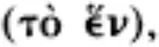
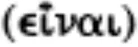
General accounts of Plotinus’ metaphysics typically assert that his system contains three “hypostases,” the One
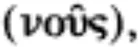
Intellect
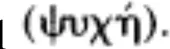
and Soul
Such a division is misleading. First, as Plotinus explains, these are the only three “in the intelligible world”, that is, in contrast to the sensible world (II.9.1.15–16).1 He also says that the three are “in us” as well as in nature (V.1.10.5–6). Second, the above statement gives the impression that
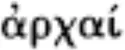
is a technical term reserved for primary entities in the system. This is false. Plotinus speaks often of the
of a variety of things such as wisdom, matter, love, numbers, relations, time, motion, and so on.2 In the majority of passages, the term means simply “extra-mental existence” or “existents” in the plural.3 When Plotinus raises a question about the
of X, he is generally not in doubt that X exists in some way, but he is intent on arguing that some opponent’s account of that existence is false and that a better (i.e., Platonic) one is needed. Such an account of the existence of X is usually understood by Plotinus according to traditional categories of material/immaterial; independent/dependent; generated/ungenerated; particular/universal. Thus, one opponent, say, a Stoic, will hold that the
of X is material and dependent, while Plotinus wants to argue that it is in fact immaterial and independent.
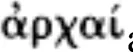
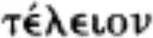
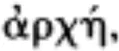
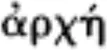
It is more helpful and accurate to refer to the One, Intellect, and Soul as
or principles, as Plotinus frequently does (see II.9.1.12–16; V.1.9.23–4; V.2.1.1; V.3.15.27;V.3.16.7, 13, 38; V.4.1.12; V.8.7.44; VI.8.9.5; VI.8.19.16; VI.9.5.24; VI.9.6.35, etc.).4 The One, Intellect, and Soul are principles in three ways.
First, they are principles of explanation or starting-points for solving the inventory of philosophical problems inherited from the tradition to which Plotinus is attached. Thus, if Plotinus is giving an account of, say, voluntary action or memory or evil, he will appeal to his three principles as providing the conceptual framework for his account. These principles are supposed to enable him to interpret phenomena correctly. They are fundamental explanatory categories.
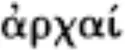
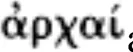
Second, they are principles in the sense of paradigms. Like Platonic Forms,Plotinus’ three
are identitatively whatever it is that participates in them is predicatively. Nevertheless, Plotinus’ paradigmatism is more complex than Plato’s. For Plato, Forms alone are paradigms. For Plotinus, however, although Intellect is the locus of Forms, the One and Soul also serve a paradigmatic function. Thus, the notion of image or copy is expanded beyond its basic Platonic reference to the instances of Forms.
Third, they are actual causes of some sort. Plotinus shows no interest in merely notional or theoretical paradigms. The three
of Plotinus are first causes in distinct kinds of explanation. They function in his arguments as explanatory entities, adduced to account for specific kinds of data. These
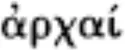
are ordered in terms of scope. Thus, the first
the One, includes within its causal scope the second and third
Intellect and Soul. And the second includes the third in its causal scope. These causes overlap, but they are irreducible. They can be severally adduced to explain various features of the same things, but their causality is not identical. That is why Intellect and Soul are not just inferior manifestations of the One. The
One is the cause only of its proper effect.
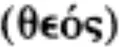
Plotinus’ argument for the existence of an unconditionally first principle of all belongs to a long tradition of philosophical theology. To call this first principle “god”
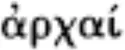
is uncontentious within this tradition.5 Among the arguments definitely known to Plotinus were Plato’s and the Stoics’ design arguments, Aristotle’s argument for an unmoved mover based on the eternity of motion, and the ubiquitous argument ex consensu gentium.6 Plotinus does not employ any of these arguments, opting instead for a different and original approach. Actually, he confidently alludes to a plethora of unnamed demonstrations of the first
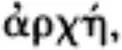
7 Perhaps he believed that, since he has at least one good argument, there must be others. Or perhaps he believed that one basic argumentative strategy is variously nameable depending on the particular type of data employed. In any case, the most direct line to Plotinian metaphysics goes through the argument for the existence of a first principle. Here is the passage containing the beginning of the argument:
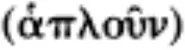
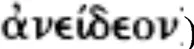
For there must be
something simple
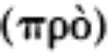
before
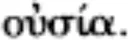
all things, and this must be other than all the things which come after it, existing by itself, not mixed with the things which derive from it, and all the same able to be present in a different way to these other things, being really one, and not a different being and then one; it is false even to say of it that it is one, and there is “no concept or knowledge” of it; it is indeed also said to be “beyond being”
For if it is not to be simple, outside all coincidence and composition, it could not be a principle
and it is the most self sufficient, because it is simple and the first of all: for that which is not the first needs that which is before it, and what is not simple is in need of its simple components
so that it can come into existence from them. (V.4.1.5–15)8
At first glance, this passage looks like the statement of a banal analytic truth masquerading as a metaphysical argument. The existence of complexes entails the existence of simples. This certainly does not seem promising. But notice that the argument explicitly distinguishes the “simple” that is “before” a complex and a simple component. It is of course only the latter that is entailed by the existence of a complex. So, we are left to wonder, where is the argument for the existence of the former?
A clue is contained in the next line of the text, where Plotinus claims that “such a thing [i.e., ‘something simple before all things’] must be one alone: for if there were another of this kind, both would be one.” The only reason given for this claim is that if there were two, both would be one. Presumably, this means “specifically one,” since it would be nonsense to claim that there cannot be numerically two things because then they would be numerically one. But what is wrong with saying that two things are specifically one, differing solo numeral We must not suppose a sort of Leibnizian reply from Plotinus based on the principle of the identity of indiscernibles for the obvious reason that Plotinus is talking about the uniqueness of the absolutely simple first principle of all, not the uniqueness or identity of any individual, which of course may be complex. This uniqueness is supposed to follow from its being the sort of thing it is
namely, one or simple.9 Evidently, unqualified simplicity is thought to be incapable of duplication.
Let us ask first of all what unqualified simplicity is supposed to mean. Minimally, this means that it has no predicates (III.8.10.29–35). We cannot say of the unqualifiedly simple, claims Plotinus, that it is one or even that it exists. Why would this entail a denial of simplicity? I suggest that the only complexity that would be entailed in such a proposition as “the One exists” is a real distinction grounded in reality between what exists and its existence. A mere conceptual distinction between whatever it is that “it” means and what “exists” means would not entail complexity. As we shall see in the next chapter, there are many possibilities for non-redundantly referring to the One so long as these are understood to be merely conceptually distinct ways of referring to that which is unqualifiedly simple.
If unqualified simplicity entails an absence of a real or extra-mental distinction between whatever it is that the name “One” refer to and its existence, then we might construct the following argument to show why it may be supposed that the One is utterly unique as well. Let there be two unqualifiedly simple things, A and B. In that case, each one will have no predicates. They will both exist, but we cannot say of each “it exists.” Then how could we establish that there are two? Presumably, the only way we could refer to two existents is by referring to what it is that exists in each case. But if in each case we cannot distinguish what it is from its existence, we can make no such reference. We might say simply that “exists” is not a referring expression but that referring expressions are needed to refer to the putative duo. Nor does it even seem possible that we can conceive of what itwould mean for there to be two such unqualifiedly simple existents. To conceive of each is to conceive of what each is. Even an “I know not what” is something.
Perhaps it will be said that the reason why we cannot conceive of more than one unqualifiedly simple thing is that we cannot conceive of even one. Plotinus is actually sensitive to such an objection. After all, if the One is “beyond being,” then it is apparently beyond conceivability so long as conceivability is taken to belong to all and only that which has being in some sense. I think we shall better understand Plotinus’ highly creative and nuanced response to this problem if we suppose that the One’s being “beyond being” does not mean that it has no nature or essence at all or that it is a blank ontological place-holder or bare particular. Rather, its essence is identical with its existence and therefore it is unqualifiedly simple. By contrast, if in everything else essence or nature or “whatness” is really distinct from existence, then what each thing is can be conceived of apart from its existence. If the One is identical to its existence, conceiving of it is impossible.
In claiming that the first principle of all is unique Plotinus can draw on many arguments of his predecessors for support. For example, Plato argued for the uniqueness of every Form.10 Still, every Form will share in some characteristics with every other Form, such as eternality, immateriality, oneness, and so on. Thus, Forms are not unqualifiedly unique; they may be nevertheless the same in some respects. A more pertinent model for Plotinus is...
Table of contents
Cover Page
Half Title Page
Series Page
Title Page
Copyright Page
Dedication
Contents
Acknowledgments
The Enneads
Introduction
PART I
PART II
Some concluding remarks
Notes
Bibliography
General index
Index of texts cited
Trusted by 375,005 students
Access to over 1.5 million titles for a fair monthly price.
Study more efficiently using our study tools.
Frequently asked questions
Yes, you can cancel anytime from the Subscription tab in your account settings on the Perlego website. Your subscription will stay active until the end of your current billing period. Learn how to cancel your subscription
No, books cannot be downloaded as external files, such as PDFs, for use outside of Perlego. However, you can download books within the Perlego app for offline reading on mobile or tablet. Learn how to download books offline
Perlego offers two plans: Essential and Complete
Essential is ideal for learners and professionals who enjoy exploring a wide range of subjects. Access the Essential Library with 800,000+ trusted titles and best-sellers across business, personal growth, and the humanities. Includes unlimited reading time and Standard Read Aloud voice.
Complete: Perfect for advanced learners and researchers needing full, unrestricted access. Unlock 1.5M+ books across hundreds of subjects, including academic and specialized titles. The Complete Plan also includes advanced features like Premium Read Aloud and Research Assistant.
Both plans are available with monthly, semester, or annual billing cycles.
We are an online textbook subscription service, where you can get access to an entire online library for less than the price of a single book per month. With over 1.5 million books across 990+ topics, we’ve got you covered! Learn about our mission
Look out for the read-aloud symbol on your next book to see if you can listen to it. The read-aloud tool reads text aloud for you, highlighting the text as it is being read. You can pause it, speed it up and slow it down. Learn more about Read Aloud
Yes! You can use the Perlego app on both iOS and Android devices to read anytime, anywhere — even offline. Perfect for commutes or when you’re on the go. Please note we cannot support devices running on iOS 13 and Android 7 or earlier. Learn more about using the app
Yes, you can access Plotinus-Arg Philosophers by Lloyd P. Gerson in PDF and/or ePUB format, as well as other popular books in Philosophy & Ancient & Classical Philosophy. We have over 1.5 million books available in our catalogue for you to explore.