The recent surfacing of actor-network theory (ANT) in tourism studies correlates to a rising interest in understanding tourism as emergent thorough relational practice connecting cultures, natures and technologies in multifarious ways. Despite the widespread application of ANT across the social sciences, no book has dealt with the practical and theoretical implications of using ANT in Tourism research.
This is the first book to critically engage with the use of ANT in tourism studies. By doing so, it challenges approaches that have dominated the literature for the last twenty years and casts new light on issues of materiality, ordering and networks in tourism. The book describes the approach, its possibilities and limitations as an ontology and research methodology, and advances its use and research in the field of tourism.
The first three chapters of the book introduce ANT and its key conceptual premises, the book itself and the relation between ANT and tourism studies. Using illustrative cases and examples, the subsequent chapters deal with specific subject areas like materiality, risk, mobilities and ordering and show how ANT contributes to tourism studies. This part presents examples and cases which illustrate the use of the approach in a critical way. Inherently, the study of tourism is a multi-disciplinary field of research and that is reflected in the diverse academic backgrounds of the contributing authors to provide a broad post-disciplinary context of ANT in tourism studies.
This unique book, focusing on emerging approaches in tourism research, will be of value to students, researchers and academics in tourism as well as the wider Social Sciences.
eBook - ePub
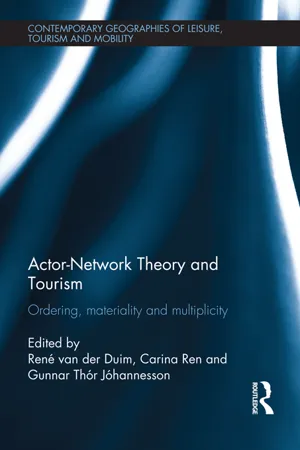
Actor-Network Theory and Tourism
Ordering, Materiality and Multiplicity
- 184 pages
- English
- ePUB (mobile friendly)
- Available on iOS & Android
eBook - ePub
Actor-Network Theory and Tourism
Ordering, Materiality and Multiplicity
About this book
1 Introduction
Relations are, in fact, ways of moving from place to place, or of wandering
(Serres and Latour 1995: 3)
In spring 2010, the global system of air mobility was heavily disrupted by what at first seemed to be a very local event, namely an eruption of Eyjafjallajökull, Iceland. The reason was the unhappy encounter between ash particles and running jet engines that may cause aircrafts to lose power. Volcanic eruptions are not uncommon in Iceland and this particular one was not much different from many others in terms of ash volume (Davies et al. 2010). However, the ash cloud produced by Eyjafjallajökull, contaminated European airspace as it was transported towards it by winds, thereby turning the state of usual order into a state of chaos. Hundreds of airports were closed and millions of passengers were stranded (Calleja 2010). As Lund and Benediktsson (2011) note, the effects of the Eyjafjallajökull eruption may be the ultimate reminder that we ‘inhabit the earth’ (and see Latour 2007) and that tourism is an earthly endeavor. It also highlights that tourism mobilities, as other forms of mobilities, are precarious achievements that rest on associations, entanglements and orderings of various sort, including earthly materials (Benediktsson et al. 2011; Lund and Benediktsson 2011). Whenever we embark on travel we enact – take part in and make use of – heterogeneous associations as those on which the order of European airspace relies where technologies, bodies, imaginations, memories and materials are bundled together. As Huijbens and Gren (in chapter 10 of this book) point out, the etymology of travelling refers to labor (travail) and tourism indeed involves a wide array of relational work (see also Löfgren 2008). We book an e-ticket, pay it with a credit card, we do mind-travel to our destination and think about how our stay will turn out, and in order to get there safely and back again we have to remember a little thing called a passport.
How should we study this kind of complexity? How are we to navigate and find reasonable (or sustainable if you like) ways through the world of (post-) modern tourism as well as viable ways into the future, for tourism and our planet – the Earth? This book deals with those questions. It does not pretend to have ready made answers but it promises insights into tourism evolvement, how it comes about, the impact of tourism and its ordering effects. Basically, it offers stories of how tourism works.
It does so by using a particular toolkit in the form of actor-network theory (ANT). One of the main objectives of the book is to present the ANT approach and translate it into the field of tourism research. We share the view of Law (2007: 2) that ANT is multiple; a diaspora that “overlaps with other intellectual traditions”. The following chapters manifest this multiplicity in their take on ANT as an approach to researching tourism practices. Together they display different ways of doing ANT research without exhausting the potential ways of such work.
Introductory chapters often tell origin stories. They answer questions of how it all began. Questions like ‘Where does “ANT and tourism” come from?’ In that case the challenge is to recount the story of origin of a multiple and diasporic approach. If we accept that knowledge production is always partial and an effect of situated practices (Haraway 1991) the writing up of a holistic origin story becomes an impossible task (for a view from tourism research see Ren et al. 2010). From a very local standpoint, ‘ANT and tourism’ may have started with an encounter between Carina and Gunnar at the 18th Nordic Symposium of Tourism and Hospitality Research conference in Esbjerg, Denmark, autumn 2009. Late November Carina got the idea to produce a book on ANT and tourism as she felt that there was some buzz around the approach within tourism studies. She sent an email to Gunnar explaining her idea, mentioning that René, who was an opponent on her PhD defense earlier that year, could perhaps join the group of editors. Gunnar immediately bought the idea, knowing René’s work as well as the person, although only through email correspondence. Thus he was successfully enrolled into an emergent actor-network that was to create this book. Another email enrolled René and after some preparation works at distance the process of attracting other authors started. Through a lot of email correspondence and a few face-to-face meetings the group of editors was established as a collective actor and an obligatory point of passage for the author’s chapters to go through on their way to publishing. The publishing company is obviously also such a node in the actor-network that in the end made it possible for you, as reader, to pick up what hopefully will be an interesting book for you – even if it may only be on your obligatory reading list!
Surely this is very selective and narrow account of how it all began; only concerned with this particular book on ‘ANT and tourism’ and indeed only one of many possible ways of telling of its origins. We could for instance go further back in time or draw out other incidences and events, like when Carina and René met for the first time during an ATLAS conference in Poland. The point to make is that there is probably no fixed starting point other than the one we choose to make – or to stabilize, in the vocabulary of ANT. ANT appreciates the world as emergent through unfolding relations thus drawing attention to the practices and enactments through which the relations are ordered and stabilized, at least from time to time. This means that ‘reality is done and enacted rather than observed’ (Mol 1999: 77, italics in original). Thereby, reality may come in multiple yet interrelated forms and orders. We might thus want to switch focus and follow alternative traces that tell about how ‘it all started’ with ANT and tourism. One possibility is to pick up on that ‘buzz’ Carina felt in the field of tourism studies and which partly triggered the work on this book.
ANT and Tourism
Tourism studies have always been relatively open towards concepts and theories from other fields of study. Tribe (2010) recently described tourism research as a fragmented field or a ‘multidisciplinary endeavor’. He identified two major force fields within tourism, that of the business of tourism and tourism social science (Tribe 2010). A longstanding criticism of tourism studies is that it remains methodologically diverse and weakly theorized (see e.g. Cohen 1984; Crick 1989; Shaw and Williams 2002; Franklin and Crang 2001). Different responses to a call for more critical social theory and, as such, the bolstering of the tourism social science field, can be documented. One is the political economy approach, catalyzed by Britton in the early 1990s. He highlighted the ‘capitalistic nature’ of tourism and called for an explicit supply-side approach to tourism in order to understand its role ‘in capitalist accumulation, its economic dynamics, and its role in creating the materiality and social meaning of places’ (Britton 1991: 452). Hence, the system of capitalism and the realm of economy were defined as main resource of explanation of tourism practices. This line of argument is still well presented by the work of Mowforth and Munt (2009) and by authors like Brockington et al. (2008) discussing the role of tourism in conservation. A second set of critical perspectives has emphasized the role of culture as the organizational principle of tourism (Coleman and Crang 2002; Crang 2004; Ringer 1998; Rojek and Urry 1997). This broad cultural approach has moved from a rather narrow understanding of cultures of tourism and tourism’s effect on cultures to a more nuanced view that recognizes the contingency of tourism practices (Crang 2004). This move has also been manifested through the critical turn in tourism theory and methodologies (Ateljevic et al. 2007) and in a set of relational approaches, such as non-representational theory, the mobility paradigm and the performance turn (Sheller and Urry 2004a; Hannam et al. 2006; Bærenholdt et al. 2004). The latter approaches share the view of ANT that social orders need to be enacted or performed and as such are precarious achievements. For instance, from the mobilities perspective, tourism is brought into being through (dis)ordering of different mobilities. In the words of Sheller and Urry: ‘many different mobilities inform tourism, shape the places where tourism is performed, and drive the making and unmaking of tourist destinations’ (Sheller and Urry 2004b: 1).
This general conceptual development forms the background of emergent ANT inspired tourism studies. It is tempting to relate the emergence of an ANT approach to tourism to the apparent bolstering of the tourism social science subfield. It is however difficult to categorize ANT in any finite way. ANT travels and it has been around for a while. It originated within the circles of STS studies in the 1980s and has since moved to different areas of the social sciences, especially organizational studies, anthropology, geography and most recently – as will be explained in chapter 3 – tourism studies (O’Neill and Whatmore 2000; Franklin 2004; Cloke and Perkins 2005; van der Duim 2005, 2007; Jóhannesson 2005, 2007; Ren 2010, 2011; Ren et al. 2010; Tribe 2010; Paget et al. 2010; Rodger et al. 2009; Arnaboldi and Spiller 2011). Rather than think of ANT as a part of a predefined force-field we would like to advocate a view of ANT as a translation device. It provides means to move around, make connections and follow relations between seemingly opposed positions or dualisms. Seen from this angle, the emergence of ANT within tourism may be interpreted as an effect of a perceived need of moving beyond dichotomous understandings of tourism as either a purified economic or equally pure cultural practice.
Actor-Network Theory
Although tales with fixed beginnings and powerful creators are not usually provided in relational descriptions, it is fair to say that almost 30 years have now passed since different undertakings labelled as ANT came together in the realm of Science and Technologies Studies. From there it would soon spread out and impact on larger parts of social studies as an ‘alternative’ social theory based, as noted above, on relationalism (Emirbayer 1997). Its main focus is not the usual why questions of social sciences but rather questions of how social arrangements are held together. This means that it is not interested in what tourism is, but in how tourism works, how it is assembled, enacted and ordered. ANT has thus been preoccupied with questions of the ways in which society is constructed and ordered and it follows that society is not taken to be what holds us together but to the contrary; what has to be held together (Latour 1986). In the context of this book we grouped the main premises of ANT into three interrelated themes: ordering, materiality and multiplicity.
The question of order is at the heart of much social theory. Bauman nicely captures the essence as well as the attraction of order:
To put it in a nutshell: things are in order if you do not need to worry about the order of things; things are orderly if you do not think, or feel the need to think, of order as a problem, let alone as a task […]. Any attempt to ‘put things in order’ boils down to manipulating the probabilities of events. This is what any culture does, or at least is supposed to do. […] The manipulation of probabilities and so the conjuring up of order out of chaos is the miracle performed daily by culture. More precisely: it is the routine performance of that miracle that we call culture.
(Bauman 2001: 31–32, italics in original)
Put in this way, the prime task of ANT is to trace the manipulation of ‘probabilities of events’ or trace relational practices of actors and the ways they are ordered into more or less stabilized networks that often appear as black boxes in real life. Early examples of this ambition include studies of the construction of scientific facts (Callon 1986; Latour and Woolgar 1986), the ways in which political and economic control is exerted at a distance (Law 1986) and the processes of invention and innovation (Callon 1980, 1991).
A particular characteristic of ANT studies is their stress on materiality and the role of materials and non-human elements in general, in the processes of ordering (Law 1992). The proponents of ANT have pushed the material relationalism to the edge, most clearly expressed in the principal of ‘general symmetry’. It insists that researchers should refute all pre-given distinctions between classes of possible actors (natural/social, local/global and economic/cultural) and focus instead on the process of network building and network consolidation (see e.g. Callon 1986; Law 1992; Murdoch 1997). Consequently, ANT approaches the world as consisting of heterogeneous relations and practices through which humans and non-humans alike are treated as possible actors.
This basically means that we cannot take anything as given, as everything is an effect of relational practices. Actors are assembled and structures are arranged in a recursive process of networking or translation (Law 1994). Through the filter of ANT, the world is depicted as a mobile arrangement and thus it abandons the purified and often static conceptual categories of the modern episteme. If ANT has a project or a general ambition it is first of all to highlight the frailty of the modernistic worldview (Latour 1993) and underline how the making of society demands association of diverse elements.
This ‘project’ has been carried out in diverse ways and not without controversies. In the last two decades ANT has been consistently targeted for being ‘too light on theory’, ‘male’ and ‘Machiavellian’, ‘managerialist’ and ‘a-political’, ‘inconsistent’ or ‘unclear’, and a variety of authors have warned against incorporating material agency (see for these discussions, e.g. Amsterdamska 1990; Collins and Yearley 1992; Fine 2005; Gingras 1995; Haraway 1997; Law 1999; Latour 1999; Murdoch 1997; Pickering 1993; Star 1991; Woods 1997). In this book, we purport an understanding of ANT similar to the one forwarded by Law (2007), seeing it as a modest, yet important plurality of research undertakings rather than as a strong and monolithic theory. ANT is not a theory in the usual sense of the word. It does not offer wide ranging explanations of the world, of why something happens (Law 2007). ANT offers examples, cases and stories of how things work, of how relations and practices are ordered. At the same time it may offer opportunities to interfere in those relations or even rework them. As noted above, ANT underlines that reality may come in multiple although interrelated forms and it is only emerging through relational work or networking. ANT does not strive to uncover the ‘order of things’, but rather to describe the diverse and multiple orderings through which our world emerges.
Themes and Chapters of the Book
The aims of the book are to present the performances of ANT in tourism studies, to critically engage with the approach in relation to tourism and advance its use in the field. The chapters pr...
Table of contents
- Cover
- Half Title
- Title Page
- Copyright
- Contents
- List of Figures
- Notes on Contributors
- Acknowledgements
- 1. Introduction
- 2. How ANT works
- 3. Tourismscapes, Entrepreneurs and Sustainability: Enacting ANT in Tourism Studies
- 4. The Choreography of a Mobile World: Tourism Orderings
- 5. Tourism Materialities: Enacting Cigars in Touristic Cuba
- 6. Enacting Risk at Besseggen
- 7. Walking Down the Boulevard: On Performing Cultural Tourism Mobilities
- 8. Enacting Destinations: The Politics of Absence and Presence
- 9. Destinations as Virtual Objects of Tourist Communication
- 10. Tourism, ANT and the Earth
- 11. Gatherings: Ordering, Materiality and Multiplicity
- Index
Trusted by 375,005 students
Access to over 1.5 million titles for a fair monthly price.
Study more efficiently using our study tools.
Frequently asked questions
Yes, you can cancel anytime from the Subscription tab in your account settings on the Perlego website. Your subscription will stay active until the end of your current billing period. Learn how to cancel your subscription
No, books cannot be downloaded as external files, such as PDFs, for use outside of Perlego. However, you can download books within the Perlego app for offline reading on mobile or tablet. Learn how to download books offline
Perlego offers two plans: Essential and Complete
- Essential is ideal for learners and professionals who enjoy exploring a wide range of subjects. Access the Essential Library with 800,000+ trusted titles and best-sellers across business, personal growth, and the humanities. Includes unlimited reading time and Standard Read Aloud voice.
- Complete: Perfect for advanced learners and researchers needing full, unrestricted access. Unlock 1.5M+ books across hundreds of subjects, including academic and specialized titles. The Complete Plan also includes advanced features like Premium Read Aloud and Research Assistant.
We are an online textbook subscription service, where you can get access to an entire online library for less than the price of a single book per month. With over 1.5 million books across 990+ topics, we’ve got you covered! Learn about our mission
Look out for the read-aloud symbol on your next book to see if you can listen to it. The read-aloud tool reads text aloud for you, highlighting the text as it is being read. You can pause it, speed it up and slow it down. Learn more about Read Aloud
Yes! You can use the Perlego app on both iOS and Android devices to read anytime, anywhere — even offline. Perfect for commutes or when you’re on the go.
Please note we cannot support devices running on iOS 13 and Android 7 or earlier. Learn more about using the app
Please note we cannot support devices running on iOS 13 and Android 7 or earlier. Learn more about using the app
Yes, you can access Actor-Network Theory and Tourism by René van der Duim, Carina Ren, Gunnar Thór Jóhannesson, René van der Duim,Carina Ren,Gunnar Thór Jóhannesson in PDF and/or ePUB format, as well as other popular books in Business & Hospitality, Travel & Tourism Industry. We have over 1.5 million books available in our catalogue for you to explore.