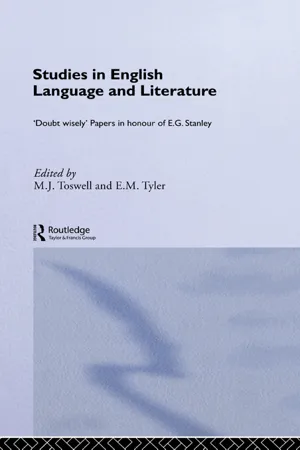
This collection of twenty-nine papers is in honour of E. G. Stanley, Rawlinson and Bosworth Emeritus Professor of Anglo-Saxon at the University of Oxford and Emeritus Fellow of Pembroke College, Oxford. Written by scholars he has supervised, examined or otherwise served as mentor for within the last twenty years, the contributors illustrate the advantages of following John Donne's axiom to 'doubt wisely'. Professor Stanley's own published work has shown the utility of wise scepticism as a critical stance; these papers presented to him apply similar approaches to a wide variety of texts, most of them in the field of Old or Middle English literature. The primary focus of the collection is on the close reading of words in their immediate context, which commonly entails a reconsideration of accepted assumptions. Consequently, new links are created here among the disciplines in medieval studies, based on various combinations of these scholarly applications.
Contributors provide new analyses of such difficult but rewarding fields as Old English metre and syntax, Beowulf, the origins and development of standard English, the definitions of Old English words and their connotations, the styles and themes of Old English poems, Middle English poetry and prose, the post-medieval reception of medieval works and the styles, themes and sources of Old English poetry and prose.
M.J. Toswell is Associate Professor of English at the University of Western Ontario.E.M. Tyler is Lecturer in the Department of English and Related Literature at the Centre for Medieval Studies, University of York.
- 560 pages
- English
- ePUB (mobile friendly)
- Available on iOS & Android
eBook - ePub
About this book
Information
Part 1
On language and linguistics
This thing hath travail’d, and saith, speakes all tongues
And only knoweth what to all States belongs.
Made of th’Accents, and best phrase of all these,
He speakes no language; If strange meats displease,
Art can deceive, or hunger force my tast,
But Pedants motley tongue, souldiers bumbast,
Mountebankes drugtongue, nor the termes of law
Are strong enough preparatives, to draw
Me to beare this: yet I must be content
With his tongue, in his tongue call’d complement:
In which he can win widdowes, and pay scores
Make men speake treason, cosen subtlest whores,
Out-flatter favorites, or outlie either
Jovius, or Surius, or both together.
He names mee, and comes to mee; I whisper, God!
How have I sinn’d, that thy wraths furious rod,
This fellow chuseth me? He saith, Sir,
I love your judgement; Whom doe you prefer,
For the best linguist? And I seelily
Said, that I thought Calepines Dictionarie;
Nay, but of men, most sweet Sir.
(John Donne, ‘Satyre IV: Well; I may now receive’, lines 35–55)
The ‘best linguist’ is for John Donne a dictionary, to be trusted and consulted. But dictionaries are dependent upon the people who make them, review them, and use them, in that the decisions made in the development of the procedures and practices of a dictionary are always subject to question. Here, Toni Healey, editor of the Dictionary of Old English at the Centre for Medieval Studies in the University of Toronto, reconsiders some recent entries, and points out some of the issues they raise (and some which they put to rest). She is concerned throughout with issues of meaning, and with the intelligent determination of what the meaning of a given Old English word is most likely to be. Among the tools she uses in her work are the place-name studies, numismatic analysis, and philology which are questioned and discussed by Fran Colman here. Her recent influential book on Old English onomastics opened a number of areas for discussion; she responds here to some of the questions raised, and raises more wise doubts of her own.
Two papers written in what Donne might call the ‘Pedants motley tongue’ consider the issues of very late Old English, transitional Old English, or very early Middle English. Opening for scholarly analysis issues which have been little considered in the history of the language, Andreas Fischer and Christine Franzen present some of the evidence by which to assess the lexical substitutions (Fischer) and the grammatical, phonological, and syntactic changes (Franzen) evident in twelfth- and early thirteenth-century copies of Old English manuscripts. Their conclusions suggest both that further research in this field is necessary, and that the evidence can be both contradictory and confusing, so that caution when interpreting the results will be necessary.
Finally, two of the papers in this section consider that issue which Donne lists first: ‘th’Accents’. Lynda Mugglestone elucidates a shining example of a rare phenomenon, a nineteenth-century philologist unwilling to make firm and judgmental statements. Her analysis of Alexander Ellis and his wise caution in considering the pronunciation of English from early Middle English to contemporary times shows that one of the most useful ways to approach a subject is its historiography. Laura Wright employs a similar approach in her reconsideration of fourteenth-century London English, presenting the ways in which scholars of the twentieth century have moved from the early and tentative conclusions of Eilert Ekwall to apparently certain statements about the ways in which the modern standard of English usage is based on a London/East Midlands dialect of the fourteenth century. Analysing a collection of guild certificates, some of which are newly discovered and some of which have formed part of the evidence for earlier conclusions, she proposes a possible new way of interpreting this material.
1
Names will never hurt me
INTRODUCTION
What follows aims to illustrate some attempts to ‘doubt wisely’ the use of written records in reconstructing Old English. The discussion is based (though not exclusively) on selected and at times interconnected issues relating to interpretations of spelling-forms of personal names. As Coates remarks, name study is ‘an intensely satisfying discipline’: ‘its subject matter is central to human life, of deep anthropological and social significance, and touching all sorts of other disciplines’.1 As well as onomastics, I will, for instance, be invoking numismatics, philology, and linguistics, and, to some extent, social and political reconstruction. One of the issues addressed specifically concerns the Kentish dialect, and prompts a pursuit of non-onomastic material in relation to an apparent anomaly in the prevailing characterisation of this dialect.
ONOMASTICS AND GENDER
The familiar assumption that Anglo-Saxon (and cognate Germanic) personal names were formed from elements cognate with common words (e.g., Æthelman = æðele ‘noble’ + man ‘man’) allows for a working hypothesis about the potential value of proper-name forms for linguistic reconstruction: just as variation in spellings of common words may be taken as potential evidence for diachronic and diatopic difference, so too may variation in representations of the cognate proper-name elements. On the other hand, Colman sides with proponents of the argument that proper names have reference but not sense (so, Æthelman does not mean ‘noble man’);2 and correlates the purely referential function of proper names with phonological, morphological, and syntactic behaviour different from that of common nouns (see further below on analyses of putative phonological differences).3
On the basis of personal names on late Anglo-Saxon coins, Colman proposes an ‘onomastic system’ for late Old English, characterised in terms of the inventory of units, common words, selected to form Old Engish personal names, and of the possible patterns of combination of such units (as first and/or second elements in dithematic names, and/or as single items in monothematic ones: e.g. Æthelman but not *Manæthel, Manna but not *Æthel).4 It is also crucially characterised in terms of the function of the units: as referential. A description of an onomastic system therefore includes more than whatever principles of proper-name formation may be discerned, and aims, to borrow the words of Coates, ‘to validate the notion proper name as a linguistic category’,5 whose members, once ‘removed’ from the category of common nouns, may go their separate ways.6 (This removal may have been behind Colman’s choice of the Greek-based term, ‘onomastic system’, rather than ‘nomenclature’, which might be taken to include only selection and combination of elements, but exclude function, and the correlative linguistic behaviour.)
Coates is uneasy about the concept of an onomastic system for late Old English:
if some collection of names were systematic, one would expect in principle to be able to write a grammar to describe it. If such a collection were unsystematic, one would write a list. This latter enshrines the spirit of acceptance of Ziffs Law, which states that strings of words of whatever constituency may function as proper names – that is, their namehood renders their constituent structure irrelevant.7
Coates points out, too, (1) that not all personal name-elements theoretically able to combine actually do so in late Old English, e.g. *Beorhtheard; and (2) that by this period, the frequency of established names such as Godwine (noch einmal) suggests that ‘a degree of inertia and fashion crept into the names of Old English. … Any systematicity there might once have been broke down.’8
While I would be the last to disagree with the claim that once a common word is used to form a proper name its ‘namehood’ renders irrelevant its original categorial status, it does not seem to be the case that Old English personal names were formed from common words from all major classes (verbal etyma are rare, and controversial) or from all lexical semantic classes (in so far as these can be classified).9 The first part of Ziff’s Law would seem to be called into question: writing a list of late Old English personal names would suggest, contrary to available data, that any common word at all could be transferred to the function of proper-name element. Do Coates’s other observations undermine the concept of an onomastic system?
They certainly confirm my own tentative responses to Barley’s assertion of the ‘regularity of the Anglo-Saxon naming system’ (the definite noun phrase here raising its own, but unaddressed, questions about the possibility of different systems for different periods, which I cannot detail here).10 But any system can have gaps. The formation of Old English personal names is analogous to the formation of common words by derivational morphology. Derivational morphology is systematic, but not all potential inputs participate in a given rule. In English, for instance, while the suffix -ness attaches to adjectives to form abstract nouns, not all adjectives are inputs. So, too, while -heard is attested as an Old English personal name deuterotheme, not all protothemes combine with it (e.g. see *Beorhtheard). And then, the output of a derivational rule may become lexicalised, as in instances of compound-obscuration, and/or of reanalysis of affixes as part of roots (witness, as always, the cl...
Table of contents
- Cover Page
- Half Title page
- Title Page
- Copyright Page
- Contents
- List of Contributors
- Preface and acknowledgments
- List of abbreviations
- Introduction
- Part I On language and linguistics
- Part II On words and phrases
- Part II On the interpretation of a single text
- Part IV On taxonomies, genres, and sources
- Part V On Assumptions
- Index
Trusted by 375,005 students
Access to over 1.5 million titles for a fair monthly price.
Study more efficiently using our study tools.
Frequently asked questions
Yes, you can cancel anytime from the Subscription tab in your account settings on the Perlego website. Your subscription will stay active until the end of your current billing period. Learn how to cancel your subscription
No, books cannot be downloaded as external files, such as PDFs, for use outside of Perlego. However, you can download books within the Perlego app for offline reading on mobile or tablet. Learn how to download books offline
Perlego offers two plans: Essential and Complete
- Essential is ideal for learners and professionals who enjoy exploring a wide range of subjects. Access the Essential Library with 800,000+ trusted titles and best-sellers across business, personal growth, and the humanities. Includes unlimited reading time and Standard Read Aloud voice.
- Complete: Perfect for advanced learners and researchers needing full, unrestricted access. Unlock 1.5M+ books across hundreds of subjects, including academic and specialized titles. The Complete Plan also includes advanced features like Premium Read Aloud and Research Assistant.
We are an online textbook subscription service, where you can get access to an entire online library for less than the price of a single book per month. With over 1.5 million books across 990+ topics, we’ve got you covered! Learn about our mission
Look out for the read-aloud symbol on your next book to see if you can listen to it. The read-aloud tool reads text aloud for you, highlighting the text as it is being read. You can pause it, speed it up and slow it down. Learn more about Read Aloud
Yes! You can use the Perlego app on both iOS and Android devices to read anytime, anywhere — even offline. Perfect for commutes or when you’re on the go.
Please note we cannot support devices running on iOS 13 and Android 7 or earlier. Learn more about using the app
Please note we cannot support devices running on iOS 13 and Android 7 or earlier. Learn more about using the app
Yes, you can access Studies in English Language and Literature by M. J. Toswell,E. M. Tyler in PDF and/or ePUB format, as well as other popular books in Languages & Linguistics & Linguistics. We have over 1.5 million books available in our catalogue for you to explore.