eBook - ePub
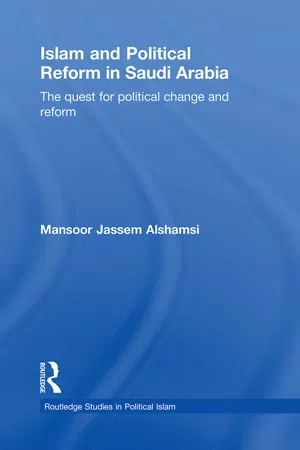
Islam and Political Reform in Saudi Arabia
The Quest for Political Change and Reform
- 304 pages
- English
- ePUB (mobile friendly)
- Available on iOS & Android
eBook - ePub
Islam and Political Reform in Saudi Arabia
The Quest for Political Change and Reform
About this book
This book examines the link between Islamic thought/jurisprudence on the one hand and political action on the other. It shows how reformism is deeply rooted in Islamic tradition and how Sunni scholars have become activists for change in Saudi Arabia.
Information
1
Introduction
This book is based on the author’s PhD dissertation, titled ‘The Discourse and Performance of the Saudi Sunni Islamic Reformist Leadership: 1981–2003’, brought up to date to mid-2006. It investigates the discourse and performance of a contemporary domestic Saudi Sunni Islamic reformist leadership of three ‘new generation’ ‘ulama: Safar al-Hawali, Salman al-Oudah and Nassir al-Omar. As a scholarly Sunni Islamic reformist group, they are a political force that has sought political change and reform in Saudi Arabia through accommodation. Using primary sources, the author examines the development, phases and dimensions of the political struggle of the reformist leadership from 1981 to 2006.
The primary objective of this book is to investigate the reformist leadership’s concepts on the question of political change and reform, and to understand the leadership’s dominant policy formation paradigm. This is essential for understanding the way in which the reformist leadership addresses the question of political change and reform, and the consequences of raising this question, which is important in understanding the policy applied to this end.
The author examines the discourse, in its wider sense, of the reformist leadership since 1981. In this discourse, the question of political change and reform was born, and arguments and a number of policy formation models are defined in the reformist leadership’s literature. This has shown Sunni Islamic fiqh [Law and Jurisprudence], in general, and fiqh al-siyasa al-shar‘iyah [Islamic Political Jurisprudence], in particular, as the foundation concepts for the three scholars. The reformist leadership’s fiqh is connected to a wider examination of Sunni Islamic jurisprudence and political juristic works, both classical and contemporary, and the author explains his understanding of the discourse and performance of the reformist leadership. This study endeavours to improve understanding by showing how the reformist leadership has taken a leading role in the movement for political change and reform. The reformist leadership’s relationship with the Monarchy, in particular, is defined and examined. It is concluded that al-mudafa‘a [dimension of countering], as a policy, has emerged as the dominant style of these scholars through the last two decades, indicating a two-dimensional policy of countering and appeasement, applied in a dynamic, systematic and flexible manner towards internal and external players.
Background
In contemporary Saudi Arabia, a new generation of ‘ulama [plural of ‘alim, one who knows, a scholar of Islam]1 is seeking political change and reform through ‘accommodation’ and not through revolution.2 This raises the decisive role of Sunni Islamic fiqh [Law and Jurisprudence], in general, and fiqh al-siyasa al-shar‘iyah [Islamic Political Jurisprudence], in particular, as key factors in how these ‘ulama behave politically and shape their concepts.
This domestic Saudi Sunni Islamic leadership comprises of three ‘new generation’ ‘ulama: Shaikhs Safar Ibn Abd al-Rahman al-Hawali, Salman Ibn Fahd al-Oudah and Nassir Ibn Sulayman al-Omar (hereinafter the reformist leadership, or leadership). Their political behaviour and discourses highlight key issues in dealing with political change and reform in the Kingdom of Saudi Arabia. Proceeding directly to this group helps draw distinctions that, in turn, provide initial direction in studying political change and reform. The three leaders pursue an academic approach and place emphasis on their intellectual stance within the Sunni Islamic framework. Studying at Islamic schools, known in Saudi Arabia as al-ma‘ahid al-‘ilmiyah [Islamic scientific schools],3 they undertook their graduate and postgraduate studies at Saudi Islamic universities.
The Sunni Islamic relationship between the three scholars is intellectual and organizational in nature. The intellectual dimension refers to the common core concern of the three scholars that al-hukm bima anzala Allah [applying the Islamic Law]must be applied by both state and society as a matter of iman [faith]. Al-Hawali, in particular, developed this intellectual dimension in his discourses of the 1980s; which gives him a leading and influential intellectual role in this triangular relationship. The organizational dimension refers to the character of the political Sunni Islamic struggle the three scholars have maintained over the last two decades; a civic–civil illustration of their struggle. Al-Oudah and al-Omar were mainly involved in developing the organizational base in their discourses of the 1980s and 1990s, and play a leading and influential organizational role in this relationship.
Al-Hawali was born in 1372H/1952AD,4 and studied at al-Ma‘had al-‘Ilmi [an Islamic school]; reading for his bachelor’s degree at the Islamic University of al-Madina. He gained his Master’s degree in 1981 and his PhD degree in 1985, at the Islamic University of Umm al-Qura in the Holy City of Makkah. Becoming a professor at the same university, he later became Head of the Department of al-‘aqidah [Islamic creed, faith, tenet, doctrine, belief].
Al-Oudah, born in 1376H/1955AD, also studied at al-Ma‘had al-‘Ilmi. He became a student at the College of Arabic Language for two years, and then studied at the College of Shari‘ah. On graduation, he became a teacher at al-Ma‘had al-‘Ilmi and taught there for four years, whereafter he entered the Al-Imam Muhammad Ibn Sa‘ud Islamic University, al-Qassim branch, where he studied for his Master’s degree in the Department of Sunnah. Al-Oudah gained his Master’s degree in 1408H/1988AD at the Imam Muhammad Ibn Sa‘ud Islamic University, where he registered his PhD dissertation while still a teaching assistant at the University. In 2004, al-Oudah gained his PhD degree.
Al-Omar, born in 1372H/1952AD, finished his secondary schooling in 1390H/1970AD at al-Ma‘had al-‘Ilmi. He took his first university degree in 1394H/1974AD at the College of Shari‘ah, and then his Master’s degree in 1979 at the Al-Imam Muhammad Ibn Sa‘ud Islamic University, and his PhD degree, gained in 1984, from the same university. In 1984, al-Omar became a teaching assistant and later a professor at the College of Usul5 al-Din6 [Foundations of Religion].
The theses and dissertations by these three scholars are published in more than one edition, which indicates their significance. They also supervised postgraduate students and conducted a number of studies while teaching at universities. The Sunni Islamic scholarly sphere laid the foundation for their movement, by raising questions of political change and reform from two main aspects: work in the academic environment and al-da‘wah al-islamiyah or da‘wah [Islamic call].7 While postgraduate students, and later professors during the 1980s, they decided to become du‘ah [Islamic callers], and to progress towards high scholarly Sunni Islamic status by becoming ‘ulama.
While the reformist discourses of the three scholars were developing and growing at universities, mosques and public places, important regional events occurred in 1990. Iraq invaded Kuwait in August of that year, and the Saudi Monarch decided to accept foreign forces, mainly American, to confront the Iraqi threat to the Kingdom. Both the Iraqi invasion and the Monarch’s decision were criticized and condemned by the reformist leadership, who disagreed strongly with the policy of the Monarchy.
The important discourses of al-Hawali, al-Oudah and al-Omar, dealing with these events were unique, and the reformist leadership questioned Saudi governmental decisions, directly and indirectly, through recorded lectures that reached vast numbers of people. The questions and critique were submitted as studies to the highest state Islamic institution, Hay’at Kibar al-‘Ulama [The Council of the Senior ‘Ulama].
Al-Hawali, al-Oudah and al-Omar continued delivering lectures to the public during, and after, these regional events, with lectures not only restricted to the subject of the Iraqi invasion of Kuwait and the Monarch’s decision to receive American forces, but also included topics covering various matters within the Sunni Islamic juristic framework. By 1991, the question of political change and reform had become explicit, with not only the Monarch’s decision to receive American forces being questioned, but also Saudi domestic and foreign policies in general.
Al-Hawali, al-Oudah and al-Omar comprise a distinguished younger generation scholarly core, within the wider Saudi contemporary domestic Sunni Islamic movement, demanding political change and reform. This wider movement consists of senior and official ‘ulama, academics, technocrats and professionals, who voice the desire for political change and reform in the Kingdom. The wider grouping of Saudi Sunni Islamic reformers represent various regions and provinces in the Kingdom, and includes persons educated in Saudi Arabia and others educated in the West. This domestic Saudi movement, including the reformist leadership, approached the Monarchy through the submission of two petitions: one in 1991 and the other in 1992, which demanded political change and reform based on shari‘ah [Islamic Law].
The first petition has since become known as the Kitab Shawal [Letter of Shawal] or Kitab al-‘Ulama.8 It was submitted to the King’s office in the month of Shawal 1411H/May 1991AD, during the Second Gulf War. Kitab Shawal was also called the Address of the ‘Ulama as many of the signatories were ‘ulama.
In Muharram 1413H/July 1992AD, a wider Saudi Sunni Islamic circle, with 111 signatories, including the leadership, submitted the second petition, Mudhakkirat al-Nasihah [Memorandum of Advice],9 which required political change and reform. The Memorandum of Advice was comprehensive in these demands, and raised ten major topics, including the economy, the societal and administrative system, human rights, the judiciary and the enactment of law and regulations, and foreign policy, with each discussed from an Islamic perspective. The role of the ‘ulama, in a state that applies shari‘ah [Islamic Law], was also raised, and by examining aspects of the topics, insights were gathered on rights, or performance, the Monarchy was failing to deliver. The Monarch was not pleased by earlier discourses, nor receptive to either petition, and particularly not to the Memorandum of Advice.
The two petitions were important developments in contemporary Saudi political history, and were in general, and the Memorandum of Advice in particular, firmly constructed. They presented clear Sunni Islamic-based demands for political change and reform. Reformist suggestions and ideas were proposed to bring about change and reform to domestic and foreign policy. It was argued that the ruling authority and state apparatus should be questioned, checked and held to account on constitutional and institutional bases, and required that the Monarchy should introduce institutional, constitutional and legal-based reforms, with the ruling authority subject to Sunni Islamic Law. The demands for change, and the reform advocated, provided a basis for the transformation of the Monarchy into a constitutional Sunni Islamic Monarchy.
The thinking behind the two petitions needs to be examined. The author sees al-Hawali, al-Oudah and al-Omar as consistent Sunni Islamic reformists leading forward a process of political change and reform. Within ...
Table of contents
- Routledge studies in political Islam
- Contents
- Author’s notes
- 1 Introduction
- 2 Context
- 3 The Sunni fiqh
- 4 Further perspectives on the Sunni fiqh
- 5 Intellectual interaction
- 6 Political struggle
- 7 Countering policy in the 1990s
- 8 Petitions and challenges
- 9 The Monarchy and support
- 10 Appeasement
- 11 External focus
- 12 Political realism
- 13 Conclusion
- Appendices
- Glossary
- Notes
- Selected references
- Index
Trusted by 375,005 students
Access to over 1.5 million titles for a fair monthly price.
Study more efficiently using our study tools.
Frequently asked questions
Yes, you can cancel anytime from the Subscription tab in your account settings on the Perlego website. Your subscription will stay active until the end of your current billing period. Learn how to cancel your subscription
No, books cannot be downloaded as external files, such as PDFs, for use outside of Perlego. However, you can download books within the Perlego app for offline reading on mobile or tablet. Learn how to download books offline
Perlego offers two plans: Essential and Complete
- Essential is ideal for learners and professionals who enjoy exploring a wide range of subjects. Access the Essential Library with 800,000+ trusted titles and best-sellers across business, personal growth, and the humanities. Includes unlimited reading time and Standard Read Aloud voice.
- Complete: Perfect for advanced learners and researchers needing full, unrestricted access. Unlock 1.5M+ books across hundreds of subjects, including academic and specialized titles. The Complete Plan also includes advanced features like Premium Read Aloud and Research Assistant.
We are an online textbook subscription service, where you can get access to an entire online library for less than the price of a single book per month. With over 1.5 million books across 990+ topics, we’ve got you covered! Learn about our mission
Look out for the read-aloud symbol on your next book to see if you can listen to it. The read-aloud tool reads text aloud for you, highlighting the text as it is being read. You can pause it, speed it up and slow it down. Learn more about Read Aloud
Yes! You can use the Perlego app on both iOS and Android devices to read anytime, anywhere — even offline. Perfect for commutes or when you’re on the go.
Please note we cannot support devices running on iOS 13 and Android 7 or earlier. Learn more about using the app
Please note we cannot support devices running on iOS 13 and Android 7 or earlier. Learn more about using the app
Yes, you can access Islam and Political Reform in Saudi Arabia by Mansoor Jassem Alshamsi in PDF and/or ePUB format, as well as other popular books in Politics & International Relations & Peace & Global Development. We have over 1.5 million books available in our catalogue for you to explore.