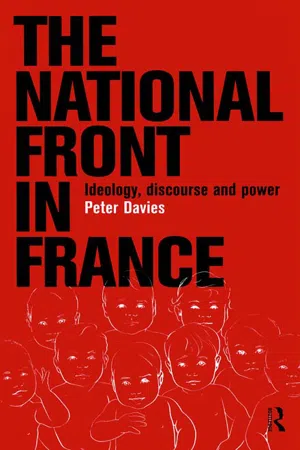
- 288 pages
- English
- ePUB (mobile friendly)
- Available on iOS & Android
eBook - ePub
About this book
This provocative and non-polemic study explores the value system of the National Front movement in France, and explains the way in which the movement's ideology has been formulated and articulated in the 1980s and 1990s. Also discussing the crucial role of Le Pen, this book provides a fascinating enquiry into the most controversial political party in contemporary France.
1
The contours of FN nationalism
Influences and emphases
The French identity is a priceless treasure.
(Bruno Mégret, L'Alternative nationale)
The Great Change.
(Title of Le Pen's publicity video for the 1997 Legislative elections)
The Front National is the political expression of an authentic current of thought…The intellectual approach presented by the Front National is a synthesis built around three main poles: identity, liberty and power.
(FN handbook, Militer au front)
This chapter focuses on the nationalism of the FN – the party's nationalist ideology and discourse. It is important first to define the two terms that we will be using throughout the chapter. ‘Ideology’ can be defined as the ideas at the basis of a political system – in this context, the nationalism of the FN. As Thompson argues, ideology can be viewed as ‘a purely descriptive term: one speaks of “systems of thought”, of “systems of belief”, of “symbolic practices” which pertain to social action or political projects’.1 It must be noted, however, mat the FN disputes the fact that it has an ‘ideology’ at all and actually uses the word in an extremely pejorative manner. Instead it prefers to say that it has a ‘doctrine’.2 ‘Doctrine’ for the FN connotes a body of ‘common sense’, ‘concrete’ belief; ‘ideology’, on the other hand, is viewed as ‘abstract’, ‘scientific’ and associated with the left. The position of the party is as follows: ‘The Front National has presented itself from the start as the political affirmation of the national, popular and social right… the quiet presentation of incontestable truths’. However, even though commentators such as Bihr and Cambadélis and Osmond argue that it is very difficult to actually pin down and define the essence of FN ideology – Bihr talks about the ‘political and ideological heterogeneity’ of the FN, while Cambadélis and Osmond speak of the ‘plurality’ of FN ideas and a ‘changing discourse’ – it will soon become clear that there is a set of discernible ideas at the base of the party's nationalism; and hence we will use the term ‘ideology’ in relation to the FN.3
‘Discourse’ on the other hand can be defined as ‘language’ and ‘vocabulary’ – in this case, the language and vocabulary utilised by the FN in parading its nationalist beliefs and ideology. In a sense discourse is the language in which a political party expounds its doctrine, formulates its policies, and crafts its rhetoric. As Eagleton notes:
All discourse is aimed at the production of certain effects in its recipients and is launched from some tendentious ‘subject position’; and to this extent we might conclude with the Greek Sophists that everything we say is really a matter of rhetorical performance with which questions of truth or cognition are strictly subordinate. If this is so, then all language is ‘ideological’.4
By necessity, therefore, we will be interested in what Bruno Mégret – Le Pen's deputy at the top of the FN – has described as the ‘vocabulary battle’, and in the way in which the FN expounds its doctrine and policies at both the national and regional level. We should also be aware of the findings of Souchard et al, who have added to our understanding of the FN in their analysis entitled, aptly, Le Pen, Les mots. They have dissected the language of the FN leader and examined the individual words that he uses in set-piece speeches. Their conclusion is that Le Pen's discourse is coherent to a very significant extent and does, in the end, amount to a ‘true ideological system’.5 Although the current study does not seek to be as ‘scientific’ as this 1997 enquiry, it will focus on many of the themes and political ideas that Souchard claims are intrinsic to FN discourse: among which are nation, nature, culture, hierarchy, work, family and country.
Bihr, in his provocative study of the FN, highlights other aspects of the FN's discourse. He is particularly interested in the type of discourse put forward by Le Pen and the FN, stressing its efficiency, but also its irrationality and internal contradictions. His main contention is that Le Pen's seductive charm is far more impressive than his argumentation and that, in essence, he actually perverts language for his own ends. This perhaps is a point of fundamental significance. The content of FN discourse is of course interesting, but maybe the style of it is of even greater, and more substantive, importance. Bihr's conclusion seems to be that Le Pen's discourse is flawed but still, somehow, attractive to many French voters. It is in this sense that it is viewed as the symptom of a serious cultural crisis.6
It is interesting that Bihr refers to the linkage between the discourse of Le Pen and the French electorate. Even though this study is about the ideas of the FN, and not the sociology of its vote, it is important at this early stage in our enquiries to be aware of this relationship. The specific point that Bihr appears to be making is that people are liable to vote FN even if they suspect that the discourse of the party is incoherent or somehow ‘wrong’. This is a vital point. It leads us to believe that the motivations of FN voters are various. Indeed, it would be true to say that while some French people do commit themselves to the FN on account of the ideas and policies it embraces, others – perhaps a significant minority – vote for the party in spite of the party's discourse and ideology, or are even completely ignorant of it. It could be argued that for these people it is anger at, and frustration with, the political system which provokes them into voting for the FN – a significantly vociferous ‘anti-system’ party. Thus, while many writers have conducted in-depth investigations into the nature and make-up of the FN electorate – and concluded that it is both cross-sectional and, increasingly, popular and working class7 – for us the key issue remains the significance of discourse and ideology in determining voting patterns: is the FN vote based, at bottom, on ‘negative’ protest or the ‘positive’ appeal of the party's ideas?
The evidence here is mixed. It is of course manifestly the case that the FN styles itself as a protest party – as a party apart from the reigning political system, and actually hostile to it. Moreover, it has significant criticisms of the Fifth Republic as a political regime and of the parties – both on the left and the right – that operate within it. The feeling is that many French voters are attracted to the FN precisely because it is new, different and not a ‘traditional’ political party, and in this sense it has succeeded the PCF as the main receptacle of the protest vote. Girardet in his analysis talks about a party ‘contesting and protesting’; likewise Perrineau argues that the FN actually thrives on ‘anger’ and uses this to its political advantage.8 The inference to be drawn here is that individuals who vote for the party are not opting in ‘favour’ of the policies and political ideas embodied by it, but rather, choosing to vote ‘against’ the political status quo in France.
If this is true up to a point, it must also be recognised that, as this whole study seeks to demonstrate, the FN does possess a reasonably coherent political programme. Not only this, but contrary to the line of thought that views the FN as both ‘fascist’ and devoid of political principles, the party does appear to have a significant appeal precisely because of its ideas. Indeed, data from recent elections casts important light on this issue. For example, an exit poll during the 1988 Presidential elections revealed that 76 per cent of Le Pen's voters opted for him because of his ideas, while only 57 per cent of Barre voters and 46 per cent of Chirac loyalists said that the ideas personified by their candidate motivated them.9 Although we should not read too much into these figures – the other possible motivations, ‘personality’ and ‘party loyalty’, are significant variables in the equation – there is a strong indication here that ideas are important to prospective FN voters and we should not dismiss the FN as a movement with no positive appeal.
Similarly, an opinion poll during the 1984 European elections – a landmark stage in the rise of the FN – revealed the chief motivations to vote of FN supporters. The top five motivations to vote made interesting reading: supporting the idea of reducing immigration (64 per cent), opposing left-wing government (33 per cent), the personality of Le Pen (31 per cent), not wanting to vote for Simone Veil (26 per cent), and to vent hostility towards the ‘classic opposition parties’, the UDF and RPR (22 per cent). While motivations 2, 4 and 5 are all ‘negative’ and about protest, 1 is about policy and 3 about personal charisma rather than political ideas. This of course is just a snapshot of opinion – albeit at a formative stage in the FN's political development – but it does suggest that both protest and policy are significant dimensions to the FN's electoral attraction, and thus when we refer to the party's electorate we should not jump to hasty conclusions. Of course the FN poses as the protest party par excellence, but as this study unfolds we should not forget that vital constituencies within the French electorate – small businessmen, farmers and the unemployed, to name but three – are attracted to the FN for positive reasons and because the brand of nationalism upheld by the party is in some sense seductive.10
This chapter will now introduce and outline the main contours of the FN's nationalism, with Chapters 2, 3 and 4 building upon this initial discussion. At this specific juncture we will pay attention to two particular elements: change and evolution, and the ‘regional’ dimension to the party's discourse.
THE ‘NATIONAL’ FN
Change and evolution: a static or evolving nationalism?
This section seeks to examine the evolution of FN nationalism since the founding of the party in 1972. In so doing it will attempt to show how, to what extent and why the ideology and discourse of the FN has evolved over three decades. It will also, by implication, serve as a general introduction to FN nationalism. In more specific terms, there is an important question at the heart of this section: if there have been changes and evolutions in the FN's nationalism, do they relate to the core ideological beliefs of the party or the way in which these beliefs have been displayed and expounded to the wider public?
It needs be said at the outset that political parties are certainly not monolithic, static or unchanging entities. In the case of the FN there is plenty of evidence to show that the membership, electorate, organisational structures, and also the popularity, of the party have all evolved dramatically since 1972.11 It should not surprise us, therefore, if there have also been, at the same time, significant evolutions in ideology and discourse. On this issue Birenbaum points out that on scope and depth alone, the political programme of the FN has changed; he contrasts the two-page manifesto of 1973 with the ‘more detailed’ brochure produced ten years later. That said, we should also note the view of Shields, who has stressed the element of continuity in FN thinking. He says that Le Pen's manifesto for the 1988 Presidential elections was ‘a distillation of the programme on which he and his party had campaigned from the moment they first arrived on the national stage in 1984’.12
It is certainly possible to identify a set of core beliefs that have prevailed since 1972. Birenbaum argues that the FN has viewed it as a ‘priority’ to stay disciplined in ideological terms, and that the aim has been to ‘conceive and diffuse a consistent political doctrine’. However, we must also acknowledge that the FN has not felt itself limited or constrained by its ideology: Hayward, for instance, has stated that the party's ideological appeal had a ‘more than circumstantial and protest bias’, while Shields has claimed that at bottom the FN represents ‘less an ideological crusade than an opportunistic political movement’.13
We must also recognise mat over three decades the discourse of the party – the language in which it has expounded its nationalism – has evolved significantly and has responded to changing contexts. Different writers have differing perspectives on this matter. On a general level, Jenkins and Sofos focus on globalisation. They argue that even though the recent trend towards globalisation has been strong, the nation as a concept and nationalism as an ideology have maintained a remarkable resilience. In this sense one could argue that moves towards globalisation have given a renewed impetus to nationalist movements like the FN. Bourseiller, on the other hand, has argued that the Front's political line has evolved in line with ‘events and the little phrases of Jean-Marie Le Pen’; while Soudais claims that it was the end of Communism (c. 1989–92) which enabled the FN to return to its true nationalist roots. For his part Birenbaum notes another crucial change in FN discourse: the move f...
Table of contents
- Front Cover
- The National Front in France
- Title Page
- Copyright
- Dedication
- Contents
- List of illustrations
- Acknowledgements
- Introduction
- 1 The contours of FN nationalism: influences and emphases
- 2 ‘The nation’ in FN ideology: ‘France for the French’
- 3 ‘Threats’ to the nation: the fear of French decline
- 4 Nationalism in a local context: Toulon, Orange, Marignane and Vitrolles
- Conclusion
- Notes
- Bibliography
- Index
Trusted by 375,005 students
Access to over 1.5 million titles for a fair monthly price.
Study more efficiently using our study tools.
Frequently asked questions
Yes, you can cancel anytime from the Subscription tab in your account settings on the Perlego website. Your subscription will stay active until the end of your current billing period. Learn how to cancel your subscription
No, books cannot be downloaded as external files, such as PDFs, for use outside of Perlego. However, you can download books within the Perlego app for offline reading on mobile or tablet. Learn how to download books offline
Perlego offers two plans: Essential and Complete
- Essential is ideal for learners and professionals who enjoy exploring a wide range of subjects. Access the Essential Library with 800,000+ trusted titles and best-sellers across business, personal growth, and the humanities. Includes unlimited reading time and Standard Read Aloud voice.
- Complete: Perfect for advanced learners and researchers needing full, unrestricted access. Unlock 1.5M+ books across hundreds of subjects, including academic and specialized titles. The Complete Plan also includes advanced features like Premium Read Aloud and Research Assistant.
We are an online textbook subscription service, where you can get access to an entire online library for less than the price of a single book per month. With over 1.5 million books across 990+ topics, we’ve got you covered! Learn about our mission
Look out for the read-aloud symbol on your next book to see if you can listen to it. The read-aloud tool reads text aloud for you, highlighting the text as it is being read. You can pause it, speed it up and slow it down. Learn more about Read Aloud
Yes! You can use the Perlego app on both iOS and Android devices to read anytime, anywhere — even offline. Perfect for commutes or when you’re on the go.
Please note we cannot support devices running on iOS 13 and Android 7 or earlier. Learn more about using the app
Please note we cannot support devices running on iOS 13 and Android 7 or earlier. Learn more about using the app
Yes, you can access The National Front in France by Peter Davies in PDF and/or ePUB format, as well as other popular books in History & World History. We have over 1.5 million books available in our catalogue for you to explore.