eBook - ePub
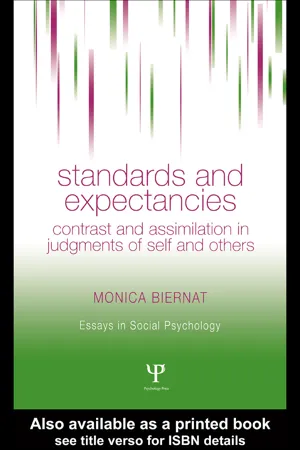
Standards and Expectancies
Contrast and Assimilation in Judgments of Self and Others
- 225 pages
- English
- ePUB (mobile friendly)
- Available on iOS & Android
eBook - ePub
About this book
This book examines how standards and expectancies affect judgments of others and the self. Standards are points of comparison, expectancies are beliefs about the future, and both serve as frames of reference against which current events and people (including the self) are experienced. The central theme of the book is that judgments can be characterized as either assimilative or contrastive in nature. Assimilation occurs when the target of evaluation (another person, the self) is pulled toward or judged consistently with the standard or expectation, and contrast occurs when the target is differentiated from (judged in a direction opposite) the comparative frame. The book considers factors that determine whether assimilation versus contrast occurs, and focuses on the roles of contextual cues, the self, and stereotypes as standards for judging others, and the roles of internalized guides, stereotypes, and other people for judging the self.
Information
Publisher
Psychology PressYear
2012Print ISBN
9781138006003
9781841690681
Edition
1eBook ISBN
9781135432966
CHAPTER 1
Standards and Expectancies: An Introduction and Overview
It is almost a truism to say that life is relative—that our experiences and judgments of people, things, and events occur against the backdrop of some comparative standard or frame of reference. My claims that “I'm hungry” or “my daughter is brilliant” or “that haircut is ghastly” are all made with reference to some standard. Indeed, in communicating these things, I assume that you have at least some notion of the standards I have in mind—the contextual background—and can interpret my claims accordingly. Thus, you can pretty readily assume that my hunger level does not require medical attention, that my 5-year-old's brilliance does not qualify her for early admission to an Ivy League school, and that the haircut is unlikely to frighten away small children and animals. Note that this occurs even though the judgment appears absolute—“she's brilliant!”—for such statements imply more x (more brilliance) than others, and they are therefore inherently comparative (Huttenlocher & Higgins, 1971).
This theme of relativity has been emphasized by a great number of researchers who have described the wide variety of sources or types of standards that may be used to define and describe our everyday encounters with the world. Beginning with research on such diverse areas as psychophysics (Helson, 1947, 1964; Parducci, 1956; Postman & Miller, 1945; Stevens, 1957; Volkmann, 1951; Wever & Zener, 1928) and the self (James, 1890/1948), psychologists have long emphasized the relativity of many forms of intra- and interpersonal experience. That judgment is relative or comparative appears in research on attitudes (Sherif & Hovland, 1961) and decision making (Houston & Sherman, 1995; Kahneman & Miller, 1986), as well as in two domains that are highlighted in this book—person perception (Higgins & Lurie, 1983) and self-evaluation (Festinger, 1954a).
Indeed, this book will focus primarily on the role of judgment standards and expectations in evaluations of others and the self. One central theme pervades the book— namely, that the outcome of a comparative process can be conceptualized in terms of either assimilation or contrast. Assimilation occurs when the target of evaluation (e.g., another person, the self) is pulled toward or judged consistently with the standard or expectation, and contrast occurs when the target is differentiated from (judged in a direction opposite) the comparative frame. By “judgment,” I typically refer to a connotative evaluation (e.g., a rating on some trait dimension) but also to outcomes that are affective (such as mood or self-esteem) or behavioral in nature as well.
In person perception, assimilation is reflected in studies in which a target is judged consistently with primed trait adjectives (e.g., Higgins, Rholes, & Jones, 1977), and contrast is reflected in the finding that a member of a stereotyped group is judged to have less of a stereotypical trait than a member of the contrasting group (Biernat & Kobrynowicz, 1997). In the domain of self-evaluation, assimilation can be seen when one reacts to an upward social comparison with positive self-evaluations (the self assimilates to a “superstar”; Lockwood & Kunda, 1997), and contrast when one responds with increased sadness upon considering how the actual self is discrepant from an ideal self-state (Higgins, 1987). Behavioral assimilation can be seen when one engages in actions designed to meet self-standards (Carver & Scheier, 1998) or in health behaviors that conform with favorably viewed “risk images” (Gibbons & Gerrard, 1995, 1997), and behavioral contrast is evident when one behaves or performs counter to a primed exemplar (Dijksterhuis, Spears, Postmes, Stapel, Koomen, van Knippenberg, & Scheepers, 1998) or group stereotype (Schubert & Häfner, 2003). One of the key questions asked throughout this book will be, when does assimilation occur in social judgment, and when does contrast?
A secondary theme of the book is the constructivist nature of comparisons and judgment. Individuals often have leeway to pick and choose their reference points, drawing from a broad knowledge base as well as the specifics of a situation or context to subjectively define evaluative standards (Kahneman & Miller, 1986; Miller & Prentice, 1996). This is particularly evident in the literature on social comparison, which paints an image of the “active comparer,” who may selectively choose a target of comparison (or even construct a target of comparison) to meet particular needs (e.g., see Goethals, Messick, & Allison, 1991). On the other hand, the literature on contextual priming would seem to suggest that perceivers are subject to the whims of context; constructs may be activated without awareness and affect our judgments through the basic mechanism of knowledge accessibility (Higgins, 1996). Even social comparisons may be thrust upon us—they may occur unintentionally and without awareness (Gilbert, Giesler, & Morris, 1995; Mussweiler, Rüter, & Epstude, 2004; Stapel & Blanton, 2004; Wood, Michela, & Giordano, 2000). The extent to which perceivers control the environment and the comparative standards they use will be highlighted throughout this volume.
Before going further, some working definitions of the terms standards and expectancies should be offered. Higgins (1990) provides a useful definition of the first construct: “a standard is a criterion or rule established by experience, desires, or authority for the measure of quantity and extent, or quality and value” (p. 302). A social standard in particular may be thought of as “any attribute of a person or of a collection of people that serves as a point of comparison for an individual” (Miller & Prentice, 1996, p. 800). Standards are assumed to take a variety of forms. For example, Higgins (1990; Higgins, Strauman, & Klein, 1986) describes three general types: (1) factual standards (beliefs about the attributes of others), (2) guides (“criteria of excellence or acceptability”; Higgins et al., 1986, p. 30), and (3) possibilities (standards regarding what will, could, or might exist).
In this volume, the “factual standards” considered include the self as a standard for judging others and individual others as standards for judging the self, as well as group stereotypes as a source of both self- and other-judgment. Additionally, I will consider context—information made accessible in the immediate judgment setting—as a source of standards in both self- and other-judgment (another type of “factual” standard). “Guides” and “possibilities” will be reflected in the examination of internalized representations of goals/values/“oughts” as standards for judging the self. It is worth noting, however, that “factual standards” may also function as “guides.” For example, group stereotypes may represent not only our beliefs about what groups are like but also our prescriptions regarding what group members should be like (e.g., see Hogg & Abrams, 1988; Rabbie & Horwitz, 1988; Wilder & Shapiro, 1991). In this sense, standards for judging self and others can be viewed as norms that include both descriptive and prescriptive components (Miller & Prentice, 1996; see also Cialdini, Kallgren & Reno, 1991).
Expectancies have also been broadly defined as “beliefs about a future state of affairs …subjective probabilities linking the future with an outcome at some level of probability ranging from merely possible to virtually certain” (Olson, Roese, & Zanna, 1996, p. 211). This definition incorporates the notion of anticipation more than evaluation or measurement, but expectancies are nonetheless similar to standards in that they are mental constructs, based on both memory and current experience, that provide the backdrop against which outcomes and events are experienced. Thus, a social stereotype can be viewed as an expectation about the likely attributes of a group of people (e.g., Hamilton & Sherman, 1994) or as a judgment standard against which individual group members are evaluated (Biernat, Manis, & Nelson, 1991; Biernat & Manis, 1994). Similarly, one's goals and aspirations can be conceptualized in terms of perceived probability or expectation of future success (e.g., Atkinson, 1957; Festinger, 1942; Lewin, Dembo, Festinger, & Sears, 1944) or as future (possible) self-standards (Higgins, 1990; Markus & Nurius, 1986; Schlenker, 1985).
Furthermore, standards and expectancies can be either met or not met, confirmed or disconfirmed, with predictable consequences. For example, the violation of an expectation is likely to produce a negative affect, deeper (more systematic) subsequent processing, attributional search, reduced certainty, and a more explicit knowledge or awareness of the expectation (Olson et al., 1996). Unmet standards are likely to produce at least some of the same effects (e.g., see Stangor & McMillan, 1992; Bettencourt, Dill, Greathouse, Charlton, & Mulholland, 1997; and Biernat, Vescio, & Billings, 1999; Higgins, 1987 on self-evaluation). For these reasons, I will often use the terms “standards” and “expectancies” interchangeably.
As will become apparent throughout the book, however, standards are often viewed as conducive to contrast effects (e.g., targets are judged relative to and therefore different from the standard), whereas expectations are typically viewed as conducive to assimilation (e.g., targets are perceived in line with expectations, because the expectation serves as an interpretive frame; see, e.g., Manis & Paskewitz, 1984a). But this book will make clear that things are not this straightforward or simple, as standards can lead to assimilation (witness anchoring effects), and expectations can lead to contrast as well (as in judgmental extremity produced by expectancy violation). In any case, standards and expectancies are similar in that targets and events are experienced and evaluated in reference to them.
Organization and Overview
This book is organized into three broad sections. The first section includes two chapters that describe basic principles and models of assimilation and contrast. Specifically, Chapter 2 focuses on the role of contextual cues in affecting judgment outcomes and describes some ten f actors that have been found to affect whether assimilation or contrast is the dominant pattern in social judgment. This chapter takes a “piecemeal” or bottom-up approach, focusing on empirical findings rather than theoretical accounts of judgment outcomes. Chapter 3, on the other hand, takes the opposite approach and describes a number of recent theoretical models that incorporate and explain the “pieces” identified in Chapter 2. The review of theoretical models highlights recent perspectives, but these perspectives, in turn, owe a great debt to a number of classic models of social judgment that do not receive much coverage here. For a deeper consideration of those models, I suggest Eiser's (1990) wonderful monograph Social Judgment.
The second broad section of the book contains three chapters on the judgment standards and expectations that guide evaluations of other people. Chapter 4 considers the role of self and other exemplars as standards for judging others. This chapter reviews literature on the role of the self in similarity judgments, the tendency to use our own attributes to describe specific others, false consensus and false uniqueness effects, and the “transference” of attributes of specific exemplars onto other targets. Chapter 5 turns to the role of stereotypes in social judgment and highlights the manner in which stereotypes serve as expectations that color our interpretation of specific members of stereotyped groups, in an assimilative fashion. This chapter considers several models of the stereotyping process and begins to articulate how stereotypes may also produce contrast effects, particularly when individual targets violate stereotypical expectations. Chapter 6 picks up this theme more fully and describes the “shifting standards” model of stereotyping, which I have developed and tested over the last dozen years or so. This model focuses on the role of stereotypes as comparative standards but highlights the fact that both assimilation to and contrast from stereotypes can occur depending on the nature of the judgment being rendered.
The third broad section of the book includes three chapters that focus on standards used in evaluation of the self. Chapter 7 considers the role of personal standards— internal guides or “rules”—in affecting emotional reactions, judgment, and behavior. This chapter reviews literature on objective self-awareness and self-discrepancy theories and considers the issue of self-regulation more generally as an assimilative process. Not surprisingly, there is overlap in the standards relevant to self- and other-judgment, and thus the two remaining chapters in the “self-judgment” section of this book have their counterparts in the “other-judgment” section. Specifically, Chapter 8 considers the role of stereotypes in judgments of the self, focusing on the process of self-stereotyping as an assimilative process. This chapter also considers the role of stereotypes in contributing to contrast effects as well, as when the individual reacts against or compares and distinguishes the self from group characterizations. And Chapter 9 examines another social standard used to judge the self—specific other people, or social comparisons. This chapter reviews classic questions that emerge from the social comparison literature, including motives for comparing, choice of comparison targets, and the consequences of engaging in social comparison. It is with regard to this latter topic that the themes of assimilation and contrast can be seen, as emotion, self-evaluation, and behavior can be either consistent with or contrary to the implications of the comparison standard.
The final chapter in this book, Chapter 10, attempts to review the major themes of the book and to offer some ideas about how the range of topics on self- and other-judgment might be integrated into a broader perspective on comparison processes and judgment outcomes in everyday life. I do not promise an integrative model but rather a collection of themes or lessons relevant to judgment regardless of who the target is (self or other), type of judgment, and type of standard or expectation.
What Is Not Here?
Standards and expectancies are relevant to many domains of experience—maybe to every domain of experience—and this book cannot possibly review or even touch on literatures relevant to all of these domains. Here, I will highlight a few areas that do not receive coverage in this book. I will not examine the role of expectation as it is outlined in the literature on self-efficacy (Bandura, 1977, 1997), in theories of achievement motivation (Atkinson & Feather, 1966; McClelland, Atkinson, Clark, & Lowell, 1953; Raynor, 1969), or in other expectancy-value models (Abelson & Levi, 1985; Ajzen & Fishbein, 1980; Feather, 1967, 1990; Fishbein & Ajzen, 1975; Heckhausen, 1967; Reisenzein, 1996; Rotter, 1966). I also will not explore the large literature on “self-fulfilling prophecy” (Jones, 1986; Jussim, 1986; Jussim, Eccles, & Madon, 1996; Rosenthal & Jacobson, 1968), which posits (erroneous) expectations as the starting point for behavioral confirmation effects. Counterfactual thinking—which is about comparing realities to alternatives—receives only brief mention in the book as well (Miller, Turnbull, & McFarland, 1990; Roese & Olson, 1997), as does the literature on relative deprivation (Abeles, 1976; Crosby, 1976; Olson & Hafer, 1996; Pettigrew, 1967). Surely many other domains in which standards play a role are missed here as well. These choices to exclude were based on my own knowledge base and interest, and on perceived fit to the theme of when assimilation versus contrast occurs. These other literatures dwell on processes and outcomes that I judged to take us too far afield from the primary concern with the role of expectations and standards in self- and other-judgment.
CHAPTER 2
Judging Others and the Self: Contextual Factors Affecting Assimilation and Contrast
As we negotiate our daily lives, opportunities are rife for the assessment and evaluation of others and the self. We often and seemingly effortlessly decide that “Judy is smart,” “Eric is annoying,” “Donald is hostile,” or “I'm not very athletic.” No doubt, a number of factors contribute to these types of judgments, including observed information, social stereotypes or other expectations, and contextually activated frames of reference. In this chapter, I will review evidence suggesting that these judgments may be made and can be interpreted in light of particular evaluative and comparative contexts—that is, information that is made accessible in the immediate judgment setting. I will examine— piecemeal—the features of contexts that have been shown empirically to produce either assimilation or contrast effects. In the next chapter, I will turn to a consideration of several models of social judgment that offer explanations for why these findings emerge.
The Immediate Context, Expectations, and Judgment: An Overview of Findings and Features That Moderate Context Effects
When we form impressions of and make judgments about others, we can be influenced by expectations or standards introduced in the specific setting or context at hand. A classic example is Kelley's (1950) study in which students were led to believe a guest instructor in their economics class was “warm” versus “cold.” Judgments of the instructor after the class indicated assimilation to expectations: Those led to believe the instructor was “warm” judged him to be more considerate, informal, sociable, popular, good-natured, humorous, and humane than those led to believe he was “cold.” It is worth noting, too, that these effects were not attributable to a general halo effect, as the judgment differences emerged on traits relevant to interpersonal warmth but not on traits more distant from that construct (e....
Table of contents
- Front Cover
- Half Title
- Essays in Social Psychology
- Title Page
- Copyright
- Dedications
- Contents
- Preface
- Chapter 1 Standards and Expectancies: An Introduction and Overview
- Chapter 2 Judging Others and the Self: Contextual Factors Affecting Assimilation and Contrast
- Chapter 3 Models of Assimilation and Contrast
- Chapter 4 Self and Other Exemplars as Standards for Judging Others
- Chapter 5 Stereotypes and Stereotyping of Others
- Chapter 6 Beyond Assimilation: Toward a Broader View of Stereotyping Effects
- Chapter 7 Internalized Guides as Standards for Judging the Self
- Chapter 8 Stereotypes as Standards for Judging the Self: Self-Stereotyping
- Chapter 9 Other People as Standards: Social Comparison
- Chapter10 Assimilation and Contrast Revisited
- References
- Author Index
- Subject Index
Trusted by 375,005 students
Access to over 1.5 million titles for a fair monthly price.
Study more efficiently using our study tools.
Frequently asked questions
Yes, you can cancel anytime from the Subscription tab in your account settings on the Perlego website. Your subscription will stay active until the end of your current billing period. Learn how to cancel your subscription
No, books cannot be downloaded as external files, such as PDFs, for use outside of Perlego. However, you can download books within the Perlego app for offline reading on mobile or tablet. Learn how to download books offline
Perlego offers two plans: Essential and Complete
- Essential is ideal for learners and professionals who enjoy exploring a wide range of subjects. Access the Essential Library with 800,000+ trusted titles and best-sellers across business, personal growth, and the humanities. Includes unlimited reading time and Standard Read Aloud voice.
- Complete: Perfect for advanced learners and researchers needing full, unrestricted access. Unlock 1.5M+ books across hundreds of subjects, including academic and specialized titles. The Complete Plan also includes advanced features like Premium Read Aloud and Research Assistant.
We are an online textbook subscription service, where you can get access to an entire online library for less than the price of a single book per month. With over 1.5 million books across 990+ topics, we’ve got you covered! Learn about our mission
Look out for the read-aloud symbol on your next book to see if you can listen to it. The read-aloud tool reads text aloud for you, highlighting the text as it is being read. You can pause it, speed it up and slow it down. Learn more about Read Aloud
Yes! You can use the Perlego app on both iOS and Android devices to read anytime, anywhere — even offline. Perfect for commutes or when you’re on the go.
Please note we cannot support devices running on iOS 13 and Android 7 or earlier. Learn more about using the app
Please note we cannot support devices running on iOS 13 and Android 7 or earlier. Learn more about using the app
Yes, you can access Standards and Expectancies by Monica Biernat in PDF and/or ePUB format, as well as other popular books in Psychology & History & Theory in Psychology. We have over 1.5 million books available in our catalogue for you to explore.