eBook - ePub
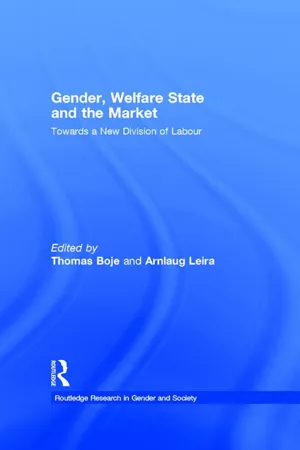
Gender, Welfare State and the Market
Towards a New Division of Labour
- 272 pages
- English
- ePUB (mobile friendly)
- Available on iOS & Android
eBook - ePub
About this book
This volume represents the present state of theoretical debate in welfare state scholarship, drawing on research from western Europe, North America and Japan. It therefore provides a valuable balance of breadth and detail from the broad international overview to comparisons between specific welfare states and national case studies.
Information
Part I
Women's employment and welfare systems
1
Paid work, unpaid work and welfare
Towards a framework for studying welfare state variation
Mary Daly
Introduction
The study of welfare state variation proceeds apace. Much of the recent impetus in scholarship on the welfare state has come from gender-focused work. As a result, one has a choice of approaches to study the gender dimension of welfare states. But there has been little critical comment on the gender-focused work. Even though it has provided a critique of the conventional perspectives on the welfare state, feminist work has itself been subjected to little by way of review and appraisal. This is in some ways surprising for a perspective that is critical in origin. While one may speculate about the reasons for the absence of critique, some appraisal of feminist work on the welfare state is overdue. It is time to take stock. Towards this end, I intend in this chapter to undertake a review of some of the main approaches to understanding and studying variations in how welfare states treat and influence gender relations. This analysis sounds several key notes of a theoretical, conceptual and methodological nature.
One could say that three main approaches to the welfare state prevail in the feminist-oriented literature today. The first centres on the concept of care, employing it to uncover the characteristics of caring as labour and a set of relationships and to reveal the links between care and the gender dimension of welfare state provision. Work that explores the gendered aspects of the welfare state from within the paradigm of citizenship forms a second bulk of feminist scholarship on the welfare state. Third, feminists have proffered the breadwinner/housewife typology as a way of understanding the organizing principles of welfare states from a gender-sensitive perspective. While they have some common links, each approach tends to adopt a different perspective on how to theorize and identify the gender dimension(s) of the welfare state. Each of the three frameworks will be reviewed in this chapter for its capacity to countenance the key elements involved in the relation between gender and the welfare state and associated variations. The thrust of my analysis with regard to these approaches will demonstrate that each has strengths and weaknesses which enhance, but at the same time delimit, analytic capacity. Second, I want to consider the main methodological approaches adopted by feminist work in recent years in order to identify the general methodological principles of this work as well as the direction in which it is heading. In particular, the merits and demerits of typologizing need to be carefully debated. In the third part of the chapter I suggest some ways in which it is possible to move towards a better conceptualization of the relationship between state, market and family in terms of how they embody and shape gender relations. It will be interesting to ascertain if it is possible to do so by undertaking a synthesis of the three approaches of care, citizenship and breadwinner models. The key challenge is to rework these concepts into a comprehensive framework capable of countenancing variation and complexity in how welfare states embody and affect gender relations. This third part of the chapter will also consider how methodological approaches can be rendered more satisfactory.
To the extent that what I undertake here is a review or evaluation of feminist work on the welfare state, the evaluative criteria should be made explicit at the outset. Some such criteria are easily identifiable. It goes without saying that the overriding criterion of the utility of an approach is that it be able to capture the gender dimension of social policies. The meaning of this is not, of course, straightforward, but I am specific in my use of it. What I mean is that an approach should be capable of countenancing the position of both women and men, their relations and the state/family/market relation as they are envisaged in and shaped by social policies. Second, any satisfactory approach should be able to cope with variation. With welfare state research becoming increasingly comparative, an essential evaluative criterion is the capacity of perspectives to accommodate and account for variation. Third, this piece is guided by the conviction that welfare state analyses must become more comprehensive and for this purpose it is necessary, somewhat paradoxically perhaps, that they become more differentiated. More precisely, the difference between the content or design of policies, the processes which policies set in train and the outcomes which they bring about must be registered. These have tended to be elided in the literature. I do not wish to imply that these are in practice separate but a distinction between them for analytic purposes seems to me to be essential, especially for work that searches after the analytic strengths and weaknesses of particular approaches to the welfare state. A key goal of the review of the feminist work that follows, then, is to ascertain the potential of each approach on the basis of these lines of evaluation.
Critical overview of work on gender and the welfare state
Gender as a practice and process of social differentiation and a key constituent of identity has proved to be one of the major growth areas in the social sciences over the last decade and a half. In the welfare state, as in other domains, it has yielded a rich legacy of concepts and approaches. This work is especially good on the nature and content of social policies. We can, for instance, analyse gender in the welfare state in terms of the underlying institutional and normative models underlying policy (conceptualized either as breadwinner models, gender regimes or models of marriage), the quality of social rights (conditions of access and entitlement to benefits, the range of risks covered and the extent to which hierarchies exist between women and men's risks), or the different roles for women and men which are envisaged by welfare state provisions. Alternatively, we may take the outcome side as our starting point and focus upon women and men's lives as they are influenced or affected by welfare state provisions. Here we have the choice of examining how welfare states help to shape gender roles, how they act to distribute paid and unpaid labour and time, and, over the longer run, women and men's life chances and opportunities.
This review engages not with the details of each of these strands of analysis but rather with the general principles that underpin them. It is useful to begin with an attempt to differentiate the conceptual and methodological dimensions of existing work.
Conceptual approaches
Feminist work on the welfare state is impossible to understand apart from its historical context. This is a body of work that is, and should be seen as, a critical response to either the downgrading of women and gender in mainstream work or their outright exclusion from it. The originating critique by feminism of the conventional work on the welfare state focused upon the failure to consider gender as a constituent element of political identity, the role that female political agency played in shaping welfare states, the contribution of female labour, both paid and unpaid, to welfare in societies and the fact that welfare states may have both shaped these and led to gendered outcomes. Concepts, if not theories, have been at the forefront of the feminist critique. Looking at the body of feminist work on the welfare state as a whole, it could be said to have proceeded along two lines, the tracks of which were laid out by the critique of existing perspectives.1 Either scholars felt that they had to develop new concepts and approaches or they, implicitly or explicitly, reworked existing frameworks so as to render them more ‘gender-friendly’. The latter comprises the greater bulk of the work, although the former would probably have been the more sought-after goal.
Three core approaches have guided the most recent wave of feminist work on the welfare state. They are the care-centred work, that focused on citizenship and the scholarship around the breadwinner model. There is surprisingly little conversation between the different approaches – while their relationship is not competitive or adversarial, it is not complementary either. Work on the different strands proceeds more or less independently of each other. This is a pity for, as the analysis to follow will demonstrate, the three conceptual approaches have something to say to each other and complement one another at important junctures.
The concept of care2
Care, one of the truly original concepts to emerge from feminist scholarship and arguably one of the most widely used in feminist analyses of welfare states today, has its origins in an attempt to define the work that makes up caring for others and to analyse how that work reinforced the disadvantaged position of women. The nature of the labour involved in caring was a key consideration from the outset, the goal being to define in its own right the set of activities that make up caring for others, to identify its specific if not unique features and to analyse how both the activity and responsibility for caring reinforced the disadvantaged position of women. Caring was, initially at any rate, conceived of in relation to the unpaid domestic and personal services provided through the social relations of marriage and kinship. So defined, the concept turned attention on the material and emotional processes that made up care and at the same time confirmed women as (for the most part unpaid) carers. The pioneering work on care (Finch and Groves 1983; Waerness 1984) focused mainly on unpaid, informal care in the family. The approach could be said to have served the feminist analytic purpose well, having led to a body of scholarship which demonstrated the ubiquity and specificity of the activity of caring. In this regard, it drew attention to the fact that care was more than just unpaid personal services. Not only was it inherently defined by the relations within which it was embedded and carried out but care, conceived as responsibility and/or need, played a powerful role in defining the life situation of women and men and the nature of family life. The specificity of the relations of care was elaborated and they were shown to be characterized by personal ties of obligation, commitment, trust and loyalty (Leira 1992).
Over time, the concept of care was broadened, reflecting both the changing nature of arrangements for caring in practice and the complexity introduced by the increasingly comparative nature of scholarship. Across nations and over time within them, care-giving has shifted between the realms of paid and unpaid work, a movement that has never been solidly in one direction. Moreover, the interpretation of the meaning and significance of care-related policies for women is not straightforward. Early Scandinavian feminist analysis of social policy argued that the entry of women into jobs in day-care centres, schools, hospitals and old people's homes – in the service of the welfare state – represented a form of ‘public patriarchy’ (e.g. Siim 1987). Women were now doing in the public sphere the work which they had traditionally carried out in the home. Others have been more eager to claim this shift as an unequivocal gain (e.g. Kolberg 1991). As these and other debates were unfolding, care was maturing as an academic concept. Graham (1991), for example, sought to include non-kin forms of home-based care so as to enable the concept to embrace relations of class and race alongside those of gender. Leira (1992) drew attention to how care involves the interface of public authorities, especially the welfare state, and private agents. Tronto (1993) elaborated a view of care as both practice and disposition. Thomas (1993) further developed the concept, identifying seven dimensions to it. These pertain to the identity of the providers and recipients of care, the relationship between them, the social content of the care, the economic character of the relationship and of the labour involved, and the social domain and institutional setting within which care is provided.
Care has, therefore, matured into both a complex concept – it does not dovetail, for example, in any simplistic way with the paid/unpaid work differentiation – and one with considerable analytic potential in relation to the welfare state. Part of its beauty is that it is enlightening about the content and context of a defining element of women's life situation and how welfare states relate to and reinforce that. This is a strength, indeed a not inconsiderable one, and it has led to a number of insightful analyses of welfare state provision from the perspective of care (Knijn and Kremer 1997; Boje and Almqvist in this volume). This and other strengths notwithstanding, the concept of care is both ambiguous and contested. Part of the problem may lie in its very popularity – it has been used in such diverse ways that it is in danger of losing its core meaning. If one is to employ the concept of care as a category of analysis in relation to the welfare state, one must find a way of retaining its capacity to reveal important dimensions of women's lives (indeed, the human condition) as well as develo...
Table of contents
- Front Cover
- Gender, Welfare State and the Market
- Routledge Research in Gender and Society
- Title page
- Copyright
- Contents
- List of figures
- List of tables
- Notes on Editors
- Notes on Contributors
- Introduction: gender, welfare state and the market – towards a new division of labour
- PART I Women’s employment and welfare systems
- PART II Family policy – work and care in different welfare systems
- Index
Trusted by 375,005 students
Access to over 1.5 million titles for a fair monthly price.
Study more efficiently using our study tools.
Frequently asked questions
Yes, you can cancel anytime from the Subscription tab in your account settings on the Perlego website. Your subscription will stay active until the end of your current billing period. Learn how to cancel your subscription
No, books cannot be downloaded as external files, such as PDFs, for use outside of Perlego. However, you can download books within the Perlego app for offline reading on mobile or tablet. Learn how to download books offline
Perlego offers two plans: Essential and Complete
- Essential is ideal for learners and professionals who enjoy exploring a wide range of subjects. Access the Essential Library with 800,000+ trusted titles and best-sellers across business, personal growth, and the humanities. Includes unlimited reading time and Standard Read Aloud voice.
- Complete: Perfect for advanced learners and researchers needing full, unrestricted access. Unlock 1.5M+ books across hundreds of subjects, including academic and specialized titles. The Complete Plan also includes advanced features like Premium Read Aloud and Research Assistant.
We are an online textbook subscription service, where you can get access to an entire online library for less than the price of a single book per month. With over 1.5 million books across 990+ topics, we’ve got you covered! Learn about our mission
Look out for the read-aloud symbol on your next book to see if you can listen to it. The read-aloud tool reads text aloud for you, highlighting the text as it is being read. You can pause it, speed it up and slow it down. Learn more about Read Aloud
Yes! You can use the Perlego app on both iOS and Android devices to read anytime, anywhere — even offline. Perfect for commutes or when you’re on the go.
Please note we cannot support devices running on iOS 13 and Android 7 or earlier. Learn more about using the app
Please note we cannot support devices running on iOS 13 and Android 7 or earlier. Learn more about using the app
Yes, you can access Gender, Welfare State and the Market by Thomas Boje,Arnlaug Leira in PDF and/or ePUB format, as well as other popular books in Social Sciences & Sociology. We have over 1.5 million books available in our catalogue for you to explore.