This book studies the effects of repetitive musical rhythm on the brain and nervous system, and in doing so integrates diverse fields including ethnomusicology, psychology, neuroscience, anthropology, religious studies, music therapy, and human health. It presents aspects of musical rhythm and biological rhythms, and in particular rhythmic entrainment, in a way that considers cultural context alongside theoretical research and discussions of potential clinical and therapeutic implications. Considering the effects of drumming and other rhythmic music on mental and bodily functioning, the volume hypothesizes that rhythmic music can have a dramatic impact on mental states, sometimes catalyzing profound changes in arousal, mood, and emotional states via the stimulation of changes in physiological functions like the electrical activity in the brain. The experiments presented here make use of electroencephalography (EEG), galvanic skin response (GSR), and subjective measures to gain insight into how these mental states are evoked, what their relationship is to the music and context of the experience, and demonstrate that they are happening in a consistent and reproducible fashion, suggesting clinical applications. This comprehensive volume will appeal to scholars in cognition, ethnomusicology, and music perception who are interested in the therapeutic potential of music.
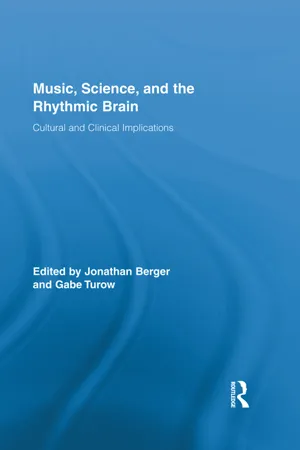
eBook - ePub
Music, Science, and the Rhythmic Brain
Cultural and Clinical Implications
- 14 pages
- English
- ePUB (mobile friendly)
- Available on iOS & Android
eBook - ePub
Music, Science, and the Rhythmic Brain
Cultural and Clinical Implications
About this book
Information
Part I
Research on Rhythmic Entrainment in Music
1 Introduction to Entrainment and Cognitive Ethnomusicology
Ethnomusicology and Cognitive Ethnomusicology
Ever since their discovery in the early 20th century brain rhythms have fascinated the human mind and spurred a wide range of fascinating research aimed at understanding the functions of these rhythms at various levels. Brain rhythms are not only essential for organizing motor actions—for example in music-making—but also, as research in recent decades has indicated, for our cognition and for how we experience the world (for a good review on this: Buzsáki, 2006). Surprisingly, it seems that musicologists and ethnomusicologists, for whom, one might assume, rhythm would be a topic of foremost interest, have hardly taken note of this research, much less taken part in it.
For the most part this lack of interest can be attributed to the antiscientific stance of the post-modern culturalism that came to dominate approaches in anthropology and ethnomusicology since the ‘60s. With the introduction and acceptance of the Schneider-Geertzian ideas about culture as an autonomous domain of arbitrary symbolic representations, action and social context lost their place in the research agenda—a radical transformation and departure from the model of their teacher, Parson’s general theory of action. However, political and economic forces, social institutions, biological and physiological processes cannot be wished away, or simply assimilated into systems of knowledge and belief. Already one of Schneider’s students, David Labby (1976:12), noted:
The ‘cultural analysis’ that attempts to define the way people think but ignores the way people live … seems to me to be significantly misconceived … there is, properly speaking, no such thing as a distinct or separate ‘cultural analysis’.
As we have argued elsewhere (Will, 2007), despite its magnitude and influence on contemporary cultural anthropology and ethnomusicology, this postmodernist approach is seriously biased and flawed by premises that are more rooted in modernist thinking than in alternatives to it—postmodernism as the elaborated logical continuation and extension of the modern, the cultural logic of the late capitalist condition. This is most evident in the objectification and materialization of the notion of culture, the resurgence of the notion of race, the acceptance of the illusory nature–culture divide, the ignorance of the human body, and the exclusive reliance on verbal accounts of actors’ conscious thoughts. Indeed, in both the accounts of the cognitivists and the culturalists, biology (physiology) and culture are considered independent autonomous domains; this may be one of the central reasons why there has been little talk and exchange across the disciplines.
Though problems and limitations of the interpretive culturalist approach have been recognized early on even by postmodernist thinkers like V. Turner (Turner, 1987), this approach has been and still is dominant in ethnomusicology. Nevertheless, in recent years we see a variety of new topics and orientations emerging. As in other humanistic disciplines, such changes are in part motivated by the realization of the changing human life-world. Ethnomusicology not only has to take account of new types of music, new, technologies and conditions of music production and transmission, but is also facing changes in its working conditions in (see, e.g., the discussion on fieldwork in Wood, 2008) and for society. New roles and tasks for ethnomusicologists are sought, for example, within the emerging field of medical ethnomusicology, which aims to combine efforts of various experts, music and health specialists among them, to work on health and disease related issues in societies the world over (e.g., Barz, 2006). Guided by the collaboration of health sciences and healing arts, this field wants to engage knowledge from diverse research areas and domains of human life conventionally viewed as disparate, yet laden with potential benefits for an improved or vibrant quality of life, prevention of illness and disease, even cure and healing (from the liner notes, Koen, 2008).
In other recent developments in ethnomusicology, focus has been redirected towards music performances. There are indications of a shift from performance studies theory to practice (e.g., Keil, 1998) as well as a reevaluation of the performative capabilities of ethnomusicologists (Bailey, 2008). There are also new developments towards more empirically oriented analyses of musical performances (see, e.g., various contributions in Stobart, 2008). These latter developments are emerging in response to reflections on the current state of ethnomusicology and its relationship to other disciplines, in particular, the sciences. Quite a few scholars have realized that the culturalist position has not only led to theoretical problems and practical impasses in their own discipline (Will, 2007) but also to an unfortunate insulation from developments in other disciplines that are of utmost relevance for overcoming those difficulties and for reconnecting cultural studies with relevant discourses in other disciplines.
Developments in cognitive sciences since the ‘80s suggest that we are witnessing a breakdown of concepts at the very basis of the culturalists’ approach. They show that human cognition is not independent of the body (e.g., works of Johnson, Kay & McDaniel, Barsalou, Damasio), that meaning is grounded in the interactions of organisms with and within their environment, not in arbitrary socio-cultural conventions (e.g., works of Varela, Johnson, Rizzolatti, Ramachandran), and that the working of the brain is largely shaped by experience (works of Freeman, Merzenich, Varela). These developments make clear that the old dichotomies between nature and nurture, biology and culture, the individual and universal have lost their explanatory significance and can no longer be maintained. For both the cultural and natural sciences these developments pose serious challenges as cognitivists and culturalists are losing their foundational concepts. Furthermore, they call not only for extensive conceptual and methodological changes in both fields, but also for close cooperation and cross-disciplinary exchange.
Cooperation is especially needed in the domain of music that, since the mid ‘90s, was discovered by the cognitive sciences as a new area of research, complementary to language studies. This has led to the publication of a number of special volumes dedicated to the cognitive processing of music by the New York Academy of Sciences, by Nature Neuroscience, and reviews, editorials, and essays in major scientific journals.
However, this surge of cognitive studies on music comes with a concern. The research seems to be fundamentally biased towards Western music: Though lip service is frequently paid to the importance of variety in music cultures, experimental and clinical studies almost exclusively utilize subjects from Western cultures and music based on the Western classical tradition. Clearly, as Ian Cross (2003) has put it, the foundational categories of theorized Western musical practices form the basis for most perceptual and cognitive theory and experimentation about music. This is of concern because Western Classical music has developed in close connection with a specific writing system and many of its principles are different from those of non-Western musics (for details and examples: Blacking, 1961; Arom, 1997; Will, 1999; Cross, 2003). To arrive at a generalizable understanding of cognitive processing of music, cross-cultural studies are needed and this is where the experience of ethnomusicology is a condition sine qua non. This experience, however, cannot just be borrowed. Extensive interdisciplinary cooperation is needed for an integration of cognitive and ethnographic research programs. If, in terms of the revised conceptualizations mentioned above, understanding situated music making requires more than analysis of verbal accounts, then we need to consider additional explanatory variables, like for example, spatial and temporal structures of musicians actions, their physiological states of mind and body, etc. The significant methodological problem ethnomusicology has to address is: how to study these variables in an ecologically valid manner. This is what we would consider the proper domain of cognitive ethnomusicology, and the case of musical entrainment is an example par excellence of the active, contributing role ethnomusicology can and would have to play in order to make this approach work.
Entrainment is a concept coming from complex systems theory that posits that two or more independent, autonomous oscillatory processes, if and when they can interact, influence (entrain) each other mutually, and the degree of influence is dependent on the coupling force(s). Complex systems theory, however, is ignorant as to what constitutes a coupling factor. It is here where the expertise of the discipline applying the concept—ethnomusicology in our example—is needed in order to identify the coupling factors at work in specific musical contexts. Entrainment is a concept with a considerable history—first identified by the Dutch physicist Christiaan Huygens in 1665 and subsequently applied widely in mathematics and the physical, biological, and social sciences. It is a process that manifests in many ways, some of which involve human agency or cognition.
This principle posits that any two oscillators will entrain if allowed to interact for long enough. Huygens discovered this phenomenon during an experiment with pendulum clocks: He set them each in motion and found that when he returned the next day, the sway of their pendulums had all synchronized. He extrapolated that entrainment is a ubiquitous natural phenomenon that manifests via the conservation of energy during the interaction of closely related rhythmic cycles. The tendency for rhythmic processes or oscillations to adjust in order to match other rhythms has been described in a wide variety of systems and over a wide range of time scales (i.e., periodicities): from fireflies illuminating in synchrony, through human individuals adjusting their speech rhythms to match each other in conversation, to the movement of electric driers placed in close proximity, to the way that a room of clapping people will spontaneously fall into rhythm (Neda, Ravasz, Brechet, Vicsek, & Barabsi, 2000). Examples have been claimed from the relatively fast frequency oscillations of brainwaves to periods extending over months and years, and in organisms from the simplest to the most complex as well as in the behavior of inorganic materials and systems.
Strangely, entrainment has had relatively little impact to date on studies of music, where it might be thought particularly relevant. We believe that this concept could have a particularly significant impact if applied to musicological and ethnomusicological research because it offers a new approach to understanding music making and music perception as an integrated, embodied, and interactive process, and can therefore shed light on many issues central to musicological thought. Entrainment will be of special relevance to research orientations for which performance of and listening to music are the focus of interest, as well as for those interested in understanding the impact of musical rhythms and rhythmic stimulation on the human body and mind.
Sensory Stimulation as Ritual Technology
From Tibetan Buddhist rites to Middle Eastern Sufirituals, from Siberian, European, and South American Shamanic traditions to Caribbean Hatian ceremonies, and in Jewish and Christian worship in America and elsewhere, repetitive musical rhythm is a common feature in religious practice (Eliade, 1964; Keil & Feld, 1994). The ubiquity of this form of stimulation in religious contexts suggests that it is more than ornamental or simply traditional.
Mantra recitation, perhaps the most common rhythmic prayer, has been scientifically investigated in some detail. A mantra is any string of words that are repeated over and over again with the intention of inducing a meditative state or of inspiring religious experience. Reciting a mantra can be an intense and consistent form of rhythmic auditory stimulation. Mantra recitation has been shown to reduce anxiety levels and increase alpha power (Lee et al., 1997), induce relaxation (Janowiak & Hackman, 1994), lower blood pressure (Seer & Raeburn, 1980), and induce an increase in theta and delta waves (Stigsby, Rodenberg, & Moth, 1981).
Rhythmic prayer also has interesting effects. In a study comparing recitation of the Ave Maria prayer to the yogic mantra Om Mani Padme Hum, scientists observed that both types of rhythmic recitation equally slowed respiration and caused striking, powerful, and synchronous increases in exist...
Table of contents
- Cover Page
- Half Title page
- Series page
- Title Page
- Copyright Page
- Contents
- Figures
- Tables
- Acknowledgments
- Preface
- Part I Research on Rhythmic Entrainment in Music
- Part II Clinical Implications of Rhythmic Entrainment Research
- List of Contributors
- Index
Trusted by 375,005 students
Access to over 1.5 million titles for a fair monthly price.
Study more efficiently using our study tools.
Frequently asked questions
Yes, you can cancel anytime from the Subscription tab in your account settings on the Perlego website. Your subscription will stay active until the end of your current billing period. Learn how to cancel your subscription
No, books cannot be downloaded as external files, such as PDFs, for use outside of Perlego. However, you can download books within the Perlego app for offline reading on mobile or tablet. Learn how to download books offline
Perlego offers two plans: Essential and Complete
- Essential is ideal for learners and professionals who enjoy exploring a wide range of subjects. Access the Essential Library with 800,000+ trusted titles and best-sellers across business, personal growth, and the humanities. Includes unlimited reading time and Standard Read Aloud voice.
- Complete: Perfect for advanced learners and researchers needing full, unrestricted access. Unlock 1.5M+ books across hundreds of subjects, including academic and specialized titles. The Complete Plan also includes advanced features like Premium Read Aloud and Research Assistant.
We are an online textbook subscription service, where you can get access to an entire online library for less than the price of a single book per month. With over 1.5 million books across 990+ topics, we’ve got you covered! Learn about our mission
Look out for the read-aloud symbol on your next book to see if you can listen to it. The read-aloud tool reads text aloud for you, highlighting the text as it is being read. You can pause it, speed it up and slow it down. Learn more about Read Aloud
Yes! You can use the Perlego app on both iOS and Android devices to read anytime, anywhere — even offline. Perfect for commutes or when you’re on the go.
Please note we cannot support devices running on iOS 13 and Android 7 or earlier. Learn more about using the app
Please note we cannot support devices running on iOS 13 and Android 7 or earlier. Learn more about using the app
Yes, you can access Music, Science, and the Rhythmic Brain by Jonathan Berger, Gabe Turow, Jonathan Berger,Gabe Turow in PDF and/or ePUB format, as well as other popular books in Biological Sciences & Ethnomusicology. We have over 1.5 million books available in our catalogue for you to explore.