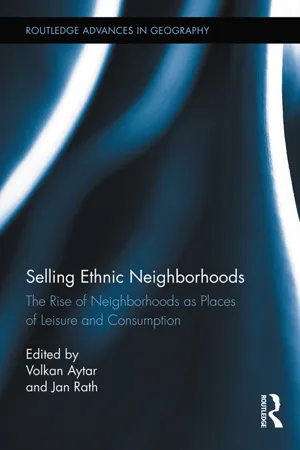
While ethnic neighborhoods are usually associated with poverty, crime and social problems, they have also emerged as places of leisure and consumption, providing opportunities for numerous entrepreneurs and employees. Local and national governments and other regulatory actors, as well as the media, have started to see and promote these neighborhoods as urban attractions for tourists, city dwellers and others. This book aims to analyze the roles of ethnic entrepreneurs and their associations and governments, and - by extension - of consumers and other actors in the rise of ethnic neighborhoods as places of leisure and consumption. Through case studies, it situates those neighborhoods at the edge of different theoretical debates about urban political economy and the politics of culture, and seeks a dynamic synergy between both.
eBook - ePub
Selling Ethnic Neighborhoods
The Rise of Neighborhoods as Places of Leisure and Consumption
- 174 pages
- English
- ePUB (mobile friendly)
- Available on iOS & Android
eBook - ePub
Selling Ethnic Neighborhoods
The Rise of Neighborhoods as Places of Leisure and Consumption
1 Urban Ethnic Tourism in New York’s Neighbourhoods
Then and Now
Johannes Novy
There are two faces to New York. First of all it is a city of business, a gigantic anthill, throbbing with life. . . . But it is also a city of memories, a city where one can stroll, because the tourist with perceptive eyes discovers hidden treasures: urbanism, history, migration and so on. It seems that the different races of the world decided to meet here. From the Negro quarter of Harlem to the Ghetto, from the Italian and Polish slums to Chinatown, everything awakens tourism’s curiosity. Each of these peoples’ lives there transplanted but untransformed, carefully preserving the customs of their ancestors.
New-York. La Ville Merveilleuse. Revue de Voyages (quoted in Gilbert and Hancock 2006: 96)
[S]ome Harlemites thought the millennium had come. . . . I don’t know what made any Negroes think that—except that they were mostly intellectuals doing the thinking. The ordinary Negroes hadn’t heard of the Negro Renaissance. And if they had, it hadn’t raised their wages any. As for all those white folks in the speakeasies and night clubs of Harlem—well, maybe a colored man could find some place to have a drink that the tourists hadn’t yet discovered.
Langston Hughes (1940: 228)
The ‘20s are gone and lots of fine things in Harlem night life have disappeared like snow in the sun—since it became utterly commercial, planned for the downtown tourist trade, and therefore dull.
Langston Hughes (1940: 227)
Introduction
Ethnic urban tourism is sometimes seen as a phenomenon of the late twentieth and early twenty-first centuries, a result of recent demographic, economic and political transformations that have fostered new patterns of leisure and consumption and changed the ethnic makeup of cities across the advanced capitalist world. But ethnic urban tourism is by no means a new phenomenon. In New York and Chicago, for instance, it was already fashionable in the mid-nineteenth century to visit segregated urban areas where the ethnic and foreign-born were concentrated—to go ‘rubbernecking’ (see Gates 1997; Cocks 2001; Gilbert and Hancock 2006).
New York’s Chinatown became the object of a considerable slumming craze in the second half of the nineteenth century (Lin 1998b). Neighbourhoods such as the Jewish Lower East Side, Little Italy and the Black Tenderloin District followed suit a few decades later, while tourism in Harlem became a mass phenomenon in the 1920s and 30s when white (upper-) middle class New Yorkers and tourists crowded into Uptown jazz clubs and cabarets to explore the neighbourhood’s nightlife and experience the creative spirit and excitement of the ‘Harlem Renaissance’.
The popularity of neighbourhoods like Harlem and Chinatown as destinations between the mid-nineteenth and mid-twentieth centuries demonstrates, as Gilbert and Hancock (2006) point out, that racial and ethnic diversity was a key part of New York’s appeal as the city joined Rome, London and Paris as one of the world’s iconic urban tourist landscapes. ‘As New York developed as a tourist city, “slumming”—sight-seeing trips into poor districts—became both more organised and standardised, and the spectacle of ethnicity and race became an important “sight” in the city, as significant in its own way as the Statue of Liberty or the Empire State Building’ (Gilbert and Hancock 2006: 4).
New York has undergone profound changes since it became one of the world’s great international tourist destinations. Yet the city’s ethnic and racial diversity in the form of ethnic precincts, restaurants, shops and celebrations represent one of the city’s most sought-after aspects. As Hughes’ comments above illustrate, urban ethnic tourism remains a source of both great hopes and equally great disappointments.
Unlike in the past when tourism was viewed as little more than a marginal social activity, tourism today (along with leisure and consumption more generally) is considered a driver of contemporary urban change in New York, a critical source of revenue for the city and its neighbourhoods. As New York transformed into a multi-ethnic, post-industrial city centred on finance, real estate, culture and leisure in the second half of the twentieth century, tourism played an integral part in the city’s transition. New York City’s ethnic and minority neighbourhoods, which despite their appeal to earlier generations of visitors were considered anachronistic by the city’s elites, came to be seen as vital economic and symbolic resources.
Embedded in a discussion of the political-economic, demographic and cultural changes that encompass urban ethnic tourism, the chapter first explores the origins and evolution of tourism and leisure in New York’s ethnic and minority neighbourhoods from the beginnings of commercialised urban tourism up until the mid-twentieth century. It then examines ethnic and minority neighbourhoods’ recent revalorisation as tourist destinations to discuss some of the key issues raised by the development of urban ethnic tourism in the advanced capitalist world. We focus on the neighbourhood of Harlem in northern Manhattan as its development exemplifies many of the different—and frequently contradictory—characteristics and effects associated with tourism in ethnic and minority neighbourhoods.1
Tourism and Ethnicity in New York: Then
The rise of urban ethnic tourism is the product of profound changes in American cities and culture over the second half of the nineteenth century. Two developments deserve particular mention: (i) the urbanisation and industrialisation that transformed American cities such as New York from relatively small, homogenous towns into modern, sprawling metropoles with large immigrant populations; and (ii) the development of a commercial urban culture centred on leisure and consumption, together with the transformation of American cities into domestic and international tourist destinations (see Cocks 2001). These changes laid the groundwork for the emergence of New York as a tourist destination. Immigration from abroad and the northward migration of freed slaves from the southern states—alongside increasing segregation of the ethnic and foreign-born and the resulting pronunciation of cultural difference—set the stage for ethnic and racial diversity to become exploitable resources.
For politicians of the time, ‘ghettos’ such as Chinatown, Little Italy and the Lower East Side represented blighted, dangerous places standing in the way of modernisation and cultural assimilation. For many visitors, however, they were exotic and alien places where the foreign could be observed, dripping with exoticism and lurking danger. As tourism developed in these neighbourhoods, it steadily became more organised. Guidebooks and magazines began to feature New York’s impoverished and ‘colored’ quarters as well as their perceived pleasures and horrors, while self-appointed guides began offering tours for ‘slumming parties’ (New York Times 1884). By the beginning of the twentieth century, so-called ‘rubberneck automobiles’ took spectators on journeys into New York’s nether parts (Tracey 1905: SM 4). By the 1910s, about 200,000 ‘strangers’ were visiting New York each day; in the words of the New York Times (1912: SM4), the city had become ‘the Greatest Summer Resort in the United States’. Alongside Manhattan’s iconic skyline and the other expressions of modernity that shaped New York’s image as an archetypal twentieth-century city, the ‘spectacle of poverty as well as of ethnic authenticity and exoticism’ (Gilbert and Hancock 2006: 97) became a primary attraction for visitors ‘doing the town’.
Members of New York’s emerging leisure class meanwhile expressed shock and dismay over the class and ethnic stratification that had come to define their city, as well as over the crime and social unrest in its slums. That said, they were fascinated by the mix of despair, exoticism, pleasure and vice inherent in them. Many nineteenth-century descriptions reveal that explorations of New York’s ‘low life’ (Sante 1991) were inspired by both voyeurism and a developing sense of the ‘pleasures of cosmopolitan consumption’ (Gilbert and Hancock 2006: 98). While xenophobia and racism intensified during the period and many New Yorkers were troubled over the growing number of foreign faces in their midst (Cocks 2001: 194), ethnic and racial differences were increasingly regarded as curiosities and commodities as a new cultural emphasis on leisure and consumption gradually took hold. The appeal of those neighbourhoods where the ethnic and foreign-born were concentrated was heightened by the image of insular ‘villages’ where ‘primitive’ inhabitants withstood the forces of modernity to offer visitors ‘pure’ and ‘authentic’ experiences in an otherwise relentlessly transforming metropolis (Dowling 2007).
It did not take long for those areas hailed as particularly ‘authentic’ and ‘genuine’ to become staged. Residents began using tourism for their own ends as New York’s bourgeoning tourism and leisure economy moved in. Chinatown’s development was a case in point: as early as the beginning of the twentieth century, tourists had begun complaining that the area was losing its appeal (Gilbert and Hancock 2006). The New York Times lamented that touring the nearby Bowery, once a paradise for slumming and rubbernecking, was ‘very much like seeing Pompeii: One must rely on imagination and reading to get an idea of the real thing’ (Tracey 1905: SM4). The residents of Chinatown meanwhile grew increasingly unnerved over tourism and the stereotyping and voyeurism it involved. One local businessman complained about the ‘barkers’ on sightseeing buses: ‘They relate stories of crime that never took place. They characterize the homes of respectable Chinese . . . as opium joints. They point to any building at random and inform visitors that . . . murderer . . . hid there. We have had enough’ (New York Times 1923: 16).
Destination Harlem: Then
Harlem did not attract much attention as a tourist destination until the early 1900s when the immigration of blacks from other parts of New York, from the South, and from Africa and the Caribbean turned the neighbourhood into the ‘capital of the African Diaspora’ (Maurrasse 2006: 17), or in the words of James Weldon Johnson (1991: 2), the ‘greatest Negro city in the world’. What had been a suburban community for the upper classes in the north of Manhattan became a ‘neighbourhood transformed’, ‘housing 50,000 Blacks in 1914, and nearly 165,000 by 1930’. As Harlem developed, artistic and intellectual activity began to flourish in the soon legendary neighbourhood (Sacks 2006: 3).
This ‘Harlem Renaissance’, as the period between the 1920s and 1930s soon became known, ‘not only fostered a sense of pride among people of African descent, it also caught the attention of Whites’ (Maurrasse 2006: 21). By the mid-1920s, Harlem had acquired a ‘world-wide reputation’ (Johnson 1991: XIV): white Americans and foreign tourists flocked to the neighbourhood to visit jazz clubs and cabarets, experience the area’s lively street culture, and consume alcohol as Prohibition laws were less effectively enforced in Harlem than in other parts of the city. A sizable tourism and leisure economy thus developed, employing thousands of residents and reinforcing Harlem’s image as an entertainment destination. At the same time, Harlem’s lure also obscured the hardships experienced by most of its residents. While Harlem’s entertainment industry was indeed thriving, ‘much of the ownership of the Harlem institutions of the time rested in white hands’ (Maurrasse 2006: 22). Most residents saw little of the thousands of dollars spent night after night in the neighbourhood’s cabarets and clubs. What had been created in Harlem was, according to Gilbert and Hancock (2006: 99), ‘a many layered fantasy world of black life and culture’ that effectively trivialised the neighbourhood’s social and racial tensions. Over the years, more and more Harlemites grew concerned over the exploitive nature of the tourist trade in their midst. Their concerns were reflected in Langston Hughes’ The Big Sea, which illustrated their awareness that the growing presence of white tourists was threatening the area’s main ‘selling point’—its ‘blackness’:
ordinary Negroes [did not] like the growing influx of whites toward Harlem after sundown, flooding the little cabarets and bars, where formerly only colored people laughed and sang, and where now the strangers were given the best ringside tables to sit and stare at the Negro customers—like animals in a zoo. . . . Some of the owners of Harlem clubs, delighted at the flood of white patronage, made the grievous error of barring their own race. . . . But most quickly lost business and folded up, because they failed to realize that a large part of the Harlem attraction . . . lay in simply watching the colored customers amuse themselves (Hughes 1940: 221).
Resentments over Harlem becoming a white playground were fuelled by the unaltered discrimination and lack of opportunities confronting African Americans. The area’s living conditions deteriorated significantly in the late 1920s and early 1930s when overcrowding reached new heights and the Great Depression set in, leaving half of Harlem’s residents unemployed and two-fifths of the neighbourhood’s families on government relief (Greene 1979: 514; Osofski 1963). As Harlem’s fortunes declined, the neighbourhood’s allure as a joyful place of ‘laughing, singing and dancing’ (Johnson 1991: XIV) faded; disinvestment, deterioration, poverty and social disorder took its place.
By the 1960s, over 25 per cent of Harlem’s housing stock was dilapidated beyond rehabilitation while the neighbourhood was widely considered too dangerous to visit. Harlem had transformed into Marcuse’s (1998) ‘outcast ghetto’ where the marginalised, unemployed and unwanted involuntarily congregated, while those who could afford to left the area. With factory jobs disappearing, urban renewal projects threatening the integrity of the built environment and residents fleeing the inner city by the thousands, many ethnic neighbourhoods in the city were experiencing a similar fate. Some vanished altogether as a result of slum clearance, assimilation and slowing immigration streams. By the end of the 1960s, analysts nationwide were speaking of an urban crisis as poverty, crime, racial tensions, economic distress and social pessimism intensified in cities across the country. New York’s social, political and economic problems loomed particularly large; the city became a ‘metaphor for all of the nation’s intractable urban ills’ (Sagalyn 2001: 5). The ‘Fun City’, as then Mayor John Lindsay cheerfully labelled New York (Gates 1997; Greenberg 2008), became known as ‘Fear Cit...
Table of contents
- Cover
- Half Title
- Title Page
- Copyright
- Contents
- List of Figures
- Introduction: Ethnic Neighbourhoods as Places of Leisure and Consumption: Volkan Aytar and Jan Rath
- 1. Urban Ethnic Tourism in New York’s Neighbourhoods: Then and Now: Johannes Novy
- 2. Ethnic Minority Restaurateurs and the Regeneration of ‘Banglatown’ in London’s East End: Stephen Shaw and Sue Bagwell
- 3. Gateways to the Urban Economy: Chinatowns in Antwerp and Brussels: Ching Lin Pang
- 4. Kreuzberg’s Multi- and Inter-cultural Realities: Are They Assets?: Johannes Novy
- 5. Sanitising the Metropolis of Leisurely Consumption: A Missed Chance to Re-invent Entrepreneurial Dynamism in Sulukule, Istanbul: Volkan Aytar and Süheyla Kirca-Schroeder
- 6. When Diversity Meets Heritage: Defining the Urban Image of a Lisbon Precinct: Catarina Reis De Oliveira
- 7. Symbols of Ethnicity in a Multi-ethnic Precinct: Marketing Perth’s Northbridge for Cultural Consumption: Kirrily Jordan and Jock Collins
- 8. Risotto and Zighiní? Milano’s Lazzaretto between Multiculturalism and Insecurity: Roberta Marzorati and Fabio Quassoli
- Contributors
- Index
Trusted by 375,005 students
Access to over 1.5 million titles for a fair monthly price.
Study more efficiently using our study tools.
Frequently asked questions
Yes, you can cancel anytime from the Subscription tab in your account settings on the Perlego website. Your subscription will stay active until the end of your current billing period. Learn how to cancel your subscription
No, books cannot be downloaded as external files, such as PDFs, for use outside of Perlego. However, you can download books within the Perlego app for offline reading on mobile or tablet. Learn how to download books offline
Perlego offers two plans: Essential and Complete
- Essential is ideal for learners and professionals who enjoy exploring a wide range of subjects. Access the Essential Library with 800,000+ trusted titles and best-sellers across business, personal growth, and the humanities. Includes unlimited reading time and Standard Read Aloud voice.
- Complete: Perfect for advanced learners and researchers needing full, unrestricted access. Unlock 1.5M+ books across hundreds of subjects, including academic and specialized titles. The Complete Plan also includes advanced features like Premium Read Aloud and Research Assistant.
We are an online textbook subscription service, where you can get access to an entire online library for less than the price of a single book per month. With over 1.5 million books across 990+ topics, we’ve got you covered! Learn about our mission
Look out for the read-aloud symbol on your next book to see if you can listen to it. The read-aloud tool reads text aloud for you, highlighting the text as it is being read. You can pause it, speed it up and slow it down. Learn more about Read Aloud
Yes! You can use the Perlego app on both iOS and Android devices to read anytime, anywhere — even offline. Perfect for commutes or when you’re on the go.
Please note we cannot support devices running on iOS 13 and Android 7 or earlier. Learn more about using the app
Please note we cannot support devices running on iOS 13 and Android 7 or earlier. Learn more about using the app
Yes, you can access Selling Ethnic Neighborhoods by Volkan Aytar,Jan Rath in PDF and/or ePUB format, as well as other popular books in Social Sciences & Geography. We have over 1.5 million books available in our catalogue for you to explore.