Polish: A Comprehensive Grammar
eBook - ePub

Polish: A Comprehensive Grammar

  1. 648 pages
  2. English
  3. ePUB (mobile friendly)
  4. Available on iOS & Android
eBook - ePub

Polish: A Comprehensive Grammar

About this book

Polish: A Comprehensive Grammar is a complete reference guide to the grammar system for intermediate to advanced learners of Polish. It presents an accessible and systematic description of the language, focusing on real patterns of use in contemporary Polish.

The Grammar is a comprehensive work and an invaluable resource for students and anyone interested in linguistics and the way modern Polish works.

Features include:

  • coverage of all parts of speech
  • full cross referencing
  • well selected and illuminating examples.

The book is organised in such a way to promote a thorough understanding of Polish at all levels of structure; the sound system, formation of word and phrases and sentence construction. It offers a stimulating analysis of the complexities of the language, providing clear explanations and examples of each point.

Polish: A Comprehensive Grammar is the essential reference work on Polish grammar for all learners and users of the language.

Frequently asked questions

Yes, you can cancel anytime from the Subscription tab in your account settings on the Perlego website. Your subscription will stay active until the end of your current billing period. Learn how to cancel your subscription.
No, books cannot be downloaded as external files, such as PDFs, for use outside of Perlego. However, you can download books within the Perlego app for offline reading on mobile or tablet. Learn more here.
Perlego offers two plans: Essential and Complete
  • Essential is ideal for learners and professionals who enjoy exploring a wide range of subjects. Access the Essential Library with 800,000+ trusted titles and best-sellers across business, personal growth, and the humanities. Includes unlimited reading time and Standard Read Aloud voice.
  • Complete: Perfect for advanced learners and researchers needing full, unrestricted access. Unlock 1.4M+ books across hundreds of subjects, including academic and specialized titles. The Complete Plan also includes advanced features like Premium Read Aloud and Research Assistant.
Both plans are available with monthly, semester, or annual billing cycles.
We are an online textbook subscription service, where you can get access to an entire online library for less than the price of a single book per month. With over 1 million books across 1000+ topics, we’ve got you covered! Learn more here.
Look out for the read-aloud symbol on your next book to see if you can listen to it. The read-aloud tool reads text aloud for you, highlighting the text as it is being read. You can pause it, speed it up and slow it down. Learn more here.
Yes! You can use the Perlego app on both iOS or Android devices to read anytime, anywhere — even offline. Perfect for commutes or when you’re on the go.
Please note we cannot support devices running on iOS 13 and Android 7 or earlier. Learn more about using the app.
Yes, you can access Polish: A Comprehensive Grammar by Iwona Sadowska in PDF and/or ePUB format, as well as other popular books in Languages & Linguistics & Languages. We have over one million books available in our catalogue for you to explore.
Chapter 1
Pronunciation and Spelling
1.1 Alphabet
The Polish alphabet is based on the Latin alphabet.
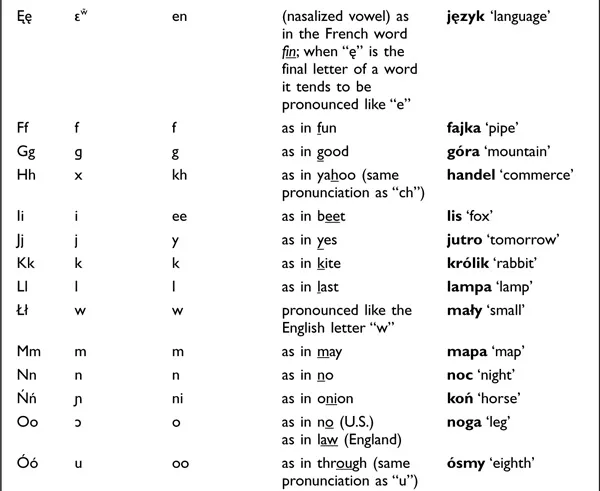
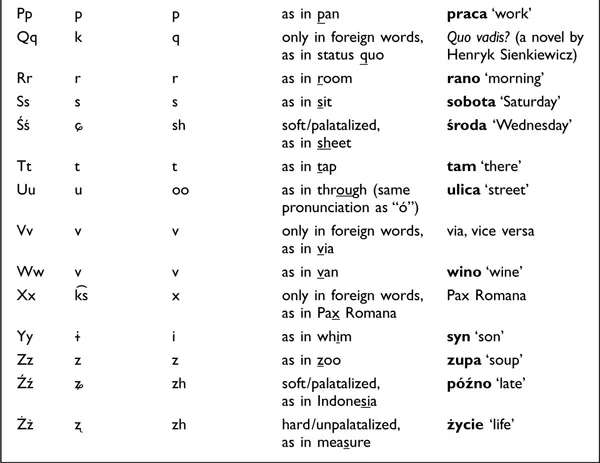
Aa Ąą Bb Cc Ćć Dd Ee Ęę Ff Gg Hh Ii Jj Kk Ll Łł Mm Nn Ńń Oo Óó Pp Qq Rr Ss Śś Tt Uu Vv Ww Xx Yy Zz Źź Żż
The letters q, v, and x appear in words of foreign origin and are sometimes not listed as part of the Polish alphabet. For alphabetization, each letter is ordered separately; troska precedes trójca in the dictionary (unlike French where élixir precedes elle).
In Polish, the letter x is called “iks,” y is called “igrek,” and z is called “zet.”
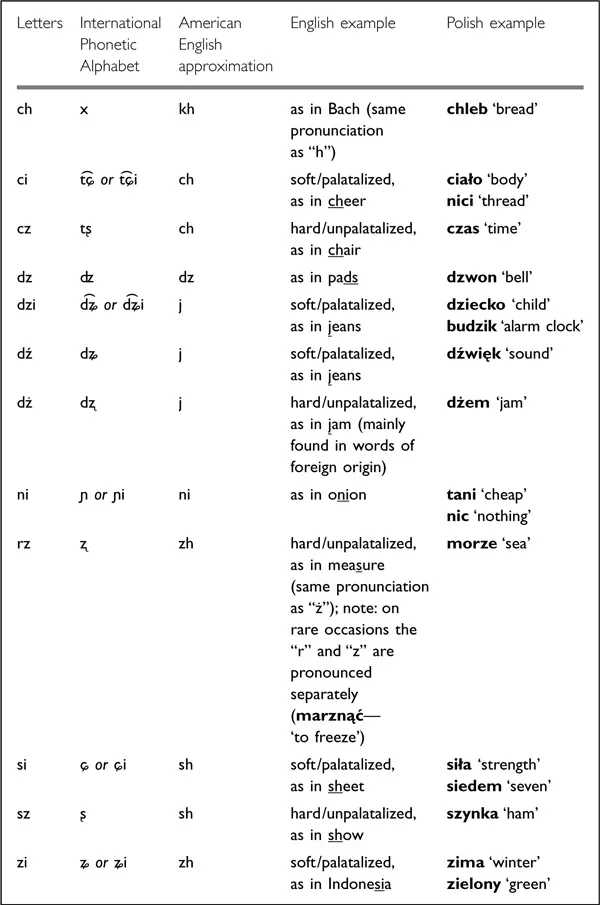
There are 12 letter combinations that can be pronounced as a single sound:
ch, ci, cz, dz, , , ni, rz, si, sz, zi, and dzi.
Table 1.1 Polish alphabet
Table 1.2 Letter combinations
1.2 Vowels
1.2.1 Oral
Polish has seven letters that represent oral vowels: a, e, i, o, ó, u, and y. Two of these letters represent the exact same sound and are pronounced identically: ó and u.
The primary pronunciations of the oral vowels are as follows (based on a comparison with general American English pronunciation and Received Pronunciation in England). In general, Polish vowels are shorter in duration than English vowels.
a
as in father
fala ‘wave’ [fala]
A is pronounced in Polish with the tongue in the front of the mouth, rather than in the back as in English.
e
as in met
tekst ‘text’ [tzkst]
i
as in beet
lis ‘fox’ [lis]
I in Polish is pronounced like the vowel sound in the English word “beet,” but the Polish i is shorter in duration.
o
as in no
noga ‘leg’ [nwga]
An approximation of the Polish o in general American English pronunciation is the first part of the “o” sound in the word “no.” However, the American English “o” is a diphthong, consisting of two sounds together. To approximate the Polish o, start to say “no” but stop short before completing the word. Additionally, the Polish o is pronounced with the tongue further toward the bottom of the mouth than in American English.
The Polish o is pronoun...
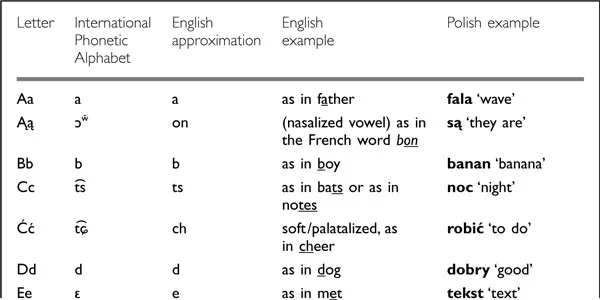
Table of contents

  1. Cover
  2. Half Title
  3. Title Page
  4. Copyright
  5. Contents
  6. List of tables
  7. List of abbreviations
  8. 1. Pronunciation and Spelling
  9. 2. Case usage
  10. 3. Nouns
  11. 4. Adjectives
  12. 5. Pronouns
  13. 6. Verbs
  14. 7. Adverbs and adverbial phrases
  15. 8. Numerals and clock time
  16. 9. Prepositions
  17. 10. Conjunctions
  18. 11. Interjections
  19. 12. Gender issues of address
  20. Notes
  21. Bibliography
  22. Index