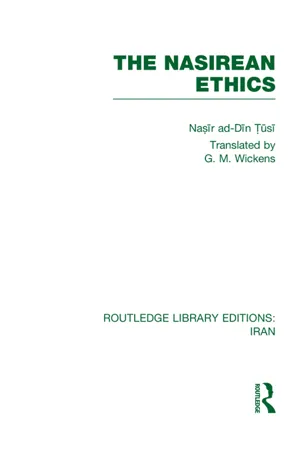
The Nasirean Ethics is the best known ethical digest to be composed in medieval Persia, if not in all mediaeval Islam. It appeared initially in 633/1235 when T?s? was already a celebrated scholar, scientist, politico-religious propagandist. The work has a special significance as being composed by an outstanding figure at a crucial time in the history he was himself helping to shape: some twenty years later T?s? was to cross the greatest psychological watershed in Islamic civilization, playing a leading part in the capture of Baghdad and the extinction of the generally acknowledged Caliphate there. In this work the author is primarily concerned with the criteria of human behaviour: first in terms of space and priority allotted, at the individual level, secondly, at the economic level and thirdly at the political level.
- 348 pages
- English
- ePUB (mobile friendly)
- Available on iOS & Android
eBook - ePub
The Nasirean Ethics (RLE Iran C)
Notes
1. This doxology contains several quotations from the Koran and elsewhere, not all strictly accurate. In a manner familiar to Islamic scholars, these quotations have been inserted as an integral part of the sentence-structure. Such skilful dovetailing cannot always be reproduced in English, but all such passages are indicated by quotation marks.
2. Ṭūsī, in excusing himself for having served the Ismā ʽīlīs of Quhistān, uses a typical Shīʽite tradition justifying taqīya, i.e. strictly speaking, the concealment of one’s faith to save one’s life, but—by extension— taking the line of least resistance in any difficult situation. However, he can here almost be regarded as implying that he sees himself merely as an unheroic Sunnī! Of the five versions I have used, only Lahore 1952 and 1955 give yaqī (‘protects’); the others provide a Sunnī flavour by writing yūfì or yuwaffī (‘fulfils’), which seems to destroy the argument. Strictly speaking, all the readings (in Arabic they differ only by one dot) involve a grammatical looseness unlikely in a genuine, early tradition: the use of the indicative, instead of the jussive, in a quasi-conditional clause. The transition from formality and mannerism to the bald ‘there was nothing else I could do’, corresponds to the Persian.
3. While this is a Persianized form of a common title of Ibn Miskawaih’s treatise, Ṭūsī is clearly only alluding to that fact here, not quoting the title as such. Cf. Notes 39 and 237.
4. Respectively ‘Practical Wisdom’ (ḥikmat-i ‘amalī), ‘Civic Wisdom’ (ḥikmat-i madanī) and ‘Domestic Wisdom’ (ḥikmat-i manzilī). Ṭūsī means that Ibn Miskawaih treats only of Ethics. Cf. Note 39.
5. ‘Moral Wisdom’ (ḥikmat-i khulqī). Cf. Note 39.
6. ‘Wisdom’ (ḥikmat).
7. ‛ilm and ‛amal respectively.
8. ‘Wise man’ (ḥakīm).
9. Koran 11:272.
10. ḥikmat-i naẓarī and ḥikmat-i ‛amalī respectively.
11. Respectively: ‛ilm-i mā ba‛d al-ṭabī ‘a, ‛ilm-i riyāḍī, and ‘ilm-i ṭabī ‛ī.
12. uṣūl and furū ‛respectively.
13. ‛The Divine Science’ (‘ilm-i ilāhī).
14. falsafa-i ūlā.
15. ‛ilm -i handasa.
16. ‛ilm -i ‘adad.
17. ‛Science of Aspect’ (‛ilm -i hai’a).
18. ‘Laws or Judgments of the Stars’ (aḥkām-i nujūm).
19. ‛ilm -i ta’līf.
20. ‛ilm -i mūsīqā.
21. Respectively: ‘Science of Spectacles and Mirrors’ (‛ilm-i manāẓir u marāyā); ‘Science of Reparation and Equation’ (‛ilm-i jabr u muqābala); ‘Science of Drawing Weights’ (‛ilm -i jarr-i athqāl).
22. ‘The Commonly Accepted relating to Nature’ (samā‛-i ṭabī‘ī). This corresponds to Aristotle’s supposed eight books of Physics.
23. basā’iṭ-i ‛ulwā u suflā (cf. Note 173).
24. samā’ u ‘ālam.
25. arkān u ʼnnāṣir.
26. ‛ilm-i kaun u fasād.
27. ‘Sublime impressions’ (āthār-i ’ulwà).
28. ‘ilm-i ma‛ādin.
29. ‘Growing’ (nāmī).
30. ‘Science of Plants’ (‛ilm-i nabāt).
31. ‘Science of Animals’ (‛ilm-i ḥayawān).
32. ‘Speaking’ (nāṭiq). Cf. Note 135.
33. ‘Science of the Soul’ (‘ilm-i nąfs).
34. Respectively: ‛ilm -i ṭibb; ‛ilm-i aḥkām-i nujūm (see Note 18); and ‛ilm-i falāḥat.
35. ‛ilm-i manṭiq.
36. The foregoing section may be compared with various other schemes set out in Ch. 11 of Introduction à la Théologie Musulmane, by L. Gardet and M. M. Ana...
Table of contents
- Cover Page
- Half Title page
- Title Page
- Copyright Page
- Title Page
- Copyright Page
- Contents
- Introduction
- Preamble
- First Discourse On Ethics:39 comprising two Divisions
- Second Discourse Economics:1513 in Five Sections
- Third Discourse On Politics1513
- Notes
- Index
Trusted by 375,005 students
Access to over 1.5 million titles for a fair monthly price.
Study more efficiently using our study tools.
Frequently asked questions
Yes, you can cancel anytime from the Subscription tab in your account settings on the Perlego website. Your subscription will stay active until the end of your current billing period. Learn how to cancel your subscription
No, books cannot be downloaded as external files, such as PDFs, for use outside of Perlego. However, you can download books within the Perlego app for offline reading on mobile or tablet. Learn how to download books offline
Perlego offers two plans: Essential and Complete
- Essential is ideal for learners and professionals who enjoy exploring a wide range of subjects. Access the Essential Library with 800,000+ trusted titles and best-sellers across business, personal growth, and the humanities. Includes unlimited reading time and Standard Read Aloud voice.
- Complete: Perfect for advanced learners and researchers needing full, unrestricted access. Unlock 1.5M+ books across hundreds of subjects, including academic and specialized titles. The Complete Plan also includes advanced features like Premium Read Aloud and Research Assistant.
We are an online textbook subscription service, where you can get access to an entire online library for less than the price of a single book per month. With over 1.5 million books across 990+ topics, we’ve got you covered! Learn about our mission
Look out for the read-aloud symbol on your next book to see if you can listen to it. The read-aloud tool reads text aloud for you, highlighting the text as it is being read. You can pause it, speed it up and slow it down. Learn more about Read Aloud
Yes! You can use the Perlego app on both iOS and Android devices to read anytime, anywhere — even offline. Perfect for commutes or when you’re on the go.
Please note we cannot support devices running on iOS 13 and Android 7 or earlier. Learn more about using the app
Please note we cannot support devices running on iOS 13 and Android 7 or earlier. Learn more about using the app
Yes, you can access The Nasirean Ethics (RLE Iran C) by Nasir ad-Din Tusi,Nasīr ad Dīn Tūsi, G. M. Wickens in PDF and/or ePUB format, as well as other popular books in History & Middle Eastern History. We have over 1.5 million books available in our catalogue for you to explore.