Khayyam has been the subject of speculation on the part of literary critics ever since Edward Fitzgerald published his own version of the Rubaiyat in 1859. This edition represented the first opportunity to study in English the work of Khayyam by a Persian scholar.
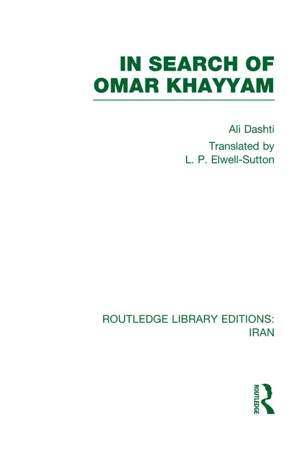
There is no conclusive evidence to prove which of the many quatrains attributed to Khayyam are authentic. Ali Dashti therefore constructs a likeness of the poet from references found in the works of writers of his day or immediately after, and from Khayyam's own works on philosophy, mathematics and astronomy, of which the authenticity is not questioned. Khayyam emerges as a widely read and broad-minded scholar, immersed in his own studies, cautious and moderate, averse to committing himself on controversial questions. Using this portrait Dashti draws up a list of some hundred quatrains which are in keeping with Khayyam's character.
Selling point: An elegant and accurate translation which throws light on the nature of Khayyam's religious and philosophical beliefs.
- 276 pages
- English
- ePUB (mobile friendly)
- Available on iOS & Android
eBook - ePub
In Search of Omar Khayyam (RLE Iran B)
About this book
Information
Part One
IN SEARCH OF KHAYYAM
Chapter One
KHAYYAM AS POET
More than 2,000 books and articles must have been written about Khayyam.1 Yet, while Khayyam the philosopher and mathematician is a clearly defined figure, easily discernible through his scientific and philosophical writings, Khayyam the poet is still unknown, a blurred indistinct personality. There is only one source from which we may judge his poetic nature – the quatrains – and we cannot be sure that any of them are his, and certainly some of them are not.
To make this point clear it is enough to glance briefly at the various collections that have been made of these. The smallest is the manuscript in the Bodleian Library at Oxford dated 1460/61, with 158 quatrains; almost contemporary with it is the Tarabkhané, compiled in 1462/3 and containing, together with many other poems, 559 quatrains attributed to Khayyam. More recent collections contain even larger numbers.2
This remarkable degree of discrepancy in numbers is matched by an equally wide range of quality. In vocabulary and style, as in content and thought, there are so many contradictions and inconsistencies, such a lack of linguistic homogeneity and continuity of ideas, that it seems inconceivable that they could all have stemmed from the genius of one man. As Sadeq Hedayat wrote: ‘Even if a man had lived for a hundred years, and had changed his religion, philosophy and beliefs twice a day, he could scarcely have given expression to such a range of ideas.’
To identify the genuine quatrains in the midst of this hodgepodge is no easy task even for foreign scholars with their tradition of research and their years of interest in the subject of Khayyam’s poetry. Their difficulty is that they rely wholly on manuscripts, which are not a satisfactory sole source, not only because their authenticity is always open to doubt, but because one cannot count on the discrimination of their compilers or the care and conscientiousness of the copyists.
The whole trouble is that Khayyam’s quatrains were never collected and written down during his lifetime. It is true to say that not a single one of them was published at the time and, in fact, none of his contemporaries who refer to him in their writings even so much as mention that he wrote poetry.
There is particular food for thought in the fact that Nezami Aruzi Samarqandi, the author of the Chahar Maqalé (Four Discourses), never once suggests that Khayyam was a poet, although he was a contemporary of Khayyam, met him in Balkh in 1112/3, devoted two anecdotes to him in his third Discourse and visited his grave in 1135/6; furthermore, in the second Discourse, which is devoted to the art of poetry, there is no mention of Khayyam or of any verse by him.
For this reason critics who demand proof before they will accept a statement have questioned whether in fact Khayyam was a poet and whether a learned mathematician such as he was could have written poetry. They point to the fact that with the passage of time the number of quatrains attributed to him steadily increased, and at the same time remarkable differences developed in the style and content, for the most part quite at variance with the poetry of the eleventh century. Some of them are so trite and repetitive that it is impossible to connect them with what we know of Khayyam’s philosophical personality.
The doubts of these critics are at first sight plausible, and the fact that there is no documentation from Khayyam’s own time must give pause to even the most unsuspecting reader. Some scholars have found confirmation of their doubts in a passage in the anonymous Mu’jam al-Alqab (Collection of Titles):
‘Ala’oddin Ali b. Mohammad b. Ahmad b. Khalaf Khorasani known as Khayyam, who has a divan of Persian poetry. His many poems are well known in Khorasan and Azarbayejan. I reproduce this Arabic verse from a manuscript in his own handwriting:
Is it musk or the down of a rosy cheek that surrounds
like a halo your moon-like face?
Or did they unveil your beauty too soon, and to hide
it you wove this new mantle of silk?’
First of all though it must be stressed that there is no record in the history of Persian literature of any such poet. One is entitled therefore to doubt the credibility of this account, especially as the writer of the book is unknown and we do not know how well versed he was in Persian language and literature. But still more to the point is the fact that wherever we find verses attributed to Khayyam he is never described as ‘the unknown Khayyam’ or ‘Khayyam the poet’, let alone ‘Ibn Khalaf’, but always as ‘Omar Khayyam the learned mathematician’, as a philosopher who composed quatrains by way of diversion from his scientific labours. Let us quote a few examples.
Khayyam’s poetry is mentioned for the first time in the Kharidat al-Qasr of Emadoddin Kateb Qazvini, a well documented biographical work on the poets of the Islamic world, written in about 1174/5, that is, some fifty-five years after Khayyam’s death. In the chapter dealing with the poets of Khorasan the author writes:
‘Omar Khayyam was without equal in his time, and without peer in the fields of astronomy and natural philosophy. His name has become proverbial, and in Isfahan they still repeat this Arabic verse of his:
If I may be content with simple living,
Such as my hand may gain by its own efforts,
I shall be safe ‘midst all the turns of Fate.
O Time! Be thou my right arm and my aid!’
The first reference to Khayyam’s Persian poetry is to be found in the Nuzhat al-Arwah (The Delight of Spirits) of Shahrazuri, written some years after the Kharidat al-Qasr and perhaps seventy or eighty years after Khayyam’s death.3 However this states simply that ‘he composed elegant verse in Persian and Arabic’, and then proceeds to quote several Arabic verses (including the one given in the Kharidat al-Qasr), but none in Persian.
It is not until we come to the essay by Fakhroddin Razi (d. 1209/10) entitled Risalat al-Tanbih ’ala ba’d Asrar al-Muda’a fi ba’d Suwar al-Qur’an (Essay on some of the secrets of certain chapters of the Koran) that we find a Persian verse by Khayyam actually quoted:
Our elements were merged at His command;
Why then did he disperse them once again?
For if the blend was good, why break it up?
If it was bad, whose was the fault but His? (19)4
Roughly contemporary with, or possibly earlier than, Razi’s Risala, is the Sendbadnamé of Mohammad b. Ali Zahiri Samarqandi, written towards the end of the twelfth century; this quotes five quatrains without attribution, all of which are assigned to Khayyam in later sources. The Marzbannamé (1210–25), as Homa’i points out in his introduction to the Tarabkhané, similarly quotes three Khayyamic quatrains without attribution.
Our next source is the Mirsad al-’Ibad (The Watch-tower of the Faithful) by Sheikh Najmoddin Dayé, written about a hundred years after Khayyam’s death. This is especially important because the two quatrains quoted in it are not only clearly attributed to Khayyam, but also used as grounds for criticism of him.
After this we find odd quatrains attributed to Khayyam in the Tarikh-e Jahangosha (1260), the Tarikh-e Gozidé (1329/30), the Tarikh-e Vassaf (1328) and the Ferdous at-Tavarikh (1405/6). The first substantial collections of quatrains also date from the first half of the fourteenth century, that is to say, some 220 years after Khayyam’s death; these are the Nozhat al-Majales (1330/1), which contains thirty-one, and the (perhaps more reliable) Mo’nes al-Ahrar (1339/40), which has thirteen.
Recently Mohammad Roushan discovered several quatrains by Khayyam in a manuscript of the Lam’at as-Seraj, copied in 1296; all but one are to be found in the above-mentioned sources. These verses are on the margins of the manuscript but in the hand of the original copyist.
So we have some 50 quatrains quoted over a period of more than two centuries, beginning with only 1 in the earliest source and working up to the 31 quoted in the Nozhat al-Majales; these in fact are grouped in a special section of the book, which contains altogether some 4,000 quatrains.
The important point is that the quatrains that appear in these various sources are not all the same, so we cannot assume that one author copied from another without acknowledgment. The Nuzhat al-Arwah and Qifti’s Tarikh al-Hukama (History of the Philosophers) repeat the verses quoted in the Kharidat al-Qasr but with the addition of several others, so that the latter cannot have been their sole source. The quatrain quoted by Imam Fakhr Razi also appears in the Mirsad al-’Ibad but with the addition of one other, while this latter one appears in the Mo’nes al-Ahrar with twelve others.
Obviously the source of this gradually increasing collection of quatrains cannot have been a book compiled in Khayyam’s lifetime or shortly after his death. We must assume that they came together in one of two ways. In the first place his friends and associates must have written down verses they heard him recite, which were passed on to the others or left among their papers; Khayyam had such a reputation for learning and wisdom that his quatrains would naturally have impressed themselves on the minds of thoughtful people who were weary of the bickering of the traditionalists and the formalist jurists, and the frequent variant readings suggest also that they circulated to begin with by word of mouth. The other possibility is that after Khayyam’s death quatrains were found among his papers and memoranda, but not immediately published through fear of the prevalent religious fanaticism of the day.
The most significant fact is that at least thirty or forty of these quatrains, scattered in so many different sources, are completely consistent in both style and thought, and seem clearly to be the product of a single genius. If, therefore, Khayyam existed, if in spite of his preoccupation with philosophy and mathematics he found time to write quatrains, and if in addition to this he had registered them under his own name as he might have done today, we can be fairly sure that the list would not be so very different from the one that we have put together on a largely speculative basis.
The problem is not whether or not Khayyam composed quatrains; it is not reasonable to suppose that writers, philosophers and historians should have connived together over a period of two centuries to attribute verses falsely to Khayyam. The real problem is to decide how many we can safely attribute to him, particularly in view of the fact that the further we move from Khayyam’s death the more numerous the quatrains become. This is particularly true after the first half of the fourteenth century; from this date onwards there is a steady increase in the numbers and size of collections of quatrains attributed to Khayyam. At the same time there is a progressive loss of unity and harmony in their literary style and line of thought. It is at this point that we have to bring into play certain principles of selection, of which reliance on manuscript authority is only one.
As a warning we may take the work of the Danish scholar, Arthur Christensen, who worked through eighteen sources including manuscripts in the Bodleian Library, the British Museum, the Bibliothéque Nationale, the Asiatic Museum in Leningrad and the Staatsbibliothek in Berlin, and editions published in Calcutta and by Rosen in 1925, and on this basis compiled a list of 121 quatrains that satisfied his academically sound principles. Yet, on the grounds of inconsistency with the others alone, 30 or 40 of these are open to doubt.
Persian-speaking scholars have a better chance of reaching a reasonable result, provided that they bring their instinctive good taste to bear and keep in mind such matters as the poetic style of the eleventh century and Khayyam’s own social position and spiritual state. Forughi and Hedayat are two good examples.
Forughi started with sources written before the fifteenth century – the Mirsad al-’Ibad, the Tarikh-e Jahangosha, the Tarikh-e Gozidé, the Nozhat al-Majales, the Mo’nes al-Ahrar and two manuscript anthologies in the Majles Library in Tehran, one of them dated 1349/50. These sources gave him a total of 66 quatrains, which he used as a criterion for some 500 others attributed to Khayyam, accepting only those that were in harmony with them in style and content and rejecting the rest. On this basis he considered that 178 quatrains could be ascribed to Khayyam with reasonable confidence, though he was careful to add that
‘… we do not claim that these quatrains that we have selected are unquestionably Khayyam’s, nor do we assert that they are the only ones he composed. The most we can say is that they are in the style of the Philosopher of Nishapur, and so can reasonably be held to be his. But the true arbiter has been our own personal taste and discrimination, rather than documentary evidence.’
Sadeq Hedayat was a young man when he made his selection and so perhaps did not have the same maturity of judgment. The extent to which he relied on his own sympathies is evident from the rather emotional wording of his introduction. His ch...
Table of contents
- Cover
- Halftitle
- Title
- Copyright
- Contents
- Introduction
- Note on Transliteration
- Preface to the Persian Second Edition
- PART 1. In Search of Khayyam
- PART 2. In Search of the Quatrains
- PART 3. Random Thoughts
- Appendix 1. Biographical Notes
- Appendix II. Glossary of Technical Terms
- Bibliography
- Index
Trusted by 375,005 students
Access to over 1.5 million titles for a fair monthly price.
Study more efficiently using our study tools.
Frequently asked questions
Yes, you can cancel anytime from the Subscription tab in your account settings on the Perlego website. Your subscription will stay active until the end of your current billing period. Learn how to cancel your subscription
No, books cannot be downloaded as external files, such as PDFs, for use outside of Perlego. However, you can download books within the Perlego app for offline reading on mobile or tablet. Learn how to download books offline
Perlego offers two plans: Essential and Complete
- Essential is ideal for learners and professionals who enjoy exploring a wide range of subjects. Access the Essential Library with 800,000+ trusted titles and best-sellers across business, personal growth, and the humanities. Includes unlimited reading time and Standard Read Aloud voice.
- Complete: Perfect for advanced learners and researchers needing full, unrestricted access. Unlock 1.5M+ books across hundreds of subjects, including academic and specialized titles. The Complete Plan also includes advanced features like Premium Read Aloud and Research Assistant.
We are an online textbook subscription service, where you can get access to an entire online library for less than the price of a single book per month. With over 1.5 million books across 990+ topics, we’ve got you covered! Learn about our mission
Look out for the read-aloud symbol on your next book to see if you can listen to it. The read-aloud tool reads text aloud for you, highlighting the text as it is being read. You can pause it, speed it up and slow it down. Learn more about Read Aloud
Yes! You can use the Perlego app on both iOS and Android devices to read anytime, anywhere — even offline. Perfect for commutes or when you’re on the go.
Please note we cannot support devices running on iOS 13 and Android 7 or earlier. Learn more about using the app
Please note we cannot support devices running on iOS 13 and Android 7 or earlier. Learn more about using the app
Yes, you can access In Search of Omar Khayyam (RLE Iran B) by Ali Dashti, L Elwell-Sutton in PDF and/or ePUB format, as well as other popular books in Social Sciences & Regional Studies. We have over 1.5 million books available in our catalogue for you to explore.