When it was originally published this book broke new ground in presenting one continuous narrative of the history of Christians in Persia from the second century A.D to the 1970s. The material gathered here was previously only to be found in obscure books, manuscripts and foreign periodicals.
Christians in Persia shows the intricate history of the period concerned; the personalities of the rulers and the ruled; the difficult task of the missionaries; their successes and failures and the consequences of their efforts. All this is related to the wider history of the country and to the expansion of Christianity in the East.
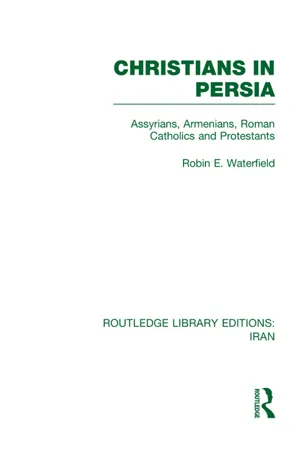
eBook - ePub
Christians in Persia (RLE Iran C)
Assyrians, Armenians, Roman Catholics and Protestants
- 204 pages
- English
- ePUB (mobile friendly)
- Available on iOS & Android
eBook - ePub
Christians in Persia (RLE Iran C)
Assyrians, Armenians, Roman Catholics and Protestants
About this book
Information
Part One
THE NESTORIAN PLANTING
Chapter One
THE BACKGROUND
Iran, the land better known to us as Persia, has a recorded history of some 2,500 years, but human settlements have been found dating back to 10,000 BC and a more or less continuous record of settlement can be traced from 5000 BC. Around 1800 BC the first wave of Aryans migrating from Transoxiana reached Iran, and it is from them that Iran received its name. Six hundred years later a second wave of migrants arrived, bringing with them their own religion and the Vedic Pantheon of Gods.
The first group in Iran to form a definite kingdom was the Medes who in alliance with the Scythians and the Babylonians attacked Assyria in 612 BC and destroyed its capital, Nineveh, thus becoming the overlords of the great Assyrian Empire. Just over fifty years later, in fact in 559 BC, Cyrus, heir to a petty dynasty in South Persia, overthrew his Median overlord, Astyages, and established the Achaemenian dynasty. Here, for the Persians, begins the history of their monarchy, which has endured as an institution for over twenty-five centuries and, as the recent celebrations show, is still a potent factor in the life of the country.
The dynasty founded by Cyrus (who fully deserved the title ‘Great’ which was accorded to him) was unparalleled by any previous one in its extent, its organisation, artistic achievement, and religious tolerance and respect for human rights. Its influence on Persian life and thought throughout the ages has been immense, and is still strongly felt today. This has been clearly demonstrated during the recent 2,500th anniversary celebrations.
One of the distinctive features of the period covered by the Achaemenian dynasty is the long drawn out war with the Greeks, who prevented Persia from expanding to the West. This war was finally settded in the reign of Darius III when the Greeks, under the leadership of the young Alexander of Macedon, attacked Persia. By a series of brilliant military marches, Alexander traversed Asia Minor and in 333 BC met and defeated the armies of Darius near the Cilician Gates at Issus. Alexander did not wait to consolidate his victory but pressed on eastwards. In 331, after capturing Tyre and making a detour into Egypt, he crossed the Euphrates and moved towards the village of Gaugamela near Arbela, where Darius had made his camp. On 1 October 331 the battle was fought which sealed the fate of the Persian Empire. Alexander next pushed on into the heartland of Persia, the province of Fars, and reached Persepolis, the site of Darius’ sacred palace and the symbolic heart of the Persian Empire, where he stayed until the spring of 330. During his stay there the palace was burnt, whether on purpose or by accident we shall probably never know. But whether the fire was accidental or intended, the destruction of Persepolis was a devastating psychological blow to Persian pride, and was seen by all as revenge for the burning of the Acropolis and the Great Temple at Babylon.
Until now Alexander had simply been the general acting on behalf of the League of Corinth in the prosecution of a war against the Persians. This assignment was now completed; henceforward Alexander acted on his own initiative – driven forward by his own ambitions and ideals. Alexander had been a pupil of Aristotle and had been greatly influenced by him and by Aristotle’s older contemporary, Isocrates. These philosophers had propounded the concept of homonoia, a word which can roughly be translated as ‘a being of one mind together’. Aristotle had propounded this idea as being the means whereby the various Greek city states might settle their differences, but he had never thought of applying it to anyone but the Greeks. But according to Eratosthenes, Alexander ‘believed that he had a mission from God to harmonise men generally and to be the reconciler of the world, bringing men from everywhere into a unity and mixing their lives and customs, their marriages and social ways, as in a loving cup’. A modern writer has summed up Alexander’s achievement in this way:
Alexander united the whole civilised world for the first time under a single head and gave to it a common language and culture. By the natural gifts of his extraordinary personality, he at the same time set before it a perfect model of kingship and thus ensured the persistence of the monarchical principle for two millennia. This, his conscious work, had a direct effect on the evolution of monotheism, while in other respects his conquests proved the turning point in the history of religions…. Before his coming we see the ancient world divided into separate communities each with its own pantheon and forms of worship … but immediately after, all this is changed. The interchange of ideas between East and West has thrown the religions of the world into the melting-pot in which the germs of a different grouping of the human race are dimly visible (Legge, Forerunners and Rivals of Christianity (1915), Vol. 1, pp. 26–7).
It was this vision of a world state living in peace and harmony that inspired Alexander and enabled him to reconcile those who were turning against him. At the great feast at Opis in 324 BC, when Macedonians and Persians sat down together and poured a libation from the great Krater or loving cup, Alexander prayed that they might in future be one commonwealth and live in homonoia together. Sir William Tarn was surely not exaggerating when he called Alexander ‘the man whose career was one of the dividing lines of world history’. Alexander’s ideals have had many echoes since that time: the Mazdakite dream of late Zoroastrianism and the Christian and Muslim ideals of the universal brotherhood of man were all foreshadowed in Alexander’s youthful idealism. Perhaps only Christianity has understood fully the price that mankind must pay for the realisation of such a dream. The fact that Alexander, or Iskandar as he is known to the Persians, is the enemy par excellence of Persia, has not diminished his stature in their eyes.
On the death of Alexander in 323 BC his Empire was divided between his generals. The main portion, including Persia, was inherited by Seleucus. Seleucus may have hoped to continue Alexander’s policies (he had married a Persian princess), but he and his successors preferred to live in Syria and paid little attention to the eastern parts of their kingdom. Less than 100 years later, these revolted and the Arsacid dynasty of Parthia came into being. At its greatest extent the Parthian kingdom extended from Afghanistan to the Tigris and from the Caspian Sea to the Persian Gulf.
THE RISE OF ZOROASTRIANISM
Most of Alexander’s ideals seemed irrevocably lost, but through the intermarriage which he encouraged and the cities which he founded, Greek culture and art spread throughout Persia and Central Asia. The Parthian kingdom lasted until AD 270, during which time the Romans replaced the Greeks as the enemy in the West. But Hellenistic culture was remarkably longlived, as may be gathered from the fact that centuries after Alexander’s death when the Parthians overcame the Consul Crassus, the Roman prisoners were surprised to find their Armenian Arsacid captors enjoying the plays of Euripides. Nevertheless, the Parthians were Persians at heart, as Ghirshmann writes: ‘By their revival of the Iranian spirit and their successful foreign policy, the Parthian-Arsacids prepared the way for the Sassanians, who were enabled to achieve a national unity and a civilisation that was more exclusively Iranian than it had ever been before (Ghirshmann, Iran, p. 288).
The Seleucid period had been a time of foreign domination and of cultural and religious ferment. The Parthian era had seen the absorption of foreign influences and the gradual rise of a national consciousness, not least in the matter of religion. The dominant religion of the Achaemenian period had, by the reign of Artaxerxes I (c. 441 BC), become Zoroastrianism. By the time of the Parthians, therefore, Zoroastrianism had already had a long and chequered career. Its founder, Zoroaster (? 628–551 BC), was probably a Median by birth, who attempted to reform the prevailing religion of his time, inherited from the Aryans and about which we know very little. He was opposed by the priestly caste and was forced to migrate eastwards to the kingdom of Chorasmia (now north-east Persia and western Afghanistan), where he was supported by the King, Vishtaspa.
In its original form the religion of Zoroaster was monotheistic and only dualistic in its ethics. Gradually this new religion moved westwards and for a time was as popular as the older religions. Religious rites and practices of whatever kind were in the hands of the Magi whose position, as Professor Zaehner says, ‘would seem to correspond to that of the Levites among the Jews, or, even more closely, to that of the Brahmans in India; they were a hereditary caste entrusted with the supervision of the national religion, whatever form it might take and in whatever part of the Empire it might be practised’ (Zaehner, Dawn and Twilight of Zoroastrianism, p. 163). Under the influence of the Magi many new elements were introduced and the simple monotheism of Zoroaster was lost; a religion far removed from his original teaching was gradually developed, strongly dualistic and with a rigid caste system.
With the rise of the Sassanian dynasty in AD 226 there was a revival of Persian nationalism and with this a desire to purify and strengthen the national religion and make it an instrument of state policy. The Sassanians continued the reaction against the religious and cultural pluralism, which had begun under the Parthians. They made the Zoroastrian religion and unrelenting opposition to the West the twin pillars of their national policy.
Various monarchs at various times flirted with unorthodox ideas. Shapur I, for instance, was interested in Manichaeism, and Kavad nearly destroyed his kingdom by his adherence to the Mazdakite heresy. Various members of the Sassanian dynasty gave greater or lesser support to Christianity as the general situation seemed to demand, but fundamentally they disapproved of all religions except Zoroastrianism and of all people except the Persian-speaking Aryans of the high plateau. Unfortunately, Persia has constantly found itself in contact with alien religions and alien races, some of whom have conquered the country or have for long periods been its rulers.
Such, briefly, was the situation and its background when Christians became an organised religious community in Persia round about AD 200.
Chapter Two
CHRISTIANITY IN IRAN TO THE END OF THE SASSANIAN DYNASTY
The tradition that the three kings who came to worship Christ at his birth were Persians is so old and honourable that one must begin with it. An earlier historian of Christian missionary work in Iran began his book by quoting from St John Chrysostom’s sixth Homily on Matthew’s Gospel where he writes:
The Incarnate Word on coming to the world gave to Persia, in the persons of the Magi, the first manifestations of His mercy and light … so that the Jews themselves learn from the mouths of Persians of the birth of their Messiah. Persico sermone didicerunt quae prophetis nuntiantibus discere noluerunt.
Still within the Gospel narrative we may hazard a guess that news of the new religion was also brought to Iran by some of those Parthians, Medes and Elamites whom Luke mentions as being present in Jerusalem on the Day of Pentecost. Perhaps some of these men and women may have brought to Iran the first rumours of the new religion, or may even have practised it themselves.
A very old tradition represents the Apostle Thomas as having brought Christianity to Parthia as well as to India – though later traditions mention only India. If we remember, however, that the Parthian Empire included present-day Afghanistan and quite a large portion of Northern India, then the two traditions are not irreconcilable. Tertullian and others confirm that there were Christians in Persia before the Sassanians and that by AD 220 the Church had some organisation with a number of loosely federated episcopal sees.
More certain are the links between Christians in Persia and Christianity in the little state of Osrhoene on her western borders, whose capital city, Edessa (modern Urfa in Turkey), was an important staging post on the trade route between the East and the Mediterranean. The tradition that the King of Edessa, Abqar, corresponded with Jesus or that the apostles, Thomas and Thaddaeus, or St Simon the Zealot brought the faith to the city must reluctantly be dismissed as baseless. But we know that by about AD 150, while Edessa was still part of the Parthian Empire, Christianity existed there and that by 190, when a controversy arose about the date of Easter, there were numerous bishoprics all over the Parthian Empire and Edessa itself was a flourishing Christian centre. It is possible that about this time the King was baptised since on coins minted between 180 and 192 a cross appears on the headdress of King Abqar VIII.
Edessa, from its origins as a Christian centre, came under the ecclesiastical control of the Patriarch of Antioch. Antioch was a largely Greek-speaking city, whereas, since the eighth century BC, the inhabitants of the Mesopotamian basin had spoken various dialects of the Semitic language Aramaic, not unlike the language spoken in Palestine at the time of Jesus. The eastern Aramaic dialect of Edessa was to become the literary and liturgical language of the Eastern Church there and later of the Church in Persia, where the language was also widely used for official and business purposes. The literary language known as Syriac produced a fine body of Christian literature and is still used by the remnant of the ancient Church in Persia and Iraq to this day.
Osrhoene, being a border state, was continuously involved in the wars between Rome and Parthia and later between Rome and the Persian Empire. In AD 216 the Romans conquered it and occupied it. So from the very earliest times it was torn between East and West and the uncertainty as to which side it was really on was one of the underlying causes of many future disputes. This tension is seen in one of the greatest Christian writers of Edessa, Tatian (born 150), whose only surviving original work is a violent diatribe against the Greeks – their culture, philosophy and religious ideas. His other work, The Diatessaron or harmony of the Gospel narratives, for long the only Gospel known to the Eastern Christians and greatly revered, was eventually condemned by the West as heretical.
THE SASSANIAN CHALLENGE
With the coming of the Sassanian dynasty the Christians soon found themselves in a changing and less favourable environment. It is impossible to estimate their numbers but we know that they formed a substantial minority of the population and on the whole were well educated and famous for their skill in medicine and the sciences.
Ardeshir, founder of the Sassanian dynasty, was the grandson of Sasan, the mobed or priest in charge of the important fire temple at Istakr near Persepolis. The Zoroastrian hierarchy consisted of mobeds, who were in charge of an area with numerous lesser clergy under them, and a mobed-mobedan or High Priest. As time went on, the power of the religious hierarchy greatly increased and they and the hereditary nobles and lesser rulers were constant sources of concern to the Shah-in-Shah or King. By 237 Ardeshir had made inroads into the Roman frontier provinces and had captured the important fortresses of Haran and Nisibis. The war continued and in 258–9 Ardeshir’s successor, Shapur I, pushed west as far as Antioch, beseiged Edessa, and even captured the unfortunate Roman Emperor Valerian.
The result of this successful campaign was that vast numbers of prisoners were brought into Persia. Many of these were Christians, including, it is said, Demetrius, Bishop of Antioch. The prisoners were settled near the small village of Beit Lapat in Khuzistan and were ordered by the King to build a new town, Gondishapur, afterwards to become a famous centre of learning. There is no doubt that many of the doctors and other learned men who made the university of Gondishapur famous were Christians.
The first figure in the Christian Church who emerges clearly is Papa, who became Bishop of Seleucia-Ctesiphon (the capital of the Empire) around 300. His importance lies in the fact that he tried to define the limits of the various dioceses, to regularise the method of appointing bishops and to bring them into some sort of federation, which would acknowledge the supremacy of the see of which he was bishop. Naturally enough, he met with considerable opposition, notably from Miles, Bishop of Susa. Miles, who was born near present-day Tehran, was a convert from Zoroastrianism and as Wigram puts it ‘began to show that combination of devotion, zeal, quarrelsomeness and restlessness which makes him so typical a son of his nation’. After quarrelling with his diocese he went on a pilgrimage to Jerusalem and Egypt. On his return he attended the episcopal synod convened to discuss the reforms of Papa. During the synod the argument between Miles and Papa became so heated that the elderly Papa had a stroke and had to retire temporarily from his post, leaving his reforms uncompleted.
THE PERSECUTION UNDER SHAPUR
In 323 the Emperor Constantine issued the Edict of Toleration at Milan. This meant the end of persecution for Christians in the Roman Empire and the nominal if not actual acceptance of Christianity as its official religion. In his Church history Eusebius relates that Constantine wrote a letter to King Shapur II congratulating him on his good treatment of the Christians in his kingdom and rejoicing in the continued growth of the Church in Persia. There is indeed much evidence that in the early years of Shapur’s reign – at least until the death of Constantine in 337 – the King was disposed to treat the Christians well. All this changed, however, when Shapur felt himself strong enough to challenge Rome and to demand back the five provinces ceded to Galerius in 297. Constantine, for whom the Persians had great personal respect, died just before the war broke out. His death no doubt encouraged the Persians to treat the Christians with manifest mistrust and to brand them as traitors. In 340 the King informed Simon Bar Sabbae, the Bishop of Seleucia-Ctesiphon (or the Catholicos as he was called), that henceforth he must collect double the previous tax from the Christians. The Catholicos refused to consent to such an unjust imposition. He was summoned to the court and given a final chance to agree. He again refused saying: ‘I am no tax-collector but a shepherd of the Lord’s flock.’ On Good Friday, 17 April 341, he and about 100 other Christians, including many clergy and some monks and nuns, were put to death. The long martyrdom of the Persian Christians had begun. This persecution lasted for almost forty years with scarcely any remission, and was borne with remarkable fortitude. Apostacies were few and the early Martyrologies are full of accounts of torture and sufferings borne with that courage and loyalty which Persians have always shown themselves capable of in any cause to which they have given their allegiance.
The accusations against the Christians that gave rise to the persecution are summed up in the King’s official rescript authorising its commencement. These Nazarenes ‘inhabit our country and share the sentiments of our enemy Caesar’ – words which have echoed in the ears of Persian Christians down the centuries ...
Table of contents
- Cover
- Halftitle
- Title
- Copyright
- Contents
- Preface
- PART 1. The Nestorian Planting
- PART 2. The Roman Catholic Era
- PART 3. The Protestant Endeavour and the Founding of Indigenous Churches
- Appendix. The Bible in Persian
- Bibliography
- Map
- Index
Trusted by 375,005 students
Access to over 1.5 million titles for a fair monthly price.
Study more efficiently using our study tools.
Frequently asked questions
Yes, you can cancel anytime from the Subscription tab in your account settings on the Perlego website. Your subscription will stay active until the end of your current billing period. Learn how to cancel your subscription
No, books cannot be downloaded as external files, such as PDFs, for use outside of Perlego. However, you can download books within the Perlego app for offline reading on mobile or tablet. Learn how to download books offline
Perlego offers two plans: Essential and Complete
- Essential is ideal for learners and professionals who enjoy exploring a wide range of subjects. Access the Essential Library with 800,000+ trusted titles and best-sellers across business, personal growth, and the humanities. Includes unlimited reading time and Standard Read Aloud voice.
- Complete: Perfect for advanced learners and researchers needing full, unrestricted access. Unlock 1.5M+ books across hundreds of subjects, including academic and specialized titles. The Complete Plan also includes advanced features like Premium Read Aloud and Research Assistant.
We are an online textbook subscription service, where you can get access to an entire online library for less than the price of a single book per month. With over 1.5 million books across 990+ topics, we’ve got you covered! Learn about our mission
Look out for the read-aloud symbol on your next book to see if you can listen to it. The read-aloud tool reads text aloud for you, highlighting the text as it is being read. You can pause it, speed it up and slow it down. Learn more about Read Aloud
Yes! You can use the Perlego app on both iOS and Android devices to read anytime, anywhere — even offline. Perfect for commutes or when you’re on the go.
Please note we cannot support devices running on iOS 13 and Android 7 or earlier. Learn more about using the app
Please note we cannot support devices running on iOS 13 and Android 7 or earlier. Learn more about using the app
Yes, you can access Christians in Persia (RLE Iran C) by Robin Waterfield in PDF and/or ePUB format, as well as other popular books in Social Sciences & Regional Studies. We have over 1.5 million books available in our catalogue for you to explore.