Throughout his life the Shams-ul-Ullema devoted himself to advancing the Zoroastrian Faith, not only as a priest and teacher, but also as a writer. This volume of papers is authored by an international group of scholars and covers the history, philosophy, literature and language of Persia and the Indo-Iranians.
eBook - ePub
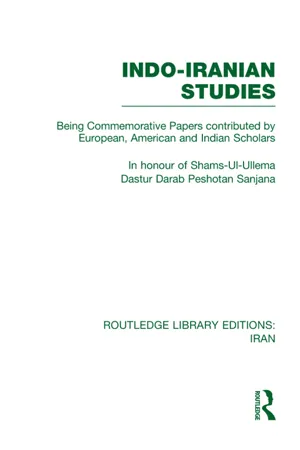
Indo-Iranian Studies
Being Commemorative Papers contributed by European, American and Indian Scholars
- 308 pages
- English
- ePUB (mobile friendly)
- Available on iOS & Android
eBook - ePub
Indo-Iranian Studies
Being Commemorative Papers contributed by European, American and Indian Scholars
About this book
Information
LAW IN ANCIENT IRAN
The systems of laws prevailing in different countries very in accordance with the moral, social and religious life of the people. The study of a nation’s laws can very well furnish us with the customs in vogue at a particular period in that nation’s history. Ancient history further reveals to us that justice administered in primitive society was nothing better than the decision of the elders laying down rules of conduct for the others to follow, a breach of such rules being punished. It is only when a society emerges from the primitive stage and when the people begin to live in larger groups of villages, towns and countries that regular courts of law come into existence, and different judges and other officers are appointed to administer justice. People in course of time then find it necessary to promulgate laws and rules of procedure and evidence in order that the administration of justice may be similar in all the courts in the country.
The laws at present prevailing in different countries of Europe are mostly based on the works of the great Roman jurists who early saw the advantages of codifying their laws. A large number of the works of these ancient jurists is still extant and they help us in getting a good idea of the different social and religious institutions in vogue among the ancient Romans. It is our misfortune that we do not possess the works on law written by the ancient Iranians in their entirety to give us similar information regarding the people of a country that saw the birth and fall of so many ancient civilizations. While the Code of Justinian giving the collection of all legal information then available and useful can still be studied and admired by lovers of ancient law and history, we are only favoured with a summary of the voluminous legal literature of the ancient Persians which was at one time collected in what were called the Dâtic Nasks.
It is significant to note here that the law books which comprised these Dâtic Nasks were all composed and written long before the Achæmenian period in the history of Persia, and are thus much older than most of the books we now possess from the lawgivers of ancient Greece or Rome. The Nasks were originally written in Avesta, and subsequently, like all other A vest a works, they were translated into Pahlavi. It is our misfortune that both the Avesta text and its Pahlavi translation of all the Dâtic Nasks, with the only exception of the Vendîdâd, have not survived the ravages of time and the vicissitudes which the people of Iran were subjected to in later times at the hands of their foreign conquerors. But for the labours taken by the compilers of the voluminous Pahlavi work, the Dînkard, we could have no idea of the scope and extent of these law books of ancient Iran.
The Dînkard Books VIII. and IX. are devoted to the contents of the twenty-one Nasks in which the original Avesta books were divided. Here we are concerned with the seven Nasks which are included in the Dâtic group, viz., the Nîkâdûm, the Dûbâsrûjîd, the Hûspâram, the Sakâdûm, the Vîd-shaêdâ-Dâta, the Chitra-dâta, and lastly the Bagân-yasht. Fortunately for us the contents of most of the Dâtic Nasks have been given in details unlike those of the Nasks of the other two groups, the Gâthic and the Hadha-Māthric. The compiler in his Pahlavi introduction lays down a plan for the grand work he had in mind. He wanted, in Dînkard Book VIII., to give a short summary of each Nask, and then give fuller details dealing with each section of the Nask in Dînkard Book IX. and subsequent works. But, somehow, this plan has not been strictly followed. Till we come to Chapter XIV . of Book VIII. each Nask is only briefly summarised. These chapters include those devoted to two of the Dâtic Nasks, viz., the Chitra-dâta and the Bagân-yasht. These two Nasks are not so important for a student of legal institutions among the people of ancient Iran, and we have not lost much by the author omitting to give the contents in details as he did with regard to the other Nasks in the group. While passing on to these more interesting Nasks it might be mentioned here that the Chitra-dâta Nask is more important to a student of ancient Persian history as it traces the descent of various races of mankind, and incidentally narrates the exploits of the great rulers of ancient Persia, up to the end of the Kayânîan dynasty. The Bagân-yasht was devoted to a description of the good spirits and how they were to be adored. Beginning with Chapter XV . of Book VIII. twenty-nine interesting chapters are devoted to the contents of the remaining five Dâtic Nasks, each section of each Nask being described separately and faithfully.
A study of the contents of these Dâtic Nasks reveals to us the fact that these law books were not compiled like the codes in Greece or Rome, and we should not believe that they had any authority of the legislature behind them like the Acts passed by a Parliament or sovereign authority. These books contained a collection of legal principles on which justice was administered in the country. In some chapters we even find subjects treated which had very little to do with law, but were, it appears, included in the Dâtic Nasks as principles of morals or religion which the people ought to observe. Each violation of the divine law as revealed by Zarathushtra was then regarded a crime against society and punishe...
Table of contents
- Cover
- Halftitle
- Title
- Copyright
- Contents
- Professor Wilhelm Geiger’s Letter
- Introduction
- Zarathustra: His Life and Doctrine. By Prof. Christian Bar-tholomse, University of Heidelberg. Translated from the German by Dr. V. S. Sukthankar, M.A., PH.D
- Avesta Urvato and old Persian Usabarim. By Professor A. V. Williams-Jackson, Columbia University, New York City
- Pahlavi, Pazand, and Persian References to the double nature of the Amshaspands. By Prof. Louis H. Gray, University of Nebraska
- The Religion of the Achaemenids from the German of Prof. A. V. Williams-Jackson. By the Revd. Dr. D. Mackichan, M.A., D.D., LL.D
- The Zarvanite System. By Mr. Irvin Frederick Blue, M.A.
- Educational Elements in the Gathas. By the Rev. Prof. R. Zimmer-mann, S.J.
- Law in Ancient Iran. By Mr. Jamshed C. Tarapore, M.A., LL.B.
- Ahura Mazda’s Fravashi. By Dastur Dr. Maneckji Nusservanji, Dhalla, PH.D.
- The Pahlavi Text of Aogemadaechd. By Ervad Bamanji Nusservanji Dhabhar, M.A.
- The Sixteen Sanskrit Shlokas given in Dastur Aspandiarji Kam-dinji’s Book. By Mr. Shapurji Kavasji Hodivala, B.A.
- The word (ahura) in Sanskrit and the Gobhilas. By Dr. Irach J. S. Taraporewala, B.A., PH.D., Bar.-at-Law, Professor of Comparative Philology in the University of Calcutta
- Ahura Mazda, the Knowing Lord. By M. Raffaele Pettazzoni, Professor of History of Religions at the R. University of Rome.
- The Gathic Doctrine of Dualism in Aristotle. By Mr. Sorabji Navroji Kanga, B.A.
- Miscellaneous Iranian Notes. By Mr. R. P. Dewhurst, i.o.s. (Retired)
- Palace Ruins and Cyrus Relief Pasargadse. By Dr. Herbert Cushing Tolman, PH.D., S.T.D., LL.D., Dean of the College of Arts and Science, Vanderbilt University
- The Indo-Iranians and their neighbours. By Dr. Edward Joseph Thomas, M.A., D.LITT
- An Allusion to Manichseism and Zoroastrianism in the Armenian Writer Eznig of Goghp. By Mr. Vahan H. Kalenderian, A.B., LL.B., Columbia University, New York City
- A Notice of Manichsean Persecution by the Sasanian King Kawad in the Fifth Christian Century. By Dr. Abraham Yohannan, Columbia University, New York City
- The Zoroastrian Demon Az in the Manichsean Fragments from Turfan. By Dr. George 0. 0. Haas, A.M., New York City
- The Account of Zoroastrianism given by the Byzantine Historian Agathias. By Dr. Charles J. Ogden of New York City, U.S.A.
- Iran’s Primeval Heroes and the Myth of the First Man. By Prof. A. J. Carnoy, Louvain, Belgium
- A Metrical Translation of the Nirang-i-Kusti. By Mr. Sorabji Pestonjee Kanga, Assistant Financial Secretary (Retired), H. E. H. the Nizam’s Government, Hyderabad (Deccan)
- – The Two Spirits—Spenta and Angra—in the Avesta. By Mr. N. D. Khandalavala, B.A., LL.B
- The Avestan Instrumental ending in -IŠ and -UŠ. By Prof. Hans Reichelt
- The Sovereignty of the Persians, from the German of Dr. Ferd. Justi. By the Revd. Dr. D. Maekich an, M.A., D.D., LL.D.,
- Zum Kar-Namak. By Prof. Von Albrecht Goetze, Heidelberg
- A Fragment of the Sanskrit Version of the Videvdat, and Glossary of Select Words. By Dr. J. M. Unvala, PH.D.
- Zaota. By Prof. Karl F. Geldner. Translated from the German by Dr. J. M. Unvala, PH.D.
- A brief History of the Study of the Religion and Literature of the Zoroastrians during the different epochs of History. By Mr. Shapursha Sorabsha Dalai, B.A
- Appendix
Trusted by 375,005 students
Access to over 1.5 million titles for a fair monthly price.
Study more efficiently using our study tools.
Frequently asked questions
Yes, you can cancel anytime from the Subscription tab in your account settings on the Perlego website. Your subscription will stay active until the end of your current billing period. Learn how to cancel your subscription
No, books cannot be downloaded as external files, such as PDFs, for use outside of Perlego. However, you can download books within the Perlego app for offline reading on mobile or tablet. Learn how to download books offline
Perlego offers two plans: Essential and Complete
- Essential is ideal for learners and professionals who enjoy exploring a wide range of subjects. Access the Essential Library with 800,000+ trusted titles and best-sellers across business, personal growth, and the humanities. Includes unlimited reading time and Standard Read Aloud voice.
- Complete: Perfect for advanced learners and researchers needing full, unrestricted access. Unlock 1.5M+ books across hundreds of subjects, including academic and specialized titles. The Complete Plan also includes advanced features like Premium Read Aloud and Research Assistant.
We are an online textbook subscription service, where you can get access to an entire online library for less than the price of a single book per month. With over 1.5 million books across 990+ topics, we’ve got you covered! Learn about our mission
Look out for the read-aloud symbol on your next book to see if you can listen to it. The read-aloud tool reads text aloud for you, highlighting the text as it is being read. You can pause it, speed it up and slow it down. Learn more about Read Aloud
Yes! You can use the Perlego app on both iOS and Android devices to read anytime, anywhere — even offline. Perfect for commutes or when you’re on the go.
Please note we cannot support devices running on iOS 13 and Android 7 or earlier. Learn more about using the app
Please note we cannot support devices running on iOS 13 and Android 7 or earlier. Learn more about using the app
Yes, you can access Indo-Iranian Studies by Various in PDF and/or ePUB format, as well as other popular books in Social Sciences & Regional Studies. We have over 1.5 million books available in our catalogue for you to explore.