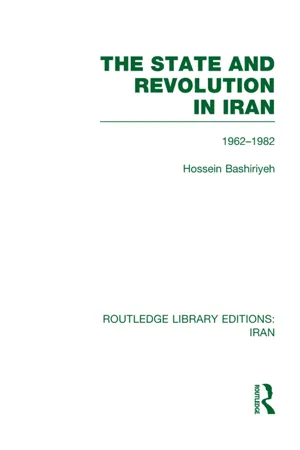
This book analyses the distant and proximate causes of the 1978 revolution in Iran as well as the dynamics of power which it set in motion. The volume explains the complex and far-reaching processes which produced the revolution, beginning in the late nineteenth century. In explaining the more proximate causes of the revolution, the book analyses the nature of the old regime and its internal contradictions; the emergence of some fundamental conflicts of interest between the state and the upper class; the economic crisis of 1975-8 which made possible a revolutionary mass immobilisation; and the emergence of a new religious interpretation of political authority and the unusual spread of the ideology of political Islam among a segment of the modern intelligentsia. The volume relates the diverse aspects of class, ideology and economic structure in order to provide an understanding of the political processes.
- 212 pages
- English
- ePUB (mobile friendly)
- Available on iOS & Android
eBook - ePub
The State and Revolution in Iran (RLE Iran D)
About this book
Information
1 THE EVOLUTION OF THE STATE STRUCTURE
In order to arrive at an analysis of the state which was overthrown in the 1979 revolution, this chapter investigates the major historical changes in the structure of Iranian polity and society since the turn of the century, as well as the more recent origins of the pre-revolutionary state.
The Break-up of Absolutism
During the second half of the nineteenth century or the so-called ‘Age of Imperialism’, Iranian society passed through a process of fundamental change which amounted to a significant break with its past. The reverberations of those changes have since formed the political history of Iran.
The traditional Iranian state had been based on an absolutist power structure in which the Shahs wielded supreme political authority. In times of strength, the royal court (darbār) subdued all society to its power, and in times of relative weakness. it manipulated and neutralised all contending sources of power. The structure of authority was patrimonial and the kings made grants and commissions as acts of grace.1 This political absolutism was founded on the absence of legal private property and the existence of state-communal property.2 The Persian despot was in possession of the means of production, i.e. land, and as a result, in Persian absolutism in contrast to Western feudalism, no established hereditary landed nobility developed.3 Land-holding was bureaucratic and the ruler granted land assignments (tuyūl). But this was temporary in nature and there was no contract between the ruler and the assignee (tuyūldār)4 The political upheavals characteristic of Persian history, i.e. internal tribal fighting and foreign invasions, also contributed to this social instability. Besides bureaucratic land-holding, absolutism also meant the interference of the state in trade and commerce. The bazaar guilds, originally imposed from above, were channels for the administration of the bazaars, which were subordinated to the absolutist state.5
This picture of absolutism is only the ideal type of the premodern history of Iran. At times, Iranian polity fluctuated between despotism and feudalism, especially during the rule of foreign invaders when feudal land-holdings were established.6 After a long period of invasions and weakness, a strong despotic state was established under the first Shiite dynasty, the Safavids (1501-1722) who subdued the tuyūldārān and extended state control of the bazaar.7 The absolutist state structure began to disintegrate, however, under the Qajar dynasty (1796-1925) due to compounded external and internal causes. During the nineteenth century, classes with independent sources of power and wealth began to emerge. In this period, the state was in need of money in order to buy Western arms to defend itself. This led to the systematisation of the sale of state lands and offices and consequently to the growing power of the landed classes, the mercantile bourgeoisie and the clergy.8 Furthermore, the expansion of the world economy and Western imperialism accelerated the process of the disintegration of absolutism. Although the state was saved from outright foreign control due mainly to a conflict of interests between the two great powers, Britain and Russia, its hold over society declined. The system of tuyūldārī began to disintegrate and the state became increasingly dependent on foreign powers.9 Also, due to a growth in foreign trade resulting from the increasing incorporation of Iran into the capitalist exchange system, the merchant class prospered and a number of big business families rose to prominence.10 Another consequence of the disintegration of the Qajar state was an increase in the power of the ‘Ulama and the Mujtaheds (the learned men of Islam and doctors of divinity). Under the Safavids who established the first Shiite state in Iran and who imported clerics from Arab lands to legitimise their claim to religious authority, the Ulama were closely associated with the rulers and were also in charge of religious endowments (ouqāf). No conflict occurred between the kings and the Ulama in the Safavid era in spite of the fact that Shiism had originally been an opposition movement in Islam and the main point of its opposition concerned the qualities of the political leader. Theoretically, all temporal power was illegitimate and legitimate authority belonged to Imams from the line of ‘Ali (the first Shiite Imam), and since the Occultation of the last Imam, Mahdī in AD 874, the Ulama were considered to be the ‘general agency’ of the Absent Imam.11 However, despite the persisting ambiguity of the theoretical relationship between temporal and religious powers, under the Safavids the Mujtaheds emerged as a major power elite and cooperated with the kings.
During the Qajar era, a rift began to arise between the rulers and the Ulama. Paradoxically, the increasing foreign influence contributed more to a rise in the power of the Ulama than to their weakness. They were opposed to Western penetration and the ensuing secularisation of traditional institutions. The reaction of the Ulama to Western influence gave them a new position of power, and they emerged as the proponents of the rising indigenous nationalism which was expressed in terms of Islam. Thus, the increasing power and opposition of the Ulama were more functions of rising nationalism in the face of Western imperialism than the imperatives of Shiite political theory.12 The Ulama also had strong connections with the bazaar through the religious taxes they received for the financing of mosques and seminaries. In addition, law and education were the prerogatives of the Ulama.13 Another important consequence of increasing contact with the West was the emergence of the modern intelligentsia which as a constitutionalist and secularist class-fragment posed a new challenge to the traditional order.
On the whole, under the Qajars the structures of the traditional state began to dissolve.14 The fragmentation of the Qajar polity into contending classes and interests finally led to the Constitutional Revolution of 1905. It began with the protests of merchants and the Ulama about the influence of foreign officials in the government and led to the introduction of a constitution (adapted from the 1830 Belgian Constitution) and the establishment of a parliament. The revolution was the result of an alliance among the bazaar bourgeoisie, the Ulama, the modern intelligentsia and some landed nobles and tribal chiefs.15 The Constitution granted all participants prerogatives and rights while limiting the power of the court. The 1906 Electoral Law gave the vote to the Qajar tribe, the Ulama, nobles, merchants, landowners and the guilds and distributed Majles seats among the same classes.16 Of the deputies of the First Majles, 21 per cent were landlords, 37 per cent were from the bazaar guilds, 17 per cent were from the Ulama and 25 per cent were state employees and professionals.17 The Ulama obtained a significant prerogative. A parliamentary committee of five Mujtaheds was to be formed in order to ensure the conformity of legislation with Islamic law. As to the landlords, one of the early Acts of the Majles abolished the tuyūlārī system and established private property on land. Thus the majority of villages fell under landlord ownership and most peasants became landless share-croppers.18 On the whole, several classes came to occupy the power bloc which was born out of the revolution. The landed nobility, the Ulama and the bazaar emerged as forces to be reckoned with. As the royal court under the young son of the exiled Mohammad Ali Shah continued to weaken in the 1910s, the landed class emerged as the dominant force. In the 1907-21 period, the number of landed Majles deputies increased from 21 to 50 per cent; that of the guilds declined from 37 to 5 per cent; that of the Ulama also declined from 17 to 13 per cent; and the number of professional deputies rose from 25 to 31 per cent.19
The constitutional system gave rise to factionalism and party politics. After 1909, two main parties, representing the main classes in the power bloc, dominated the Majles. The intelligentsia formed the Social Democrats Party, a secularist minority faction advocating land reform and the creation of an army. And the landed and Ulama deputies formed the Social Moderates Party, the conservative majority faction in the Majles.20
Although the aim of the Constitution was to establish a liberal regime, due to a number of factors, a military authoritarian regime emerged in the 1920s. The outbreak of the First World War; the weakening of the central administration; the suspension of the Majles; the outbreak of local rebellions in Gilān, Āzarbāyjān and Khorāsān; the growing influence of Great Britain in Iran after the October Revolution in Russia; and the declining influence of the Qajar court – all these contributed to a transfer of power in 1921, in a British-backed coup d’état, to Reza Khan, a colonel in the Cossack Brigade. With the Qajar court in ruins, the Majles proposed, in 1924, to declare a republic. But in the face of opposition to this from the Ulama and the bazaar, Reza Khan was declared king as the founder of the Pahlavi dynasty.
Under Reza Shah’s authoritarian regime (1925-41) an attempt was made to centralise the state and to secularise society. Although the landed class became firmly established in its estates, it was politically subordinated to the military. The bazaar guilds were also suppressed and the public sector in the modern sense began to emerge in the context of the world economic crisis of the 1930s. In particular, the influence of the Ulama was severely undermined. Religious practices were discouraged and the anti-clerical integral nationalism of the state put emphasis on pre-Islamic Iranian culture. The Ulama were denied their constitutional right of appointing a parliamentary commission to supervise legislation, and in 1934 the state extended its hold over pious endowment lands. Reza Shah’s authoritarian regime was, of course, not the restoration of traditional absolutism. It was rather the first such regime to develop in the context of the new social formation ushered in by the Constitutional Revolution. Unlike the regimes which followed it, however, Reza Shah’s regime was a traditional authoritarian regime which ruled over a rather politically inert population resulting in the political exclusion of social classes rather than in their incorporation in a political party. The rule of Reza Shah came to an abrupt end after the occupation of Iran by the Allies during the Second World War, due to Iran’s pro-German sympathies. He was succeeded to the throne by his twenty-year-old son, Mohammad Reza Pahlavi (1941-79).
Despite the emergence of authoritarianism, the work of the Constitutional Revolution was accomplished, in that Iranian society was delivered from oriental despotism to a new social formation, in which the concepts of freedom and rights of the civil society became predominant, i.e. the capitalist social formation. Once the absolutist state crumbled, several classes and class-fractions came to the fore to shape the emerging state. Thus we enter into a class conception of Iranian politics.
The Emerging Social Classes and Political Forces
After the Constitutional Revolution, the specific interests of the social classes which thus came to the fore, and the political ideologies maintained by those classes, led to the emergence of a number of political parties. With regard to the social organisation of production, the social structure was composed of the following classes: the landed and tribal nobility (including the royal family), the high Ulama and the emerging upper bourgeoisie who were in possession of the main means of production, i.e. land and mercantile capital; the bazaar national and petty bourgeoisie; the rising salaried new petty bourgeoisie; the working class and the peasantry. The political ideological system which emerged after the revolution comprised four ideologies: liberal conservatism, democracy, non-liberal clerical fundamentalism (political Islam) and popular socialism. It was mainly the upper and middle classes which developed ideologies of their own; there were no peasant and few working-class traditions. Liberalism was the ideology of the landed and merchant class, advocating a strong parliamentary system but no major social changes. The majority of the Ulama also advocated liberal-constitutionalism as provided for by the Constitution. As we shall see in some detail, the major constitutionalist Ulama during and after the revolution, such as Ayatollahs Behbehani, Tabatabai, Khorasani and Naini, accepted the legitimacy of a secular-constitutional state based on a combination of divine and man-made laws. After the revolution, a minority of the Ulama, however, called for the adoption of Islamic law (Sharīat) rather than a Western constitution as the law of the state; this was the ideological origin of fundamentalist Islam. The bazaar petty bourgeoisie was close to the Ulama and supported their liberalism and traditionalism, but in association with the lower clergy and religious students, it als...
Table of contents
- Cover
- Halftitle
- Title
- Copyright
- Contents
- Preface
- Introduction: Analytical Framework
- 1. The Evolution Of The State Structure
- 2. The Old Regime: The Rule of the Monarchy
- 3. The Rise Of A Revolutionary Ideology: Resurgence Of Islamic Nationalism
- 4. The Crisis of the Economy and the Crisis of the Dictatorship
- 5. The Coming Of The Revolution
- 6. Towards the Reconstitution of the State
- 7. The Rule Of The Fundamentalist Clergy
- Postscript: The Thermidor
- Conclusion
- Select Bibliography
- Index
Trusted by 375,005 students
Access to over 1.5 million titles for a fair monthly price.
Study more efficiently using our study tools.
Frequently asked questions
Yes, you can cancel anytime from the Subscription tab in your account settings on the Perlego website. Your subscription will stay active until the end of your current billing period. Learn how to cancel your subscription
No, books cannot be downloaded as external files, such as PDFs, for use outside of Perlego. However, you can download books within the Perlego app for offline reading on mobile or tablet. Learn how to download books offline
Perlego offers two plans: Essential and Complete
- Essential is ideal for learners and professionals who enjoy exploring a wide range of subjects. Access the Essential Library with 800,000+ trusted titles and best-sellers across business, personal growth, and the humanities. Includes unlimited reading time and Standard Read Aloud voice.
- Complete: Perfect for advanced learners and researchers needing full, unrestricted access. Unlock 1.5M+ books across hundreds of subjects, including academic and specialized titles. The Complete Plan also includes advanced features like Premium Read Aloud and Research Assistant.
We are an online textbook subscription service, where you can get access to an entire online library for less than the price of a single book per month. With over 1.5 million books across 990+ topics, we’ve got you covered! Learn about our mission
Look out for the read-aloud symbol on your next book to see if you can listen to it. The read-aloud tool reads text aloud for you, highlighting the text as it is being read. You can pause it, speed it up and slow it down. Learn more about Read Aloud
Yes! You can use the Perlego app on both iOS and Android devices to read anytime, anywhere — even offline. Perfect for commutes or when you’re on the go.
Please note we cannot support devices running on iOS 13 and Android 7 or earlier. Learn more about using the app
Please note we cannot support devices running on iOS 13 and Android 7 or earlier. Learn more about using the app
Yes, you can access The State and Revolution in Iran (RLE Iran D) by Hossein Bashiriyeh in PDF and/or ePUB format, as well as other popular books in Social Sciences & Regional Studies. We have over 1.5 million books available in our catalogue for you to explore.