eBook - ePub
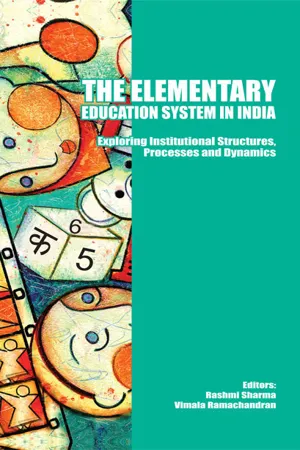
The Elementary Education System in India
Exploring Institutional Structures, Processes and Dynamics
- 368 pages
- English
- ePUB (mobile friendly)
- Available on iOS & Android
eBook - ePub
The Elementary Education System in India
Exploring Institutional Structures, Processes and Dynamics
About this book
This book focuses on the failure of elementary education since Independence, which is usually seen as the result of simplified phrases like 'lack of political will', 'because of poverty', etc. This book looks at the system as a whole: infrastructure, quality of teaching, privatisation, nutritional incentives, curriculum. It contains samples from two states namely Rajasthan and Andhra Pradesh.
Trusted by 375,005 students
Access to over 1.5 million titles for a fair monthly price.
Study more efficiently using our study tools.
Information
Topic
EducationSubtopic
Elementary Education1
Introduction
Vimala Ramachandran and Rashmi Sharma
The State shall endeavour to provide, within a period of ten years from the commencement of this Constitution, free and compulsory education for all children until they complete the age of fourteen years (Article 45, Directive Principles of State Policy, Constitution of India, 1950).
The State shall provide free and compulsory education to all children of the age of six to fourteen years in such manner as the State may, by law, determine (86th Amendment, Article 21 A, Constitution of India, December 2002).
A span of more than half-a-century separates the articulation of the Directive Principles of the Indian Constitution that saw elementary education as a moral obligation that the State would endeavour towards, and the 86th Amendment that made the Right to Education a fundamental right, enabling citizens, at least theoretically, to demand it of the State. This shift encapsulates the story of post-independence State action in elementary education in the country. At the time of India's independence, less than a fifth of its population was literate; thus, for a newly independent country, the task of making elementary education universal was truly monumental. Six decades later, in the next century, the task still looms large and, as the approach paper to the Tenth Plan (2002-07) points out: ‘Out of approximately 200 million children in the age group 6-14 years, only 120 million are in schools and net attendance in the primary level is only 66 per cent of enrolment.’ But in 2002, unlike immediately after independence, the inability of India — which was celebrating its accelerating economic growth and racing ahead to consolidate its position in the field of information technology — to make elementary education universal seemed both incomprehensible and shameful. Six years later in 2008, as this book is written, the economy remains buoyant and Indian pride in the success we have achieved in the high-tech field of information technology is still rising, but elementary education is not yet universal.
The factors that have contributed to our failure to universalise elementary education form the point of departure for this book. We begin with the assumption that these need to be understood in their complexity, rather than in terms of such phrases such as ‘lack of political will’, ‘because of poverty’ or ‘grand collusive designs of the national elites with the forces of international capital’. We do not deny that all these, and many other such phrases, do contain several grains of truth. But they also divert our attention from the intricate dynamic that underlies the problems of elementary education in India. It is this dynamic that this book attempts to articulate.
The difficulties and dilemmas of elementary education need to be seen against the fact that they have persisted over six decades of varying economic, political (at least since 1977) and policy contexts. In other words, they are not simply attributable to the level of economic growth or political ideology, though these can provide important bases for addressing various issues. This is visible in the relative success in elementary education achieved by various states. For instance, Punjab and Haryana have witnessed a high degree of economic growth, but are not leaders in education. In contrast, Kerala is well known for its success in elementary education and literacy despite modest economic growth. Equally, West Bengal has had some success with land reforms and a range of pro-poor economic policies, but not with elementary education.
At the same time, these problems have persisted not only across the changing larger context but, as the discussion in the following sections of this chapter shows, also across a range of various types of policy thrusts and programmes. For instance, a fairly wide set of strategies and programmes vis-à-vis elementary education has been initiated by the central government to address issues like expansion of schooling, upgradation of teacher qualifications and salaries (followed by reversals during the 1990s), provision of infrastructure, creation of an institutional structure for teacher education, non-formal and alternative schooling, institutionalisation of community participation, curricular and textbook reform, and so on. Yet all these programmes, from the simplest to the relatively more complex, from the most rigid to the fairly flexible, have been bogged down by a common problem of ‘poor implementation’. While some policy thrusts and programmes have been better conceptualised than others, and consequently have had somewhat greater impact, the commonality of the problems that confront all policy thrusts and programmes is striking.
The fact that the successes and failures of elementary education in India are not fully explicable in terms of levels of economic growth, ideologies of political regimes and even policy thrusts (though these are, of course, important) indicates that there are issues embedded more deeply in the ‘system’ or the institutional structures, processes and dynamics, which need to be closely examined.. Two other factors point in the same direction. First, there is increasing evidence in recent studies that the functioning of schools is itself a major problem area (The PROBE Report 1999). A fairly large part of the ‘school problem’ comprises poor motivation and skills of teachers and supervisors, inadequate time spent on classroom teaching and unsatisfactory classroom processes. The second factor is the paucity of administrative and institutional reforms in the area of elementary education. While policies have been formulated to address a range of concerns such as out-of-school children and curricula, no policy has attempted to comprehensively address the reform of an administrative system set up in the colonial era, or the lack of vibrancy and productivity of various educational institutions. In this book, we explore this silence, and attempt to understand ‘the system’ or the institutional set-up of elementary education in India.
Before exploring the institutional structures, processes and dynamics, however, it is important to become familiar with the current situation and the main problems of elementary education in India, as well as the policy and programmatic thrusts in this area. In the current chapter we briefly sketch the national picture vis-à-vis elementary education, and while doing so also substantiate the case for the need to examine the ‘system’, i.e., the institutional structures, processes and dynamics. In the first section we highlight the major milestones of national policy development; in the second we outline the main problems of elementary education in India; in the third we describe the major national-level programmatic thrusts; and finally, in the last section, we explain the structure of the rest of the book.
The Overall National Policy Context
As per the Indian Constitution as originally enacted after independence, education was a ‘state’ subject, i.e., the responsibility of state governments rather than the national government. Yet, in the post-independence years, the central government played a critical role in developing a fairly uniform system across the country. One way in which it did this was by creating national institutions that could advise, play a leadership role and set standards. The Central Advisory Board of Education (CABE),1 which played a role in policy formulation, was already in existence since before independence. The National Council for Educational Research and Training (NCERT)2 was set up in 1961 and the Central Board for Secondary Education (CBSE)3 in 1962. NCERT 's mandate includes a range of activities to improve school education including research, curriculum, textbook production and training. The most important role of CBSE is to conduct examinations and grant certificates and diplomas for secondary schools (Shukla 1989). In the same year (1962) the Institute of Educational Planning and Administration was established in collaboration with UNESCO, of which the central government took over responsibility in 1970. In 1979, the institute was renamed the National Institute for Educational Planning and Administration (NIEPA).4 Its mandate includes training of educational planners, administrators and teacher educators, facilitation of seminars and discussions, research in planning and administration, and provision of consultancy services to state and local governments as well as to other countries on request (ibid.). Much later, in 1995, the National Council for Teacher Education (NCTE) was established with the goal of accrediting teacher education institutes and providing guidance regarding curricula and teaching methods in teacher education (GoI 1996).
An important landmark in the early years was the setting up of the Education Commission, also known as the Kothari Commission (1964-66) (at this time the Congress formed the government at the centre), and the subsequent passing of a resolution on the National Policy on Education (NPE) in 1968. According to the NPE 1968, a radical reconstruction of education was essential for the economic and cultural development of the country, for national integration and for realising the ideal of a socialist pattern of society (GoI 1968: 1). In accordance with the Directive Principles of the Constitution, the policy laid emphasis on the provision of free and compulsory education; enhancement of teachers’ status through an increase in emoluments and improvement of other service conditions as well as teacher education; the development of regional languages and their use as media of education; equalisation of opportunities for education through a common school system;5 emphasis on the education of girls, Scheduled Caste/Scheduled Tribe (SC/ST) children as well as physically and mentally challenged children; and an emphasis on work experience to bring the school closer to society. A common structure of education, i.e., 10 years of school education followed by two years of higher secondary education (and another three years of education for the first college degree) was seen as advantageous and attempts were to be made to increase the expenditure on education to the level of 6 per cent of the national income.
In 1976, through a Constitutional Amendment, education became a concurrent rather than a state subject, i.e., both the central and state governments could legislate on it. The next major policy statement came in 1986 (again, during Congress rule).6 A document, ‘Challenge of Education’, was prepared and used to initiate a nationwide debate. It was on the basis of this document and the debates that followed that the National Policy on Education, 1986 (GoI 1986) was formulated and adopted. In 1990, as the United Front government was formed at the centre, a committee set up under the chairmanship of Acharya Rammurthy reviewed NPE 1986. The report of this committee was tabled in Parliament, but the government lost its mandate before it could be approved. The revision of the policy, which endorsed the NPE 1986 substantially, was completed and introduced in 1992, along with the revised Programme of Action.
Like NPE 1968, NPE 1986 emphasised economic and technical development and reiterated several policy thrusts of the previous policy such as provision of access to education of a comparable quality to all children and better service conditions and training for teachers. NPE 1986 laid a special stress on universal education for all children up to the age of 14 years, removal of disparities across gender and various social groups (see Chapter 7 in this volume) and teacher education. It also sought to create special opportunities for talented rural children and envisaged decentralisation and the creation of District Boards of Education for managing school education at the district level. Important centrally sponsored schemes followed NPE 1986, including Operation Blackboard (OB) and the Scheme for Restructuring and Reorganisation of Teacher Education.
Though there has been no separate overarching national policy statement on education subsequent to NPE 1986, the 1990s did witness important developments that had a policy-like impact. These are discussed in detail below. It is also important to keep the broder background to these developments in view. During the 1990s, important shifts took place in the country's economic policy. In 1991, India liberalised its economy, lifting controls on domestic industry and reducing external tariff barriers. A parallel, equally important development was that the pressure to make elementary education universal increased during the decade. In 1993, the Supreme Court of India delivered a landmark judgment (Unnikrishnan vs. State of Andhra Pradesh), pronouncing the Right to Education a Fundamental Right.7 Subsequently, the 86th Constitutional Amendment Act of 2002 led to the new Article 21a, which has been quoted in the beginning of this chapter. A corresponding ‘Free and Compulsory Education Bill, 2004’ was drafted by the Ministry of Human Resource Development for consid...
Table of contents
- Cover
- Half Title
- Title Page
- Copyright
- Contents
- List of Tables
- List of Boxes
- List of Figures
- List of Abbreviations
- Acknowledgements
- 1 Introduction
- 2 State Education Policy and Institutions
- 3 Public Expenditure in Education in Two Educationally Backward States
- 4 Glimpses from the Villages and Schools
- 5 The Internal Dynamic
- 6 Teaching and Learning — The Practices
- 7 Systemic Issues Framing Equity
- 8 Implications for the Future
- Bibliography and References
- About the Editors
- Notes on Contributors
- Index
Frequently asked questions
Yes, you can cancel anytime from the Subscription tab in your account settings on the Perlego website. Your subscription will stay active until the end of your current billing period. Learn how to cancel your subscription
No, books cannot be downloaded as external files, such as PDFs, for use outside of Perlego. However, you can download books within the Perlego app for offline reading on mobile or tablet. Learn how to download books offline
Perlego offers two plans: Essential and Complete
- Essential is ideal for learners and professionals who enjoy exploring a wide range of subjects. Access the Essential Library with 800,000+ trusted titles and best-sellers across business, personal growth, and the humanities. Includes unlimited reading time and Standard Read Aloud voice.
- Complete: Perfect for advanced learners and researchers needing full, unrestricted access. Unlock 1.5M+ books across hundreds of subjects, including academic and specialized titles. The Complete Plan also includes advanced features like Premium Read Aloud and Research Assistant.
We are an online textbook subscription service, where you can get access to an entire online library for less than the price of a single book per month. With over 1.5 million books across 990+ topics, we’ve got you covered! Learn about our mission
Look out for the read-aloud symbol on your next book to see if you can listen to it. The read-aloud tool reads text aloud for you, highlighting the text as it is being read. You can pause it, speed it up and slow it down. Learn more about Read Aloud
Yes! You can use the Perlego app on both iOS and Android devices to read anytime, anywhere — even offline. Perfect for commutes or when you’re on the go.
Please note we cannot support devices running on iOS 13 and Android 7 or earlier. Learn more about using the app
Please note we cannot support devices running on iOS 13 and Android 7 or earlier. Learn more about using the app
Yes, you can access The Elementary Education System in India by Rashmi Sharma, Vimala Ramachandran, Rashmi Sharma,Vimala Ramachandran in PDF and/or ePUB format, as well as other popular books in Education & Elementary Education. We have over 1.5 million books available in our catalogue for you to explore.