The premise of this book is that legal theory in general, and critical legal theory in particular, do not facilitate the identification of choices being made in the different facets of law -- whether in the enacting, interpreting, administering or theorising of law.
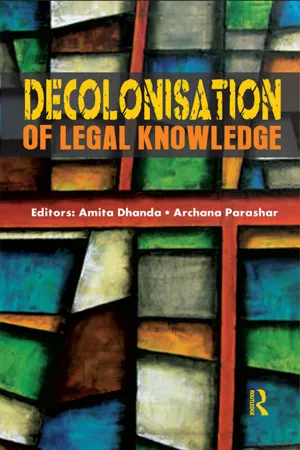
eBook - ePub
Decolonisation of Legal Knowledge
- 316 pages
- English
- ePUB (mobile friendly)
- Available on iOS & Android
eBook - ePub
Decolonisation of Legal Knowledge
About this book
Information
Chapter 1
Development and the Limits of State Politics: Rethinking Emancipatory Politics in Contemporary Africa1
Michael Neocosmos
The twentieth century has been, in fact, that of the power of the state … In truth everyone is prepared to criticize … [the] ‘economic horrors’ [of neoliberalism] … On the other hand, no one is prepared to critique [liberal] democracy. This is a taboo, a major consensual fetish. Democracy is, in fact, the true subjective principle, everywhere in the world, of the support for liberal capitalism (Badiou 2002a: 3,15).
At the very time when it most often mouths the word, the West has never been further from being able to live a true humanism — a humanism made to the measure of the world (Césaire 1972: 56).
Introduction
I begin from the axiomatic point that, despite the form it eventually took — namely, that of a neocolonial process — development was understood and fought for in Africa as (part of) an emancipatory project central to the liberatory vision of the pan-African nationalism which emerged victorious at independence. Indeed, independence was always seen, by radical nationalism in particular, as only the first step towards freedom and liberation from oppression, the second being economic development. It was, after all, Kwame N'krumah who had noted that ‘true liberation’ would only finally come with national economic independence from imperial domination. Up to this day, Africa has been seen by many nationalists as unfree because of its economic dependence, and not so much because of its politics — as if the road to freedom, justice and equality was not necessarily a political one.
The failure of development to emancipate the people of Africa was not the result of a betrayal or a con trick. It was, rather, the effect of a common worldwide conception in the 20th century — a view according to which human emancipation could only be achieved through one form or other of state politics. Indeed, economism and statism were mirror images of each other: it was believed that only the economy could liberate humanity and that only the state could drive the economy to progress. Today, the first proposition has been retained, but the second has been dropped from hegemonic discourse. Yet, the two are inseparable twins; it is in fact the case that just as the latter is false, so is the former — for human emancipation is, and can only be, a political project.
To maintain that human emancipation is essentially an economic question, is to necessarily reduce politics to the state and to foreclose the possibility of political agency. Today, the interests of capital are simply managed by the state in different ways than they were prior to the mid-seventies. In fact, economic liberalism, social democracy, ‘actually existing socialism’ and Third World developmentalism have all relied (and, insofar as they still exist, still do) on the state (or supra-state-like institutions) to manage economic forces.
Today, such state management simply means the management of the economy by the state in the interests of capital, in a manner which is in all essentials equivalent to ‘private sector management’. Such management is today primarily biased towards financial interests, while restraining, incorporating and otherwise softening the impact of popular responses, so as not to threaten these interests. The shift from a dominant so-called Fordist ‘regime of accumulation’, to a more ‘flexible’ regime in a globalised economy is a dimension of this change, not its supersession (Harvey 1990). Imperialism and neocolonialism have taken different, more complex and more diverse forms in today's ‘globalised’ world; they have not disappeared. It follows that if we are to consider development as an aspect of human emancipation, it must be thought of differently today, and not abandoned to the market which can only ‘emancipate the few’ — an obvious contradiction in terms, as the idea of emancipation has to be universal to have any meaning.
If neither the state nor the market are emancipatory, the challenge then is to help to rethink development in a non-statist and non-economistic manner, and perforce to rethink politics in a manner that is not state-focused, despite the unavoidable importance of the state and its institutions in the field of politics. To detach development from its foundations in both the state and the economy, to think of it as truly political — i.e., as containing the possibility of emancipation — this is the major yet necessary challenge without which we cannot move forward in Africa today. I can only hope to make a very small contribution to this thinking here.
Development and Freedom
The idea of an economic prerequisite for freedom was, of course, central to the notion of progress in whichever ideological configuration it took — liberal, social-democratic or ‘Marxist-Leninist’ (where it took the form of the ‘primacy of the productive forces’). The corollary of this ideology of the primacy of economic development was the central role of the state in the process. In capitalist societies, the state was either to manage change so as to maintain order, as in the case of the various forms of liberalism, or to mitigate the unequalising effects of the market, as in the case of social democracy, or both (Cowen and Shenton 1996). The ‘progress’ which 19th century thought maintained could be realised through the teleological unfolding of history, was held by 20th century thought to be realisable in the ‘here and now’, via an act of will through control of the state (or the ‘commanding heights’ of the economy, or a number of variations on the same theme) by a party. This overwhelmingly voluntarist perspective was therefore not unique to developmentalism (whether in Africa or elsewhere in the Third World), but permeated the whole of 20th century thought, even beyond the confines of development theory, as Badiou (2005a) shows with great clarity.
Today, the temptation often exists to re-varnish the tarnished slogans of social democracy, to bring back (perhaps a slightly modified version of) the post-war European social-democratic model, and even to ‘rediscover’ the long lost writings of the revolutionaries of the 18th century, such as Tom Paine (see Stedman-Jones 2004). The South African state is currently refurbishing the ‘developmental state’ model and seeing Malaysia as its (democratic?) ideal. Notions of the ‘public good’ or ‘social citizenship’ are resurfacing, along with arguments on the need to spend state resources on infrastructural projects, while the ‘social responsibility’ of big capital is touted as an important component in ‘public-private partnerships’. While neoliberalism has not yet been abandoned, there seems to be a serious seduction of many by these formulations, as they seem to presage some kind of alternative to the extreme crassness and highly exploitative character of Western neoliberalism. However, an economic critique of this liberalism is clearly insufficient; if a critique of its politics is not undertaken, such purported alternatives could end up being an expensive error for developing an emancipatory alternative.
In both Europe and Africa (and probably worldwide), the politics of the 20th century were the politics of states and parties and the dominance of economic thought over politics, as the latter was usually reduced to (class) interests expressed by parties and the state. While the colonial state attempted to overcome its economic problems at home by ‘developing’ its colonies, especially post 1945 (Cowen and Shenton 1996), in postcolonial Africa the same colonial statist practices were continued, paradoxically in order to overcome economic dependence. The same coercive and exclusionary politics against the working people were now justified in terms of building a nation. In very few cases were attempts made to free and encourage the creative possibilities inherent in the people.
Not only did the state dominate development, it did so by subsuming popular-national interests in Western ones, and thus by reproducing neocolonial structures and practices. Capital accumulation did not only take place via the plunder of state resources, it did so in compradorial ways (Shivji 1985). While the state managed class (and other) struggles, through outright coercion (forced removals, labour, cultivation, dispossession, etc.) the idea was for either the state or the market to ‘capture’, in the formulation made famous by Goran Hyden, those beyond their power in order to increase the rate of exploitation. Development then was thus contradictory from the very start: it was concerned in increasing the welfare of the population through achieving economic growth, but given the paucity of technology available, that growth could only be achieved fundamentally through what Marx has referred to as the ‘formal subordination of labour to capital’ — in other words, an increase in exploitation through physical means. It increased capital accumulation primarily through dispossession. Therefore, as has been mentioned on numerous occasions, the state took a direct part in the coercive character of production relations (Mamdani 1985, 1987).
Today, the state has delegated (or perhaps better, sub-contracted) its development management functions to external bodies such as NGOs, and insists on the ‘social responsibility’ of capital to provide ‘social upliftment’ without sacrificing its profits. The former are frequently simply new parastatals and, simultaneously, vehicles for social entrepreneurship for a ‘new’ middle-class of development professionals. The activists of yesterday have largely joined the state, not necessarily directly, but by becoming subsumed within the new mode of rule through ‘civil society’, a nawe rediscovered during the anti-state struggles in Poland and South Africa in the 1980s. Activism has been replaced by professionalism. ‘Feminism’ and ‘empowerment’, for example, have often been systematically transformed from popular struggles and demands to professions. We have now a new mode of state rule, which forms the context for rethinking development. Central to this new mode of rule are the hegemony of human rights discourse and the incorporation of NGOs into the state, either directly by turning them into parastatals, or more generally by subsuming them within a state domain of politics.2 If we attempt to analyse the process of transformation and development from an emancipatory perspective, which is what I am arguing we should do, a crucial lesson has become apparent today — namely, that the state cannot emancipate anybody, or at least no more than a select few. This is for a number of reasons, of which I only wish to mention three core ones here.
First, because state subjectivity is invariably bureaucratic and founded on a managerialist ideology. Today, that managerialist ideology is identical to that of private corporate interests (so-called ‘private sector management’), and a specific ‘public sector management’ (or ‘public administration’), which had suggested some specificity — in particular, concerning a certain social responsibility by the ‘public service’ towards ‘the public’ — seems to have been pushed aside. Irrespective of the specific character of managerialism today, the latter is a feature of the state in general — of all states without exception — and therefore has, in truly democratic conditions, to be counterbalanced by popular democratic pressure. This feature is simply the result of the fact that the foundation of the state is precisely control and regulation, and that the state sees itself as the monopoly of power and knowledge, and not only of the deployment of violence. At best therefore, in its management of social change, all the state can do is to substitute itself for popular struggles and independent popular organisations, all in the name of the monopoly of knowledge and/or the maintenance of social stability. To avoid misunderstanding, it should be stressed that I am referring here to state ‘modes of thought’, in simpler terms to ‘subjectivities’. All this is to be clearly distinguished from possible structural or other contradictions within the state between different institutional or other interests, or indeed from state provisioning or the enactment of progressive social legislation. Moreover, it should perhaps be reiterated that the state (institutionalised power) is in no way, either conceptually or politically, to be reduced to the government.
Second, because the state systematically transforms a pre-existing emancipatory politics into a technical process to be run by professionals (planners, economists, lawyers, judges, administrators, etc.) under its ambit within bureaucratic structures and subjectivities. This amounts to a process of de-politicisation of, say, a popular nationalist, or even revolutionary politics. In sum, the state systematically evacuates politics from state life, in favour of technique. In addition, under liberal democratic systems, politics is reduced to voting, which itself becomes simply a question of numbers to be predicted, counted and analysed by professionals. This process is a highly complex one, but ultimately universal in its fundamentals. It also includes, in today's parlance, the institutionalisation of rights fought for by people, and their transformation into ‘human rights’ to be defended and delivered by the state itself (Neocosmos 2005). While this is obviously a historical process contiguous with the achievement of independence/liberation in Africa, it is also an ongoing process. Popular demands for democratisation are gradually incorporated by the state into the system of power and deradicalised in the process; for example, some feminist and environmentalist demands have been embraced by names such as ‘empowerment’, ‘good governance’ and ‘sustainability’.
Third, because evidence overwhelmingly suggests that it is the state (along with corporate, bureaucratic or communitarian interests), in whatever form and irrespective of ideology, which is, and has universally been, the main threat to genuine democracy; and that the latter has only been won by hard fought popular struggles by workers, peasants, women and all the multitudes of the oppressed throughout the world. Thus, while it is important for state power to be divided between various mutually controlling institutions and ‘powers’, it is ultimately only the people who can be the fundamental guarantors of freedom and democracy, not a constitution or the judiciary. In the last instance then, it is only the politically organised people who are to fight for freedom, justice and equality. There are numerous examples of cases in Africa where the people never rose to defend democratic constitutions subverted, undermined and finally overthrown by rulers in search of uncontrolled power. This because the people had been depoliticised, or because constitutions had lost support due to their evident manipulation and corruption by politicians or simply because of their gradual exclusion of popular concerns.
To stress that the state cannot emancipate does not mean either that the state is not of use in the development process or indeed that it is absent from the sphere of politics altogether. In actual fact, during the first phase of the postcolonial state (1960s-70s) — that of development — although a national emancipation project may have failed because of its exclusion of large sections of the population, at least some state project was in existence — a fact which is no longer the case today. Despite its problems and its ultimate authoritarianism, the necessity of critically supporting that programme at its inception cannot be denied; its origins, in fact, were precisely in an emancipatory vision. The best way of stating this point is simply to note that state-led emancipatory projects are obsolete today. In fact, today we have to completely reinvent an emancipatory politics, as such a conception has simply disappeared from thought. Thus, to remind ourselves of the emancipatory vision of pan-Africanist struggles for development in the early life of nationalism is crucially important for the recapturing of such a vision. It is to this vision that we must be faithful, and not to a fetishism of state power.
In sum then, the question we have to pose ourselves is: if indeed the state cannot emancipate anybody, how is emancipation, and perforce emancipatory development, to begin to be thought? Clearly the market cannot do so and no one believes it can, so can can development indeed be thought of as an emancipatory project today?
Social Citizenship in Africa Today
One of the main political perspectives whi...
Table of contents
- Cover
- Half Title
- Title Page
- Copyright
- Dedication
- Contents
- Acknowledgements
- Introduction: Decolonisation of Knowledge:Whose Responsibility?
- Chapter 1: Development and the Limits of State Politics: Rethinking Emancipatory Politics in Contemporary Africa
- Chapter 2: The Successful Failing of Legal Theory
- Chapter 3: Power and Responsibility: The Curse of Spider-Man
- Chapter 4: International Laws and the Discontented: Westernisation, the Development and the Underdevelopment of International Laws
- Chapter 5: The Female Diaspora: Interrogating the Female Trafficked Migrant
- Chapter 6: Sexualised Economics: Divorce and the Division of Farming Property in Australia
- Chapter 7: Responsibility for Legal Knowledge
- Chapter 8: The Governance of Power: Taxing Choices
- Chapter 9: The Ability to Respond: Responsibility of Regulatory Institutions
- Chapter 10: The Power of One: The Law Teacher in the Academy
- About the Editors
- Notes on Contributors
- Index
Trusted by 375,005 students
Access to over 1.5 million titles for a fair monthly price.
Study more efficiently using our study tools.
Frequently asked questions
Yes, you can cancel anytime from the Subscription tab in your account settings on the Perlego website. Your subscription will stay active until the end of your current billing period. Learn how to cancel your subscription
No, books cannot be downloaded as external files, such as PDFs, for use outside of Perlego. However, you can download books within the Perlego app for offline reading on mobile or tablet. Learn how to download books offline
Perlego offers two plans: Essential and Complete
- Essential is ideal for learners and professionals who enjoy exploring a wide range of subjects. Access the Essential Library with 800,000+ trusted titles and best-sellers across business, personal growth, and the humanities. Includes unlimited reading time and Standard Read Aloud voice.
- Complete: Perfect for advanced learners and researchers needing full, unrestricted access. Unlock 1.5M+ books across hundreds of subjects, including academic and specialized titles. The Complete Plan also includes advanced features like Premium Read Aloud and Research Assistant.
We are an online textbook subscription service, where you can get access to an entire online library for less than the price of a single book per month. With over 1.5 million books across 990+ topics, we’ve got you covered! Learn about our mission
Look out for the read-aloud symbol on your next book to see if you can listen to it. The read-aloud tool reads text aloud for you, highlighting the text as it is being read. You can pause it, speed it up and slow it down. Learn more about Read Aloud
Yes! You can use the Perlego app on both iOS and Android devices to read anytime, anywhere — even offline. Perfect for commutes or when you’re on the go.
Please note we cannot support devices running on iOS 13 and Android 7 or earlier. Learn more about using the app
Please note we cannot support devices running on iOS 13 and Android 7 or earlier. Learn more about using the app
Yes, you can access Decolonisation of Legal Knowledge by Amita Dhanda, Archana Parashar, Amita Dhanda,Archana Parashar in PDF and/or ePUB format, as well as other popular books in Law & Law Theory & Practice. We have over 1.5 million books available in our catalogue for you to explore.